
关联,聚合和组合(复合)--Association, Aggregation and Composition
概要
Association, Aggregation and Composition are terms that represent relationships among objects. They are very basic stuff of Object Oriented Programming.
关联
Association is a relationship among the objects. Association is "*a*" relationship among objects. In Association, the relationship among the objects determine what an object instance can cause another to perform an action on its behalf. We can also say that an association defines the multiplicity among the objects. We can define a one-to-one, one-to-many, many-to-one and many-to-many relationship among objects. Association is a more general term to define a relationship among objects. Association means that an object "uses" another object.
For example Managers and Employees, multiple employees may be associated with a single manager and a single employee may be associated with multiple managers.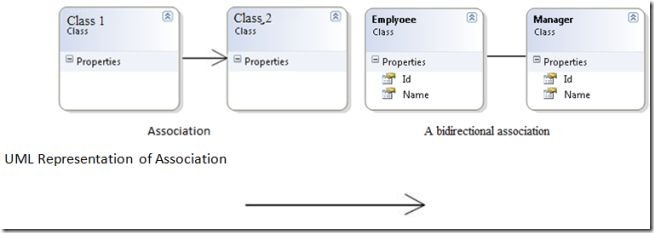
聚合
Aggregation is a special type of Association. Aggregation is "*the*" relationship among objects. We can say it is a direct association among the objects. In Aggregation, the direction specifies which object contains the other object. There are mutual dependencies among objects.
For example, departments and employees, a department has many employees but a single employee is not associated with multiple departments.
UML Representation of Aggregation (white diamond):
The UML representation of the example above (relation between employee and department):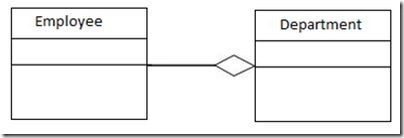
Here, the lives of both objects are independent of each other. That means that in this Association (Aggregation) the object has their own life cycle. Employees may exist without a department. Here, department can be called an owner object and the employee can be called a child object. The owner and child objects cannot belong to a different parent object.
组合(复合)
Composition is special type of Aggregation. It is a strong type of Aggregation. In this type of Aggregation the child object does not have their own life cycle. The child object's life depends on the parent's life cycle. Only the parent object has an independent life cycle. If we delete the parent object then the child object(s) will also be deleted. We can define the Composition as a "Part of" relationship.
For example, the company and company location, a single company has multiple locations. If we delete the company then all the company locations are automatically deleted. The company location does not have their independent life cycle, it depends on the company object's life (parent object).
UML Representation of Composition (black diamond):
UML representation of the example above (relation between Company and Company Location):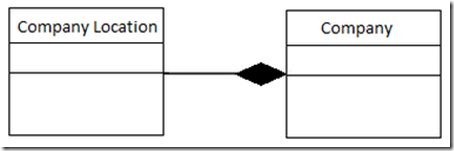
Here, the lives of both objects are not independent. The life of the company location object can be determined by the life of the company object. The company object is responsible for creating and destroying company location objects.
关联,聚合和组合三者之间的关系图
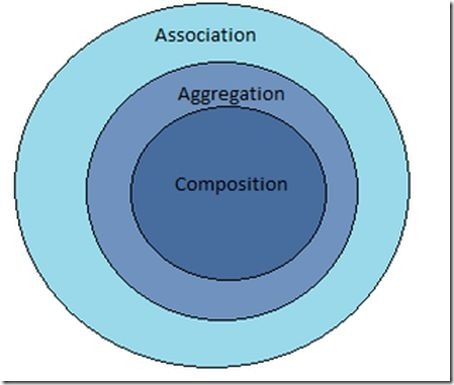
Aggregation and Composition are a special type of Association. Composition is again a special type of Aggregation. We can define Aggregation and Composition as "has a" relationships. Composition is more restrictive or more specific. In Composition, composed objects cannot exist without the other object. This type of restriction does not exist in Aggregations. In Aggregation, the existence of a composed object is optional. In Aggregation, the child object can exist beyond the life cycle of its parent whereas in Composition the child object cannot exist beyond the life cycle of its parent.
Combined example of Aggregation and Composition: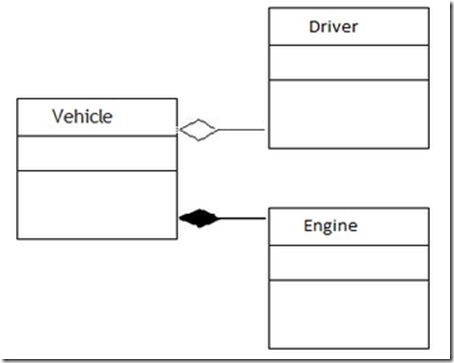
聚合VS组合
| Aggregation | Composition |
| Aggregation is a special type of Association. | Composition is a special type of Aggregation. |
| All objects have their own life cycle. | In Composition, the child object does not have their own life cycle and it depends on the parent's life cycle. |
| A parent class is not responsible for creating or destroying the child class. | The parent class is responsible for creating or destroying the child class. |
| Aggregation can be described as a "Has-a" relationship. | Composition can be described as a "Has-a" relationship as well as a "Part of" relationship, but here the difference is the length of the relationship among the objects. |
| Aggregation is a weak Association. | Composition is a strong Association. |
| Aggregation means one object is the owner of another object. | Composition means one object is contained in another object. |
| The direction of a relation is a requirement in both Composition and Aggregation. The direction specifies which object contains the other one. | |
| Both have a single direction of association. | |
| Both have a single owner. | |
结论
These three terms are more important in the object oriented world. They denote or represent the relations among objects. If you are confused or unable to decide whether a specific relation best describes an Association, Aggregation or Composition then it can be decribed as an Association.
引用:http://www.c-sharpcorner.com/UploadFile/ff2f08/association-aggregation-and-composition/
关联,聚合和组合(复合)--Association, Aggregation and Composition的更多相关文章
- UML类关系:依赖,关联,聚合和组合
UML图示例:(可使用StartUML来画图,小巧^_^) http://www.blogjava.net/lukangping/archive/2010/08/01/327693.html 聚合:表 ...
- Inheritance, Association, Aggregation, and Composition 类的继承,关联,聚合和组合的区别
在C++中,类与类之间的关系大概有四种,分别为继承,关联,聚合,和组合.其中继承我们大家应该都比较熟悉,因为是C++的三大特性继承Inheritance,封装Encapsulation,和多态Poly ...
- UML类关系(依赖,关联,聚合,组合,泛化,实现)
转自https://blog.csdn.net/k346k346/article/details/59582926 在学习面向对象设计时,类关系涉及依赖.关联.聚合.组合和泛化这五种关系,耦合度依 ...
- UML类图关系(泛化 、继承、实现、依赖、关联、聚合、组合)
UML类图关系(泛化 .继承.实现.依赖.关联.聚合.组合) 继承.实现.依赖.关联.聚合.组合的联系与区别 分别介绍这几种关系: 继承 指的是一个类(称为子类.子接口)继承另外的一个类(称为父类.父 ...
- java--依赖、关联、聚合和组合之间区别的理解
在学习面向对象设计对象关系时,依赖.关联.聚合和组合这四种关系之间区别比较容易混淆.特别是后三种,仅仅是在语义上有所区别,所谓语义就是指上下文环境.特定情景等. 依赖(Dependency)关系是类与 ...
- java_UML:继承/泛化、实现、依赖、关联、聚合、组合的联系与区别 (2016-07-12)
分别介绍这几种关系: UML关系:继承(泛化).实现.依赖.关联.聚合.组合的联系与区别 一.表示符号上的区别 二.具体区别与联系 1. 继承/泛化(Generalization) [泛化关系]:是一 ...
- UML[1] UML类图关系(泛化 、继承、实现、依赖、关联、聚合、组合)(转)
转自:http://blog.csdn.net/zhaoxu0312/article/details/7212152 继承.实现.依赖.关联.聚合.组合的联系与区别 分别介绍这几种关系: 继承 指的是 ...
- UML图中类之间的关系:依赖,泛化,关联,聚合,组合,实现
UML图中类之间的关系:依赖,泛化,关联,聚合,组合,实现 类与类图 1) 类(Class)封装了数据和行为,是面向对象的重要组成部分,它是具有相同属性.操作.关系的对象集合的总称. 2) 在系统中, ...
- UML类图及依赖,泛化,关联,聚合,组合,实现
UML图中类之间的关系:依赖,泛化,关联,聚合,组合,实现 类与类图 1) 类(Class)封装了数据和行为,是面向对象的重要组成部分,它是具有相同属性.操作.关系的对象集合的总称. 2) 在系统中, ...
随机推荐
- 发现程序bug思路
大家有没有遇到过项目,程序出现个bug,但花了好久(真的是a long long time啊)才发现引发这个问题的原因,心想原来就这个原因导致的啊,要是早想到就好了! 其实我们确实的是方法,希望我的抛 ...
- JavaScript -- 操作input CheckBox 全选框
<!DOCTYPE html PUBLIC "-//W3C//DTD XHTML 1.0 Transitional//EN" "http://www.w3.org/ ...
- Qt 安装事件过滤器installEventFilter
Qt 安装事件过滤器installEventFilter (2013-01-28 14:29:18) 转载▼ 分类: 工作笔记 Qt的事件模型一个强大的功能是一个QObject对象能够监视发送其他 ...
- Spring初学之spring的事务管理xml
所有的java类都是用的上一篇文章:Spring初学之spring的事务管理 不同的是,这时xml配置事务,所以就要把java类中的那些关于spring的注解都删掉,然后在xml中配置,Applica ...
- 项目开发之git配置
1.本地安装git配置 安装步骤,这里不详细介绍,软件下载然后安装即可. 查看git安装版本 #git --version 2.git密钥生成 ssh-keygen -t rsa -C "f ...
- python基础2 - 运算符
3. 运算符 3.1 算数运算符 算数运算符是 运算符的一种 是完成基本的算术运算使用的符号,用来处理四则运算 运算符 描述 实例 + 加 10 + 20 = 30 - 减 10 - 20 = -10 ...
- selenium对富文本框的处理
一般输入框有以下几种形式 第一种:短的input框 如百度首页的输入框,<input type="text" class="s_ipt" name=&qu ...
- 如何关闭Windows10系统更新
单击左下角开始菜单点击设置图标进入设置界面 在设置窗口中输入“服务”搜索 在结果中选择查看本地服务 在服务列表中找到windows update服务双击它 点击停止按钮先停止该服务,稍等片 ...
- oracle管理优化必备语句以及oracle SQL语句性能调整
本文转自http://www.dataguru.cn/article-3302-1.html oracle数据库管理优化必备语句: 1. SELECT T.START_TIME,T.USED_UBLK ...
- java 网页 保存上传文件
网页请求提交到另外一个jsp 进行处理 index.jsp <%@ page language="java" import="java.util.*" p ...