
Structures, unions, enumerations, and bitfields in ARM C and C++
Structures, unions, enumerations, and bitfields in ARM C and C++
| Non-Confidential | ARM DUI0375E | |||
|
||||
| Home > C and C++ Implementation Details > Structures, unions, enumerations, and bitfields in ARM C and C++ | ||||
10.4 Structures, unions, enumerations, and bitfields in ARM C and C++
Describes the implementation of the structured data types union, enum, and struct. It also discusses structure padding and bitfield implementation.
Unions
union is accessed using a member of a different type, the resulting value can be predicted from the representation of the original type. No error is given.Enumerations
enum is implemented in the smallest integral type that contains the range of the enum.--enum_is_int, if an enum contains only positive enumerator values, the storage type of the enum is the first unsigned type from the following list, according to the range of the enumerators in the enum. In other modes, and in cases where an enum contains any negative enumerator values, the storage type of the enum is the first of the following, according to the range of the enumerators in the enum:unsigned charif not using--enum_is_intsigned charif not using--enum_is_intunsigned shortif not using--enum_is_intsigned shortif not using--enum_is_intsigned intunsigned intexcept C with--strictsigned long longexcept C with--strictunsigned long longexcept C with--strict.
Note
In ARM Compiler 4.1 and later, the storage type of the enum being the first unsigned type from the list applies irrespective of mode.
enum in this way can reduce data size. The command-line option --enum_is_int forces the underlying type of enum to at least as wide as int.Note
--enum_is_int option, and that share interfaces or data structures.ints. That is, they must be in the range -2147483648 to +2147483647, inclusive. A warning is issued for out-of-range enumerator values:#66: enumeration value is out of "int" range
unsigned int, long long, or unsigned long long.armcc --diag_error=66 ...
Structures
- all C structures
- all C++ structures and classes not using virtual functions or base classes.
sizeof() function returns the size of the structure including padding.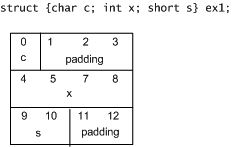
according to how the structure is defined:
- Structures that are defined as
staticorexternare padded with zeros. - Structures on the stack or heap, such as those defined with
malloc()orauto, are
padded with whatever is previously stored in those memory locations. You cannot
usememcmp()to compare padded structures defined in this
way.
--remarks option to view the messages that aregenerated when the compiler inserts padding in a
struct.struct
{
int x;
} X = { };
--cpp and--c90 options, an error is generated.Packed structures
__packed qualifier. Alternatively, you can use #pragma pack(n) to make sure that any structures with unaligned data are packed. There is no command-line option to change the default packing of structures.Bitfields
- Little-endian
-
Lowest addressed means least significant.
- Big-endian
-
Lowest addressed means most significant.
Note
int, signed int, and unsigned int. For non-int bitfields, the compiler displays an error.signed or unsigned qualifiers, is treated as unsigned. For example, int x:10 allocates an unsigned integer of 10 bits.struct X
{
int x:10;
int y:20;
};
x. At the second declaration, the compiler finds the existing integer container with a sufficient number of unallocated bits, and allocates y in the same container as x.z overflows the container if an additional bitfield is declared for the structure:struct X
{
int x:10;
int y:20;
int z:5;
};
z.struct X
{
int x:10;
char y:2;
};
x. These 10 bits occupy the first byte and two bits of the second byte of the integer container. At the second declaration, the compiler checks for a container of type char. There is no suitable container, so the compiler allocates a new correctly aligned char container.char is 1, the compiler searches for the first byte that contains a sufficient number of unallocated bits to completely contain the bitfield. In the example structure, the second byte of the int container has two bits allocated to x, and six bits unallocated. The compiler allocates a char container starting at the second byte of the previous int container, skips the first two bits that are allocated to x, and allocates two bits to y.y is declared char y:8, the compiler pads the second byte and allocates a new char container to the third byte, because the bitfield cannot overflow its container. The following figure shows the bitfield allocation for the following example structure:struct X
{
int x:10;
char y:8;
};

Note
container types. For example, adding an
int bitfield to the example structure gives:struct X
{
int x:10;
char y:8;
int z:5;
}
int container starting at the same location as the int x:10 container and allocates a byte-aligned char and 5-bit bitfield, as follows:
bitfield of size zero. A bitfield of zero size fills the container up to the end
if the container is not empty. A subsequent bitfield declaration starts a new
empty container.
Note
container with unspecified values when a bitfield is written. This does not
affect normal usage of bitfields.
Bitfields in packed structures
packed structures, have an alignment of 1. Therefore the maximum bit padding
inserted to align a packed bitfield container is 7 bits.
8*sizeof(container-type)-1 bits.ensure arrays of the structure will have their elements correctly aligned.
the bitfield that declared it. Non-packed bitfield containers are the size of
their type.
struct A { int z:17; }; // sizeof(A) = 4, alignment = 4
struct A { __packed int z:17; }; // sizeof(A) = 3, alignment = 1
__packed struct A { int z:17; }; // sizeof(A) = 3, alignment = 1
struct A { char y:1; int z:31; }; // sizeof(A) = 4, alignment = 4
struct A { char y:1; __packed int z:31; }; // sizeof(A) = 4, alignment = 1
__packed struct A { char y:1; int z:31; }; // sizeof(A) = 4, alignment = 1
struct A { char y:1; int z:32; }; // sizeof(A) = 8, alignment = 4
struct A { char y:1; __packed int z:32; }; // sizeof(A) = 5, alignment = 1
__packed struct A { char y:1; int z:32; }; // sizeof(A) = 5, alignment = 1
struct A { int x; char y:1; int z:31; }; // sizeof(A) = 8, alignment = 4
struct A { int x; char y:1; __packed int z:31; }; // sizeof(A) = 8, alignment = 4
__packed struct A { int x; char y:1; int z:31; }; // sizeof(A) = 8, alignment = 1
struct A { int x; char y:1; int z:32; }; // sizeof(A) = 12, alignment = 4 [1]
struct A { int x; char y:1; __packed int z:32; }; // sizeof(A) = 12, alignment = 4 [2]
__packed struct A { int x; char y:1; int z:32; }; // sizeof(A) = 9, alignment = 1
struct example1
{
int a : 8; /* 4-byte container at offset 0 */
__packed int b : 8; /* 1-byte container at offset 1 */
__packed int c : 24; /* 3-byte container at offset 2 */
}; /* Total size 8 (3 bytes tail padding) */;
struct example2
{
__packed int a : 8; /* 1-byte container at offset 0 */
__packed int b : 8; /* 1-byte container at offset 1 */
int c : 8; /* 4-byte container at offset 0 */
}; /* Total size 4 (No tail padding) */
struct example3
{
int a : 8; /* 4-byte container at offset 0 */
__packed int b : 32; /* 4-byte container at offset 1 */
__packed int c : 32; /* 4-byte container at offset 5 */
int d : 16; /* 4-byte container at offset 8 */
int e : 16; /* 4-byte container at offset 12 */
int f : 16; /* In previous container */
}; /* Total size 16 (No tail padding) */
| Non-Confidential | ARM DUI0375E | |
| Copyright 2007, 2008, 2011, 2012, 2014 ARM. All rights reserved. |
| Home > C and C++ Implementation Details > Structures, unions, enumerations, and bitfields in ARM C and C++ |
struct X

{

    int x:10;

    char y:8;

    int z:5;

}
Structures, unions, enumerations, and bitfields in ARM C and C++的更多相关文章
- delphi 保存网页MHT
delphi 保存网页MHT uses ADODB_TLB, CDO_TLB, ComObj,MSHTML;{$R *.dfm}{能把网页如 WWW.QQ.COM保存为一个单文件 .MHT但不能把 ...
- Python C/C++ 拓展使用接口库(build-in) ctypes 使用手册
Python C/C++ 拓展使用接口库(build-in) ctypes 使用手册 ctypes 是一个Python 标准库中的一个库.为了实现调用 DLL,或者共享库等C数据类型而设计.它可以把这 ...
- [转]Keyword Reference (F#)
Visual F# Development Portal http://msdn.microsoft.com/en-us/library/vstudio/ff730280.aspx 本文转自:http ...
- c++学习书籍推荐《The C++ Programming Language第四版》下载
百度云及其他网盘下载地址:点我 作者简介 Bjarne Stroustrup is the designer and original implementer of C++, the author o ...
- Delphi 如何在程序中执行动态生成的Delphi代码
如何在程序中执行动态生成的Delphi代码 经常发现有人提这类问题,或者提问内容最后归结成这种问题 前些阵子有位高手写了一个“执行动态生成的代码”,这是真正的高手,我没那种功力,我只会投机取巧. 这里 ...
- Swift声明参考
一条声明可以在你的程序里引入新的名字和构造.举例来说,你可以使用声明来引入函数和方法,变量和常量,或者来定义 新的命名好的枚举,结构,类和协议类型.你也可以使用一条声明来延长一个已经存在的命名好的类型 ...
- Core Java Volume I — 1.2. The Java "White Paper" Buzzwords
1.2. The Java "White Paper" BuzzwordsThe authors of Java have written an influential White ...
- The Swift Programming Language-官方教程精译Swift(4)字符串和字符
String 是一个有序的字符集合,例如 "hello, world", "albatross".Swift 字符串通过 String 类型来表示,也可以表示为 ...
- LibVLC video controls
原文 http://www.videolan.org/developers/vlc/doc/doxygen/html/group__libvlc__video.html VLC 3.0.0-git ...
- 《C++程序设计语言(英文第四版)》【PDF】下载
<C++程序设计语言(英文第四版)>[PDF]下载链接: https://u253469.pipipan.com/fs/253469-230382177 内容简介 本书是C++领域经典的参 ...
随机推荐
- Pytest 失败重运行
需安装第三方插件:pytest-rerun.pytest-rerunfailures 失败重试和失败重运行的区别 失败重试:[--reruns=1],用例执行失败后,会立即开始重试一次此用例,再执行下 ...
- 【golang】json数据中复杂key的处理
例1 type Transport struct { Time string Id int } func main() { //将struct的切片包装成json格式 var st []Transpo ...
- 面试官:Java类是如何被加载到内存中的?
面试连环call Java类是如何被加载到内存中的? Java类的生命周期都有哪些阶段? JVM加载的class文件都有哪些来源? JVM在加载class文件时,何时判断class文件的格式是否符合要 ...
- 解决方案 | tk.entry数字验证(输入框如何保证只能输入数字)
from tkinter import * root = Tk() # 创建文本框 entry = Entry(root) entry.pack() # 设置文本框只能输入数字 entry.confi ...
- 一图看懂网易数帆指标平台EasyMetrics
简化数据分析,提升决策速度!EasyMetrics,指标的全生命周期管理平台. 为何EasyMetrics? 集中化管理,降低门槛.开箱即用,提升查询速度. 适合人群? 业务用户.开发者.数据团队,E ...
- 共享库soname机制
目录 前言 共享库版本号 共享库命名机制 realname soname linkname 总结 参考文章 前言 在使用第三方库时,我们会发现第三方库会提供一组文件,他们的后缀一般是.so(如libn ...
- CF1204A 题解
洛谷链接&CF 链接 本篇题解为此题较简单做法及较少码量,并且码风优良,请放心阅读. 题目简述 给定一个二进制字符串 \(S\),求这个二进制数包含 \(4 ^ k\) 的个数. 特殊的:若 ...
- UE-自带的HotUpdate【转】
原文链接:https://baijiahao.baidu.com/s?id=1745200406976270792&wfr=spider&for=pc 这是百度可以直接搜索到的 UE4 ...
- windows上传app到构建版本的方法
ios打包好ipa文件后,ipa文件需要上架到app store,用户才能安装.而在app store里,无法直接将ipa上传,需要使用工具上传,但是官方提供的工具,比如xcode等只能安装在苹果电脑 ...
- java实现二维码登录功能
本文采用Springboot工程进行开发,使用Google的zxing生成二维码,直接放代码: <?xml version="1.0" encoding="UTF- ...