
Mockito+Junit5单元测试
参考:
https://segmentfault.com/a/1190000006746409
https://waylau.com/mockito-quick-start/
1.引入依赖
下面这个最新版本匹配似乎有问题
    testCompile group: 'org.mockito', name: 'mockito-core', version: '3.7.7'

    testCompile group: 'org.mockito', name: 'mockito-junit-jupiter', version: '3.7.7'

    testCompile group: 'org.junit.jupiter', name: 'junit-jupiter', version: '5.7.0'
改用下面的旧版本测试成功
    testCompile group: 'org.mockito', name: 'mockito-core', version: '2.18.3'

    testCompile group: 'org.mockito', name: 'mockito-junit-jupiter', version: '2.18.3'

    testCompile group: 'org.junit.jupiter', name: 'junit-jupiter-engine', version: '5.2.0'
2.编写测试用例
import org.junit.jupiter.api.Assertions;

import org.junit.jupiter.api.Test;

import org.mockito.ArgumentCaptor;

import org.mockito.InOrder;

import org.mockito.Mockito;

import java.util.*;

/**

 * @author zhengqian

 * @date 2021.01.22

 */

public class CommonTest {

    @Test

    public void createMockObject() {

        // 使用 mock 静态方法创建 Mock 对象.

        List mockedList = Mockito.mock(List.class);

        Assertions.assertTrue(mockedList instanceof List);

        // mock 方法不仅可以 Mock 接口类, 还可以 Mock 具体的类型.

        ArrayList mockedArrayList = Mockito.mock(ArrayList.class);

        Assertions.assertTrue(mockedArrayList instanceof List);

        Assertions.assertTrue(mockedArrayList instanceof ArrayList);

    }

    @Test

    public void configMockObject() {

        List mockedList = Mockito.mock(List.class);

        // 我们定制了当调用 mockedList.add("one") 时, 返回 true

        Mockito.when(mockedList.add("one")).thenReturn(true);

        // 当调用 mockedList.size() 时, 返回 1

        Mockito.when(mockedList.size()).thenReturn(1);

        Assertions.assertTrue(mockedList.add("one"));

        // 因为我们没有定制 add("two"), 因此返回默认值, 即 false.

        Assertions.assertFalse(mockedList.add("two"));

        Assertions.assertEquals(mockedList.size(), 1);

        Iterator i = Mockito.mock(Iterator.class);

        Mockito.when(i.next()).thenReturn("Hello,").thenReturn("Mockito!");

        String result = i.next() + " " + i.next();

        //assert

        Assertions.assertEquals("Hello, Mockito!", result);

    }

    @Test

    public void testVerify() {

        List mockedList = Mockito.mock(List.class);

        mockedList.add("one");

        mockedList.add("two");

        mockedList.add("three times");

        mockedList.add("three times");

        mockedList.add("three times");

        Mockito.when(mockedList.size()).thenReturn(5);

        Assertions.assertEquals(mockedList.size(), 5);

        // mockedList.add("one") 至少被调用了 1 次(atLeastOnce)

        Mockito.verify(mockedList, Mockito.atLeastOnce()).add("one");

        // mockedList.add("two") 被调用了 1 次(times(1))

        Mockito.verify(mockedList, Mockito.times(1)).add("two");

        // mockedList.add("three times") 被调用了 3 次(times(3))

        Mockito.verify(mockedList, Mockito.times(3)).add("three times");

        // mockedList.isEmpty() 从未被调用(never)

        Mockito.verify(mockedList, Mockito.never()).isEmpty();

    }

    @Test

    public void testSpy() {

        List list = new LinkedList();

        // 使用 spy() 部分模拟对象

        List spy = Mockito.spy(list);

        // 对 spy.size() 进行定制.

        Mockito.when(spy.size()).thenReturn(100);

        spy.add("one");

        spy.add("two");

        // 因为我们没有对 get(0), get(1) 方法进行定制,

        // 因此这些调用其实是调用的真实对象的方法.

        Assertions.assertEquals(spy.get(0), "one");

        Assertions.assertEquals(spy.get(1), "two");

        Assertions.assertEquals(spy.size(), 100);

    }

    @Test

    public void testCaptureArgument() {

        List<String> list = Arrays.asList("1", "2");

        List mockedList = Mockito.mock(List.class);

        ArgumentCaptor<List> argument = ArgumentCaptor.forClass(List.class);

        mockedList.addAll(list);

        // 获取 mockedList.addAll 方法所传递的实参 list.

        Mockito.verify(mockedList).addAll(argument.capture());

        Assertions.assertEquals(2, argument.getValue().size());

        Assertions.assertEquals(list, argument.getValue());

    }

    @Test

    public void testArgumentMatcher() {

        List mockedList = Mockito.mock(List.class);

        //stubbing using built-in anyInt() argument matcher

        Mockito.when(mockedList.get(Mockito.anyInt())).thenReturn("element");

        //stubbing using custom matcher (let's say isValid() returns your own matcher implementation):

//        when(mockedList.contains(argThat(isValid()))).thenReturn("element");

        //following prints "element"

        System.out.println(mockedList.get(999));

    }

    @Test

    public void testThrowAndVoid() {

        List mockedList = Mockito.mock(List.class);

        Mockito.when(mockedList.get(1)).thenThrow(new RuntimeException());

        //following throws runtime exception

        System.out.println(mockedList.get(1));

        Mockito.doThrow(new RuntimeException()).when(mockedList).clear();

        //following throws RuntimeException:

        mockedList.clear();

    }

    @Test

    public void testInOrder() {

        // A. Single mock whose methods must be invoked in a particular order

        List singleMock = Mockito.mock(List.class);

        //using a single mock

        singleMock.add("was added first");

        singleMock.add("was added second");

        //create an inOrder verifier for a single mock

        InOrder inOrder = Mockito.inOrder(singleMock);

        //following will make sure that add is first called with "was added first, then with "was added second"

        inOrder.verify(singleMock).add("was added first");

        inOrder.verify(singleMock).add("was added second");

        // B. Multiple mocks that must be used in a particular order

        List firstMock = Mockito.mock(List.class);

        List secondMock = Mockito.mock(List.class);

        //using mocks

        firstMock.add("was called first");

        secondMock.add("was called second");

        //create inOrder object passing any mocks that need to be verified in order

        InOrder inOrder2 = Mockito.inOrder(firstMock, secondMock);

        //following will make sure that firstMock was called before secondMock

        inOrder2.verify(firstMock).add("was called first");

        inOrder2.verify(secondMock).add("was called second");

    }

    @Test

    public void testConsecutiveStubbing() {

        List mockedList = Mockito.mock(List.class);

        Mockito.when(mockedList.get(0))

                .thenThrow(new RuntimeException())

                .thenReturn("foo");

        // 精简写法

        // when(mockedList.get(0)).thenReturn("one", "two", "three");

        //First call: throws runtime exception:

        mockedList.get(0);

        //Second call: prints "foo"

        System.out.println(mockedList.get(0));

        //Any consecutive call: prints "foo" as well (last stubbing wins).

        System.out.println(mockedList.get(0));

    }

    @Test

    public void testCallbackStubbing() {

        List mockedList = Mockito.mock(List.class);

        Mockito.when(mockedList.get(Mockito.anyInt())).thenAnswer(invocation -> {

            Object[] args = invocation.getArguments();

            return "called with arguments: " + args;

        });

        //the following prints "called with arguments: foo"

        System.out.println(mockedList.get(111));

    }

}
使用mock注解
import org.junit.jupiter.api.Assertions;

import org.junit.jupiter.api.Test;

import org.junit.jupiter.api.extension.ExtendWith;

import org.mockito.Mock;

import org.mockito.Mockito;

import org.mockito.junit.jupiter.MockitoExtension;

/**

 * @author zhengqian

 * @date 2021.01.27

 */

@ExtendWith(MockitoExtension.class)

public class UserServiceTest {

    @Mock

    private UserService userService;

    @Test

    public void testGet() {

        Mockito.when(userService.get()).thenReturn("fake user");

        Assertions.assertEquals(userService.get(), "fake user");

    }

}
3. 其他JUnit5注解
@Test :表示方法是测试方法。但是与JUnit4的@Test不同,他的职责非常单一不能声明任何属性,拓展的测试将会由Jupiter提供额外测试
@ParameterizedTest :表示方法是参数化测试,下方会有详细介绍
@RepeatedTest :表示方法可重复执行,下方会有详细介绍
@DisplayName :为测试类或者测试方法设置展示名称
@BeforeEach :表示在每个单元测试之前执行
@AfterEach :表示在每个单元测试之后执行
@BeforeAll :表示在所有单元测试之前执行
@AfterAll :表示在所有单元测试之后执行
@Tag :表示单元测试类别,类似于JUnit4中的@Categories
@Disabled :表示测试类或测试方法不执行,类似于JUnit4中的@Ignore
@Timeout :表示测试方法运行如果超过了指定时间将会返回错误
@ExtendWith :为测试类或测试方法提供扩展类引用
补充
如果运行test遇到以下错误:
FAILURE: Build failed with an exception.

* What went wrong:

Execution failed for task ':test'.

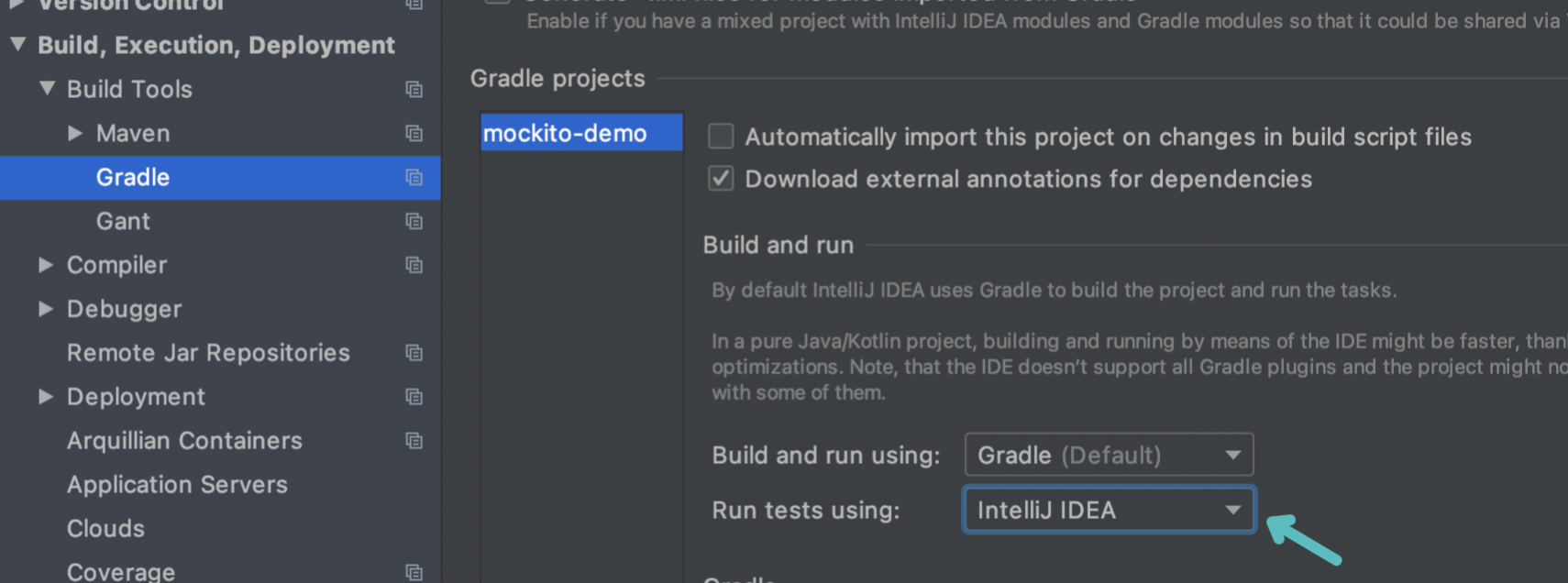
> No tests found for given includes: [org.example.mockito.demo.service.UserServiceTest.configMockObject](filter.includeTestsMatching)
改一下IDEA配置
Mockito+Junit5单元测试的更多相关文章
- 基于Springboot+Junit+Mockito做单元测试
前言 前面的两篇文章讨论过< 为什么要写单元测试,何时写,写多细 >和<单元测试规范>,这篇文章介绍如何使用Springboot+Junit+Mockito做单元测试,案例选取 ...
- 使用Mockito进行单元测试【2】—— stub 和 高级特性[转]
一篇中介绍了Mockito的基本信息,现在接着介绍Mockito强大的stub功能 2. Mockito使用实例 5. 对连续的调用进行不同的返回 (iterator-style stubbing) ...
- 使用Mockito进行单元测试【1】——mock and verify[转]
本文转自:http://qiuguo0205.iteye.com/blog/1443344 1. 为什么使用Mockito来进行单元测试? 回答这个问题需要回答两个方面,第一个是为什么使用mock?m ...
- 使用 Mockito 辅助单元测试
了解过单元测试相关概念的人应该会清楚一个概念:一个好的单元测试应该是与环境无关的,每一个测试都是相互独立的.亦即你可以在任何地方,以任意顺序运行这些测试,最后得到的结果是一样的.但是我被测试的类/方法 ...
- 使用 Junit + Mockito 实践单元测试
一.前言 相信做过开发的同学,都多多少少写过下面的代码,很长一段时间我一直以为这就是单元测试... @SpringBootTest @RunWith(SpringRunner.class) publi ...
- powermock+mockito+testng 单元测试pom文件
0:Supported versions PowerMock version 1.7.0 and upper has experimental support of Mockito 2. A lot ...
- 单元测试系列:Mock工具之Mockito实战
更多原创测试技术文章同步更新到微信公众号 :三国测,敬请扫码关注个人的微信号,感谢! 原文链接:http://www.cnblogs.com/zishi/p/6780719.html 在实际项目中写单 ...
- 单元测试系列之五:Mock工具之Mockito实战
更多原创测试技术文章同步更新到微信公众号 :三国测,敬请扫码关注个人的微信号,感谢! 原文链接:http://www.cnblogs.com/zishi/p/6780719.html 在实际项目中写单 ...
- 单元测试系列之六:JUnit5 技术前瞻
更多原创测试技术文章同步更新到微信公众号 :三国测,敬请扫码关注个人的微信号,感谢! 原文链接:http://www.cnblogs.com/zishi/p/6868495.html JUnit ...
随机推荐
- Effective Java —— 避免创建不必要的对象
本文参考 本篇文章参考自<Effective Java>第三版第六条"Avoid creating unnecessary objects" avoid creatin ...
- instanceof关键字使用的方法(解决转型异常ClassCastException)
一丶问题显现: 当你是父类的情况下,像使用子类的特定功能,就需要向下转型,但向下转型有可能会报错(ClassCastException) 而instanceof关键字就是解决异常的小能手,他能判断是否 ...
- 六个框架,一百多条检查项目,保证PCB设计不再出错
一.资料输入阶段1.在流程上接收到的资料是否齐全(包括:原理图.*.brd文件.料单.PCB设计说明以及PCB设计或更改要求.标准化要求说明.工艺设计说明文件)2.确认PCB模板是最新的3. 确认模板 ...
- CSS 面试题总结
CSS 中类 (classes) 和 ID 的区别. 书写上的差别:class名用"."号开头来定义,id名用"#"号开头来定义: 优先级不同(权重不同) 调用 ...
- python-输入列表,求列表元素和(eval输入应用)
在一行中输入列表,输出列表元素的和. 输入格式: 一行中输入列表. 输出格式: 在一行中输出列表元素的和. 输入样例: [3,8,-5] 输出样例: 6 代码: a = eval(input()) t ...
- Python读文件并写入数组
直接上代码: # 读文件 def get_venue(file): fname = file # 文件名 # 获取数据长度 len = 0 with open(fname, 'r+', encodin ...
- Spark入门之idea编写Scala脚本
一.安装Scala插件 1.File->Settings 2.Plugins->Msrketplace->搜索Scala并安装 (或者自己下载合适的scala版本,教程:自己给ide ...
- 【Android开发】EasyPermissions 请求权限
安卓6.0以后,开发应用的时候,仅在AndroidManifest.xml中申请权限已经不可以了,需要在代码中动态申请. 现在看一个google推出的机制:EasyPermissions 引入步骤: ...
- Shiro 安全框架详解一(概念+登录案例实现)
shiro 安全框架详细教程 总结内容 一.RBAC 的概念 二.两种常用的权限管理框架 1. Apache Shiro 2. Spring Security 3. Shiro 和 Spring Se ...
- 142. 环形链表 II
做题思路 or 感想 : 1,这一题用快慢指针来判断是否有环,快慢指针同一起点,速度不同,如果有环,则必定会相遇 2,第二个有意思的点就是数论环节来弄出环入口了,真的太精妙了,但因为我表述能力不好,这 ...