
AVL Tree (1) - Definition, find and Rotation
1. 定义
- (15-1) [AVL tree]:
- 一棵空二叉树是 AVL tree;
- 若 T 是一棵非空二叉树, 则 T 满足以下两个条件时, T 是一棵 AVL tree:
- T_LeftSubtree 和 T_RightSubtree 是 AVL tree.
- \(| h_{Left} - h_{Right}| \leq 1\).
- [AVL search tree]: AVL tree + binary search tree.
- AVL tree 的高度 \(h=O(\log{n})\)
- [balance foctor] 平衡因子可能取值为
-1,0,1;
对于 nodex, \(bf(x)\) 定义为: \(h_{x\_LeftSubtree} - h_{x\_RightSubtree}\).
AVL Tree 的宗旨在于使 BST 保持平衡, 进而避免 BST 过度倾斜 (极端情况下 BST 有可能成为链表) .
2. btNode 和 AVLTree 的定义
<utility> 头文件提供了 std::pair 的定义, 便于使用融合 key 类型和 value 类型的复合类型.
<iostream> 头文件提供的输出方法由 private method preOrder 使用, 以测试代码正确性.
Click to show the codes
// AVL Tree

#include <utility>

#include <iostream>

/**

 * @brief Binary tree node.

 * @tparam T Should be std::pair<Key_Type, Element_Type> in binary search tree.

*/

template<class T>

struct btNode

{

    T data;

    btNode<T>* left, * right;

    // Constructor for btNode.

    btNode(T d = {}, btNode<T>* l = nullptr, btNode<T>* r = nullptr) :

        data(d), left(l), right(r) {}

};

template<class K, class E>

class AVLTree

{

public:

    // Constructor for AVLTree.

    AVLTree() :root(nullptr) {}

    // @brief PreOrder ouput.

    void preOrder() { preOrder(this->root); }

public:

    // @brief Find the node with key {tKey} and return its address.

    btNode<std::pair<K, E>>* find(const K& theKey) const;

    // @brief [Iteration] Create a node with {tPair} and insert it to the tree.

    void insert_I(const std::pair<K, E>& tPair);

    // @brief [Recursion] Create a node with {tPair} and invoke method {m_insert_R}.

    void insert_R(const std::pair<K, E>& tPair);

    // @brief [Iteration] Erase the node with key {tKey}.

    void erase_I(const K& tKey);

    // @brief [Recursion] Erase the node with key {tKey}.

    void erase_R(const K& tKey);

private: // Rotate methods.

    // @brief Right rotate subtree whose root is {tRoot}, return {tRoot->left} as new root.

    // e.g. To rotate {parentTarget->left} : parentTarget->left = rightRotate(parentTarget->left)

    inline btNode<std::pair<K, E>>* rightRotate(btNode<std::pair<K, E>>* tRoot);

    // @brief Left rotate subtree whose root is {tRoot}, return {tRoot->right} as new root.

    // e.g. To rotate {parentTarget->left} : parentTarget->left = leftRotate(parentTarget->left);

    inline btNode<std::pair<K, E>>* leftRotate(btNode<std::pair<K, E>>* tRoot);

    // @brief For LL case, right rotate subtree {tRoot}, return {tRoot->left} as new root.

    // e.g. To rotate {parentTarget->left} : parentTarget->left = llRotation(parentTarget->left);

    inline btNode<std::pair<K, E>>* llRotation(btNode<std::pair<K, E>>* tRoot);

    // @brief For RR case, left rotate subtree {tRoot}, return {tRoot->left} as new root.

    // e.g. To rotate {parentTarget->left} : parentTarget->left = rrRotation(parentTarget->left);

    inline btNode<std::pair<K, E>>* rrRotation(btNode<std::pair<K, E>>* tRoot);

    // @brief For LR case, left rotate {tRoot->left}, right rotate {tRoot}, return {tRoot->left->right}.

    // e.g. To rotate {parentTarget->left} : parentTarget->left = lrRotation(parentTarget->left);

    inline btNode<std::pair<K, E>>* lrRotation(btNode<std::pair<K, E>>* tRoot);

    // @brief For RL case, right rotate {tRoot->right}, left rotate {tRoot}, return {tRoot->right->left}.

    // e.g. To rotate {parentTarget->left} : parentTarget->left = rlRotation(parentTarget->left);

    inline btNode<std::pair<K, E>>* rlRoattion(btNode<std::pair<K, E>>* tRoot);

private:

    // @brief Private recurse method to insert.

    btNode<std::pair<K, E>>* m_insert_R(btNode<std::pair<K, E>>* tRoot, btNode<std::pair<K, E>>* tNode);

    // @brief Private recurse method to erase.

    btNode<std::pair<K, E>>* m_erase_R(btNode<std::pair<K, E>>* tRoot, const K& tKey);

    // @brief Private recurse method for preorder output.

    void preOrder(btNode<std::pair<K, E>>* tRoot);

private:

    btNode<std::pair<K, E>>* root;

};

template<class K, class E>

void AVLTree<K, E>::preOrder(btNode<std::pair<K, E>>* tRoot)

{

    if (!tRoot) return;

    std::cout << tRoot->data.second;

    preOrder(tRoot->left);

    preOrder(tRoot->right);

}
3. Find
解释可以参照 BST 的 find 方法.
Click to show the codes
// @brief Find the node with key {tKey} and return its address.

template<class K, class E>

btNode<std::pair<K, E>>* AVLTree<K, E>::find(const K& theKey) const

{

    // {keyNode} traverse the tree, searching for matched node.

    btNode<std::pair<K, E>>* keyNode = root;

    // Iteration ends if {keyNode} is nullptr.

    while (keyNode) {

        if (theKey < keyNode->data.first) {

            keyNode = keyNode->left;

        } else if (theKey > keyNode->element.first) {

            keyNode = keyNode->right;

        }

        // ELSE: {keyNode->data.first} equals {tKey}.

        else {

            return keyNode;

        }

    }

    // No matching pair.

    return nullptr;

}
4. Left Rotate & Right Rotate
在探讨何时要旋转以及如何旋转之前, 我们不妨先实现两个单纯的左右旋转方法.
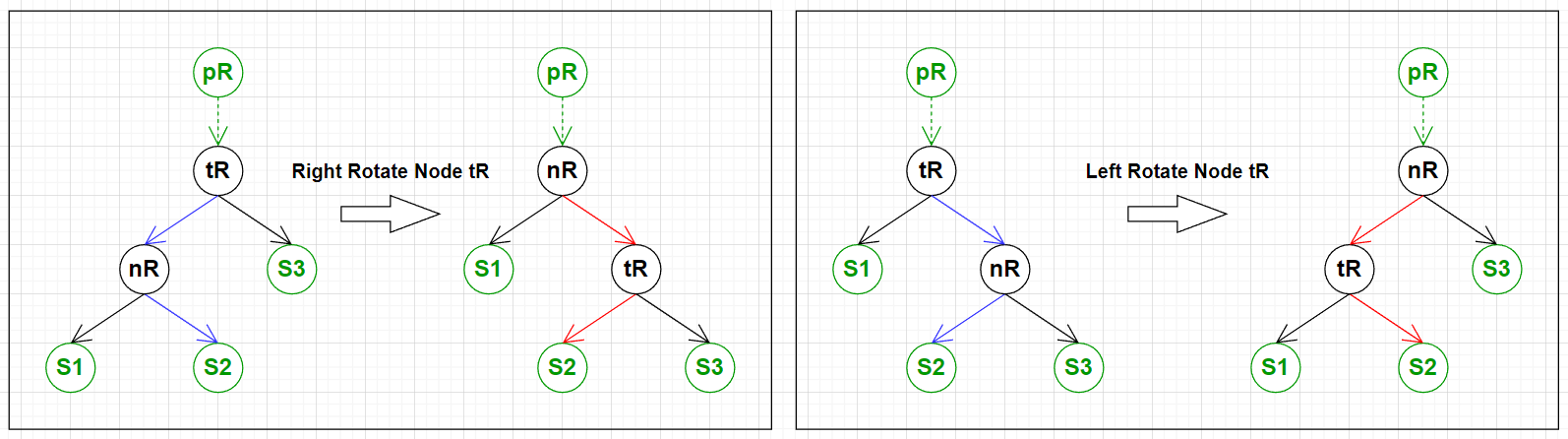
上图中左边是向右旋转 rightRotate , 右边是向左旋转 leftRotate .
很直观, 也没什么好多说的, 上代码.
Click to show the codes
// @brief Right rotate subtree whose root is {tRoot}, return {tRoot->left} as new root.

// e.g. To rotate {parentTarget->left} : parentTarget->left = rightRotate(parentTarget->left)

template<class K, class E>

inline btNode<std::pair<K, E>>* AVLTree<K, E>::rightRotate(btNode<std::pair<K, E>>* tRoot)

{

    btNode<std::pair<K, E>>* new_tRoot = tRoot->left;

    tRoot->left = new_tRoot->right;

    new_tRoot->right = tRoot;

    return new_tRoot;

}

// @brief Left rotate subtree whose root is {tRoot}, return {tRoot->right} as new root.

// e.g. To rotate {parentTarget->left} : parentTarget->left = leftRotate(parentTarget->left)

template<class K, class E>

inline btNode<std::pair<K, E>>* AVLTree<K, E>::leftRotate(btNode<std::pair<K, E>>* tRoot)

{

    btNode<std::pair<K, E>>* new_tRoot = tRoot->right;

    tRoot->right = new_tRoot->left;

    new_tRoot->left = tRoot;

    return new_tRoot;

}
5. 4 Cases for Rotation
AVL Tree 保持平衡的方法是计算 balance factor 后进行旋转.
下面四张图展示了需要旋转的 4 种情况以及旋转的方式.
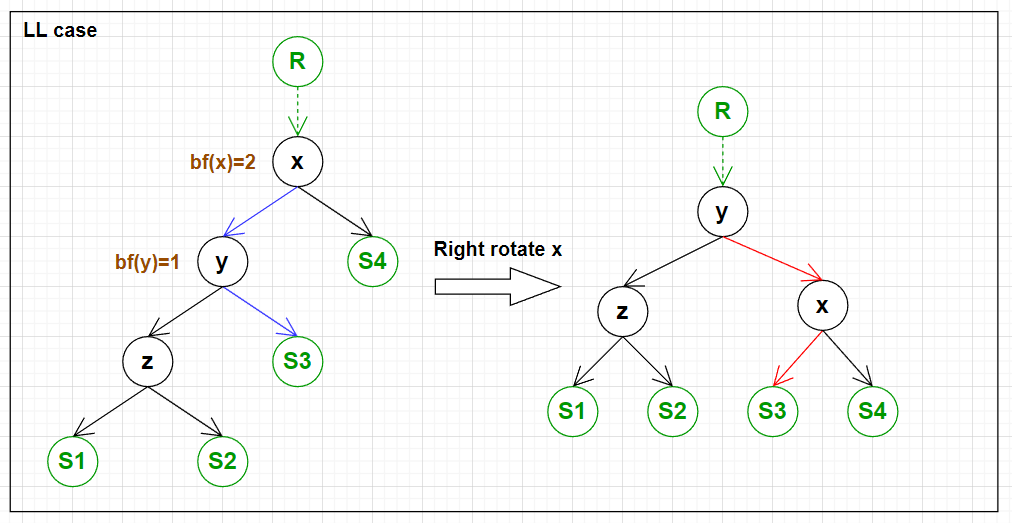
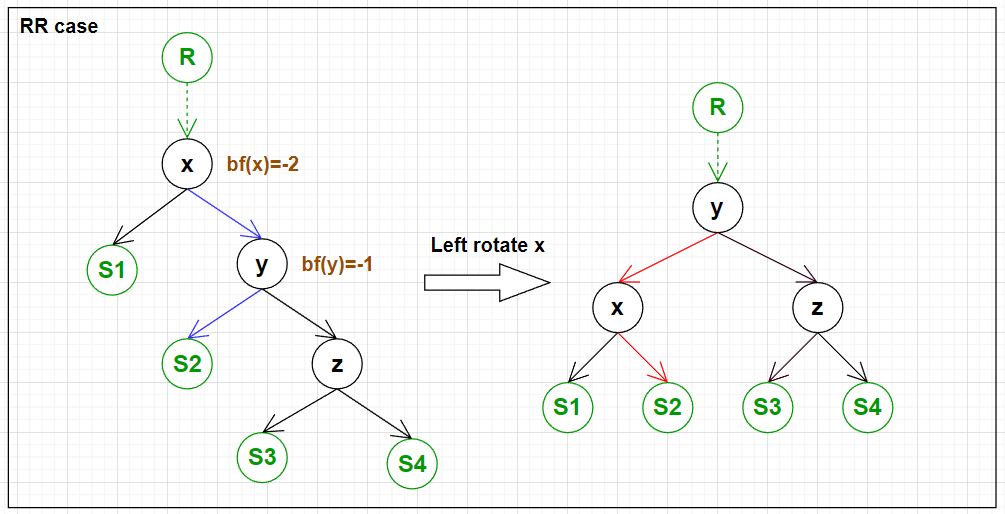
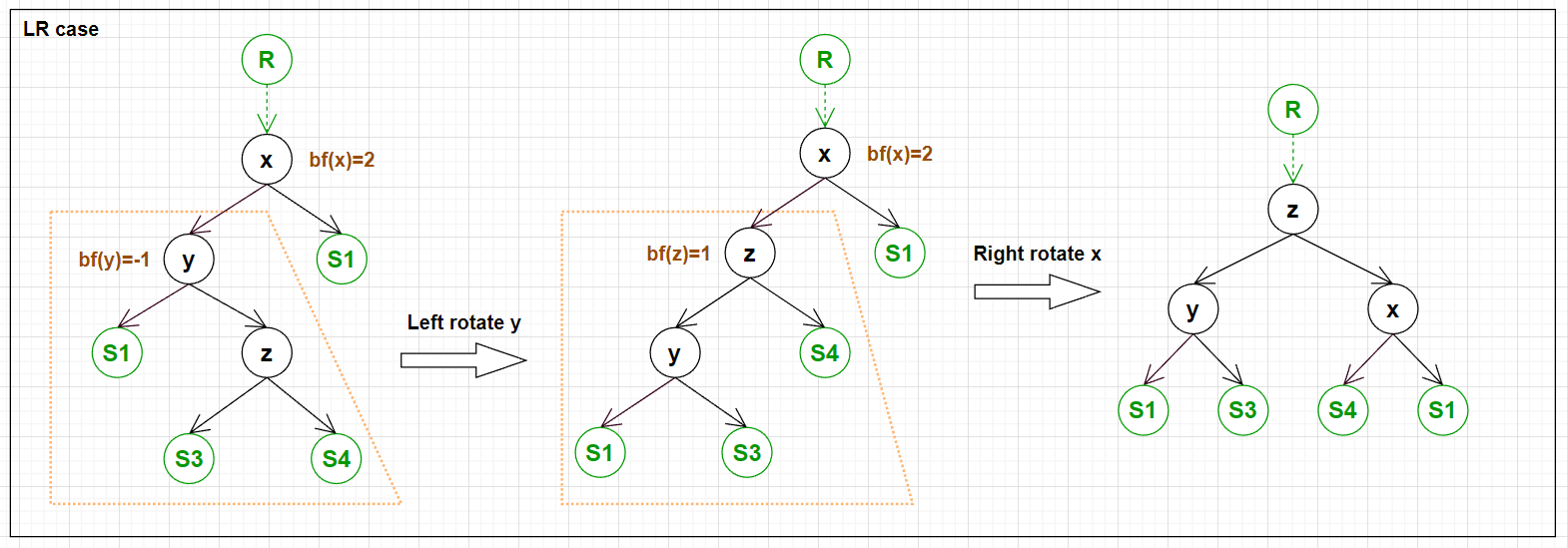
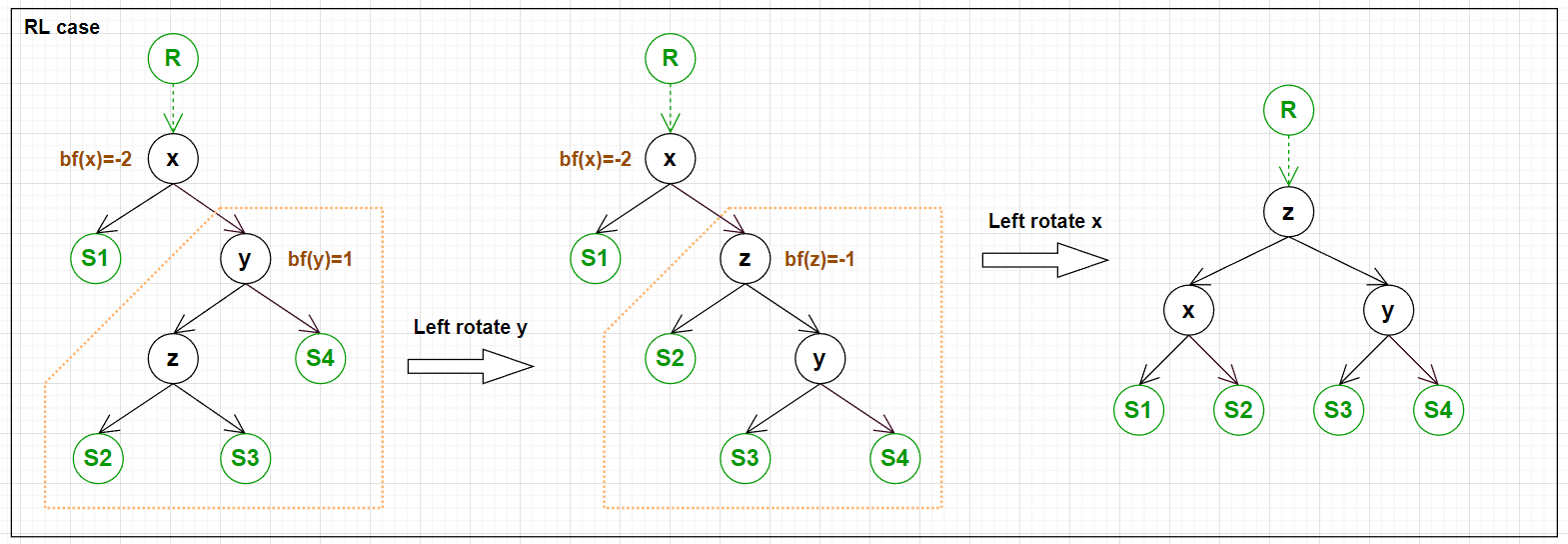
实现四种情况的旋转的代码:
Click to show the codes
// @brief For LL case, right rotate subtree {tRoot}, return {tRoot->left} as new root.

// e.g. To rotate {parentTarget->left} : parentTarget->left = llRotation(parentTarget->left);

template<class K, class E>

inline btNode<std::pair<K, E>>* AVLTree<K, E>::llRotation(btNode<std::pair<K, E>>* tRoot)

{

    return rightRotate(tRoot);

}

// @brief For LL case, left rotate subtree {tRoot}, return {tRoot->left} as new root.

// e.g. To rotate {parentTarget->left} : parentTarget->left = rrRotation(parentTarget->left);

template<class K, class E>

inline btNode<std::pair<K, E>>* AVLTree<K, E>::rrRotation(btNode<std::pair<K, E>>* tRoot)

{

    return leftRotate(tRoot);

}

// @brief For LR case, left rotate {tRoot->left}, right rotate {tRoot}, return {tRoot->left->right}.

// e.g. To rotate {parentTarget->left} : parentTarget->left = lrRotation(parentTarget->left);

template<class K, class E>

inline btNode<std::pair<K, E>>* AVLTree<K, E>::lrRotation(btNode<std::pair<K, E>>* tRoot)

{

    tRoot->left = leftRotate(tRoot->left);

    return rightRotate(tRoot);

}

// @brief For RL case, right rotate {tRoot->right}, left rotate {tRoot}, return {tRoot->right->left}.

// e.g. To rotate {parentTarget->left} : parentTarget->left = rlRotation(parentTarget->left);

template<class K,class E>

inline btNode<std::pair<K, E>>* AVLTree<K, E>::rlRoattion(btNode<std::pair<K, E>>* tRoot)

{

    tRoot->right = rightRotate(tRoot->right);

    return leftRotate(tRoot);

}
Reference |
(1) Data Structures, Algoritms, and Applications in C++, Sartaj Sahni
(2) AVL Tree | Set 1 (Insertion), princiraj1992, rathbhupendra, Akanksha_Rai, sohamshinde04, nocturnalstoryteller, rdtank, kaiwenzheng644, hardikkoriintern
AVL Tree (1) - Definition, find and Rotation的更多相关文章
- AVL Tree Insertion
Overview AVL tree is a special binary search tree, by definition, any node, its left tree height and ...
- 04-树5 Root of AVL Tree
平衡二叉树 LL RR LR RL 注意画图理解法 An AVL tree is a self-balancing binary search tree. In an AVL tree, the he ...
- 1066. Root of AVL Tree (25)
An AVL tree is a self-balancing binary search tree. In an AVL tree, the heights of the two child sub ...
- 1066. Root of AVL Tree
An AVL tree is a self-balancing binary search tree. In an AVL tree, the heights of the two child su ...
- 树的平衡 AVL Tree
本篇随笔主要从以下三个方面介绍树的平衡: 1):BST不平衡问题 2):BST 旋转 3):AVL Tree 一:BST不平衡问题的解析 之前有提过普通BST的一些一些缺点,例如BST的高度是介于lg ...
- 1123. Is It a Complete AVL Tree (30)
An AVL tree is a self-balancing binary search tree. In an AVL tree, the heights of the two child sub ...
- A1123. Is It a Complete AVL Tree
An AVL tree is a self-balancing binary search tree. In an AVL tree, the heights of the two child sub ...
- A1066. Root of AVL Tree
An AVL tree is a self-balancing binary search tree. In an AVL tree, the heights of the two child sub ...
- PAT A1123 Is It a Complete AVL Tree (30 分)——AVL平衡二叉树,完全二叉树
An AVL tree is a self-balancing binary search tree. In an AVL tree, the heights of the two child sub ...
随机推荐
- 配置SSM公钥及创建远程仓库和在IEDA中集成git操作
3.将.ssh下的id_rsa.pub公钥copy到gitee工作台中 4.创建个人仓库 5.设置开源许可证:开源是否可以随意转载,开源但是不能商业使用,不能转载,- 限制! 6.克隆到本地! IDE ...
- Python: 列表、数组及迭代器切片的区别及联系
1. 对列表和数组进行切片 1.1 切片索引 众所周知,Python中的列表和numpy数组都支持用begin: end语法来表示[begin, end)区间的的切片索引: import numpy ...
- Ubuntu挂载smb到本地
常规 sudo apt-get install cifs-utils -y sudo mkdir /airdisk;vim /etc/fstab 在/etc/fstab添加 //192.168.123 ...
- Neo4j应用
CQL函数 1. 字符串函数 功能 描述 UPPER 将所有字母改为大写 LOWER 将所有字母改为小写 SUBSTRING 将获取指定范围的子字符串 REPLACE 替换一个字符串的子字符串 mat ...
- CF1703E Mirror Grid 题解
给定一个矩阵,判断最少将多少个格反转后使得旋转零度,九十度,一百八十度,二百七十度相等. 枚举矩阵每个位置是 \(0\) 还是 \(1\),若已经判断过则跳过,全统 \(1\) 和全统 \(0\) 取 ...
- Stream流中的常用方法
count package com.yang.Test.StreamStudy; import java.util.stream.Stream; /** * 统计荷属:count * 正如旧集合Col ...
- WPF 截图控件之画笔(八)「仿微信」
前言 接着上周写的截图控件继续更新添加 画笔. 1.WPF实现截屏「仿微信」 2.WPF 实现截屏控件之移动(二)「仿微信」 3.WPF 截图控件之伸缩(三) 「仿微信」 4.WPF 截图控件之绘制方 ...
- 「Python实用秘技10」深度比较Python对象间差异
本文完整示例代码及文件已上传至我的Github仓库https://github.com/CNFeffery/PythonPracticalSkills 这是我的系列文章「Python实用秘技」的第10 ...
- 论文解读(SEP)《Structural Entropy Guided Graph Hierarchical Pooling》
论文信息 论文标题:Structural Entropy Guided Graph Hierarchical Pooling论文作者:Junran Wu, Xueyuan Chen, Ke Xu, S ...
- 如何定义 Java 的回调函数,与 JavaScript 回调函数的区别
JavaScript 中的回调函数 在 JavaScript 中经常使用回调函数,比如:get 请求.post 请求等异步任务.在我们请求之前以及请求之后,都需要完成一些固定的操作,比如:请求之前先从 ...