
轻量级CNN模型之squeezenet
SqueezeNet
论文地址:https://arxiv.org/abs/1602.07360
和别的轻量级模型一样,模型的设计目标就是在保证精度的情况下尽量减少模型参数.核心是论文提出的一种叫"fire module"的卷积方式.
设计策略
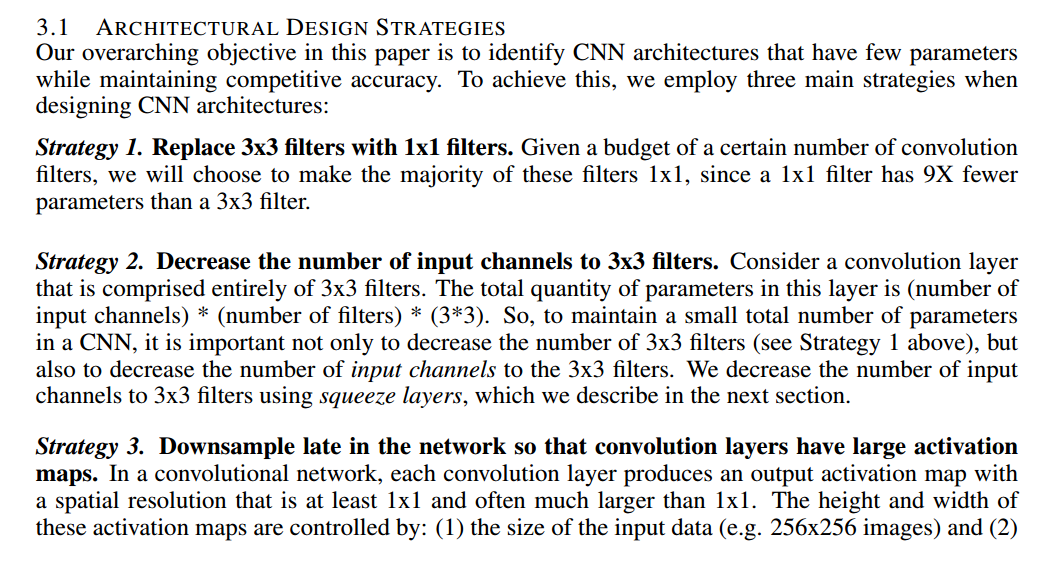
- 主要用1x1卷积核,而不是3x3.
- 减少3x3卷积核作用的channel.
- 推迟下采样的时间.以获取更大尺寸的feature map.这一点是处于精度的考虑.毕竟feature map的resolution越大,信息越丰富.下采样主要通过pool来完成或者卷积的时候控制stride大小.
Fire Module
这个就是网络的核心组件了.
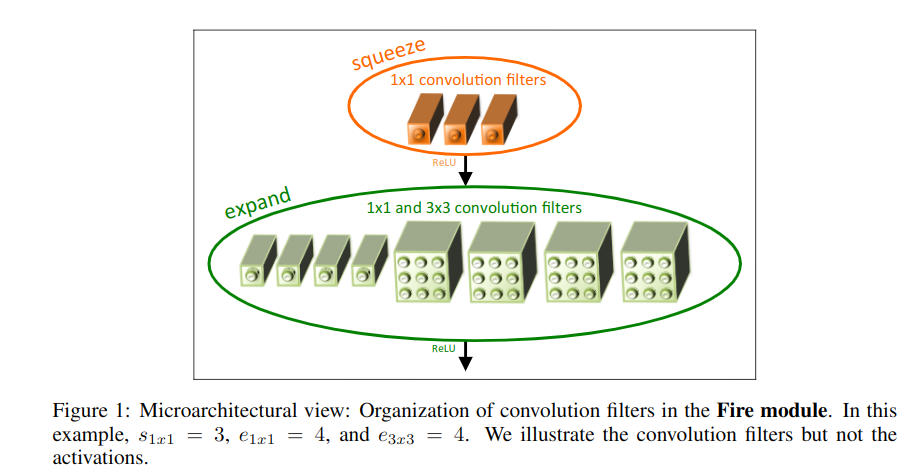
分2部分:
- squeeze convolution layer
- expand layer
其中squeeze只有1x1filter,expand layer由1x1和3x3filter组成.
在squeeze层卷积核数记为\(s_{1x1}\),在expand层,记1x1卷积核数为\(e_{1x1}\),而3x3卷积核数为\(e_{3x3}\),这三个属于超参数,可调。为了尽量降低3x3的输入通道数,让\(s_{1x1}<e_{1x1}+e_{3x3}\)。
这两层的设计分别体现了策略1(多用1x1filter)和策略2(减少3x3filter作用channel).
首先,squeeze convolution layer通过控制1x1卷积核数量达到把输入的channel数目降低的目的.这个是降低参数的最关键的一步.
然后,分别用1x1卷积核和3x3卷积核去做卷积.然后得到不同depth的输出,concat起来.([x,x,depth1],[x,x,depth2]-->[x,x,depth1+depth2])
代码实现
torch的官方实现:https://pytorch.org/docs/stable/_modules/torchvision/models/squeezenet.html
import torch

import torch.nn as nn

class Fire(nn.Module):

    def __init__(self, inplanes, squeeze_planes,

                 expand1x1_planes, expand3x3_planes):

        super(Fire, self).__init__()

        self.inplanes = inplanes

        self.squeeze = nn.Conv2d(inplanes, squeeze_planes, kernel_size=1)

        self.squeeze_activation = nn.ReLU(inplace=True)

        self.expand1x1 = nn.Conv2d(squeeze_planes, expand1x1_planes,

                                   kernel_size=1)

        self.expand1x1_activation = nn.ReLU(inplace=True)

        self.expand3x3 = nn.Conv2d(squeeze_planes, expand3x3_planes,

                                   kernel_size=3, padding=1)

        self.expand3x3_activation = nn.ReLU(inplace=True)

    def forward(self, x):

        x = self.squeeze_activation(self.squeeze(x))

        print(x.shape)

        e_1 = self.expand1x1(x)

        print(e_1.shape)

        e_3 = self.expand3x3(x)

        print(e_3.shape)

        return torch.cat([

            self.expand1x1_activation(e_1),

            self.expand3x3_activation(e_3)

        ], 1)
很显然地,squeeze convolution layer把channel数量降下来了,所以参数少了很多.
以输入tensor为[n,c,h,w]=[1,96,224,224]举例,假设fire module的squeeze layer的卷积核数量为6,expand layer中1x1卷积核数量为5,3x3卷积核数量为4.
则fire module的参数数量为1x1x96x6 + 1x1x6x5 + 3x3x6x4=822.
普通的3x3卷积,得到depth=9的feature map的话需要3x3x96x9=7776个参数.
所以模型才可以做到很小.
网络结构

基本就是fire module的堆叠.中间穿插了一些maxpool对feature map下采样. 注意一下最后用了dropout以及全局平均池化而不是全连接来完成分类.
最左边的就是类似vgg的堆叠式的结构.中间和右边的参考了resnet的skip-connection.
class SqueezeNet(nn.Module):

    def __init__(self, version='1_0', num_classes=1000):

        super(SqueezeNet, self).__init__()

        self.num_classes = num_classes

        if version == '1_0':

            self.features = nn.Sequential(

                nn.Conv2d(3, 96, kernel_size=7, stride=2),

                nn.ReLU(inplace=True),

                nn.MaxPool2d(kernel_size=3, stride=2, ceil_mode=True),

                Fire(96, 16, 64, 64),

                Fire(128, 16, 64, 64),

                Fire(128, 32, 128, 128),

                nn.MaxPool2d(kernel_size=3, stride=2, ceil_mode=True),

                Fire(256, 32, 128, 128),

                Fire(256, 48, 192, 192),

                Fire(384, 48, 192, 192),

                Fire(384, 64, 256, 256),

                nn.MaxPool2d(kernel_size=3, stride=2, ceil_mode=True),

                Fire(512, 64, 256, 256),

            )

        elif version == '1_1':

            self.features = nn.Sequential(

                nn.Conv2d(3, 64, kernel_size=3, stride=2),

                nn.ReLU(inplace=True),

                nn.MaxPool2d(kernel_size=3, stride=2, ceil_mode=True),

                Fire(64, 16, 64, 64),

                Fire(128, 16, 64, 64),

                nn.MaxPool2d(kernel_size=3, stride=2, ceil_mode=True),

                Fire(128, 32, 128, 128),

                Fire(256, 32, 128, 128),

                nn.MaxPool2d(kernel_size=3, stride=2, ceil_mode=True),

                Fire(256, 48, 192, 192),

                Fire(384, 48, 192, 192),

                Fire(384, 64, 256, 256),

                Fire(512, 64, 256, 256),

            )

        else:

            # FIXME: Is this needed? SqueezeNet should only be called from the

            # FIXME: squeezenet1_x() functions

            # FIXME: This checking is not done for the other models

            raise ValueError("Unsupported SqueezeNet version {version}:"

                             "1_0 or 1_1 expected".format(version=version))

        # Final convolution is initialized differently from the rest

        final_conv = nn.Conv2d(512, self.num_classes, kernel_size=1)

        self.classifier = nn.Sequential(

            nn.Dropout(p=0.5),

            final_conv,

            nn.ReLU(inplace=True),

            nn.AdaptiveAvgPool2d((1, 1))

        )

        for m in self.modules():

            if isinstance(m, nn.Conv2d):

                if m is final_conv:

                    init.normal_(m.weight, mean=0.0, std=0.01)

                else:

                    init.kaiming_uniform_(m.weight)

                if m.bias is not None:

                    init.constant_(m.bias, 0)

    def forward(self, x):

        x = self.features(x)

        x = self.classifier(x)

        return torch.flatten(x, 1)
https://pytorch.org/hub/pytorch_vision_squeezenet/
这里有一个用torch中的模型做推理的例子,
.....

with torch.no_grad():

    output = model(input_batch)

# Tensor of shape 1000, with confidence scores over Imagenet's 1000 classes

print(output[0])

# The output has unnormalized scores. To get probabilities, you can run a softmax on it.

print(torch.nn.functional.softmax(output[0], dim=0))
CNN结构设计的探索
主要从2个方面做实验探讨了不同结构对模型精度和模型大小的影响.

- fire module怎么设计,squeeze layer和expand layer的filter数量怎么设计
- fire module怎么串起来形成一个网络,是简单堆叠还是引入bypass
关于第一点fire module中各种filter占比的实验结果如下图:

这里的sr指的是squeeze layer的卷积核数量/expand layer比例.3x3filter比例指expand layer里3x3filter比例.
具体设计参考论文:

一点思考:
1x1的卷积核关联了某个位置的feature所有channel上的信息.3x3的卷积核关联了多个位置的feature的所有channel的信息.按道理说3x3的越多应该模型精度越好,但实验数据显示并非如此.可能有些是噪音,3x3卷积参考太多周围的feature反而导致精度下降. 这也是深度学习现在被比较多诟病的一点,太黑盒了.只知道能work,为啥work不好解释.不同的数据集可能不同的参数表现会不一样,很难讲哪个最优,调参比较依赖经验.
关于第二点在layer之间采用不同的连接方式,实验结果如下:

轻量级CNN模型之squeezenet的更多相关文章
- 轻量级CNN模型mobilenet v1
mobilenet v1 论文解读 论文地址:https://arxiv.org/abs/1704.04861 核心思想就是通过depthwise conv替代普通conv. 有关depthwise ...
- 深度学习方法(七):最新SqueezeNet 模型详解,CNN模型参数降低50倍,压缩461倍!
欢迎转载,转载请注明:本文出自Bin的专栏blog.csdn.net/xbinworld. 技术交流QQ群:433250724,欢迎对算法.技术感兴趣的同学加入. 继续前面关于深度学习CNN经典模型的 ...
- CNN 模型压缩与加速算法综述
本文由云+社区发表 导语:卷积神经网络日益增长的深度和尺寸为深度学习在移动端的部署带来了巨大的挑战,CNN模型压缩与加速成为了学术界和工业界都重点关注的研究领域之一. 前言 自从AlexNet一举夺得 ...
- 基于Pre-Train的CNN模型的图像分类实验
基于Pre-Train的CNN模型的图像分类实验 MatConvNet工具包提供了好几个在imageNet数据库上训练好的CNN模型,可以利用这个训练好的模型提取图像的特征.本文就利用其中的 “im ...
- 卷积神经网络(CNN)模型结构
在前面我们讲述了DNN的模型与前向反向传播算法.而在DNN大类中,卷积神经网络(Convolutional Neural Networks,以下简称CNN)是最为成功的DNN特例之一.CNN广泛的应用 ...
- FaceRank-人脸打分基于 TensorFlow 的 CNN 模型
FaceRank-人脸打分基于 TensorFlow 的 CNN 模型 隐私 因为隐私问题,训练图片集并不提供,稍微可能会放一些卡通图片. 数据集 130张 128*128 张网络图片,图片名: 1- ...
- Keras入门(四)之利用CNN模型轻松破解网站验证码
项目简介 在之前的文章keras入门(三)搭建CNN模型破解网站验证码中,笔者介绍介绍了如何用Keras来搭建CNN模型来破解网站的验证码,其中验证码含有字母和数字. 让我们一起回顾一下那篇文 ...
- keras训练cnn模型时loss为nan
keras训练cnn模型时loss为nan 1.首先记下来如何解决这个问题的:由于我代码中 model.compile(loss='categorical_crossentropy', optimiz ...
- keras入门(三)搭建CNN模型破解网站验证码
项目介绍 在文章CNN大战验证码中,我们利用TensorFlow搭建了简单的CNN模型来破解某个网站的验证码.验证码如下: 在本文中,我们将会用Keras来搭建一个稍微复杂的CNN模型来破解以上的 ...
随机推荐
- BCD 码、Gray 码、ASCII 码都是什么呢?
BCD 码:即(Binary Coded Decimal)码,也称为 8421 码,是十进制代码中最常见的一种.每一位的 1 代表的十进制数称为这一位的权.BCD 码中每一位的权都是固定不变的,它属于 ...
- Player的跟踪狂 -- Camera
P.S.很多游戏里的Player都会设置的被跟踪,是人性的扭曲,还是XXX,正在解密. 第三人称视角 camera紧跟player背后(角度随player改变) using System.Collec ...
- Spring Boot 整合视图层技术
这一节我们主要学习如何整合视图层技术: Jsp Freemarker Thymeleaf 在之前的案例中,我们都是通过 @RestController 来处理请求,所以返回的内容为json对象.那么如 ...
- locate,find
locate:非实时查找,模糊匹配,查找是根据全系统文件数据库进行的,可以使用updatedb命令来手动生成数据库 find:实时查找,精确匹配,支持众多查找标准,遍历指定目录中的所有文件完成查找,速 ...
- C++——数组与字符串
目录 一.数组 1.1定义与初始化 1.1.1使用 1.1.2存储 1.1.3初始化 1.2作函数参数 1.3对象数组 1.3.1定义与访问 1.3.2初始化 1.3.3数组元素所属类的构造函数 二. ...
- 3D虚拟环境中的选择技术分类
我们在3D虚拟环境(Virtual Environment, VE)中需要完成的操作有3种:选择物体,操纵(改变)物体,移位(locomotion).这里来总结一下3D VE中的选择技术的种类.本文根 ...
- [Note] Clipboard.js 使用
clipboard.js是一个用来设置剪切板的库,小巧无依赖,但用法有点诡异,必须依赖一个DOM元素 据作者说,由于浏览器相关安全策略的缘故,无法使用下面这种方式来设置剪切板 clipboard.co ...
- php导出excel乱码怎么处理
使用PHP导出excel文档,有时候莫名其妙就会出现导出的数据乱码,现在推荐一个万能修补大法 话不多说,直接上代码 核心就是在处理完数据之后,输出excel文件之前 添加 ob_end_clean() ...
- Activity初学乍练
1.Activity的概念与Activity的生命周期图: 注意事项: onPause()和onStop()被调用的前提是: 打开了一个新的Activity!而前者是旧Activity还可见的状态:后 ...
- Java 从入门到进阶之路(八)
在之前的文章我们介绍了一下 Java 中的重载,接下来我们看一下 Java 中的构造方法. 我们之前说过,我们在定义一个变量的时候,java 会为我们提供一个默认的值,字符串为 null,数字为 0. ...