
tensorflow张量排序
本篇记录一下TensorFlow中张量的排序方法
tf.sort和tf.argsort
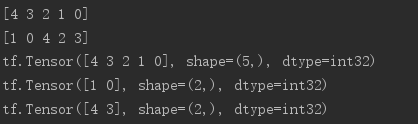
# 声明tensor a是由1到5打乱顺序组成的

a = tf.random.shuffle(tf.range(5))

# 打印排序后的tensor

print(tf.sort(a,direction='DESCENDING').numpy())

# 打印从大到小排序后,数字对应原来的索引

print(tf.argsort(a,direction='DESCENDING').numpy())

index = tf.argsort(a,direction='DESCENDING')

# 按照索引序列取值

print(tf.gather(a,index))

# 返回最大的两个值信息

res = tf.math.top_k(a,2)

# indices返回索引

print(res.indices)

# values返回值

print(res.values)
计算准确率实例:
# 定义模型输出预测概率

prob = tf.constant([[0.1,0.2,0.7],[0.2,0.7,0.1]])

# 定义y标签

target = tf.constant([2,0])

# 求top3的索引

k_b = tf.math.top_k(prob,3).indices

# 将矩阵进行转置,即把top-1,top-2,top-3分组

print(tf.transpose(k_b,[1,0]))

# 将y标签扩展成与top矩阵相同维度的tensor,方便比较

target = tf.broadcast_to(target,[3,2])

# 实现求准确率的方法

def accuracy(output,target,topk=(1,)):

    maxk = max(topk)

    batch_size = target.shape[0]

    pred = tf.math.top_k(output,maxk).indices

    pred = tf.transpose(pred,perm=[1,0])

    target_ = tf.broadcast_to(target,pred.shape)

    correct = tf.equal(pred,target_)

    res = []

    for k in topk:

        correct_k = tf.cast(tf.reshape(correct[:k],[-1]),dtype=tf.float32)

        correct_k = tf.reduce_sum(correct_k)

        acc = float(correct_k/batch_size)

        res.append(acc)

    return res
import  tensorflow as tf

import  os

os.environ['TF_CPP_MIN_LOG_LEVEL'] = ''

tf.random.set_seed(2467)

def accuracy(output, target, topk=(1,)):

    maxk = max(topk)

    batch_size = target.shape[0]

    pred = tf.math.top_k(output, maxk).indices

    pred = tf.transpose(pred, perm=[1, 0])

    target_ = tf.broadcast_to(target, pred.shape)

    # [10, b]

    correct = tf.equal(pred, target_)

    res = []

    for k in topk:

        correct_k = tf.cast(tf.reshape(correct[:k], [-1]), dtype=tf.float32)

        correct_k = tf.reduce_sum(correct_k)

        acc = float(correct_k* (100.0 / batch_size) )

        res.append(acc)

    return res

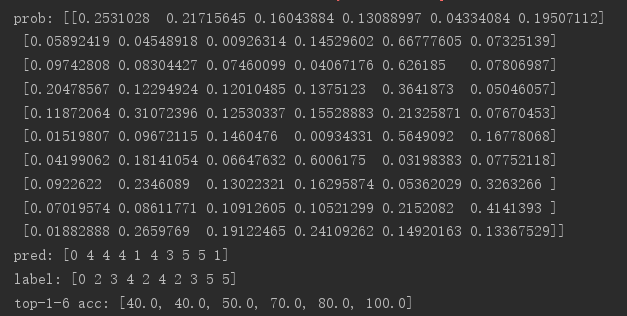
output = tf.random.normal([10, 6])

output = tf.math.softmax(output, axis=1)

target = tf.random.uniform([10], maxval=6, dtype=tf.int32)

print('prob:', output.numpy())

pred = tf.argmax(output, axis=1)

print('pred:', pred.numpy())

print('label:', target.numpy())

acc = accuracy(output, target, topk=(1,2,3,4,5,6))

print('top-1-6 acc:', acc)
tensorflow张量排序的更多相关文章
- AI - TensorFlow - 张量(Tensor)
张量(Tensor) 在Tensorflow中,变量统一称作张量(Tensor). 张量(Tensor)是任意维度的数组. 0阶张量:纯量或标量 (scalar), 也就是一个数值,例如,\'Howd ...
- Tensorflow张量
张量常规解释 张量(tensor)理论是数学的一个分支学科,在力学中有重要应用.张量这一术语起源于力学,它最初是用来表示弹性介质中各点应力状态的,后来张量理论发展成为力学和物理学的一个有力的数学工具. ...
- tensorflow 张量的阶、形状、数据类型及None在tensor中表示的意思。
x = tf.placeholder(tf.float32, [None, 784]) x isn't a specific value. It's a placeholder, a value th ...
- TensorFlow—张量运算仿真神经网络的运行
import tensorflow as tf import numpy as np ts_norm=tf.random_normal([]) with tf.Session() as sess: n ...
- Tensorflow张量的形状表示方法
对输入或输出而言: 一个张量的形状为a x b x c x d,实际写出这个张量时: 最外层括号[…]表示这个是一个张量,无别的意义! 次外层括号有a个,表示这个张量里有a个样本 再往内的括号有b个, ...
- 121、TensorFlow张量命名
# tf.Graph对象定义了一个命名空间对于它自身包含的tf.Operation对象 # TensorFlow自动选择一个独一无二的名字,对于数据流图中的每一个操作 # 但是给操作添加一个描述性的名 ...
- tensorflow张量限幅
本篇内容有clip_by_value.clip_by_norm.gradient clipping 1.tf.clip_by_value a = tf.range(10) print(a) # if ...
- 吴裕雄--天生自然TensorFlow2教程:张量排序
import tensorflow as tf a = tf.random.shuffle(tf.range(5)) a tf.sort(a, direction='DESCENDING') # 返回 ...
- Tensorflow Lite从入门到精通
TensorFlow Lite 是 TensorFlow 在移动和 IoT 等边缘设备端的解决方案,提供了 Java.Python 和 C++ API 库,可以运行在 Android.iOS 和 Ra ...
随机推荐
- Codeforces 1017D The Wu(状态压缩+预处理)
题意: 给你n m q,表示在这一组数据中所有的01串长度均为n,然后给你一个含有m个元素的multiset,之后有q次询问.每次询问会给你一个01串t和一个给定常数k,让你输出串t和multiset ...
- 《Redis5.x入门教程》正式推出
关注公众号CoderBuff回复"redis"可抢先获取<Redis5.x入门教程>PDF完整版 在<ElasticSearch6.x实战教程>之后,又斗胆 ...
- 怎么理解Laravel的核心架构
使用过larave框架的朋友都知道laravel框架里面除了提供一些基本的功能(如控制器.视图.模型)之外,还有中间件.门面.契约等,这些东西是如何在laravel框架运用起来的呢?今天就和大家详聊一 ...
- 修改 ssh 远程连接 时间
linux使用的是 红帽旗下 centos. 解释两个文件 /etc/ssh/sshd_config 配置ssh服务器端的 ...
- light oj 1095 - Arrange the Numbers排列组合(错排列)
1095 - Arrange the Numbers Consider this sequence {1, 2, 3 ... N}, as an initial sequence of first N ...
- margin合并及解决办法
外边距合并指的是,当两个垂直外边距相遇时,它们将形成一个外边距. 合并后的外边距的高度等于两个发生合并的外边距的高度中的较大者 水平方向不会发生合并 只有普通文档流中块框的垂直外边距才会发生外边距合并 ...
- Mysql 保存emoji表情报错
保存emoji表情错误 首先错误表现,抛出业务层报错之外,根源的数据库错误是: sql 错误码 1366 字符集相关错误. uncategorized SQLException; SQL state ...
- Python学习小记(3)---scope&namespace
首先,函数里面是可以访问外部变量的 #scope.py def scope_test(): spam = 'scope_test spam' def inner_scope_test(): spam ...
- 12.python内置模块之sys模块介绍
python的sys模块是与python解释器交互的一个接口,提供对解释器使用或维护的一些变量的访问,即与解释器强烈交互的函数. sys模块的常用函数: 1.sys.argv:命令行参数列表.第一个元 ...
- HTTPS原理及流程
HTTPS为什么更安全:数据对称加密传出,对称密钥使用非对称加密协商. HTTPS就一定安全吗:不一定,如果用户在浏览器端执意访问证书可疑或过期的站点,就存在安全隐患. --- HTTPS实现原理:h ...