
raw flash vs FTL
1. 区别
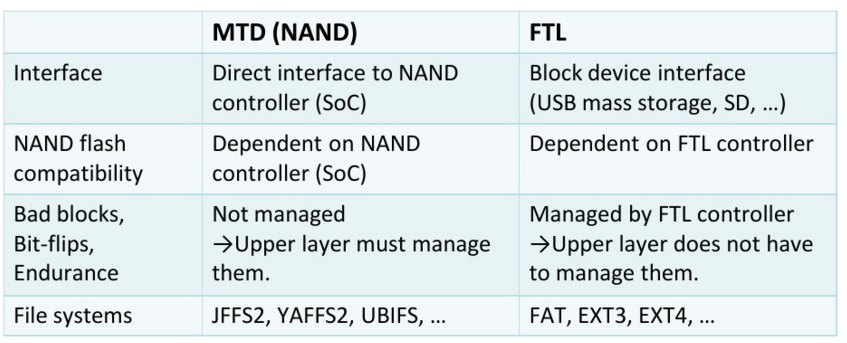
raw flash devices: NAND, NOR, OneNAND, etc,其被作为MTD设备处理(既不是字符设备,也不是块设备)。
FTL device:Flash Translation layer device, MMC, eMMC, SD,不仅包含flash,还包含控制器,其被作为块设备处理。
FTL stands for "Flash Translation Layer" and it is software which emulates a block device on top of flash
hardware. At early days FTL ran on the host computer. For example, old PCMCIA flash devices were essentially
raw flash devices, and the PCMCIA standard defined the media storage format for them. So the host computer
had to run the FTL software driver which implemented PCMCIA FTL. However, nowadays FTL is usually firmware,
and it is run by the controller which is built into the storage device. For example, if you look inside an
USB flash drive, you'll find there a NAND chip (or several of them), and a micro-controller, which runs FTL
firmware. Some USB flash drives are known to have quite powerful ARM processors inside. Similarly, MMC,
eMMC, SD, SSD, and other FTL devices have a built-in controller which runs FTL firmware.
All FTL devices have an interface which provides block I/O access. Well, the interfaces are different and
they are defined by different specifications, e.g., MMC, eMMC, SD, USB mass storage, ATA, and so on. But all
of them provide block-based access to the device. By block-based access we mean that whole device is
represented as an linear array of (usually 512-byte) blocks. Each block may be read or written.
http://www.linux-mtd.infradead.org/doc/ubifs.html#L_raw_vs_ftl
2. 常用的文件系统ext2、FAT等不能用于MTD设备上(raw flash),可运行于FTL device上。
3. mtd设备对应的设备文件为/dev/mtd,FTL设备对应的设备文件可为/dev/mtdblock。
There is an extremely simple FTL layer in Linux MTD subsystem - mtdblock. It emulates block devices over MTD
devices. There is also an mtdblock_ro module which emulates read-only block devices. When you load this
module, it creates a block device for each MTD device in the system. The block devices are then accessible
via /dev/mtdblockX device nodes.
But in many cases using mtdblock is a very bad idea because what it basically does if you change any sector
of your mtdblockX device, it reads the whole corresponding eraseblock into the memory, erases the
eraseblock, changes the sector in RAM, and writes the whole eraseblock back. This is very straightforward.
If you have a power failure when the eraseblock is being erased, you lose all the block device sectors in
it. The flash will likely decay soon because you will wear few eraseblocks out - most probably those ones
which contain FAT/bitmap/inode table/etc.
Unfortunately it is a rather difficult task to create a good FTL layer and nobody still managed to implement
one for Linux. But now when we have UBI (see here) it is much easier to do it on top of UBI.
raw flash vs FTL的更多相关文章
- UBIFS文件系统介绍
1. 引言 UBIFS,Unsorted Block Image File System,无排序区块图像文件系统.它是用于固态硬盘存储设备上,并与LogFS相互竞争,作为JFFS2的后继文件系统之一 ...
- linux kernel系列四:嵌入式系统中的文件系统以及MTD
本节介绍File System和MTD技术 一 FS 熟知的FS有ext2,3,4.但是这些都是针对磁盘设备的.而ES中一般的存储设备为Flash,由于Flash的特殊性: Flash存储按照Bloc ...
- UBIFS - UBI File-System
参考:http://www.linux-mtd.infradead.org/doc/ubifs.html#L_raw_vs_ftl UBIFS - UBI File-System Table of c ...
- UBIFS介绍 - MTD网站
转:http://blog.csdn.net/kickxxx/article/details/6583463 目录(?)[-] Big red note Overview Scalabity Writ ...
- eMMC基础技术11:flash memory
[转]http://www.wowotech.net/basic_tech/367.html 0.前言 eMMC 是 Flash Memory 的一类,在详细介绍 eMMC 之前,先简单介绍一下 Fl ...
- Flash Memory 简介【转】
本文转载自:https://linux.codingbelief.com/zh/storage/emmc/ Flash Memory 是一种非易失性的存储器.在嵌入式系统中通常用于存放系统.应用和数据 ...
- kernel下nand flash的文件系统总结
1.FLASH转换层(FTL) EXt2/EXT3/EXT4文件系统可以通过FTL实现对flash的支持,因为FTL可以将闪存flash模拟成磁盘结构. 在ext2文件系统的基础上上,为了保证数据的一 ...
- SDF:Software-Defined Flash for Web-Scale Internet Storage System
一.参考 http://www.csdn.net/article/a/2013-12-18/309280 http://gtstorageworld.blog.51cto.com/908359/126 ...
- FTL方面综述
FTL 1.百度百科 http://baike.baidu.com/link?url=HJ94Rz2Td83V8OW-6dD_h_P8CZb9VFR6HznPDopY_SFdfXDaMriYcBm1X ...
随机推荐
- Microsoft office(1)分页符和分节符
Microsoft office下的页面布局中的分页符和分节符的区别: 分页符:标记一页的终止并开始下一页的点 分节符:插入分节符并在下一页开始新节 一般情况下,分节符在分页符外围,分节符一般是各种格 ...
- Oracle中分页查询语句的写法
要动态的变化分页查询的条件,比如pageNow 这个变量表示的是当前是第几页, oracle分页有通用写法,假设一页5行 select * from ( select t.*,rownum rn fr ...
- 算法导论-顺序统计-快速求第i小的元素
目录 1.问题的引出-求第i个顺序统计量 2.方法一:以期望线性时间做选择 3.方法二(改进):最坏情况线性时间的选择 4.完整测试代码(c++) 5.参考资料 内容 1.问题的引出-求第i个顺序统计 ...
- 贯通Spark Streaming流计算框架的运行源码
本章节内容: 一.在线动态计算分类最热门商品案例回顾 二.基于案例贯通Spark Streaming的运行源码 先看代码(源码场景:用户.用户的商品.商品的点击量排名,按商品.其点击量排名前三): p ...
- [转载]Oracle Merge的使用
FROM: http://zhangqchang.blog.163.com/blog/static/464989732009219114653226/ 摘至网上的几个例子 一.************ ...
- Spark(五) -- Spark Streaming介绍与基本执行过程
Spark Streaming作为Spark上的四大子框架之一,肩负着实时流计算的重大责任 而相对于另外一个当下十分流行的实时流计算处理框架Storm,Spark Streaming有何优点?又有何不 ...
- REOBJECT structure
REOBJECT structure 包含丰富编辑控件中的OLE或图像对象的信息. Syntax 语法 typedef struct _reobject { DWORD cbStruct; LON ...
- maven命令解释
打包:mvn package编译:mvn compile编译测试程序:mvn test-compile清空:mvn clean运行测试:mvn test生成站点目录: mvn site生成站点目录并发 ...
- MPTCP 源码分析(六) 数据重发
简述 TCP使用定时器函数tcp_retransmit_timer进行数据重发,MPTCP需要重发数据的时候, 不仅仅在原路径发送数据,而且会在另外一条子路径进行重发.这样考虑的原因是: 考 ...
- B3:状态模式 State
当一个对象内在状态改变时允许改变其行为,这个对象看起来像是改变了其类.状态模式主要解决当控制一个对象状态转换条件表达式过于复杂时的情况,把状态判断逻辑移到表示不同状态的一系列类中.如果状态判断很简单, ...