
Exploring the 7 Different Types of Data Stories
Exploring the 7 Different Types of Data Stories
What makes a story truly data-driven? For one, the numbers aren’t caged in a sidebar graph. Instead, the data helps drive the narrative.
Data can help narrate as many types of stories as there are angles. My colleague Ben Jones ofTableau Public inspired me to think of data stories as seven different types (à la Christopher Booker’s seven basic story plots). Jones based his idea on analysis of numerous data stories, and his framework helps imagine ways to free data from sidebar graphs. These categories are meant to be a thought-starter, not a final count, which is sure to be higher.
Let’s explore each category using data compiled by Freedom House, an independent watchdog organization. The data ranks each country as “free,” “partly free,” or “not free,” based on a score. Using this simple dataset, we can tell seven different stories. The angle depends on what you want the data to show and how you plan to show it.
1. NARRATE CHANGE OVER TIME
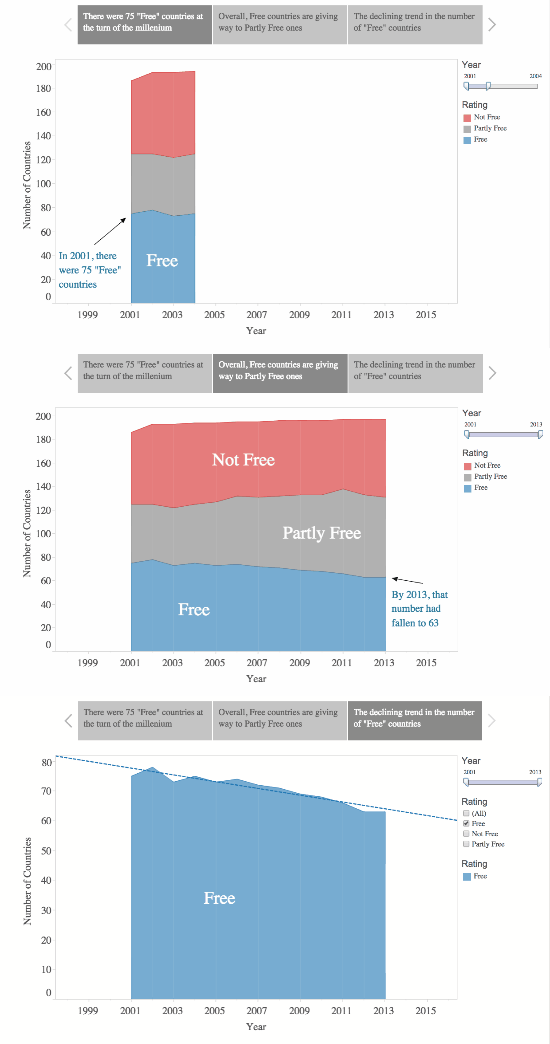
How many countries were categorized as “free” in 2013 versus in 2001? It turns out the number shrank over time. We can use the data to visualize the change, then explain the forces at work.
Credit: Ben Jones.
CNBC’s John Schoen took this approach to visualize the history of the Dow 30 over 87 years. The user can click on each decade and see how the index reacted to the tech boom, the inflation of the ‘70s, even the Great Depression. The CNBC staff paired the visualization with future forecastsbased on past trends.

The History of the Dow 30. John Schoen
Click to visit the full interactive visualization.
2. START BIG AND DRILL DOWN
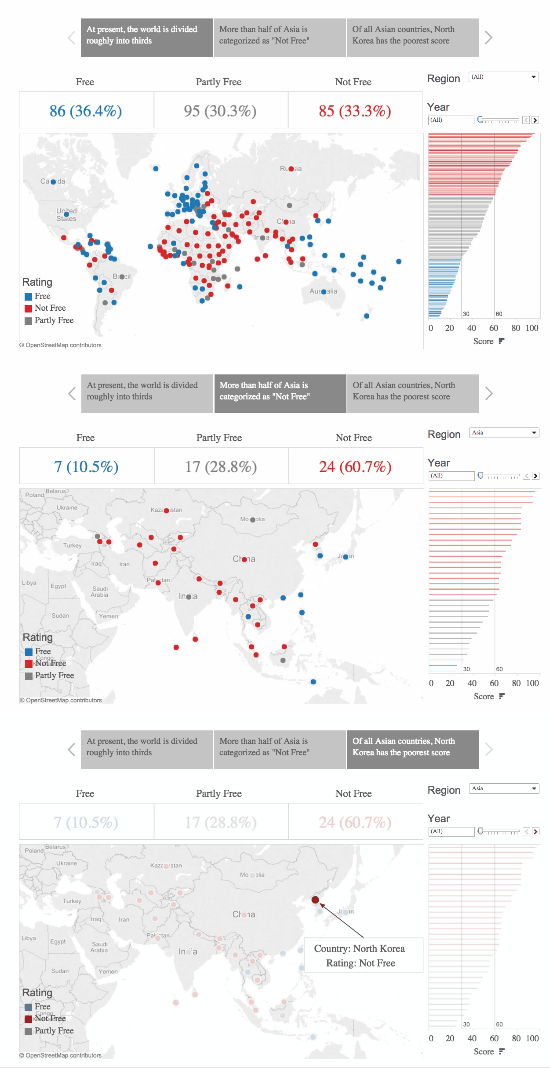
Data can guide the reader from the big-picture view down to a focused view. Using the Freedom House data, start the reader with a world map of the scores, the big view. Then the reader can zoom in on a region — Asia, say — and see that more than half of the countries there are labeled as “not free.” Zoom in even more, and the reader sees that North Korea is the least free country of all.
We can guide the reader through this sequence by providing prompts in the copy as well as interactive filters.
Credit: Ben Jones.
The example below shows vaccine-preventable outbreaks recorded around the world. The overview shows how many such cases exist. The filters allow the reader to drill down by country, disease, or year. The reader might be guided to see, for example, that whooping cough is more prevalent in the U.S. than elsewhere, and the story can outline the possible reasons why.

Vaccine-Preventable Outbreaks. Credit: CFR
Click to visit the full interactive visualization.
3. START SMALL AND ZOOM OUT
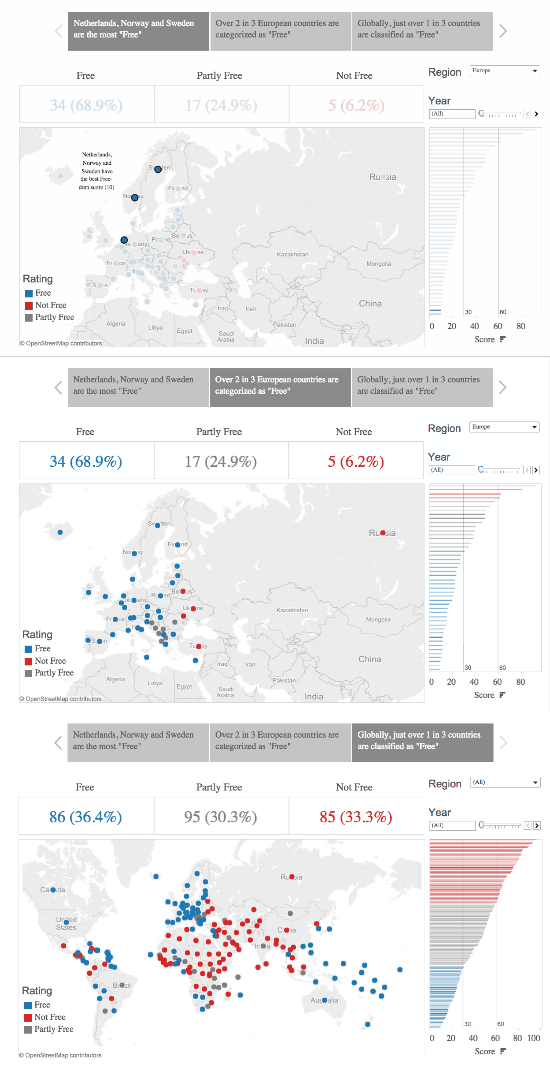
We can also do the reverse by starting with the molecular view and expanding to the larger view. For example, first focus on the three freest countries in the world, which happen to be clustered in Europe. From there, zoom out the narrative to show how other European countries stack up, then zoom out again to show the global comparison. Then the reader sees that just over one-third of all countries are labeled as “free.”
Credit: Ben Jones.
Here’s an example that looks at the impact of immigration on housing value. The reader can enter his or her zip code to start with a hyperlocal view. The interactive filter provides the statewide view, and the map overview gives the national perspective.

Immigrants and Housing. Credit: Jacob Vigdor
Click to visit the full interactive visualization.
4. HIGHLIGHT CONTRASTS
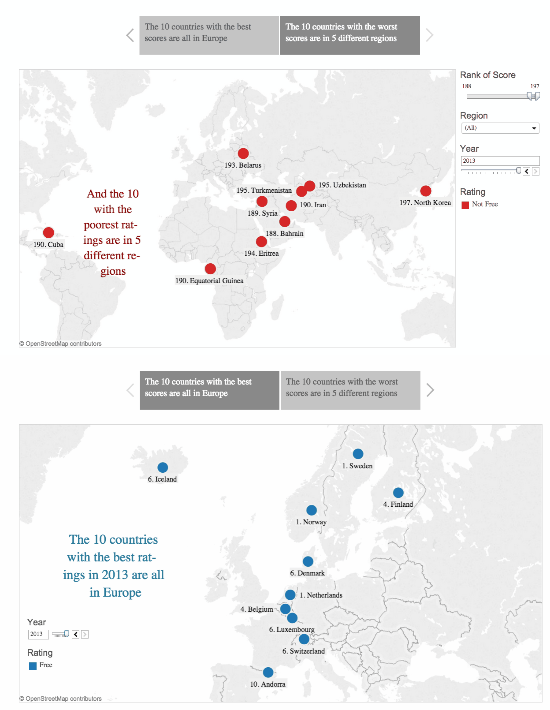
Outlining the differences in datasets can drive a powerful narrative. The 10 freest countries are all in Europe, and happen to be located close together. The 10 least free countries, on the other hand, are in five different regions.
Credit: Ben Jones.
Of course, geography is just one of the two groups’ many differences. Our story can explore the key ways in which the two groups differ, from government policies to culture to history. A study of contrasts could make for a captivating piece.
We can tell a similar story with the example below. It compares the gender gap in countries around the world based on three dimensions of human development: a long and healthy life, knowledge, and a decent standard of living. Countries on one end of the spectrum have large disparities while those on the other end have near-equality.

HDI Gender Gap. Credit: Ramon Martinez
Click to visit the full interactive visualization.
5. EXPLORE THE INTERSECTION
When two divergent lines of data intersect and one overtakes the other, questions result. The freedom data shows that the number of “partly free” countries overtake the “not free” countries, then go on to also surge past the “free” countries. What caused the shift? When standings change, people want to know the reason.
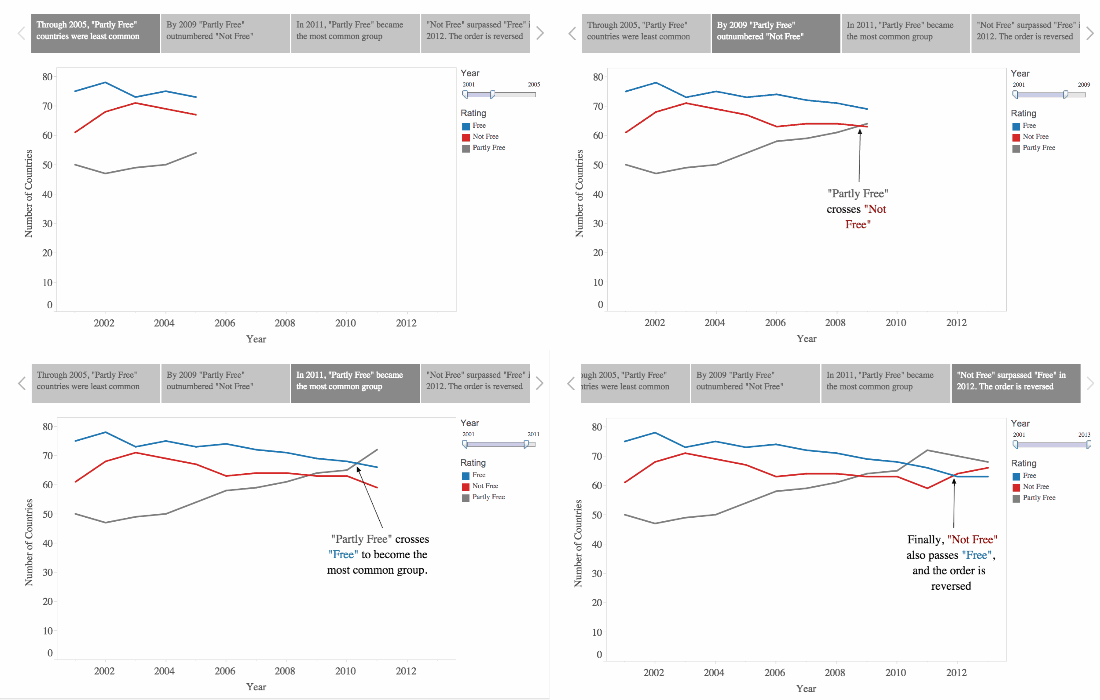
Credit: Ben Jones.
Sarah Ryley of New York Daily News visualized the number of summonses issued in New York since broken-windows policing took effect in 1993. The number rose sharply at first and held steady before starting a slow decline. Then a spike in stop-and-frisks led to an intersection with summonses in 2010. Granted, the two lines don’t compare apples to apples. However, the crossing and its components can drive a narrative about New York’s law enforcement strategy.

Summonses Since ‘Broken Windows.’ Credit: Sarah Ryley
Click to visit the full interactive visualizaton.
6. DISSECT THE FACTORS
Sometimes factors come together like pieces of a puzzle to form the big picture. The relationship might be additive or multiplicative. For example, each country’s freedom score is the sum of legal, economic and political freedom.
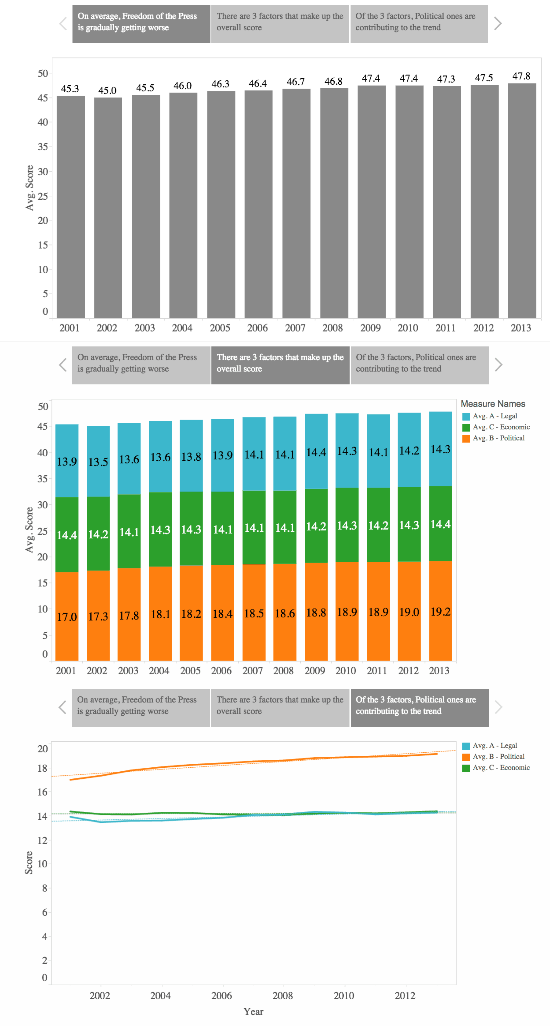
Credit: Ben Jones.
Here’s an example that shows how the sun controls the weather. The visualization draws the dot from sunspots to global weather, highlighting causal relationships along the way.

Sunspots. Credit: Matt Francis.
Click to visit the full interactive visualization.
7. PROFILE THE OUTLIERS
We are fascinated by things that aren’t like the others. We want to know the why and the how behind the outliers.
Finding the outliers sometimes takes a bit of data exploration. Visualize the freedom data as a scatterplot, and you might say there is no outlier. But break it down by regions in a box plot, and you start to see those that stand apart.
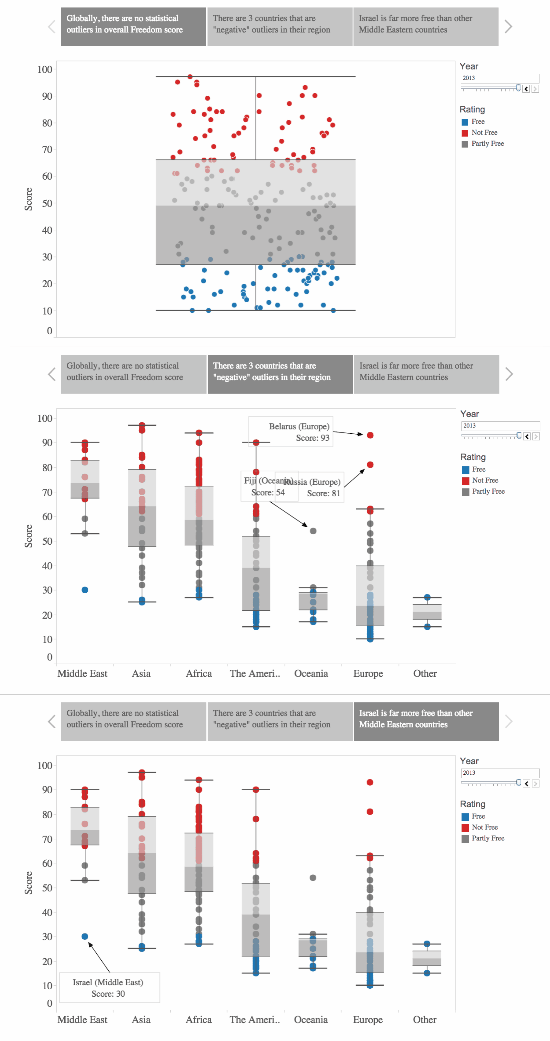
Credit: Ben Jones.
This example shows the number of government requests Facebook received in the first half of 2013. The map makes it clear that the U.S. is the clear outlier with a margin of more than 8,200 requests. An accompanying story could highlight the U.S. government’s stance on social media monitoring, main use cases, and possible reasons for the feds’ unusually high number of requests.

Facebook’s Government Requests. Credit: Andy Kriebel
Click to visit the full interactive visualization.
OTHER STORY TYPES?
We just explored the beginnings of seven different story types using one simple dataset. But as I mentioned, these categories are intended as a thought-starter. So what other types of stories should we add to this list? How else can we use data to tell stories? Share your ideas in the comments below.
Correction: This post has been updated to correct credits on the visualizations.
Martha Kang is the editorial manager of Tableau Software where she helps chronicle today’s big data revolution. A lifelong storyteller, she’s currently focused on telling data-driven stories that help us better understand our world, and ultimately, ourselves. Prior to joining Tableau, Martha worked as a journalist, first in TV news then in new media. She most recently served as the online managing editor of KPLU, an NPR affiliate in Seattle. There, she oversaw a number of projects, including the launch of Quirksee.org, a vertical site that featured two of her own award-winning stories, as well as a five-part, data-driven series, on Washington state’s idiosyncratic tax system.Martha has also worked at KOMO News, Northwest Cable News, and WLS-TV. In 2013, she was chosen as a Kiplinger fellow of public affairs journalism by Ohio State University.
Exploring the 7 Different Types of Data Stories的更多相关文章
- TYPES、DATA、TYPE、LIKE、CONSTANTS、STATICS、TABLES
声明:原创作品,转载时请注明文章来自SAP师太技术博客( 博/客/园www.cnblogs.com):www.cnblogs.com/jiangzhengjun,并以超链接形式标明文章原始出处,否则将 ...
- JavaScript data types and data structures
JavaScript data types and data structures Programming languages all have built-in data structures, b ...
- TYPES与DATA区别
例如:int a; "c语言定义 TYPES:BEGIN OF typ, filed1 TYPE c, END OF typ. "相当于int类型 DAT ...
- JAXB - XML Schema Types, Binary Data
Data that has no "natural" representation with printable characters must, for inclusion in ...
- ExtJS笔记 Ext.data.Types
This is a static class containing the system-supplied data types which may be given to a Field. Type ...
- Data Types
原地址: Home / Database / Oracle Database Online Documentation 11g Release 2 (11.2) / Database Administ ...
- Oracle Schema Objects——Tables——Oracle Data Types
Oracle Schema Objects Oracle Data Types 数据类型 Data Type Description NUMBER(P,S) Number value having a ...
- 关于powerdesigner中的data types说明
原文:关于powerdesigner中的data types说明 这一堆的数据类型看着真是头大,弄个表格对照一下. Numeric data types Standard datatype DBMS- ...
- Why Apache Spark is a Crossover Hit for Data Scientists [FWD]
Spark is a compelling multi-purpose platform for use cases that span investigative, as well as opera ...
随机推荐
- Android 中的 Service 全面总结 (转)
原文地址:http://www.cnblogs.com/newcj/archive/2011/05/30/2061370.html 1.Service的种类 按运行地点分类: 类别 区别 优点 ...
- SQL 的一个技巧
遇到一个需求,项目是我接手二次开发的,之前的大神设计数据库,订单表中没有订单号,现在让我加上这个号,规则是订单创建日期加上自增的ID,ID需要补足5位,例:00002,00124,01245这样.这个 ...
- 关于MySql entity framework 6 执行like查询问题解决方案
原文:关于MySql entity framework 6 执行like查询问题解决方案 本人不善于言辞,直接开门见山 环境:EF6.0.0.0+MySQL Server5.6+MySqlConnec ...
- [Entity Framework] MySQL @ Entity Framework 6
原文 [Entity Framework] MySQL @ Entity Framework 6 要让MySQL能够用EF6,我花了一点时间,在此记录一下 安装元件 在设定档加入Provider 安装 ...
- EF查询生成的SQL
在EF 4和EF 3.5 SP1中,我们可以使用ToTraceString()方法得到EF查询所生成的SQL. using (var context = new TestDBEntities()) { ...
- lex&yacc 9
the "line 15: error: syntax error" cant stop, if i test the statement "i<=0" ...
- .NET架构师技能体系
.NET架构师应该掌握什么样的技术?其实这个问题很简单,去看看招聘.NET架构师的公司的职位要求就知道了.比如:http://www.cnblogs.com/guwei4037/p/5615471.h ...
- winform 与 html 交互 简单案例
本文主要简单的记录winform如何与html文件中的信息如何进行交互,即在winform中加载html界面,从而可以进行相互调用. 1.新建一个winform项目,若要在winform中加载html ...
- nginx 配置文件
#基于ip设置 server{ listen 80; server_name 192.168.116.129; location /{ root /usr/etc/ngin/html/ip; inde ...
- Python Generators vs Iterators
http://stackoverflow.com/questions/2776829/difference-between-python-generators-vs-iterators iterato ...