
Linux下GPIO驱动(三) ----gpio_desc()的分析
上篇最后提出的疑问是结构体gpio_chip中的成员函数set等是怎么实现的,在回答之前先介绍下gpio_desc这个结构体。
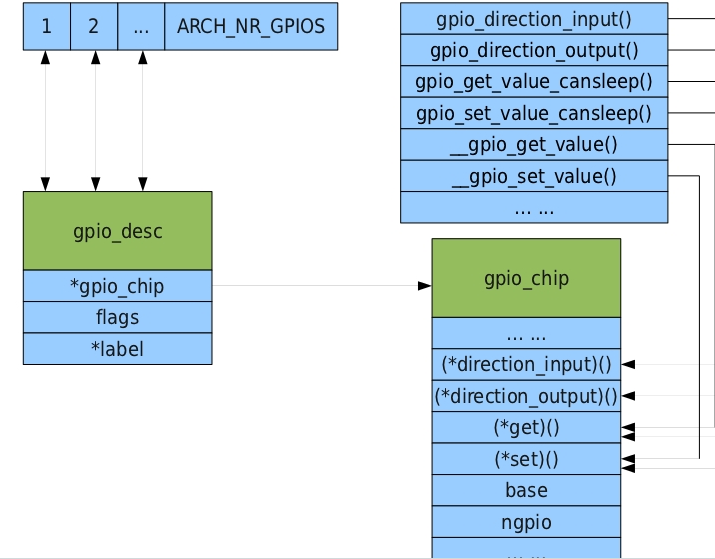
如上图所示,右上方部分为GPIO驱动对其它驱动提供的GPIO操作接口,其对应的右下方部分为GPIO硬件操作接口,也就是说对外提供的接口最终会一一对应的对硬件GPIO进行操作。
再来看左边部分,左上方部分为一全局数组,记录各个GPIO的描述符,即对应左下方的gpio_desc结构体,其中gpio_chip指向硬件层的GPIO,flags为一标志位,用来指示当前GPIO是否已经占用,当用gpio_request申请GPIO资源时,flags位就会置位,当调用gpio_free释放GPIO资源时,flags就会清零。label是一个字符串指针,用来作说明。
在软件上,我们首先通过函数gpiochip_add注册一个gpio_chip对应的gpio_desc到全局数组gpio描述符中。其中,一个描述符对应一个GPIO,所以如果我们要使用多个GPIO,那么就在gpio_chip结构体的ngpio指定个数,base为起始的GPIO号。
//每个引脚分配一个gpio_desc数据结构

struct gpio_desc {

    struct gpio_chip    *chip;

    unsigned long        flags;

};
/**

 * struct gpio_chip - abstract a GPIO controller

 * @label: for diagnostics

 * @dev: optional device providing the GPIOs

 * @owner: helps prevent removal of modules exporting active GPIOs

 * @request: optional hook for chip-specific activation, such as

 *    enabling module power and clock; may sleep

 * @free: optional hook for chip-specific deactivation, such as

 *    disabling module power and clock; may sleep

 * @direction_input: configures signal "offset" as input, or returns error

 * @get: returns value for signal "offset"; for output signals this

 *    returns either the value actually sensed, or zero

 * @direction_output: configures signal "offset" as output, or returns error

 * @set: assigns output value for signal "offset"

 * @to_irq: optional hook supporting non-static gpio_to_irq() mappings;

 *    implementation may not sleep

 * @dbg_show: optional routine to show contents in debugfs; default code

 *    will be used when this is omitted, but custom code can show extra

 *    state (such as pullup/pulldown configuration).

 * @base: identifies the first GPIO number handled by this chip; or, if

 *    negative during registration, requests dynamic ID allocation.

 * @ngpio: the number of GPIOs handled by this controller; the last GPIO

 *    handled is (base + ngpio - 1).

 * @can_sleep: flag must be set iff get()/set() methods sleep, as they

 *    must while accessing GPIO expander chips over I2C or SPI

 * @names: if set, must be an array of strings to use as alternative

 *      names for the GPIOs in this chip. Any entry in the array

 *      may be NULL if there is no alias for the GPIO, however the

 *      array must be @ngpio entries long.  A name can include a single printk

 *      format specifier for an unsigned int.  It is substituted by the actual

 *      number of the gpio.

 *

 * A gpio_chip can help platforms abstract various sources of GPIOs so

 * they can all be accessed through a common programing interface.

 * Example sources would be SOC controllers, FPGAs, multifunction

 * chips, dedicated GPIO expanders, and so on.

 *

 * Each chip controls a number of signals, identified in method calls

 * by "offset" values in the range 0..(@ngpio - 1).  When those signals

 * are referenced through calls like gpio_get_value(gpio), the offset

 * is calculated by subtracting @base from the gpio number.

 */

struct gpio_chip {

//这些函数实现在arch\arm\mach-s5pv210\gpiolib.c
    const char        *label;

    struct device        *dev;

    struct module        *owner;

    int            (*request)(struct gpio_chip *chip,

                        unsigned offset);

    void            (*free)(struct gpio_chip *chip,

                        unsigned offset);

    int            (*direction_input)(struct gpio_chip *chip,

                        unsigned offset);

    int            (*get)(struct gpio_chip *chip,

                        unsigned offset);

    int            (*direction_output)(struct gpio_chip *chip,

                        unsigned offset, int value);

    int            (*set_debounce)(struct gpio_chip *chip,

                        unsigned offset, unsigned debounce);

    void            (*set)(struct gpio_chip *chip,

                        unsigned offset, int value);

    int            (*to_irq)(struct gpio_chip *chip,

                        unsigned offset);

    void            (*dbg_show)(struct seq_file *s,

                        struct gpio_chip *chip);

    int            base;

    u16            ngpio;

    const char        *const *names;

    unsigned        can_sleep:;

    unsigned        exported:;

};
下面分析gpio_desc中成员chip的成员函数的实现:
__init int s5pv210_gpiolib_init(void)//在Linux初始化期间,此函数就执行了

{

    struct s3c_gpio_chip *chip = s5pv210_gpio_4bit;

    int nr_chips = ARRAY_SIZE(s5pv210_gpio_4bit);

    int i = ;

    for (i = ; i < nr_chips; i++, chip++) {

        if (chip->config == NULL)

            chip->config = &gpio_cfg;

        if (chip->base == NULL)

            chip->base = S5PV210_BANK_BASE(i);

    }

    samsung_gpiolib_add_4bit_chips(s5pv210_gpio_4bit, nr_chips);

    return ;

}
void __init samsung_gpiolib_add_4bit_chips(struct s3c_gpio_chip *chip,

                       int nr_chips)

{

    for (; nr_chips > ; nr_chips--, chip++) {

        samsung_gpiolib_add_4bit(chip);

        s3c_gpiolib_add(chip);


    }

}
void __init samsung_gpiolib_add_4bit(struct s3c_gpio_chip *chip)

{

    chip->chip.direction_input = samsung_gpiolib_4bit_input;

    chip->chip.direction_output = samsung_gpiolib_4bit_output;

    chip->pm = __gpio_pm(&s3c_gpio_pm_4bit);

}
__init void s3c_gpiolib_add(struct s3c_gpio_chip *chip)

{

    struct gpio_chip *gc = &chip->chip;

    int ret;

    BUG_ON(!chip->base);

    BUG_ON(!gc->label);

    BUG_ON(!gc->ngpio);

    spin_lock_init(&chip->lock);// 初始化s3c_gpio_chip的自旋锁
if (!gc->direction_input)

        gc->direction_input = s3c_gpiolib_input;//chip->direction_input
    if (!gc->direction_output)

        gc->direction_output = s3c_gpiolib_output;//chip->direction_output

    if (!gc->set)

        gc->set = s3c_gpiolib_set;//chip->set此处就回答了上篇的疑问

    if (!gc->get)

        gc->get = s3c_gpiolib_get;//chip->get


#ifdef CONFIG_PM

    if (chip->pm != NULL) {

        if (!chip->pm->save || !chip->pm->resume)

            printk(KERN_ERR "gpio: %s has missing PM functions\n",

                   gc->label);

    } else

        printk(KERN_ERR "gpio: %s has no PM function\n", gc->label);

#endif

    /* gpiochip_add() prints own failure message on error. */

    ret = gpiochip_add(gc);

    if (ret >= )

        s3c_gpiolib_track(chip);

}
/**

 * gpiochip_add() - register a gpio_chip

 * @chip: the chip to register, with chip->base initialized

 * Context: potentially before irqs or kmalloc will work

 *

 * Returns a negative errno if the chip can't be registered, such as

 * because the chip->base is invalid or already associated with a

 * different chip.  Otherwise it returns zero as a success code.

 *

 * When gpiochip_add() is called very early during boot, so that GPIOs

 * can be freely used, the chip->dev device must be registered before

 * the gpio framework's arch_initcall().  Otherwise sysfs initialization

 * for GPIOs will fail rudely.

 *

 * If chip->base is negative, this requests dynamic assignment of

 * a range of valid GPIOs.

 */

int gpiochip_add(struct gpio_chip *chip) // 在gpio_desc[]中分配空间,并链接chip结构;注册一个gpio_chip对应的gpio_desc到全局数组gpio描述符中
{

    unsigned long    flags;

    int        status = ;

    unsigned    id;

    int        base = chip->base;

    if ((!gpio_is_valid(base) || !gpio_is_valid(base + chip->ngpio - ))

            && base >= ) {

        status = -EINVAL;

        goto fail;

    }

    spin_lock_irqsave(&gpio_lock, flags);

    if (base < ) {

        base = gpiochip_find_base(chip->ngpio);// 这个函数在gpiolib.c中,在gpio_desc[]中分配chip->ngpio个空间(从最后往前分配),返回第一个index
       if (base < ) {

            status = base;

            goto unlock;

        }

        chip->base = base;

    }

    /* these GPIO numbers must not be managed by another gpio_chip */

    for (id = base; id < base + chip->ngpio; id++) {

        if (gpio_desc[id].chip != NULL) {

            status = -EBUSY;

            break;

        }

    }

    if (status == ) {// 分配到空间,正常情况下
      for (id = base; id < base + chip->ngpio; id++) {

            gpio_desc[id].chip = chip;// 这里将gpio_desc与s3c_gpio_chip联系起来,他们的chip成员指向的是同一个数据结构
/* REVISIT:  most hardware initializes GPIOs as

             * inputs (often with pullups enabled) so power

             * usage is minimized.  Linux code should set the

             * gpio direction first thing; but until it does,

             * we may expose the wrong direction in sysfs.

             */

            gpio_desc[id].flags = !chip->direction_input

                ? ( << FLAG_IS_OUT)

                : ;

        }

    }

unlock:

    spin_unlock_irqrestore(&gpio_lock, flags);

    if (status == )

        status = gpiochip_export(chip);

fail:

    /* failures here can mean systems won't boot... */

    if (status)

        pr_err("gpiochip_add: gpios %d..%d (%s) failed to register\n",

            chip->base, chip->base + chip->ngpio - ,

            chip->label ? : "generic");

    return status;

}

EXPORT_SYMBOL_GPL(gpiochip_add);
Linux下GPIO驱动(三) ----gpio_desc()的分析的更多相关文章
- 很好的linux下GPIO驱动详解文章
原文地址 http://blog.csdn.net/llxmedici/article/details/6282372 打算跟着友善之臂的<mini2440 linux移植开发指南>来做 ...
- Linux下GPIO驱动
编写驱动程序,首先要了解是什么类型的设备.linux下的设备分为三类,分别为:字符设备,块设备和网络设备.字符设备类型是根据是否以字符流为数据的交换方式,大部分设备都是字符设备,如键盘,串口等,块设备 ...
- Linux下GPIO驱动(一) ----一个简单的LED驱动
/******************************* * *杂项设备驱动:miscdevice *majior=10; * * *****************************/ ...
- Linux下GPIO驱动(五) ----misc_register();
// struct miscdevice { int minor; const char *name; const struct file_operations *fops; struct list_ ...
- Linux下GPIO驱动(四) ----gpio_request();gpio_free();
//gpio_request申请gpio口 int gpio_request(unsigned gpio, const char *label) { struct gpio_desc *desc; s ...
- Linux下GPIO驱动(二) ----s3c_gpio_cfgpin();gpio_set_value();
首先来看s3c_gpio_cfgpin(); int s3c_gpio_cfgpin(unsigned int pin, unsigned int config) { struct s3c_gpio_ ...
- 飞思卡尔imx6开发板Linux下GPIO驱动
控制GPIO_1_28的输出: #define MY_BOMB_GPIO IMX_GPIO_NR(1, 28) 配置为输出方式: gpio_direction_output (MY_BOM ...
- 【驱动】linux下I2C驱动架构全面分析
I2C 概述 I2C是philips提出的外设总线. I2C只有两条线,一条串行数据线:SDA,一条是时钟线SCL ,使用SCL,SDA这两根信号线就实现了设备之间的数据交互,它方便了工程师的布线. ...
- linux下I2C驱动架构全面分析【转】
本文转载自:http://blog.csdn.net/wangpengqi/article/details/17711165 I2C 概述 I2C是philips提出的外设总线. I2C只有两条线,一 ...
随机推荐
- python 源码解析
http://blog.donews.com/lemur/archive/category/cpython%E6%BA%90%E7%A0%81%E5%89%96%E6%9E%90/
- tar备份系统
一.概述 前几天我通过SSH正在调戏汤姆猫(tomcat)的时候,服务器上CentOS突然挂了.开机grub,使用光盘linux rescue修复提示找不到linux分区,然后想mount硬盘备份系统 ...
- php转义和去掉html、php标签函数
/** * 转义html字符 * * @param string|array $var */function fhtmlspecialchars($var) { if (is_array ( $var ...
- Input
Input Basic Input Old Input Files Please note that both Input and Request do NOT sanitize your data, ...
- 手动开启tomacat服务器
四.配置Tomcat环境变量 1,新建变量名(关键,你的tomacat安装目录):CATALINA_BASE,变量值:E:\apache-tomcat-6.0.37 2,新建变量名(关键,你的toma ...
- iOS开发技巧系列---使用链式编程和Block来实现UIAlertView
UIAlertView是iOS开发过程中最常用的控件之一,是提醒用户做出选择最主要的工具.在iOS8及后来的系统中,苹果更推荐使用UIAlertController来代替UIAlertView.所以本 ...
- How to install VXDIAG Honda, Toyota and JLR SDD software
EOBD2 has newly launched Allscanner VXDIAG multi diagnostic tool with OEM diagnostic software: Honda ...
- 深入浅出js中的this(一)
Q:this是什么? A:this是Javascript语言的一个关键字,它代表函数运行时,自动生成的一个内部对象,在每个 function 中自动根据作用域(scope) 确定, 指向的是此次调用者 ...
- 在Objective-C声明Block的几种方式
1.作为局部变量 returnType (^blockName)(parameterTypes) = ^returnType(parameters) {...}; 2.作为类的属性 @property ...
- Linux编程简介
Linux编程可以分为Shell(如BASH.TCSH.GAWK.Perl.Tcl和Tk等)编程和高级语言(C语言,C++语言,java语言等)编程,Linux程序需要首先转化为低级机器语言即所谓的二 ...