
Druid数据库连接池源码分析
上一篇文章重点介绍了一下Java的Future模式,最后意淫了一个数据库连接池的场景。本想通过Future模式来防止,当多个线程同时获取数据库连接时各自都生成一个,造成资源浪费。但是忽略了一个根本的功能,就是多个线程同时调用get方法时,得到的是同一个数据库连接的多个引用,这会导致严重的问题。
所以,我抽空看了看呼声很高的Druid的数据库连接池实现,当然关注点主要是多线程方面的处理。我觉得,带着问题去看源码是一种很好的思考方式。
Druid不仅仅是一个数据库连接池,还有很多标签,比如统计监控、过滤器、SQL解析等。既然要分析连接池,那先看看DruidDataSource类
getConnection方法的实现:
    @Override

    public DruidPooledConnection getConnection() throws SQLException {

        return getConnection(maxWait);

    }

    public DruidPooledConnection getConnection(long maxWaitMillis) throws SQLException {

        init();

        if (filters.size() > 0) {

            FilterChainImpl filterChain = new FilterChainImpl(this);

            return filterChain.dataSource_connect(this, maxWaitMillis);

        } else {

            return getConnectionDirect(maxWaitMillis);

        }

    }
返回的是一个DruidPooledConnection,这个类后面再说;另外这里传入了一个long类型maxWait,应该是用来做超时处理的;init方法在getConnection方法里面调用,这也是一种很好的设计;里面的过滤器链的处理就不多说了。
    public void init() throws SQLException {

        if (inited) {

            return;

        }

        final ReentrantLock lock = this.lock;  // 使用lock而不是synchronized

        try {

            lock.lockInterruptibly();

        } catch (InterruptedException e) {

            throw new SQLException("interrupt", e);

        }

        boolean init = false;

        try {

            if (inited) {

                return;

            }

            init = true;

            connections = new DruidConnectionHolder[maxActive];  // 数组

            try {

                // init connections

                for (int i = 0, size = getInitialSize(); i < size; ++i) {

                    Connection conn = createPhysicalConnection();  // 生成真正的数据库连接

                    DruidConnectionHolder holder = new DruidConnectionHolder(this, conn);

                    connections[poolingCount] = holder;

                    incrementPoolingCount();

                }

                if (poolingCount > 0) {

                    poolingPeak = poolingCount;

                    poolingPeakTime = System.currentTimeMillis();

                }

            } catch (SQLException ex) {

                LOG.error("init datasource error, url: " + this.getUrl(), ex);

                connectError = ex;

            }

            createAndLogThread();

            createAndStartCreatorThread();

            createAndStartDestroyThread();

            initedLatch.await();

            initedTime = new Date();

            registerMbean();

            if (connectError != null && poolingCount == 0) {

                throw connectError;

            }

        } catch (SQLException e) {

            LOG.error("dataSource init error", e);

            throw e;

        } catch (InterruptedException e) {

            throw new SQLException(e.getMessage(), e);

        } finally {

            inited = true;

            lock.unlock();  // 释放锁

            if (init && LOG.isInfoEnabled()) {

                LOG.info("{dataSource-" + this.getID() + "} inited");

            }

        }

    }
我这里做了删减,加了一些简单的注释。通过这个方法,正好复习一下之前写的那些知识点,如果感兴趣,可以看看我之前写的文章。
这里使用了lock,并且保证只会被执行一次。根据初始容量,先生成了一批数据库连接,用一个数组connections存放这些连接的引用,而且专门定义了一个变量poolingCount来保存这些连接的总数量。
看到initedLatch.await有一种似曾相识的感觉
private final CountDownLatch initedLatch = new CountDownLatch(2);
这里调用了await方法,那countDown方法在哪些线程里面被调用呢
    protected void createAndStartCreatorThread() {

        if (createScheduler == null) {

            String threadName = "Druid-ConnectionPool-Create-" + System.identityHashCode(this);

            createConnectionThread = new CreateConnectionThread(threadName);

            createConnectionThread.start();

            return;

        }

        initedLatch.countDown();

    }
这里先判断createScheduler这个调度线程池是否被设置,如果没有设置,直接countDown;否则,就开启一个创建数据库连接的线程,当然这个线程的run方法还是会调用countDown方法。但是这里我有一个疑问:开启创建连接的线程,为什么一定要有一个调度线程池呢???
难道是当数据库连接创建失败的时候,需要过了指定时间后,再重试?这么理解好像有点牵强,希望高人来评论。
还有就是,当开启destroy线程的时候也会调用countDown方法。
接着在看getConnection方法,一直调用到getConnectionInternal方法
        DruidConnectionHolder holder;

        try {

            lock.lockInterruptibly();

        } catch (InterruptedException e) {

            connectErrorCount.incrementAndGet();

            throw new SQLException("interrupt", e);

        }

        try {

            if (maxWait > 0) {

                holder = pollLast(nanos);

            } else {

                holder = takeLast();

            }

        } catch (InterruptedException e) {

            connectErrorCount.incrementAndGet();

            throw new SQLException(e.getMessage(), e);

        } catch (SQLException e) {

            connectErrorCount.incrementAndGet();

            throw e;

        } finally {

            lock.unlock();

        }

        holder.incrementUseCount();

        DruidPooledConnection poolalbeConnection = new DruidPooledConnection(holder);

        return poolalbeConnection;
我这里还是做了删减。大体逻辑是:先从连接池中取出DruidConnectionHolder,然后再封装成DruidPooledConnection对象返回。再看看取holder的方法:
    DruidConnectionHolder takeLast() throws InterruptedException, SQLException {

        try {

            while (poolingCount == 0) {

                emptySignal(); // send signal to CreateThread create connection

                notEmptyWaitThreadCount++;

                if (notEmptyWaitThreadCount > notEmptyWaitThreadPeak) {

                    notEmptyWaitThreadPeak = notEmptyWaitThreadCount;

                }

                try {

                    notEmpty.await(); // signal by recycle or creator

                } finally {

                    notEmptyWaitThreadCount--;

                }

                notEmptyWaitCount++;

                if (!enable) {

                    connectErrorCount.incrementAndGet();

                    throw new DataSourceDisableException();

                }

            }

        } catch (InterruptedException ie) {

            notEmpty.signal(); // propagate to non-interrupted thread

            notEmptySignalCount++;

            throw ie;

        }

        decrementPoolingCount();

        DruidConnectionHolder last = connections[poolingCount];

        connections[poolingCount] = null;

        return last;

    }
这个方法非常好的诠释了Lock-Condition的使用场景,几行绿色的注释解释的很明白了,如果对empty和notEmpty看不太懂,可以去看看我之前写的那篇文章。
这个方法的逻辑:先判断池中的连接数,如果到0了,那么本线程就得被挂起,同时释放empty信号,并且等待notEmpty的信号。如果还有连接,就取出数组的最后一个,同时更改poolingCount。
到这里,基本理解了Druid数据库连接池获取连接的实现流程。但是,如果不去看看里面的数据结构,还是会一头雾水。我们就看看几个基本的类,以及它们之间的持有关系。
1、DruidDataSource持有一个DruidConnectionHolder的数组,保存所有的数据库连接
private volatile DruidConnectionHolder[] connections; // 注意这里的volatile
2、DruidConnectionHolder持有数据库连接,还有所在的DataSource等
    private final DruidAbstractDataSource       dataSource;

    private final Connection                    conn;
3、DruidPooledConnection持有DruidConnectionHolder,所在线程等
    protected volatile DruidConnectionHolder holder;

    private final Thread                     ownerThread;
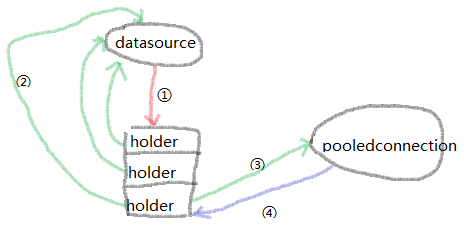
对于这种设计,我很好奇为什么要添加一层holder做封装,数组里直接存放Connection好像也未尝不可。
其实,这么设计是有道理的。比如说,一个Connection对象可以产生多个Statement对象,当我们想同时保存Connection和对应的多个Statement的时候,就比较纠结。
再看看DruidConnectionHolder的成员变量
    private PreparedStatementPool               statementPool;

    private final List<Statement>               statementTrace           = new ArrayList<Statement>(2);
这样的话,既可以做缓存,也可以做统计。
最终我们对Connection的操作都是通过DruidPooledConnection来实现,比如commit、rollback等,它们大都是通过实际的数据库连接完成工作。而我比较关心的是close方法的实现,close方法最核心的逻辑是recycle方法:
    public void recycle() throws SQLException {

        if (this.disable) {

            return;

        }

        DruidConnectionHolder holder = this.holder;

        if (holder == null) {

            if (dupCloseLogEnable) {

                LOG.error("dup close");

            }

            return;

        }

        if (!this.abandoned) {

            DruidAbstractDataSource dataSource = holder.getDataSource();

            dataSource.recycle(this);

        }

        this.holder = null;

        conn = null;

        transactionInfo = null;

        closed = true;

    }
通过最后几行代码,能够看出,并没有调用实际数据库连接的close方法,而只是断开了之前那张图里面的4号引用。用这种方式,来实现数据库连接的复用。
Druid数据库连接池源码分析的更多相关文章
- java多线程----线程池源码分析
http://www.cnblogs.com/skywang12345/p/3509954.html 线程池示例 在分析线程池之前,先看一个简单的线程池示例. 1 import java.util.c ...
- java多线程——线程池源码分析(一)
本文首发于cdream的个人博客,点击获得更好的阅读体验! 欢迎转载,转载请注明出处. 通常应用多线程技术时,我们并不会直接创建一个线程,因为系统启动一个新线程的成本是比较高的,涉及与操作系统的交互, ...
- 线程池之ThreadPoolExecutor线程池源码分析笔记
1.线程池的作用 一方面当执行大量异步任务时候线程池能够提供较好的性能,在不使用线程池的时候,每当需要执行异步任务时候是直接 new 一线程进行运行,而线程的创建和销毁是需要开销的.使用线程池时候,线 ...
- java线程池源码分析
我们在关闭线程池的时候会使用shutdown()和shutdownNow(),那么问题来了: 这两个方法又什么区别呢? 他们背后的原理是什么呢? 线程池中线程超过了coresize后会怎么操作呢? 为 ...
- Java并发编程中线程池源码分析及使用
当Java处理高并发的时候,线程数量特别的多的时候,而且每个线程都是执行很短的时间就结束了,频繁创建线程和销毁线程需要占用很多系统的资源和时间,会降低系统的工作效率. 参考http://www.cnb ...
- 【图灵学院10】高并发之java线程池源码分析
1. 提纲 1)线程池的模块结构 2)示例&原理解析 2. 问题 1)线程池包含哪些东西 2)线程池的运作原理 3)调度线程池的运作原理 4)线程池怎么实现FixRate,FixDelay,他 ...
- 线程池之ScheduledThreadPoolExecutor线程池源码分析笔记
1.ScheduledThreadPoolExecutor 整体结构剖析. 1.1类图介绍 根据上面类图图可以看到Executor其实是一个工具类,里面提供了好多静态方法,根据用户选择返回不同的线程池 ...
- druid 源码分析与学习(含详细监控设计思路的彩蛋)(转)
原文路径:http://herman-liu76.iteye.com/blog/2308563 Druid是阿里巴巴公司的数据库连接池工具,昨天突然想学习一下阿里的druid源码,于是下载下来分析了 ...
- Solr4.8.0源码分析(3)之index的线程池管理
Solr4.8.0源码分析(3)之index的线程池管理 Solr建索引时候是有最大的线程数限制的,它由solrconfig.xml的<maxIndexingThreads>8</m ...
随机推荐
- SQL2012导出的脚本没有if exists判断
SQL2012导出的脚本没有if exists判断 以前用SQL2000的时候,导出存储过程,表各种object的时候,前面会自动加if exists的一段脚本,这样的脚本很方便的可以重复执行.现在使 ...
- spring @Autowired和jdk的@Resource区别
当一个接口只有一个实例时,使用这两个注解的效果是一样的. 当含有两个实例时,非得使用 @Autowired 那么定义的引用类型必须和service实现类定义的名字相同,参照下图 定义第一个servic ...
- Kaggle实战之二分类问题
0. 前言 1. MNIST 数据集 2. 二分类器 3. 效果评测 4. 多分类器与误差分析 5. Kaggle 实战 0. 前言 "尽管新技术新算法层出不穷,但是掌握好基础算法就能解决手 ...
- Maven 整合 SSH 框架
前面的一系列文章中,我们总结了三大框架:Struts2,Hibernate,Spring 的基本知识.本篇就姑且尝试着使用 Maven 这个项目构建工具来将这三个框架整合一起.说到这里,如果有对 Ma ...
- vsftpd 安装
vsftpd 安装 这里有最简洁的安装步骤 理想流程 [root@itdragon ~]# useradd ftpuser [root@itdragon ~]# passwd ftpuser Chan ...
- 《java.util.concurrent 包源码阅读》16 一种特别的BlockingQueue:SynchronousQueue
SynchronousQueue是一种很特别的BlockingQueue,任何一个添加元素的操作都必须等到另外一个线程拿走元素才会结束.也就是SynchronousQueue本身不会存储任何元素,相当 ...
- openstack pike 使用 linuxbridge + vxlan
#openstack pike 使用 linuxbridge + vxlan #openstack pike 集群高可用 安装部署 汇总 http://www.cnblogs.com/elvi/p/ ...
- cinder块存储 后端采用lvm、nfs安装配置
#cinder块存储 后端采用lvm.nfs安装配置 openstack pike 安装 目录汇总 http://www.cnblogs.com/elvi/p/7613861.html #cinder ...
- 读懂源码:一步一步实现一个 Vue
源码阅读:究竟怎样才算是读懂了? 市面上有很多源码分析的文章,就我看到的而言,基本的套路就是梳理流程,讲一讲每个模块的功能,整篇文章有一大半都是直接挂源码.我不禁怀疑,作者真的看懂了吗?为什么我看完后 ...
- codeforces 887B Cubes for Masha 两种暴力
B. Cubes for Masha time limit per test 1 second memory limit per test 256 megabytes input standard i ...