
ThreadLocal类分析
首先试想一个场景:
多个线程都要访问数据库,先要获得一个Connection,然后执行一些操作。为了线程安全,如果用synchronized锁定一个Connection对象,那么任何时候,都只有一个线程能通过Connection对象操作数据库。这样的话,程序的效率太低。反过来,如果每次需要Connection对象就去new一个的话,就会同时存在数量庞大的数据库连接,你受得了,数据库受不了。于是就有人提出折中方案:为每个线程只生成一个Connection对象,这样别的线程访问不到这个对象,线程安全问题解决;而且无论线程有多少地方需要数据库连接,都是在复用这个Connection对象,数据库的压力会小很多。
其实不仅仅是数据库,其它的场景比如说,SimpleDateFormat。我们处理日期的时候,经常要用到这个类,但是这个类不是线程安全的,在多线程下是会出问题的。这时候,采用上述折中方案是比较合理的。
那么如何实现这种折中方案呢?我们先动手试一试呗!!!
要确保某类型的变量,每个线程只有一份。因为每个线程的ID是唯一的,这是JVM保证的,所有我们可以定义一个Map:线程ID作为key,我们要用的变量作为value。
稍微对这个Map进行简单的封装,当做一个类来用:
package threadlocal;

import java.util.HashMap;

import java.util.Map;

public class ThreadLocalVar<T> {

    Map<Long, T> threadVarMap = new HashMap<Long, T>();

    public T get() {

        return threadVarMap.get(Thread.currentThread().getId());

    }

    public void set(T value) {

        threadVarMap.put(Thread.currentThread().getId(), value);

    }

}
接下来,就把这个类扔到多线程环境里面练一练
package threadlocal;

public class MyTest {

    ThreadLocalVar<Long> longLocal = new ThreadLocalVar<Long>();

    ThreadLocalVar<String> stringLocal = new ThreadLocalVar<String>();

    public void set() {

        longLocal.set(Thread.currentThread().getId());

        stringLocal.set(Thread.currentThread().getName());

    }

    public long getLong() {

        return longLocal.get();

    }

    public String getString() {

        return stringLocal.get();

    }

    public static void main(String[] args) throws InterruptedException {

        final MyTest test = new MyTest();

        test.set();

        System.out.println(test.getLong());

        System.out.println(test.getString());

        for (int i=0; i<3; i++) {

            Thread thread1 = new Thread(){

                public void run() {

                    test.set();

                    System.out.println(test.getLong());

                    System.out.println(test.getString());

                };

            };

            thread1.start();

            thread1.join();

        }

        System.out.println(test.getLong());

        System.out.println(test.getString());

    }

}
这个程序很简单,看一遍就能明白具体逻辑。虽然都是调用的同一个对象test的getLong和getString方法,但是不同的线程获取到的值不一样。
运行结果:
1

main

9

Thread-0

10

Thread-1

11

Thread-2

1

main
哈哈,我们就是使用了奇淫巧技,把一个对象简单的get和set操作,转到了对Map的get和set操作。如果光看MyTest这个类,再看结果,还是挺迷惑的吧。
这个时候就有人说了,Java的ThreadLocal机制,不是这么实现的。对,也不对。JDK之前的老版本其实就是这么实现来着,不过后来改了。为什么改,且听我慢慢道来。
先上一个真正的ThreadLocal版本的test程序:
package threadlocal;

public class Test {

    ThreadLocal<Long> longLocal = new ThreadLocal<Long>();

    ThreadLocal<String> stringLocal = new ThreadLocal<String>();

    public void set() {

        longLocal.set(Thread.currentThread().getId());

        stringLocal.set(Thread.currentThread().getName());

    }

    public long getLong() {

        return longLocal.get();

    }

    public String getString() {

        return stringLocal.get();

    }

    public static void main(String[] args) throws InterruptedException {

        final Test test = new Test();

        test.set();

        System.out.println(test.getLong());

        System.out.println(test.getString());

        for (int i=0; i<3; i++) {

            Thread thread1 = new Thread(){

                public void run() {

                    test.set();

                    System.out.println(test.getLong());

                    System.out.println(test.getString());

                };

            };

            thread1.start();

            thread1.join();

        }

        System.out.println(test.getLong());

        System.out.println(test.getString());

    }

}
和我们之前的test程序唯一的区别,就是使用了Java自带的ThreadLocal类,那就进去看一看。
    /**

     * Returns the value in the current thread's copy of this

     * thread-local variable.  If the variable has no value for the

     * current thread, it is first initialized to the value returned

     * by an invocation of the {@link #initialValue} method.

     *

     * @return the current thread's value of this thread-local

     */

    public T get() {

        Thread t = Thread.currentThread();

        // 其实还是通过Map的数据结构

        ThreadLocalMap map = getMap(t);

        if (map != null) {

            ThreadLocalMap.Entry e = map.getEntry(this);

            if (e != null) {

                @SuppressWarnings("unchecked")

                T result = (T)e.value;

                return result;

            }

        }

        return setInitialValue();

    }
这是ThreadLocal的get方法,最终还是Map操作,但是这个Map以及Map里面的Entry都是为ThreadLocal专门定制的,后面再说。看看getMap方法的逻辑
    /**

     * Get the map associated with a ThreadLocal. Overridden in

     * InheritableThreadLocal.

     *

     * @param  t the current thread

     * @return the map

     */

    ThreadLocalMap getMap(Thread t) {

        return t.threadLocals;

    }
    /* ThreadLocal values pertaining to this thread. This map is maintained

     * by the ThreadLocal class. */

    // 定义在Thread类里面

    ThreadLocal.ThreadLocalMap threadLocals = null;
从这里能看出2点:
1、ThreadLocalMap这个Map是ThreadLocal的内部类
2、这个Map的持有者是Thread类,就是说每个线程都直接持有自己的Map
第2点跟我们之前的实现思路截然不同,我们定义的ThreadLocalVar类不被任何线程直接持有,只是独立的第三方,保持各个线程的数据。
后面再详细分析这里为什么要这么实现。
先来看看ThreadLocal的内部类ThreadLocalMap的内部类Entry(别绕晕了)
        static class Entry extends WeakReference<ThreadLocal<?>> {

            /** The value associated with this ThreadLocal. */

            Object value;

            Entry(ThreadLocal<?> k, Object v) {

                super(k);

                value = v;

            }

        }
Entry继承自弱引用,说明持有key的弱引用,而且key是ThreadLocal类型(跟之前的实现方式也截然不同)。
为了说明ThreadLocal的实现机制和类直接的关系,从网上盗一张图,图中实线是强引用,虚线是弱引用。
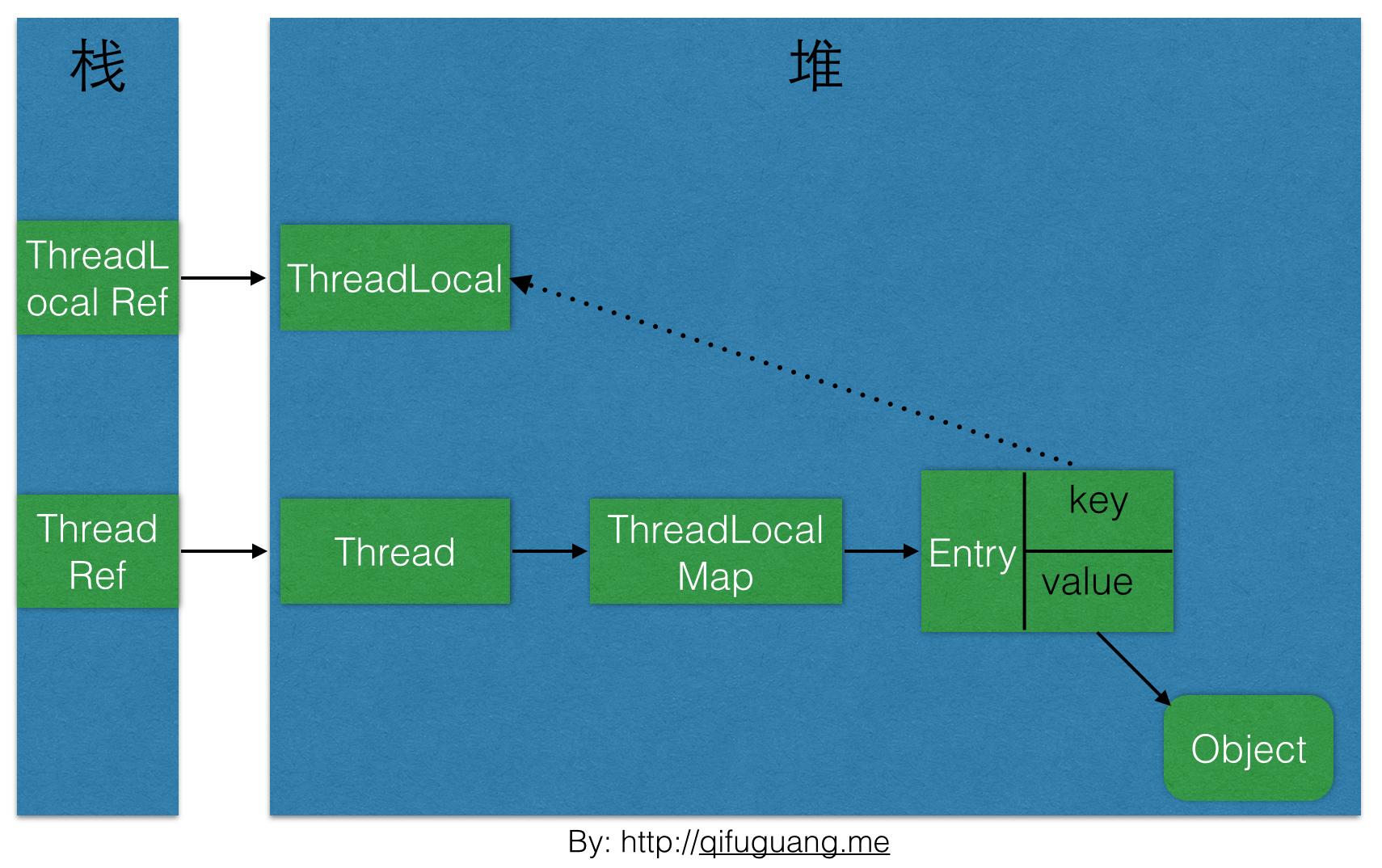
每个线程持有Map有什么好处?
1、线程消失,Map跟着消失,释放了内存
2、保存数据的Map数量变多了,但是每个Map里面Entry数量变少了。之前的实现里面,每个Map里面的Entry数量是线程的个数,现在是ThreadLocal的个数。熟悉Map数据结构的人都知道,这样对Map的操作性能会提升。
至于为什么要用弱引用,先来看看Entry类的注释
        /**

         * The entries in this hash map extend WeakReference, using

         * its main ref field as the key (which is always a

         * ThreadLocal object).  Note that null keys (i.e. entry.get()

         * == null) mean that the key is no longer referenced, so the

         * entry can be expunged from table.  Such entries are referred to

         * as "stale entries" in the code that follows.

         */
简单来说,就是当ThreadLocal类型的key不再被引用时(值为null),对应的Entry能够被删除。
具体的实现就是,get操作会调用expungeStaleEntry,set操作会调用replaceStaleEntry,它们的效果就是遇到的key为null的Entry都会被删除,那么Entry内的value也就没有强引用链,自然会被回收,防止内存泄露。这部分,请读者仔细阅读源码。
经这么一分析,是不是豁然开朗。
下面在看看ThreadLocal在一些框架里面的应用:
1、Hibernate处理session,看看一个类ThreadLocalSessionContext
       private static final ThreadLocal<Map> CONTEXT_TL = new ThreadLocal<Map>();

       protected static Map sessionMap() {

        return CONTEXT_TL.get();

    }

    @SuppressWarnings({"unchecked"})

    private static void doBind(org.hibernate.Session session, SessionFactory factory) {

        Map sessionMap = sessionMap();

        if ( sessionMap == null ) {

            sessionMap = new HashMap();

            CONTEXT_TL.set( sessionMap );

        }

        sessionMap.put( factory, session );

    }
2、Spring处理事务,看看一个类TransactionSynchronizationManager
private static final ThreadLocal<Map<Object, Object>> resources =

            new NamedThreadLocal<Map<Object, Object>>("Transactional resources");

    private static final ThreadLocal<Set<TransactionSynchronization>> synchronizations =

            new NamedThreadLocal<Set<TransactionSynchronization>>("Transaction synchronizations");

    private static final ThreadLocal<String> currentTransactionName =

            new NamedThreadLocal<String>("Current transaction name");

    private static final ThreadLocal<Boolean> currentTransactionReadOnly =

            new NamedThreadLocal<Boolean>("Current transaction read-only status");

    private static final ThreadLocal<Integer> currentTransactionIsolationLevel =

            new NamedThreadLocal<Integer>("Current transaction isolation level");

    private static final ThreadLocal<Boolean> actualTransactionActive =

            new NamedThreadLocal<Boolean>("Actual transaction active");

public static void bindResource(Object key, Object value) throws IllegalStateException {

        Object actualKey = TransactionSynchronizationUtils.unwrapResourceIfNecessary(key);

        Assert.notNull(value, "Value must not be null");

                // 处理ThreadLocal

        Map<Object, Object> map = resources.get();

        // set ThreadLocal Map if none found

        if (map == null) {

            map = new HashMap<Object, Object>();

                        // 处理ThreadLocal

            resources.set(map);

        }

        Object oldValue = map.put(actualKey, value);

        // Transparently suppress a ResourceHolder that was marked as void...

        if (oldValue instanceof ResourceHolder && ((ResourceHolder) oldValue).isVoid()) {

            oldValue = null;

        }

        if (oldValue != null) {

            throw new IllegalStateException("Already value [" + oldValue + "] for key [" +

                    actualKey + "] bound to thread [" + Thread.currentThread().getName() + "]");

        }

        if (logger.isTraceEnabled()) {

            logger.trace("Bound value [" + value + "] for key [" + actualKey + "] to thread [" +

                    Thread.currentThread().getName() + "]");

        }

    }
ThreadLocal类分析的更多相关文章
- ThreadLocal类详解:原理、源码、用法
以下是本文目录: 1.从数据库连接探究 ThreadLocal 2.剖析 ThreadLocal 源码 3. ThreadLocal 应用场景 4. 通过面试题理解 ThreadLocal 1.从数据 ...
- Spring源码分析——BeanFactory体系之抽象类、类分析(二)
上一篇分析了BeanFactory体系的2个类,SimpleAliasRegistry和DefaultSingletonBeanRegistry——Spring源码分析——BeanFactory体系之 ...
- ThreadLocal类的实现用法
ThreadLocal是什么呢?其实ThreadLocal并非是一个线程的本地实现版本,它并不是一个Thread,而是threadlocalvariable(线程局部变量).也许把它命名为Thread ...
- ThreadLocal类的简单使用
1.概述变量值的共享可以使用public 是static 变量的形式,所有的线程都使用同一个public static 变量. 如实现线程内的共享变量,jdk提供了ThreadLocal来解决这个问题 ...
- ThreadLocal 类 的源码解析以及使用原理
1.原理图说明 首先看这一张图,我们可以看出,每一个Thread类中都存在一个属性 ThreadLocalMap 成员,该成员是一个map数据结构,map中是一个Entry的数组,存在entry实体, ...
- 「Android」消息驱动Looper和Handler类分析
Android系统中的消息驱动工作原理: 1.有一个消息队列,可以往这个消息队列中投递消息; 2.有一个消息循环,不断的从消息队列中取得消息,然后处理. 工作流程: 1.事件源将待处理的消息加入到消息 ...
- 理解和使用ThreadLocal类
一.从数据结构入手 下图为ThreadLocal的内部结构图 从上面的机构图,可以窥见ThreadLocal的核心机制: 每个Thread线程内部都有一个Map: Map里面存储线程本地对象(key) ...
- 源码分析篇 - Android绘制流程(三)requestLayout()与invalidate()流程及Choroegrapher类分析
本文主要探讨能够触发performTraversals()执行的invalidate().postInvalidate()和requestLayout()方法的流程.在调用这三个方法到最后执行到per ...
- java中ThreadLocal类的使用
ThreadLocal是解决线程安全问题一个很好的思路,ThreadLocal类中有一个Map,用于存储每一个线程的变量副本,Map中元素的键为线程对象,而值对应线程的变量副本,由于Key值不可重复, ...
随机推荐
- AJAX 中JSON 和JSONP 的区别 以及请求原理
AJAX 跨域请求 - JSONP获取JSON数据 博客分类: Javascript /Jquery / Bootstrap / Web Asynchronous JavaScript and X ...
- webpack2 前篇
webpack2 前篇 #webpack 前两天用了一天半时间琢磨了下webpack2,想起去年这时候,面对webpack1那样恶心的文档,前前后后搞了好几次才摸索清楚,那真是吐了. 划重点 其实we ...
- Python获取股票历史、实时数据与更新到数据库
要做量化投资,数据是基础,正所谓"巧妇难为无米之炊" 在免费数据方面,各大网站的财经板块其实已提供相应的api,如新浪.雅虎.搜狐...可以通过urlopen相应格式的网址获取数据 ...
- easyAR图钉功能实现相关
图钉功能总算做出来了,发现真的是因为没认真看手册导致的=.=[跪 最后的代码很简单,但是过程中看了不少camera/tracker相关的东西,感觉需要整理记录一下 图钉功能记录: 目标:实现用ARCa ...
- Thread(线程)四
今天继续讲讲线程的异常处理.线程取消.多线程的临时变量和线程安全lock的问题. 1.异步处理. 一般来说如果是同步方法的异步处理,我们大多都是try catch住,但是异步方法应该怎么做呢. #re ...
- 微信客户端+微信公众平台+新浪云SAE+Arduino+WS100(控制LED)
第一步:准备 1.智能手机微信客户端或微信电脑版 2.注册微信公众平台 https://mp.weixin.qq.com 3.注册新浪账号 http://www.sinacloud.com 4.拥有一 ...
- mysql5.7.18的安装与主从复制
CentOS6.7安装mysql5.7.18 1. 解压到/usr/local目录 # tar -zxvf mysql-5.7.18-linux-glibc2.5-i686.tar.gz -C /u ...
- HTML5——JSON的方法实现对象copy
JSON(JavaScript Object Notation, JS 对象标记) 是一种轻量级的数据交换格式.它基于 ECMAScript (w3c制定的js规范)的一个子集,采用完全独立于编程语言 ...
- Java微信开发_02_本地服务器映射外网
一.工具列表 内网穿透的相关工具有: (1)natapp 官网 :https://natapp.cn/ (2)花生壳 官网:https://console.oray.com/ (2)ngrok 官网: ...
- JavaScript 开发总结(一)
数据类型:JavaScript定义的数据类型有字符串.数字.布尔.数组.对象.Null.Undefined,但typeof有区分可判别的数据分类是number.string.boolean.objec ...