
Spring Boot 中 Redis 的使用
Spring Boot 对常用的数据库支持外,对 Nosql 数据库也进行了封装自动化,如Redis、MongoDB等,本文主要介绍Redis的使用。
Redis 介绍
Redis 是目前业界使用最广泛的内存数据存储。相比 Memcached,Redis 支持更丰富的数据结构,例如 hashes, lists, sets 等,同时支持数据持久化。除此之外,Redis 还提供一些类数据库的特性,比如事务,HA,主从库。可以说 Redis 兼具了缓存系统和数据库的一些特性,因此有着丰富的应用场景。本文介绍 Redis 在 Spring Boot 中两个典型的应用场景。
如何使用
1、引入依赖包
         <!--redis依赖-->

         <dependency>

             <groupId>org.springframework.boot</groupId>

             <artifactId>spring-boot-starter-data-redis</artifactId>

         </dependency>
2、添加配置文件
 # Redis配置

 # Redis数据库索引 (默认0)

 spring.redis.database=0

 # Redis服务器地址

 5 spring.redis.host=根据实际修改

 # Redis服务器连接端口

 7 spring.redis.port=根据实际修改

 # Redis服务器连接密码(默认为空)

 9 spring.redis.password=根据实际修改

 # 连接池最大连接数(使用负值表示没有限制)

 spring.redis.jedis.pool.max-active=200

 # 连接池最大阻塞等待时间(使用负值表示没有限制)

 spring.redis.jedis.pool.max-wait=-1

 # 连接池中的最大空闲连接

 spring.redis.jedis.pool.max-idle=10

 # 连接池中的最小空闲连接

 spring.redis.jedis.pool.min-idle=0

 # 连接超时时间(毫秒)

 spring.redis.timeout=5000
3. 创建Redis配置类
package com.zr.redis;

import com.fasterxml.jackson.annotation.JsonAutoDetect;

import com.fasterxml.jackson.annotation.PropertyAccessor;

import com.fasterxml.jackson.databind.ObjectMapper;

import org.springframework.cache.annotation.CachingConfigurerSupport;

import org.springframework.cache.annotation.EnableCaching;

import org.springframework.context.annotation.Bean;

import org.springframework.data.redis.connection.RedisConnectionFactory;

import org.springframework.data.redis.core.*;

import org.springframework.data.redis.serializer.Jackson2JsonRedisSerializer;

import org.springframework.data.redis.serializer.StringRedisSerializer;

import org.springframework.stereotype.Component;

/**

 * @Author: Hujh

 * @Date: 2019/7/22 15:09

 * @Description: Redis配置类

 */

@Component

@EnableCaching // 开启注解

public class RedisConfig extends CachingConfigurerSupport {

    /**

     * @Title: redisTemplate

     * @Author : Hujh

     * @Date: 2019/7/22 15:11

     * @Description : retemplate相关配置

     * @param : factory

     * @Return : org.springframework.data.redis.core.RedisTemplate<java.lang.String,java.lang.Object>

     */

    @Bean

    public RedisTemplate<String, Object> redisTemplate(RedisConnectionFactory factory) {

        RedisTemplate<String, Object> template = new RedisTemplate<>();

        // 配置连接工厂

        template.setConnectionFactory(factory);

        //使用Jackson2JsonRedisSerializer来序列化和反序列化redis的value值(默认使用JDK的序列化方式)

        Jackson2JsonRedisSerializer jacksonSeial = new Jackson2JsonRedisSerializer(Object.class);

        ObjectMapper om = new ObjectMapper();

        // 指定要序列化的域,field,get和set,以及修饰符范围,ANY是都有包括private和public

        om.setVisibility(PropertyAccessor.ALL, JsonAutoDetect.Visibility.ANY);

        // 指定序列化输入的类型,类必须是非final修饰的,final修饰的类,比如String,Integer等会跑出异常

        om.enableDefaultTyping(ObjectMapper.DefaultTyping.NON_FINAL);

        jacksonSeial.setObjectMapper(om);

        // 值采用json序列化

        template.setValueSerializer(jacksonSeial);

        //使用StringRedisSerializer来序列化和反序列化redis的key值

        template.setKeySerializer(new StringRedisSerializer());

        // 设置hash key 和value序列化模式

        template.setHashKeySerializer(new StringRedisSerializer());

        template.setHashValueSerializer(jacksonSeial);

        template.afterPropertiesSet();

        return template;

    }

    /**

     * @Title: hashOperations

     * @Author : Hujh

     * @Date: 2019/7/22 15:12

     * @Description : 对hash类型的数据操作

     * @param : redisTemplate

     * @Return : org.springframework.data.redis.core.HashOperations<java.lang.String,java.lang.String,java.lang.Object>

     */

    @Bean

    public HashOperations<String, String, Object> hashOperations(RedisTemplate<String, Object> redisTemplate) {

        return redisTemplate.opsForHash();

    }

    /**

     * @Title: valueOperations

     * @Author : Hujh

     * @Date: 2019/7/22 15:12

     * @Description : 对redis字符串类型数据操作

     * @param : redisTemplate

     * @Return : org.springframework.data.redis.core.ValueOperations<java.lang.String,java.lang.Object>

     */

    @Bean

    public ValueOperations<String, Object> valueOperations(RedisTemplate<String, Object> redisTemplate) {

        return redisTemplate.opsForValue();

    }

    /**

     * @Title: listOperations

     * @Author : Hujh

     * @Date: 2019/7/22 15:12

     * @Description : 对链表类型的数据操作

     * @param : redisTemplate

     * @Return : org.springframework.data.redis.core.ListOperations<java.lang.String,java.lang.Object>

     */

    @Bean

    public ListOperations<String, Object> listOperations(RedisTemplate<String, Object> redisTemplate) {

        return redisTemplate.opsForList();

    }

    /**

     * @Title: setOperations

     * @Author : Hujh

     * @Date: 2019/7/22 15:12

     * @Description : 对无序集合类型的数据操作

     * @param : redisTemplate

     * @Return : org.springframework.data.redis.core.SetOperations<java.lang.String,java.lang.Object>

     */

    @Bean

    public SetOperations<String, Object> setOperations(RedisTemplate<String, Object> redisTemplate) {

        return redisTemplate.opsForSet();

    }

    /**

     * @Title: zSetOperations

     * @Author : Hujh

     * @Date: 2019/7/22 15:12

     * @Description :对有序集合类型的数据操作

     * @param : redisTemplate

     * @Return : org.springframework.data.redis.core.ZSetOperations<java.lang.String,java.lang.Object>

     */

    @Bean

    public ZSetOperations<String, Object> zSetOperations(RedisTemplate<String, Object> redisTemplate) {

        return redisTemplate.opsForZSet();

    }

}
Redis序列化方式:
spring-data-redis默认采用的序列化策略有两种,一种是String的序列化策略,一种是JDK的序列化策略。
当我们的数据存储到Redis的时候,我们的键(key)和值(value)都是通过Spring提供的Serializer序列化到数据库的。RedisTemplate默认使用的是JdkSerializationRedisSerializer,StringRedisTemplate默认使用的是StringRedisSerializer。
Spring Data JPA为我们提供了下面的Serializer:GenericToStringSerializer、Jackson2JsonRedisSerializer、JacksonJsonRedisSerializer、JdkSerializationRedisSerializer、OxmSerializer、StringRedisSerializer。
序列化方式对比:
- JdkSerializationRedisSerializer: 使用JDK提供的序列化功能。 优点是反序列化时不需要提供类型信息(class),但缺点是需要实现Serializable接口,还有序列化后的结果非常庞大,是JSON格式的5倍左右,这样就会消耗redis服务器的大量内存。
- Jackson2JsonRedisSerializer: 使用Jackson库将对象序列化为JSON字符串。优点是速度快,序列化后的字符串短小精悍,不需要实现Serializable接口。但缺点也非常致命,那就是此类的构造函数中有一个类型参数,必须提供要序列化对象的类型信息(.class对象)。 通过查看源代码,发现其只在反序列化过程中用到了类型信息。
参考:https://blog.csdn.net/neosmith/article/details/46800235
4.创建RedisService工具类
package com.zr.redis;

import org.springframework.beans.factory.annotation.Autowired;

import org.springframework.data.redis.core.BoundListOperations;

import org.springframework.data.redis.core.RedisTemplate;

import org.springframework.stereotype.Component;

import org.springframework.util.CollectionUtils;

import java.util.List;

import java.util.Map;

import java.util.Set;

import java.util.concurrent.TimeUnit;

/**

 * @Author: Hujh

 * @Date: 2019/7/22 15:13

 * @Description: Redis工具类

 */

@Component

public class RedisService {

    @Autowired

    private RedisTemplate<String, Object> redisTemplate;

    public RedisService(RedisTemplate<String, Object> redisTemplate) {

        this.redisTemplate = redisTemplate;

    }

    /**

     * 指定缓存失效时间

     * @param key 键

     * @param time 时间(秒)

     * @return

     */

    public boolean expire(String key,long time){

        try {

            if(time > 0){

                redisTemplate.expire(key, time, TimeUnit.SECONDS);

            }

            return true;

        } catch (Exception e) {

            e.printStackTrace();

            return false;

        }

    }

    /**

     * 根据key获取过期时间

     * @param key 键 不能为null

     * @return 时间(秒) 返回0代表为永久有效

     */

    public long getExpire(String key){

        return redisTemplate.getExpire(key,TimeUnit.SECONDS);

    }

    /**

     * 判断key是否存在

     * @param key 键

     * @return true 存在 false不存在

     */

    public boolean hasKey(String key){

        try {

            return redisTemplate.hasKey(key);

        } catch (Exception e) {

            e.printStackTrace();

            return false;

        }

    }

    /**

     * 删除缓存

     * @param key 可以传一个值 或多个

     */

    @SuppressWarnings("unchecked")

    public void del(String ... key){

        if(key!=null&&key.length>0){

            if(key.length==1){

                redisTemplate.delete(key[0]);

            }else{

                redisTemplate.delete(CollectionUtils.arrayToList(key));

            }

        }

    }

    //============================String=============================

    /**

     * 普通缓存获取

     * @param key 键

     * @return 值

     */

    public Object get(String key){

        return key==null?null:redisTemplate.opsForValue().get(key);

    }

    /**

     * 普通缓存放入

     * @param key 键

     * @param value 值

     * @return true成功 false失败

     */

    public boolean set(String key,Object value) {

        try {

            redisTemplate.opsForValue().set(key, value);

            return true;

        } catch (Exception e) {

            e.printStackTrace();

            return false;

        }

    }

    /**

     * 普通缓存放入并设置时间

     * @param key 键

     * @param value 值

     * @param time 时间(秒) time要大于0 如果time小于等于0 将设置无限期

     * @return true成功 false 失败

     */

    public boolean set(String key,Object value,long time){

        try {

            if(time>0){

                redisTemplate.opsForValue().set(key, value, time, TimeUnit.SECONDS);

            }else{

                set(key, value);

            }

            return true;

        } catch (Exception e) {

            e.printStackTrace();

            return false;

        }

    }

    /**

     * 递增

     * @param key 键

     * @param delta 要增加几(大于0)

     * @return

     */

    public long incr(String key, long delta){

        if(delta<0){

            throw new RuntimeException("递增因子必须大于0");

        }

        return redisTemplate.opsForValue().increment(key, delta);

    }

    /**

     * 递减

     * @param key 键

     * @param delta 要减少几(小于0)

     * @return

     */

    public long decr(String key, long delta){

        if(delta<0){

            throw new RuntimeException("递减因子必须大于0");

        }

        return redisTemplate.opsForValue().increment(key, -delta);

    }

    //================================Map=================================

    /**

     * HashGet

     * @param key 键 不能为null

     * @param item 项 不能为null

     * @return 值

     */

    public Object hget(String key,String item){

        return redisTemplate.opsForHash().get(key, item);

    }

    /**

     * 获取hashKey对应的所有键值

     * @param key 键

     * @return 对应的多个键值

     */

    public Map<Object,Object> hmget(String key){

        return redisTemplate.opsForHash().entries(key);

    }

    /**

     * HashSet

     * @param key 键

     * @param map 对应多个键值

     * @return true 成功 false 失败

     */

    public boolean hmset(String key, Map<String,Object> map){

        try {

            redisTemplate.opsForHash().putAll(key, map);

            return true;

        } catch (Exception e) {

            e.printStackTrace();

            return false;

        }

    }

    /**

     * HashSet 并设置时间

     * @param key 键

     * @param map 对应多个键值

     * @param time 时间(秒)

     * @return true成功 false失败

     */

    public boolean hmset(String key, Map<String,Object> map, long time){

        try {

            redisTemplate.opsForHash().putAll(key, map);

            if(time>0){

                expire(key, time);

            }

            return true;

        } catch (Exception e) {

            e.printStackTrace();

            return false;

        }

    }

    /**

     * 向一张hash表中放入数据,如果不存在将创建

     * @param key 键

     * @param item 项

     * @param value 值

     * @return true 成功 false失败

     */

    public boolean hset(String key,String item,Object value) {

        try {

            redisTemplate.opsForHash().put(key, item, value);

            return true;

        } catch (Exception e) {

            e.printStackTrace();

            return false;

        }

    }

    /**

     * 向一张hash表中放入数据,如果不存在将创建

     * @param key 键

     * @param item 项

     * @param value 值

     * @param time 时间(秒)  注意:如果已存在的hash表有时间,这里将会替换原有的时间

     * @return true 成功 false失败

     */

    public boolean hset(String key,String item,Object value,long time) {

        try {

            redisTemplate.opsForHash().put(key, item, value);

            if(time>0){

                expire(key, time);

            }

            return true;

        } catch (Exception e) {

            e.printStackTrace();

            return false;

        }

    }

    /**

     * 删除hash表中的值

     * @param key 键 不能为null

     * @param item 项 可以使多个 不能为null

     */

    public void hdel(String key, Object... item){

        redisTemplate.opsForHash().delete(key,item);

    }

    /**

     * 判断hash表中是否有该项的值

     * @param key 键 不能为null

     * @param item 项 不能为null

     * @return true 存在 false不存在

     */

    public boolean hHasKey(String key, String item){

        return redisTemplate.opsForHash().hasKey(key, item);

    }

    /**

     * hash递增 如果不存在,就会创建一个 并把新增后的值返回

     * @param key 键

     * @param item 项

     * @param by 要增加几(大于0)

     * @return

     */

    public double hincr(String key, String item,double by){

        return redisTemplate.opsForHash().increment(key, item, by);

    }

    /**

     * hash递减

     * @param key 键

     * @param item 项

     * @param by 要减少记(小于0)

     * @return

     */

    public double hdecr(String key, String item,double by){

        return redisTemplate.opsForHash().increment(key, item,-by);

    }

    //============================set=============================

    /**

     * 根据key获取Set中的所有值

     * @param key 键

     * @return

     */

    public Set<Object> sGet(String key){

        try {

            return redisTemplate.opsForSet().members(key);

        } catch (Exception e) {

            e.printStackTrace();

            return null;

        }

    }

    /**

     * 根据value从一个set中查询,是否存在

     * @param key 键

     * @param value 值

     * @return true 存在 false不存在

     */

    public boolean sHasKey(String key,Object value){

        try {

            return redisTemplate.opsForSet().isMember(key, value);

        } catch (Exception e) {

            e.printStackTrace();

            return false;

        }

    }

    /**

     * 将数据放入set缓存

     * @param key 键

     * @param values 值 可以是多个

     * @return 成功个数

     */

    public long sSet(String key, Object...values) {

        try {

            return redisTemplate.opsForSet().add(key, values);

        } catch (Exception e) {

            e.printStackTrace();

            return 0;

        }

    }

    /**

     * 将set数据放入缓存

     * @param key 键

     * @param time 时间(秒)

     * @param values 值 可以是多个

     * @return 成功个数

     */

    public long sSetAndTime(String key,long time,Object...values) {

        try {

            Long count = redisTemplate.opsForSet().add(key, values);

            if(time>0) {

                expire(key, time);

            }

            return count;

        } catch (Exception e) {

            e.printStackTrace();

            return 0;

        }

    }

    /**

     * 获取set缓存的长度

     * @param key 键

     * @return

     */

    public long sGetSetSize(String key){

        try {

            return redisTemplate.opsForSet().size(key);

        } catch (Exception e) {

            e.printStackTrace();

            return 0;

        }

    }

    /**

     * 移除值为value的

     * @param key 键

     * @param values 值 可以是多个

     * @return 移除的个数

     */

    public long setRemove(String key, Object ...values) {

        try {

            Long count = redisTemplate.opsForSet().remove(key, values);

            return count;

        } catch (Exception e) {

            e.printStackTrace();

            return 0;

        }

    }

    //===============================list=================================

    /**

     * 获取list缓存的内容

     * @param key 键

     * @param start 开始

     * @param end 结束  0 到 -1代表所有值

     * @return

     */

    public List<Object> lGet(String key, long start, long end){

        try {

            return redisTemplate.opsForList().range(key, start, end);

        } catch (Exception e) {

            e.printStackTrace();

            return null;

        }

    }

    /**

     * 获取list缓存的长度

     * @param key 键

     * @return

     */

    public long lGetListSize(String key){

        try {

            return redisTemplate.opsForList().size(key);

        } catch (Exception e) {

            e.printStackTrace();

            return 0;

        }

    }

    /**

     * 通过索引 获取list中的值

     * @param key 键

     * @param index 索引  index>=0时, 0 表头,1 第二个元素,依次类推;index<0时,-1,表尾,-2倒数第二个元素,依次类推

     * @return

     */

    public Object lGetIndex(String key,long index){

        try {

            return redisTemplate.opsForList().index(key, index);

        } catch (Exception e) {

            e.printStackTrace();

            return null;

        }

    }

    /**

     * 将list放入缓存

     * @param key 键

     * @param value 值

     * @return

     */

    public boolean lSet(String key, Object value) {

        try {

            redisTemplate.opsForList().rightPush(key, value);

            return true;

        } catch (Exception e) {

            e.printStackTrace();

            return false;

        }

    }

    /**

     * 将list放入缓存

     * @param key 键

     * @param value 值

     * @param time 时间(秒)

     * @return

     */

    public boolean lSet(String key, Object value, long time) {

        try {

            redisTemplate.opsForList().rightPush(key, value);

            if (time > 0) {

                expire(key, time);

            }

            return true;

        } catch (Exception e) {

            e.printStackTrace();

            return false;

        }

    }

    /**

     * 将list放入缓存

     * @param key 键

     * @param value 值

     * @return

     */

    public boolean lSet(String key, List<Object> value) {

        try {

            redisTemplate.opsForList().rightPushAll(key, value);

            return true;

        } catch (Exception e) {

            e.printStackTrace();

            return false;

        }

    }

    /**

     * 将list放入缓存

     * @param key 键

     * @param value 值

     * @param time 时间(秒)

     * @return

     */

    public boolean lSet(String key, List<Object> value, long time) {

        try {

            redisTemplate.opsForList().rightPushAll(key, value);

            if (time > 0) {

                expire(key, time);

            }

            return true;

        } catch (Exception e) {

            e.printStackTrace();

            return false;

        }

    }

    /**

     * 根据索引修改list中的某条数据

     * @param key 键

     * @param index 索引

     * @param value 值

     * @return

     */

    public boolean lUpdateIndex(String key, long index,Object value) {

        try {

            redisTemplate.opsForList().set(key, index, value);

            return true;

        } catch (Exception e) {

            e.printStackTrace();

            return false;

        }

    }

    /**

     * 移除N个值为value

     * @param key 键

     * @param count 移除多少个

     * @param value 值

     * @return 移除的个数

     */

    public long lRemove(String key,long count,Object value) {

        try {

            Long remove = redisTemplate.opsForList().remove(key, count, value);

            return remove;

        } catch (Exception e) {

            e.printStackTrace();

            return 0;

        }

    }

    /**

     * 模糊查询获取key值

     * @param pattern

     * @return

     */

    public Set keys(String pattern){

        return redisTemplate.keys(pattern);

    }

    /**

     * 使用Redis的消息队列

     * @param channel

     * @param message 消息内容

     */

    public void convertAndSend(String channel, Object message){

        redisTemplate.convertAndSend(channel,message);

    }

    //=========BoundListOperations 用法 start============

    /**

     * @Title: addToListRight

     * @Author : Hujh

     * @Date: 2019/7/22 15:20

     * @Description : 将数据添加到Redis的list中(从右边添加)

     * @param : listKey

     * @param : time

     * @param : values

     * @Return : void

     */

    public void addToListRight(String listKey, long time, Object... values) {

        //绑定操作

        BoundListOperations<String, Object> boundValueOperations = redisTemplate.boundListOps(listKey);

        //插入数据

        boundValueOperations.rightPushAll(values);

        //设置过期时间

        boundValueOperations.expire(time,TimeUnit.SECONDS);

    }

    /**

     * 根据起始结束序号遍历Redis中的list

     * @param listKey

     * @param start  起始序号

     * @param end  结束序号

     * @return

     */

    public List<Object> rangeList(String listKey, long start, long end) {

        //绑定操作

        BoundListOperations<String, Object> boundValueOperations = redisTemplate.boundListOps(listKey);

        //查询数据

        return boundValueOperations.range(start, end);

    }

    /**

     * 弹出右边的值 --- 并且移除这个值

     * @param listKey

     */

    public Object rifhtPop(String listKey){

        //绑定操作

        BoundListOperations<String, Object> boundValueOperations = redisTemplate.boundListOps(listKey);

        return boundValueOperations.rightPop();

    }

    //=========BoundListOperations 用法 End============

}
5.进行简单测试
(1)存入数据

(2).取出数据
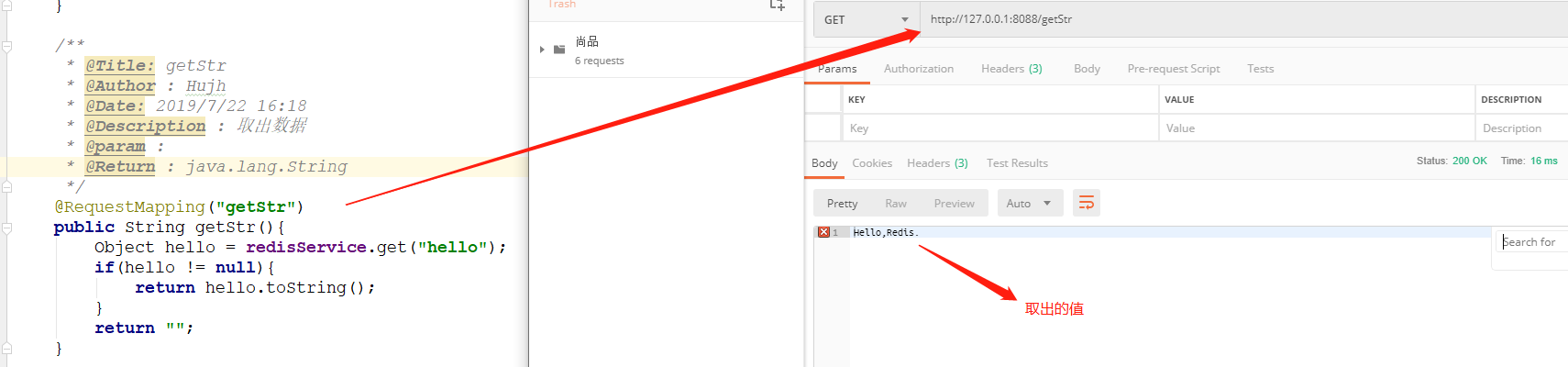
(3).设置有效期 (失效会自动删除key)

(4)删除数据
     /**

      * @Title: removeByKey

      * @Author : Hujh

      * @Date: 2019/7/22 16:19

      * @Description : 根据key删除数据 (可传入多个key)

      * @param :

      * @Return : void

      */

     @RequestMapping("removeByKey")

     public void removeByKey(){

         redisService.del("hello");

     }
Spring Boot 中 Redis 的使用的更多相关文章
- SpringBoot(三) :Spring boot 中 Redis 的使用
前言: 这一篇讲的是Spring Boot中Redis的运用,之前没有在项目中用过Redis,所以没有太大的感觉,以后可能需要回头再来仔细看看. 原文出处: 纯洁的微笑 SpringBoot对常用的数 ...
- spring boot(三):Spring Boot中Redis的使用
spring boot对常用的数据库支持外,对nosql 数据库也进行了封装自动化. redis介绍 Redis是目前业界使用最广泛的内存数据存储.相比memcached,Redis支持更丰富的数据结 ...
- springboot(三):Spring boot中Redis的使用
spring boot对常用的数据库支持外,对nosql 数据库也进行了封装自动化. redis介绍 Redis是目前业界使用最广泛的内存数据存储.相比memcached,Redis支持更丰富的数据结 ...
- Spring Boot:Spring Boot 中 Redis 的使用
Redis 介绍 Redis 是目前业界使用最广泛的内存数据存储.相比 Memcached,Redis 支持更丰富的数据结构,例如 hashes, lists, sets 等,同时支持数据持久化.除此 ...
- (转)Spring Boot(三):Spring Boot 中 Redis 的使用
http://www.ityouknow.com/springboot/2016/03/06/spring-boot-redis.html Spring Boot 对常用的数据库支持外,对 Nosql ...
- Spring boot(三)在Spring boot中Redis的使用
spring boot对常用的数据库支持外,对nosql 数据库也进行了封装自动化. redis介绍 Redis是目前业界使用最广泛的内存数据存储.相比memcached,Redis支持更丰富的数据结 ...
- Spring Boot(三):Spring Boot 中 Redis 的使用
Spring Boot 对常用的数据库支持外,对 Nosql 数据库也进行了封装自动化. Redis 介绍 Redis 是目前业界使用最广泛的内存数据存储.相比 Memcached,Redis 支持更 ...
- spring boot(九):Spring Boot中Redis的使用
Redis实战代码 1.引入 spring-boot-starter-redis <dependency> <groupId>org.springframework.boot& ...
- Spring Boot 中集成 Redis 作为数据缓存
只添加注解:@Cacheable,不配置key时,redis 中默认存的 key 是:users::SimpleKey [](1.redis-cli 中,通过命令:keys * 查看:2.key:缓存 ...
随机推荐
- uwp汉堡菜单的实现
---恢复内容开始--- 现在uwp上面的汉堡菜单(就是那个三道杠,点击之后会出现菜单)使用的越来越普遍,比如微软自己家的Cortana.现在我使用的实现方法是使用SplitView实现.首先Spli ...
- 获得QQ聊天输入框中的内容
// 首先得到输入框的句柄.通过spy++这类工具分析,聊天窗体的类名为“#32770”// 但当前系统里不只一个类名为“#32770”的窗体,这就需要全体遍历一次.// 类名为“#32770”标题含 ...
- [每天记录一个Bug]Cell中由于block加载网络请求产生的复用
Bug 出现场景: cell中使用加载图片的网络请求出现复用,截图如下: 复用原因: Cell Model中只有一个用户的uid,所有用户相关信息:例如头像\名称\信息等是通过 ...
- ansible(二)
一.软件相关模块 1.yum(下载包) 正常操作 yum 与rpm的区别 yum可以解决依赖关系rpm 全称readhat package manager(红帽包管理工具),需要自己解决依赖 yum源 ...
- Node 在chrome上调试
先确保node是否安装成功: 然后 1.创建node_module块,并在同一层级创建一个服务: 如server.js: 2.下载调试工具devtool: npm install -g devtool ...
- Error: Cannot find module '@babel/runtime/core-js/object/keys'(npm start报错)
1.问题描述: 在npm start启动react项目的时候,会出现Cannot find module '@babel/runtime/core-js/object/keys'的报错: 打开:项目根 ...
- 全自动Landsat影像温度反演软件开发
许久没有更新遥感类软件开发了,都有点生疏了,这一次我带来了一个老的算法,新的东西, 为什么这么说呢,我们知道Landat8.Landsat5等影像,单个影像去做温度反演,并没有什么太大的难度, 但是呢 ...
- select下拉箭头样式重置
select{ appearance:none; -moz-appearance:none; -webkit-appearance:none; background: url("../ima ...
- GitLab安装后修改IP/域名
gitlab版本: 10.8.7 默认安装完成后,创建的项目地址为git@www.gitlab.com:xxx.git,还需DNS解析.避免麻烦直接配置成IP地址 解决方法: 1.进入安装目录 cd ...
- [python] 安装TensorFlow问题 解决Cannot uninstall 'wrapt'. It is a distutils installed project
cmd安装 pip install tensorflow 1.遇到了 ERROR: Cannot uninstall 'wrapt'. It is a distutils installed proj ...