
[Java Basics3] XML, Unit testing
| What's the difference between DOM and SAX? | DOM creates tree-like representation of the XML document in memory, SAX is event-based. |
| What's the difference between XSD and DTD? | XSD is in XML, DTD is not. XSD is much more comprehensive than DTD |
| You're given an XML file, and you're supposed to retrieve the value of a specific element in the file. How do you do that? | Open-ended question. See how the candidate uses various types of parsers (DOM, SAX, etc) and see if he explores the usage of XPath. |
| You're supposed to unit test Java class that accesses a database, in a machine that doesn't have database server installed, and no external connectivity at all. What's your approach? |
Open-ended question. See if the answer tackles the problem effectively. See if he/she suggests mocking as an option |
| How do you ensure your unit tests have covered all paths / possibilities? |
Use code coverage tool like Cobertura, Emma, etc |
| How do you unit-test a private method? | - Use Reflection, set accessible property of that method to true - Call an accessible method that calls the private method and observe the effect caused by calling the private method |
XML Message Verification in B-Puma:
1, First get the XML message from cache component, using the ConsumerTemplate.receiverBody(uri, TIMEOUT, Node.class); and cast to Element.
2, Pass the obtained Element to OrderVerifier constructor which builds a XPathVerifyDelegate(Node):
private static XPath xpath = XPathFactory.newInstance().newXPath();
String actual = xpath.evaluate(key, node); //key is like @limitPrice, the path of the data
在这里,Node是从camel consumerTemplate里直接收到的,如果你的XML在一个file里而且你想用XPath读,你需要首先读进一个DOM object里:
DocumentBuilderFactory builderFactory = DocumentBuilderFactory.newInstance();DocumentBuilder builder = null;try { builder = builderFactory.newDocumentBuilder();} catch (ParserConfigurationException e) { e.printStackTrace(); }try { Document document = builder.parse(newFileInputStream("c:\\employees.xml"));} catch (SAXException e) { e.printStackTrace();} catch (IOException e) { e.printStackTrace();}//read an xml node using xpathString expression = "/Employees/Employee[@emplid='3333']/email";Node node = (Node) xPath.compile(expression).evaluate(xmlDocument, XPathConstants.NODE);About DOM:
The parser traverses the XML file and creates the corresponding DOM objects. These DOM objects are linked together in a tree structure.
The Node object is the primary data type for the entire DOM. Document不只包括树型元素结构,所以Element这种结构只是获取Document里的树型结构Document.getDocumentElement()。Document和Element都是Node interface的sub-interface。
A node can be an element node, an attribute node, a text node, or any other of the node types explained in the "Node types" chapter. Element is the only kind of node that can have child nodes and attributes.
DOM on the other hand is more robust - it reads the entire XML document into a tree, and is very efficient when you want to alter, add, remove data in that XML tree. XPath is useful when you only need a couple of values from the XML document, and you know where to find them (you know the path of the data, /root/item/challange/text).
如果你用DOM来获取元素:
Element rootElement = document.getDocumentElement();
NodeList nodes = element.getChildNodes();

for(int i=0; i<nodes.getLength(); i++){

  Node node = nodes.item(i);

  if(node instanceof Element){

    //a child element to process

    Element child = (Element) node;

    String attribute = child.getAttribute("width");

  }

}
A Node is a part of the DOM tree, an Element is a particular type of Node : e.g. <foo> This is Text </foo>
(I)Node
(I)Document (I)Element (I)Attr
You have a foo Element, (which is also a Node, as Element inherits from Node) and a Text Node 'This is Text', that is a child of the foo Element/Node
XPath为XML Path language: XPath包含一个标准函数库
XPath语法:
nodename 选取名为nodename节点的所有子节点
/ 从根节点选取
// 选取节点,所有,不管位置
@ 选取属性
Predicates:
例如 //tiltle[@lang] 选取所有属性lang的所有title节点
/bookstore/book[price>35]/title child::* 选取当前节点的所有子元素
//title| //price 选取若干路径"|" ancestor::book 选取当前节点的所有book先辈
XML Message Constructing in B-Puma:
<from uri="direct:default-order-record"/>
<transform>
<constant><xml/></constant>
</transform>
<to uri="xquery:com/barcap/eq/baths/core/puma/templates/DefaultOrderRecord.xml"/>
then Node.setAttribute(String name, String value);
Unit Testing or Component Testing:
1, To write a test with the JUnit 4.x/TestNG-6-3.1 framework you annotate a method with the @org.junit.Test/@org.testng.annotations.Test
annotation.
2, In TestNG, if you want to run multi-tests as a suite: define XML file with <suite> tag.
<suite><test><packages><package>...</>
Then in the test or base test, use annotation @BeforeSuite and @AfterSuite to initiate/close actors.
Other annotations: @BeforeGroups, @BeforeClass, @BeforeTest, @BeforeMethod.
3, Base class in B project:
extends AbstractTestNGSpringContextTests, part of spring-test-3.1.1, which integrates the Spring TestContext framework with testing support in a TestNG enrironment.
For example, at your base class, @ContextConfiguration(locations = {"/pApp-actors.xml"}), @ActiveProfiles({"SIT2"}).
4, Spring configuration files in test project:
====
<?xml version="1.0" encoding="UTF-8"?>
<beans xmlns="http://www.springframework.org/schema/beans"
xmlns:xsi="http://www.w3.org/2001/XMLSchema-instance"
xmlns:p="http://www.springframework.org/schema/p"
xsi:schemaLocation="http://www.springframework.org/schema/beans http://www.springframework.org/schema/beans/spring-beans.xsd">
<import resource="spring/puma.xml"/>
<bean id="paul" p:pumaGuiUsername="${puma.user.name}" class="com.barcap.eq.baths.puma.framework.interactor.impl.PumaActorCamel"/>
<beans profile="SIT2">
<bean p:locations="classpath*:env/US-SIT2-*.properties" class="org.apache.camel.spring.spi.BridgePropertyPlaceholderConfigurer"/>
</beans>
====
Either to use <beans profile> in Spring xml and @ActiveProfiles annotation, to switch among profiles,
Or <profile> in Maven xml and mvn -P Profile1.
5, TestNG also include JUnit's Assert class, which lets you perform assertions on complex objects:
import static org.testng.AssertJUnit.*; assertEquals("Beust", m_lastName);
assertTrue(boolean value), assertFalse(boolean value), assertNull(object), assertNotNull(object), assertEquals(expected, actual).
6, TestNG DataProvider
A Data Provider is a method on your class that returns an array of array of objects. This method is annotated with @DataProvider:
@DataProvider(name = "test1")
public Object[][] createData() { return new Object[][] {{"Constance", new Integer(12)}, {"Roxy", new Integer(33)}};}
@Test(dataProvider = "test1")
public void verifyData(String name, Integer age) {System.out.println(name + " " + age);}
7, Mockito testing
The concept behind mock objects is that we want to create an object that will take the place of the real object. This mock object will expect a certain method to be called with certain parameters and when that happens, it will return an expected result.
http://www.codeproject.com/Articles/516360/Mockito-a-great-mock-framework-for-Java-developmen
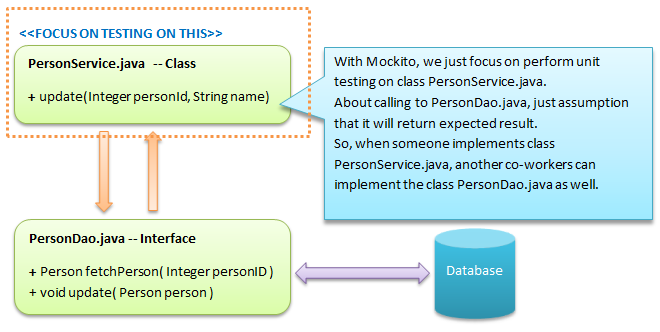
这里,没有PersonDao的具体implementation,只是为了test PersonService class,所以需要@Mock PersonDao personDao; 然后stub method calls, verify interations.
public class PersonServiceTest

{

    @Mock

    private PersonDao personDAO;

    private PersonService personService;

    @Before

    public void setUp()

        throws Exception

    {

        MockitoAnnotations.initMocks( this );

        personService = new PersonService( personDAO );

    }

    @Test

    public void shouldUpdatePersonName()

    {

        Person person = new Person( 1, "Phillip" );

        when( personDAO.fetchPerson( 1 ) ).thenReturn( person );    //Stub method calls

        boolean updated = personService.update( 1, "David" );

        assertTrue( updated );

        verify( personDAO ).fetchPerson( 1 );                       //verify interation

        ArgumentCaptor<Person> personCaptor = ArgumentCaptor.forClass( Person.class );

        verify( personDAO ).update( personCaptor.capture() );

        Person updatedPerson = personCaptor.getValue();

        assertEquals( "David", updatedPerson.getPersonName() );

        // asserts that during the test, there are no other calls to the mock object.

        verifyNoMoreInteractions( personDAO );

    }

    @Test

    public void shouldNotUpdateIfPersonNotFound()

    {

        when( personDAO.fetchPerson( 1 ) ).thenReturn( null );

        boolean updated = personService.update( 1, "David" );

        assertFalse( updated );

        verify( personDAO ).fetchPerson( 1 );

        verifyZeroInteractions( personDAO );

        verifyNoMoreInteractions( personDAO );

    }

}
8, @Listeners annotation in TestNG
提供了一种改变TestNG behavior的方法,你create的listener class要implement ITestNGListener,比如在你的listener class里:
@Override
public void onConfigurationFailure(final ITestResult testResult) {
reporter.onConfigurationFailure(testResult);
}
9,JUnit 4里有expected = IllegalArgumentException.class,在testng里是expectedExceptions = {}。
[Java Basics3] XML, Unit testing的更多相关文章
- Java Unit Testing - JUnit & TestNG
转自https://www3.ntu.edu.sg/home/ehchua/programming/java/JavaUnitTesting.html yet another insignifican ...
- 10 Unit Testing and Automation Tools and Libraries Java Programmers Should Learn
转自:https://javarevisited.blogspot.com/2018/01/10-unit-testing-and-integration-tools-for-java-program ...
- Unit Testing of Classes in Java
Every class can have a main method. That is a handy trick for unit testing of classes. For example, ...
- C/C++ unit testing tools (39 found)---reference
http://www.opensourcetesting.org/unit_c.php API Sanity AutoTest Description: An automatic generator ...
- Unit Testing of Spring MVC Controllers: “Normal” Controllers
Original link: http://www.petrikainulainen.net/programming/spring-framework/unit-testing-of-spring-m ...
- Unit Testing of Spring MVC Controllers: Configuration
Original Link: http://www.petrikainulainen.net/programming/spring-framework/unit-testing-of-spring-m ...
- Javascript单元测试Unit Testing之QUnit
body{ font: 16px/1.5em 微软雅黑,arial,verdana,helvetica,sans-serif; } QUnit是一个基于JQuery的单元测试Uni ...
- Unit Testing a zend-mvc application
Unit Testing a zend-mvc application A solid unit test suite is essential for ongoing development in ...
- java对xml节点属性的增删改查
学习本文之前请先看我的另一篇文章JAVA对XML节点的操作可以对XML操作有更好的了解. package vastsum; import java.io.File; import java.io.Fi ...
随机推荐
- linux环境下android-ndk下的ffmpeg编译
目前正在做手机底层播放器对的开发,需要用的ffmpeg,因为是新手,所以先从ffmpeg的编译开始做起.虽然是在前人的基础上,但是在linux上编译确实头一遭,因此在编译中,总有些坑是必须要填的,下面 ...
- Objective-C( Foundation框架 一 NSNumber(NSValue))
NSNumber: 是OC中处理数字的一个类 NSValue是NSNumber的子类 如何处理: 把int,float,double 包装成一个对象 使用NSNumber的好处: 可以把基本数据类型 ...
- 一些css知识
两个"::"和一个":"在css3中主要用来区分伪类和伪元素. 1.设置 placeholder属性: // firefox input::-moz-place ...
- 配置 Windows 下的 nodejs C++ 模块编译环境
根据 node-gyp 指示的 Windows 编译环境说明, 简单一句话就是 "Python + VC++ 编译环境". 所有需要的安装文件, 我都下载好放到百度云盘了: nod ...
- oracle 函数写法 总结
1:首先看创建一个函数 给定一个日期,判断是否是休息日. create or replace function test(date_in in date) return int is num int; ...
- 【 2013 Multi-University Training Contest 2 】
HDU 4611 Balls Rearrangement 令lcm=LCM(a,b),gcd=GCD(a,b).cal(n,a,b)表示sum(abs(i%a-i%b)),0<=i<n. ...
- Android Fragment的使用
定义 Fragment可以理解成一个迷你型的活动,同样可以包含布局,同样有自己的生命周期.比Activity要轻量级,在程序内部做界面跳转要比Activity快的多. 静态添加 Fragment可以静 ...
- curl get
//Get方式实现 //初始化 $ch = curl_init(); //设置选项,包括URL curl_setopt($ch, CURLOPT_URL, "http://www.jb51. ...
- 【初级】linux rm 命令详解及使用方法实战
rm:删除命令 前言: windows中的删除命令大家都不陌生,linux中的删除命令和windows中有一个共同特点,那就是危险,前两篇linux mkdir 命令详解及使用方法实战[初级]中我们就 ...
- 记第一次TopCoder, 练习SRM 583 div2 250
今天第一次做topcoder,没有比赛,所以找的最新一期的SRM练习,做了第一道题. 题目大意是说 给一个数字字符串,任意交换两位,使数字变为最小,不能有前导0. 看到题目以后,先想到的找规律,发现要 ...