
Shiro的Filter机制详解---源码分析
Shiro的Filter机制详解
首先从spring-shiro.xml的filter配置说起,先回答两个问题:
1, 为什么相同url规则,后面定义的会覆盖前面定义的(执行的时候只执行最后一个)。
2, 为什么两个url规则都可以匹配同一个url,只执行第一个呢。
下面分别从这两个问题入手,最终阅读源码得到解答。
问题一解答
相同url但定义在不同的行,后面覆盖前面
如
/usr/login.do=test3

/usr/login.do=test1,test2

不会执行test3的filter
要解答第一个问题,需要知道shiro(或者说是spring)是如何扫描这些url规则并保存的。
Web.xml配置shiro以及spring-shiro.xml的核心配置
在web.xml中定义shiroFilter
<filter>

        <filter-name>shiroFilter</filter-name>

        <filter-class>org.springframework.web.filter.DelegatingFilterProxy</filter-class>

        <init-param>

            <!-- 该值缺省为false,表示生命周期由SpringApplicationContext管理,设置为true则表示由ServletContainer管理 -->

            <param-name>targetFilterLifecycle</param-name>

            <param-value>true</param-value>

        </init-param>

    </filter>

    <filter-mapping>

        <filter-name>shiroFilter</filter-name>

        <url-pattern>/*</url-pattern>

    </filter-mapping>
在spring-shiro.xml中定义shiroFilter
(要和web.xml中的名称一样,因为spring就是依靠名称来获取这个bean的)
<bean id="shiroFilter" class="org.apache.shiro.spring.web.ShiroFilterFactoryBean">

        <property name="securityManager" ref="securityManager" />

        <property name="loginUrl" value="/login.jsp" />

        <property name="unauthorizedUrl" value="/WEB-INF/405.html" />

        <property name="filters">

            <map>

                <entry key="kickout" value-ref="kickoutSessionControlFilter" />

            </map>

        </property>

        <property name="filterChainDefinitions">

            <value>

                /**=kickout

                /usr/login.do=anon

                /security/*=anon

                /usr/login.do=authc

                /usr/test/*=authc

            </value>

        </property>

    </bean>
都定义好之后,分析org.springframework.web.filter.DelegatingFilterProxy发现该filter类的任务是:将具体工作分派给org.apache.shiro.spring.web.ShiroFilterFactoryBean这个类中的静态内部类SpringShiroFilter做。
具体spring内部是怎么将工作委派的,暂时没有分析。
现在关注的是当spring把具体工作委派给ShiroFilterFactoryBean后,该类是怎么工作的。
Spring将配置注入到ShiroFilterFactoryBean
在这之前,spring通过bean注入,将ShiroFilterFactoryBean的相关成员通过set方法注入进去。
前面已经配置了filters和filterChainDefinitions,再次贴出如下所示:
<property name="filters">

            <map>

                <entry key="kickout" value-ref="kickoutSessionControlFilter" />

            </map>

        </property>

        <property name="filterChainDefinitions">

            <value>

                /**=kickout

                /usr/login.do=anon

                /security/*=anon

                /usr/login.do=authc

                /usr/test/*=authc

            </value>

        </property>
看一下ShiroFilterFactoryBean是怎么接收他们的。
Filters很简单,只需要map接收就自动完成了。
public void setFilters(Map<String, Filter> filters) {

        this.filters = filters;

    }
但是filterChainDefinitions是String类型的,需要转换(使用了ini转换方法,内部使用LinkedHashMap保存url和filter的映射关系,保证了顺序)
public void setFilterChainDefinitions(String definitions) {

        Ini ini = new Ini();

        ini.load(definitions);

        //did they explicitly state a 'urls' section?  Not necessary, but just in case:

        Ini.Section section = ini.getSection(IniFilterChainResolverFactory.URLS);

        if (CollectionUtils.isEmpty(section)) {

            //no urls section.  Since this _is_ a urls chain definition property, just assume the

            //default section contains only the definitions:

            section = ini.getSection(Ini.DEFAULT_SECTION_NAME);

        }

        setFilterChainDefinitionMap(section);

    }
这两步完成后,filters被注入
filterChianDefinitions也被注入,但是注入方法通过shiro自定义了ini方式,
该方式通过LinkedHashMap保存url规则和对应的权限(键值对),所以当写了相同的url规则,后者会覆盖前者(------现在对HashMap的存储规则遗忘了,需要再看一下)
问题一解答完成
问题二解答:
同一个url可以匹配不同的规则,但只执行首行

/usr/* =test1,test2

/usr/login.do=test3

url = /usr/login.do请求来了,不会执行test3,因为已经匹配了/usr/* =test1,test2

要解答该问题,需要知道每个url的FilterChain是如何获取的
接上分析:
有了filter和filterChainDefinitionMap的数据后,下面的工作是构造FilterChainManager
构造FilterChainManager
为什么到这一步呢?
查看spring委托机制,最终找到ShiroFilterFactoryBean的createInstance()方法(这个方法是shiro的filter构造机制的主线),由于ShiroFilterFactoryBean 实现了FactoryBean,spring就是通过这个接口的createInstance方法获取到filter实例的,下面是该方法在ShiroFilterFactoryBean中的实现:
protected AbstractShiroFilter createInstance() throws Exception {

        log.debug("Creating Shiro Filter instance.");

        SecurityManager securityManager = getSecurityManager();

        if (securityManager == null) {

            String msg = "SecurityManager property must be set.";

            throw new BeanInitializationException(msg);

        }

        if (!(securityManager instanceof WebSecurityManager)) {

            String msg = "The security manager does not implement the WebSecurityManager interface.";

            throw new BeanInitializationException(msg);

        }

        FilterChainManager manager = createFilterChainManager();

        PathMatchingFilterChainResolver chainResolver = new PathMatchingFilterChainResolver();

        chainResolver.setFilterChainManager(manager);

        return new SpringShiroFilter((WebSecurityManager) securityManager, chainResolver);

    }
从这里可以知道,首先获取filterChainManager,具体方法如下
protected FilterChainManager createFilterChainManager() {

        DefaultFilterChainManager manager = new DefaultFilterChainManager();

        Map<String, Filter> defaultFilters = manager.getFilters();

        //apply global settings if necessary:

        for (Filter filter : defaultFilters.values()) {

            applyGlobalPropertiesIfNecessary(filter);

        }

        //Apply the acquired and/or configured filters:

        Map<String, Filter> filters = getFilters();

        if (!CollectionUtils.isEmpty(filters)) {

            for (Map.Entry<String, Filter> entry : filters.entrySet()) {

                String name = entry.getKey();

                Filter filter = entry.getValue();

                applyGlobalPropertiesIfNecessary(filter);

                if (filter instanceof Nameable) {

                    ((Nameable) filter).setName(name);

                }

                //'init' argument is false, since Spring-configured filters should be initialized

                //in Spring (i.e. 'init-method=blah') or implement InitializingBean:

                manager.addFilter(name, filter, false);

            }

        }

        //build up the chains:

        Map<String, String> chains = getFilterChainDefinitionMap();

        if (!CollectionUtils.isEmpty(chains)) {

            for (Map.Entry<String, String> entry : chains.entrySet()) {

                String url = entry.getKey();

                String chainDefinition = entry.getValue();

                manager.createChain(url, chainDefinition);

            }

        }

        return manager;

    }
分析后得知,首先在createFilterChainManager()方法中,创建一个DefaultFilterChainManager对象,而这个对象的构造函数在最后会将DefaultFilter中定义的shiro默认的filter映射加入到该对象中。如下代码就是DefaultFilter的定义。
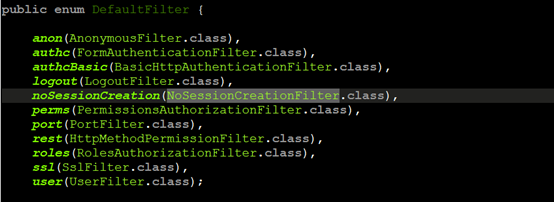
在DefaultFilterChainManager中还做了一件事就是url-filter的映射变成filterChain,这句代码就是执行这个任务(将我们在xml文件中定义的filterChainDefinitions变成filterChain)。
manager.createChain(url, chainDefinition);
作用是将权限分割:如
"authc, roles[admin,user], perms[file:edit]"
将会被分割为
{ "authc", "roles[admin,user]", "perms[file:edit]" }
具体的源代码如下:
public void createChain(String chainName, String chainDefinition) {

      //。。。。。。。。

        //parse the value by tokenizing it to get the resulting filter-specific config entries

        //

        //e.g. for a value of

        //

        //     "authc, roles[admin,user], perms[file:edit]"

        //

        // the resulting token array would equal

        //

        //     { "authc", "roles[admin,user]", "perms[file:edit]" }

        //

        String[] filterTokens = splitChainDefinition(chainDefinition);

        for (String token : filterTokens) {

            String[] nameConfigPair = toNameConfigPair(token);

            addToChain(chainName, nameConfigPair[0], nameConfigPair[1]);

        }

    }
并且通过toNameConfigPair(token)将如:roles[admin,user]形式的变成roles,admin,user形式的分割
然后根据url规则 映射 权限和角色
可以发现,每次分割一个token,都会通过addToChain方法接受
分析public void addToChain(String chainName, String filterName, String chainSpecificFilterConfig)方法
public void addToChain(String chainName, String filterName, String chainSpecificFilterConfig) {

        if (!StringUtils.hasText(chainName)) {

            throw new IllegalArgumentException("chainName cannot be null or empty.");

        }

        Filter filter = getFilter(filterName);

        if (filter == null) {

            throw new IllegalArgumentException("There is no filter with name '" + filterName +

                    "' to apply to chain [" + chainName + "] in the pool of available Filters.  Ensure a " +

                    "filter with that name/path has first been registered with the addFilter method(s).");

        }

        applyChainConfig(chainName, filter, chainSpecificFilterConfig);

        NamedFilterList chain = ensureChain(chainName);

        chain.add(filter);

    }
分析applyChainConfig(chainName, filter, chainSpecificFilterConfig);
protected void applyChainConfig(String chainName, Filter filter, String chainSpecificFilterConfig) {

      //………………………….

        if (filter instanceof PathConfigProcessor) {

            ((PathConfigProcessor) filter).processPathConfig(chainName, chainSpecificFilterConfig);

        } else {

            if (StringUtils.hasText(chainSpecificFilterConfig)) {

                //they specified a filter configuration, but the Filter doesn't implement PathConfigProcessor

                //this is an erroneous config:

                String msg = "chainSpecificFilterConfig was specified, but the underlying " +

                        "Filter instance is not an 'instanceof' " +

                        PathConfigProcessor.class.getName() + ".  This is required if the filter is to accept " +

                        "chain-specific configuration.";

                throw new ConfigurationException(msg);

            }

        }

}
由于我们自定义的filter都是PathMatchingFilter的子类,所以在applyChainConfig方法中完成的就是将url添加到filter的url表中。
在PathMatchingFilter中可以发现
protected Map<String, Object> appliedPaths = new LinkedHashMap<String, Object>();
processPathConfig 方法的实现如下
public Filter processPathConfig(String path, String config) {

        String[] values = null;

        if (config != null) {

            values = split(config);

        }

        this.appliedPaths.put(path, values);

        return this;

}
基本上在spring-shiro.xml中定义filter的载入过程已经阅读完成,
1, 定义一个DefaultFilterChainManager对象
2, 首先加载默认的filter
3, 加载xml文件中定义的filter
4, 加载xml文件定义的url和filter映射关系
5, 将映射关系解析为以url为键,NamedFilterList为值的键值对。
6, 在解析的过程中,对每个url和对应的过滤条件,都会放到对应filter的appliedPaths中(在PathMatchingFilter中定义)。
现在FilterChainManager的对象已经创建完毕,并且每个filter也已经实例化完毕。
构造SpingShiroFilter
在创建SpringShiroFilter之前还要将刚才创建的FilterChainManager对象包装成一个PathMatchingFilterChainResolver对象(注释的意思是:不直接将FilterChainManager对象暴露给AbstractShiroFilter的实现者,在这里就是SpringShiroFilter。)
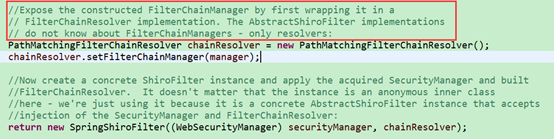
PathMatchingFilterChainResolver最重要的作用是:当请求url来的时候,他担任匹配工作(调用该类的getChain方法做匹配,暂时先不分析该方法,等知道在哪里调用该方法时候再分析。其实问题二此时已经可以解答,通过该方法就可以知道,某个url匹配到过滤链的第一个规则时就return了。)
上图最后一句话执行完成后,一个SpringShiroFilter创建完毕。
请求过滤过程分析(上)
下面分析当url请求到来的时候,shiro是如何完成过滤的。首先通过图片大致的了解一下。

现在分析AbstractShiroFilter的doFilterInternal()方法
protected void doFilterInternal(ServletRequest servletRequest, ServletResponse servletResponse, final FilterChain chain)

            throws ServletException, IOException {

        Throwable t = null;

        try {

            final ServletRequest request = prepareServletRequest(servletRequest, servletResponse, chain);

            final ServletResponse response = prepareServletResponse(request, servletResponse, chain);

            final Subject subject = createSubject(request, response);

            subject.execute(new Callable() {

                public Object call() throws Exception {

                    updateSessionLastAccessTime(request, response);

                    executeChain(request, response, chain);

                    return null;

                }

            });

        } catch (ExecutionException ex) {

            t = ex.getCause();

        } catch (Throwable throwable) {

            t = throwable;

        }

        //…………

    }
暂时不关心subject相关的创建等过程,只关心这行代码
executeChain(request, response, chain);
具体实现如下
protected void executeChain(ServletRequest request, ServletResponse response, FilterChain origChain)

            throws IOException, ServletException {

        FilterChain chain = getExecutionChain(request, response, origChain);

        chain.doFilter(request, response);

}
再看getExecutionChain(request, response, origChain);具体实现如下:
protected FilterChain getExecutionChain(ServletRequest request, ServletResponse response, FilterChain origChain) {

        FilterChain chain = origChain;

        FilterChainResolver resolver = getFilterChainResolver();

        if (resolver == null) {

            log.debug("No FilterChainResolver configured.  Returning original FilterChain.");

            return origChain;

        }

        FilterChain resolved = resolver.getChain(request, response, origChain);

        if (resolved != null) {

            log.trace("Resolved a configured FilterChain for the current request.");

            chain = resolved;

        } else {

            log.trace("No FilterChain configured for the current request.  Using the default.");

        }

        return chain;

    }
可以发现,这里用到了我们在创建SpringShiroFilter时传递的FilterChainResolver,至此,我们终于找到了getChain()方法在这里被调用了。其源码实现如下
public FilterChain getChain(ServletRequest request, ServletResponse response, FilterChain originalChain) {

        FilterChainManager filterChainManager = getFilterChainManager();

        if (!filterChainManager.hasChains()) {

            return null;

        }

        String requestURI = getPathWithinApplication(request);

        //the 'chain names' in this implementation are actually path patterns defined by the user.  We just use them

        //as the chain name for the FilterChainManager's requirements

        for (String pathPattern : filterChainManager.getChainNames()) {

            // If the path does match, then pass on to the subclass implementation for specific checks:

            if (pathMatches(pathPattern, requestURI)) {

                if (log.isTraceEnabled()) {

                    log.trace("Matched path pattern [" + pathPattern + "] for requestURI [" + requestURI + "].  " +

                            "Utilizing corresponding filter chain...");

                }

                return filterChainManager.proxy(originalChain, pathPattern);

            }

        }

        return null;

    }
从for循环可以看出,当匹配到第一个url规则,则return一个代表这个url规则的FilterChain给web容器执行。
问题二解答:每个url在匹配他的FilterChain时,当匹配到第一个URL规则时,就返回。
请求过滤过程分析(下)
FilterChain的实现类为org.apache.shiro.web.servlet.ProxiedFilterChain
从该类的doFilter方法可以知道,它会将Filter链的Filter的doFilter方法顺序执行一遍。下图展示了这一过程

现在只需要分析每个Filter的doFilter方法就行了。
先看一下shiro整个filter框架继承关系(图片来自第八章 拦截器机制——《跟我学Shiro》)

上面是它的继承关系:最终的doFilter方法在OncePerRequestFilter中实现,具体代码如下:
public final void doFilter(ServletRequest request, ServletResponse response, FilterChain filterChain)

            throws ServletException, IOException {

        String alreadyFilteredAttributeName = getAlreadyFilteredAttributeName();

        if ( request.getAttribute(alreadyFilteredAttributeName) != null ) {

            log.trace("Filter '{}' already executed.  Proceeding without invoking this filter.", getName());

            filterChain.doFilter(request, response);

        } else //noinspection deprecation

            if (/* added in 1.2: */ !isEnabled(request, response) ||

                /* retain backwards compatibility: */ shouldNotFilter(request) ) {

            log.debug("Filter '{}' is not enabled for the current request.  Proceeding without invoking this filter.",

                    getName());

            filterChain.doFilter(request, response);

        } else {

            // Do invoke this filter...

            log.trace("Filter '{}' not yet executed.  Executing now.", getName());

            request.setAttribute(alreadyFilteredAttributeName, Boolean.TRUE);

            try {

                doFilterInternal(request, response, filterChain);

            } finally {

                // Once the request has finished, we're done and we don't

                // need to mark as 'already filtered' any more.

                request.removeAttribute(alreadyFilteredAttributeName);

            }

        }

    }
可以发现该方法最终会调用doFilterInternal(request, response, filterChain);来完成具体的过滤操作,doFilterInternal方法在 SpringShiroFilter的直接父类AbstractShiroFilter的具体实现过程已经在上面分析过了:具体的就是shiro真正验证授权前的subject,session等初始化的工作,使得后面的过滤以及验证授权工作可以得到subject等然后正常工作。完成后调用其他shiro filter进行继续过滤
而除了shiroFilter之外,其余的filter都是AdviceFilter分支的子类。刚才看了AbstractShiroFilter的doFilterInternal方法,现在看一下AdviceFilter对该方法的实现:
public void doFilterInternal(ServletRequest request, ServletResponse response, FilterChain chain)

            throws ServletException, IOException {

        Exception exception = null;

        try {

            boolean continueChain = preHandle(request, response);

            if (log.isTraceEnabled()) {

                log.trace("Invoked preHandle method.  Continuing chain?: [" + continueChain + "]");

            }

            if (continueChain) {

                executeChain(request, response, chain);

            }

            postHandle(request, response);

            if (log.isTraceEnabled()) {

                log.trace("Successfully invoked postHandle method");

            }

        } catch (Exception e) {

            exception = e;

        } finally {

            cleanup(request, response, exception);

        }

    }
与AbstractShiroFilter的doFilterInternal方法不同的是,这里通过continueChain变量来判断到底后续的filter会不会被继续执行。而该变量的值由preHandle()函数决定。
基本上所有在系统中用到的filter都是继承PathMatchingFilter类的。看一下该类的preHandle()函数实现,可以发现,我们在xml文件中定义的url匹配,在这里面可以看到匹配原则了:
protected boolean preHandle(ServletRequest request, ServletResponse response) throws Exception {

        if (this.appliedPaths == null || this.appliedPaths.isEmpty()) {

            if (log.isTraceEnabled()) {

                log.trace("appliedPaths property is null or empty.  This Filter will passthrough immediately.");

            }

            return true;

        }

        for (String path : this.appliedPaths.keySet()) {

            // If the path does match, then pass on to the subclass implementation for specific checks

            //(first match 'wins'):

            if (pathsMatch(path, request)) {

                log.trace("Current requestURI matches pattern '{}'.  Determining filter chain execution...", path);

                Object config = this.appliedPaths.get(path);

                return isFilterChainContinued(request, response, path, config);

            }

        }

        //no path matched, allow the request to go through:

        return true;

    }
继续调用isFilterChainContinued(request, response, path, config)--> onPreHandle(request, response, pathConfig);
分析onPreHandle(),PathMatchingFilter自己并没有实现,只是简单的返回true。所以当我们自定义filter的时候,要将具体的逻辑实现在该方法中,或者实现该类的子类AccessControlFilter(该类对onPreHandle()方法进行了更细致的划分,大部分一般会继承该类)
有兴趣的可以分析一下shiro自带的这些filter

Shiro的Filter机制详解---源码分析的更多相关文章
- Shiro的Filter机制详解---源码分析(转)
Shiro的Filter机制详解 首先从spring-shiro.xml的filter配置说起,先回答两个问题: 1, 为什么相同url规则,后面定义的会覆盖前面定义的(执行的时候只执行最后一个). ...
- ArrayList详解-源码分析
ArrayList详解-源码分析 1. 概述 在平时的开发中,用到最多的集合应该就是ArrayList了,本篇文章将结合源代码来学习ArrayList. ArrayList是基于数组实现的集合列表 支 ...
- LinkedList详解-源码分析
LinkedList详解-源码分析 LinkedList是List接口的第二个具体的实现类,第一个是ArrayList,前面一篇文章已经总结过了,下面我们来结合源码,学习LinkedList. 基于双 ...
- Java开源生鲜电商平台-盈利模式详解(源码可下载)
Java开源生鲜电商平台-盈利模式详解(源码可下载) 该平台提供一个联合买家与卖家的一个平台.(类似淘宝购物,这里指的是食材的购买.) 平台有以下的盈利模式:(类似的平台有美菜网,食材网等) 1. 订 ...
- quartz集群调度机制调研及源码分析---转载
quartz2.2.1集群调度机制调研及源码分析引言quartz集群架构调度器实例化调度过程触发器的获取触发trigger:Job执行过程:总结:附: 引言 quratz是目前最为成熟,使用最广泛的j ...
- 定时组件quartz系列<三>quartz调度机制调研及源码分析
quartz2.2.1集群调度机制调研及源码分析引言quartz集群架构调度器实例化调度过程触发器的获取触发trigger:Job执行过程:总结:附: 引言 quratz是目前最为成熟,使用最广泛的j ...
- (1)quartz集群调度机制调研及源码分析---转载
quartz2.2.1集群调度机制调研及源码分析 原文地址:http://demo.netfoucs.com/gklifg/article/details/27090179 引言quartz集群架构调 ...
- 微服务生态组件之Spring Cloud LoadBalancer详解和源码分析
Spring Cloud LoadBalancer 概述 Spring Cloud LoadBalancer目前Spring官方是放在spring-cloud-commons里,Spring Clou ...
- Go Revel - Filter(过滤器)源码分析
在 Go Revel - server.go 源码分析 http://www.cnblogs.com/hangxin1940/p/3265538.html 说到revel框架很多重要的东西都Filte ...
随机推荐
- Java Spring 后端项目搭建
参考了几位同行的Blogs和StackOverflow上的许多问答,搭建了此后端项目,替换原来的node.js后端,和前一篇中搭建的Vue Web App项目配合使用,后端准备只提供服务,不包含后端装 ...
- [ACM_模拟] UVA 12503 Robot Instructions [指令控制坐标轴上机器人移动 水]
Robot Instructions You have a robot standing on the origin of x axis. The robot will be given som ...
- 曲演杂坛--Update的小测试
今天偶然想起一个UPDATE相关的小问题,正常情况下,如果我们将UPDATE改写成与之对应的SELECT语句,其SELECT查询结果应与UPDATE的目标表存在一对一的关系,例如: 对于UPDATE语 ...
- django分页及搜索后如何翻页
django自带了Pagnator 导入 from django.core.paginator import Paginator, PageNotAnInteger, EmptyPage 分页 def ...
- Microsoft Sql Server 2016安装在CentOS7下
安装过程 如何安装直接参考这个文章:安装sql server 整个安装过程非常简单. 上面的文档里是通过 sudo 命令,用root身份来执行,不过这里为了简单,就用root账号来安装的. (1)下载 ...
- 数据帮助类(DataHelper)
/// <summary> /// 是否为空... /// </summary> /// <param name="str">数据值</p ...
- SQL查询和替换含有回车,空格,TAB,等
---如下是查询语句 --查询名称有退格键 ),item_name) go --查询名称有制表符tab ),item_name) go --查询名称有换行 ),item_name) go --查询名称 ...
- 基于MVC框架Aspose.Words打印到Word中写法
控件bin文件下载地址:https://download.csdn.net/download/u012949335/10610726 //前端打印写法 @{ ViewBag.Title = " ...
- 在Asp.Net MVC中使用NPOI插件实现对Excel的操作(导入,导出,合并单元格,设置样式,输入公式)
前言 NPOI 是 POI 项目的.NET版本,它不使用 Office COM 组件,不需要安装 Microsoft Office,目前支持 Office 2003 和 2007 版本. 1.整个Ex ...
- django 视图中执行原生的 sql 查询语句
可以使用objects的raw()方法执行原生的sql语句,进行对数据库的查询操作,raw()方法只能执行查询语句 query_set = your_model.objects.raw("s ...