
信步漫谈之Quartz—分布式调度(整合spring早期版本【低于spring3.1】)
一、环境
使用的jar包:spring2.5.6、quartz1.8.6
二、注意点
因为spring内置的quartz版本变化,所以存在spring和quartz版本接口兼容情况,如下:
1)spring3.1之后的版本(包含)兼容quartz2.X(这里有个坑,网络资料是spring3.0对应quartz1.X,但也有人说支持quartz2.X,只要不在spring的配置文件中使用,直接在程序中调用就可以(废话),具体需要验证)
2)spring3.1之前的版本兼容quartz1.X
三、实现方案
Demo程序目录结构:
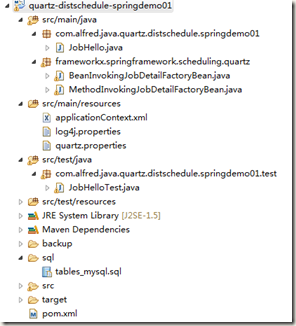
Demo核心程序源码:

package com.alfred.java.quartz.distschedule.springdemo01;

import java.text.SimpleDateFormat;

import java.util.Date;

import org.quartz.JobExecutionException;

public class JobHello {

	private static String NUM = "1";

	private static Integer count = 1;

	private static SimpleDateFormat sdf = new SimpleDateFormat("yyyy-MM-dd HH:mm:ss");

	protected void executeInternal()

			throws JobExecutionException {

		System.out.println("job hello"+NUM+":"+(count++)+":"+sdf.format(new Date()));

	}

	public static void setNUM(String nUM) {

		NUM = nUM;

	}

}
JobHello.java
<?xml version="1.0" encoding="UTF-8"?>

<beans xmlns="http://www.springframework.org/schema/beans" xmlns:xsi="http://www.w3.org/2001/XMLSchema-instance"

	xmlns:context="http://www.springframework.org/schema/context"

	xsi:schemaLocation="http://www.springframework.org/schema/beans http://www.springframework.org/schema/beans/spring-beans-3.0.xsd http://www.springframework.org/schema/context http://www.springframework.org/schema/context/spring-context.xsd">

	<!-- 配置数据源 -->

	<bean id="quartzDataSource" class="org.apache.commons.dbcp.BasicDataSource"  destroy-method="close">

		<property name="driverClassName">

			<value>org.gjt.mm.mysql.Driver</value>

		</property>

		<property name="url">

			<value>jdbc:mysql://127.0.0.1:3306/test?characterEncoding=utf8</value>

		</property>

		<property name="username">

			<value>root</value>

		</property>

		<property name="password">

			<value>123456</value>

		</property>

		<property name="maxActive" value="5"></property>

		<property name="maxIdle" value="20"></property>

		<property name="maxWait" value="50"></property>

		<property name="defaultAutoCommit" value="true"></property>

	</bean>

	<!-- 配置job -->

	<bean id="jobHelloDetail" class="com.alfred.java.quartz.distschedule.springdemo01.JobHello">

	</bean>

	<bean id="jobHelloTrigger" class="org.springframework.scheduling.quartz.SimpleTriggerBean">

		<property name="jobDetail">

			<bean class="frameworkx.springframework.scheduling.quartz.BeanInvokingJobDetailFactoryBean">

	        	<property name="concurrent" value="false"/>

	            <property name="targetBean" value="jobHelloDetail" />

	            <property name="targetMethod" value="executeInternal" />

	        </bean>

		</property>

		<property name="startDelay">

			<value>10000</value><!-- ms -->

		</property>

		<property name="repeatInterval">

			<value>40000</value><!-- 每隔40秒调度1次 -->

		</property>

	</bean>

	<bean name="quartzScheduler"

		class="org.springframework.scheduling.quartz.SchedulerFactoryBean">

		<property name="dataSource">

			<ref bean="quartzDataSource" /><!--数据源引用指向,包含集群所需的所有表 -->

		</property>

		<!--applicationContextSchedulerContextKey:

			是org.springframework.scheduling.quartz.SchedulerFactoryBean这个类中把spring上下文以key/value的方式存放在了quartz的上下文中了

			可以用applicationContextSchedulerContextKey所定义的key得到对应的spring上下文, 可以看下源码注释-->

		<property name="applicationContextSchedulerContextKey" value="applicationContextKey" />

		<property name="configLocation" value="classpath:quartz.properties" /> <!--用于指明quartz的配置文件的位置 -->

		<!-- job trigger 实例加载到 scheduler factory中 -->

		<property name="triggers">

			<list>

				<ref bean="jobHelloTrigger" />

			</list>

		</property>

	</bean>

</beans>
applicationContext.xml
#属性可为任何值,用在 JDBC JobStore 中来唯一标识实例,但是所有集群节点中必须相同。

org.quartz.scheduler.instanceName = MyScheduler

#为 AUTO即可,基于主机名和时间戳来产生实例 ID。

org.quartz.scheduler.instanceId = AUTO

org.quartz.threadPool.class = org.quartz.simpl.SimpleThreadPool

org.quartz.threadPool.threadCount = 10

org.quartz.threadPool.threadPriority = 5

#线程继承初始化线程的上下文类加载器

org.quartz.threadPool.threadsInheritContextClassLoaderOfInitializingThread = true

org.quartz.jobStore.misfireThreshold = 60000

#将任务持久化到数据中。因为集群中节点依赖于数据库来传播 Scheduler 实例的状态,你只能在使用 JDBC JobStore 时应用 Quartz 集群。这意味着你必须使用 JobStoreTX 或是 JobStoreCMT 作为 Job 存储;你不能在集群中使用 RAMJobStore。

org.quartz.jobStore.class = org.quartz.impl.jdbcjobstore.JobStoreTX

org.quartz.jobStore.driverDelegateClass=org.quartz.impl.jdbcjobstore.StdJDBCDelegate

org.quartz.jobStore.tablePrefix = QRTZ_

#jobStore处理未按时触发的Job的数量

org.quartz.jobStore.maxMisfiresToHandleAtATime=10

#告诉了 Scheduler 实例要它参与到一个集群当中。这一属性会贯穿于调度框架的始终,用于修改集群环境中操作的默认行为。

org.quartz.jobStore.isClustered = true

#定义了Scheduler实例检入到数据库中的频率(单位:毫秒)。Scheduler 检查是否其他的实例到了它们应当检入的时候未检入;这能指出一个失败的 Scheduler 实例,且当前 Scheduler 会以此来接管任何执行失败并可恢复的 Job。通过检入操作,Scheduler 也会更新自身的状态记录。clusterChedkinInterval 越小,Scheduler 节点检查失败的 Scheduler 实例就越频繁。默认值是 15000 (即15 秒)。

org.quartz.jobStore.clusterCheckinInterval=20000
quartz.properties
package com.alfred.java.quartz.distschedule.springdemo01.test;

import org.springframework.context.ApplicationContext;

import org.springframework.context.support.ClassPathXmlApplicationContext;

import com.alfred.java.quartz.distschedule.springdemo01.JobHello;

public class JobHelloTest {

	public static void main(String[] args) {

		JobHello.setNUM("1");

		ApplicationContext context = new ClassPathXmlApplicationContext("classpath:applicationContext.xml");

		try {

			Thread.sleep(10000000);

		} catch (InterruptedException e) {

			e.printStackTrace();

		}

	}

}
JobHelloTest.java
#

# Quartz seems to work best with the driver mm.mysql-2.0.7-bin.jar

#

# In your Quartz properties file, you'll need to set

# org.quartz.jobStore.driverDelegateClass = org.quartz.impl.jdbcjobstore.StdJDBCDelegate

#

DROP TABLE IF EXISTS QRTZ_JOB_LISTENERS;

DROP TABLE IF EXISTS QRTZ_TRIGGER_LISTENERS;

DROP TABLE IF EXISTS QRTZ_FIRED_TRIGGERS;

DROP TABLE IF EXISTS QRTZ_PAUSED_TRIGGER_GRPS;

DROP TABLE IF EXISTS QRTZ_SCHEDULER_STATE;

DROP TABLE IF EXISTS QRTZ_LOCKS;

DROP TABLE IF EXISTS QRTZ_SIMPLE_TRIGGERS;

DROP TABLE IF EXISTS QRTZ_CRON_TRIGGERS;

DROP TABLE IF EXISTS QRTZ_BLOB_TRIGGERS;

DROP TABLE IF EXISTS QRTZ_TRIGGERS;

DROP TABLE IF EXISTS QRTZ_JOB_DETAILS;

DROP TABLE IF EXISTS QRTZ_CALENDARS;

CREATE TABLE QRTZ_JOB_DETAILS

  (

    JOB_NAME  VARCHAR(200) NOT NULL,

    JOB_GROUP VARCHAR(200) NOT NULL,

    DESCRIPTION VARCHAR(250) NULL,

    JOB_CLASS_NAME   VARCHAR(250) NOT NULL,

    IS_DURABLE VARCHAR(1) NOT NULL,

    IS_VOLATILE VARCHAR(1) NOT NULL,

    IS_STATEFUL VARCHAR(1) NOT NULL,

    REQUESTS_RECOVERY VARCHAR(1) NOT NULL,

    JOB_DATA BLOB NULL,

    PRIMARY KEY (JOB_NAME,JOB_GROUP)

);

CREATE TABLE QRTZ_JOB_LISTENERS

  (

    JOB_NAME  VARCHAR(200) NOT NULL,

    JOB_GROUP VARCHAR(200) NOT NULL,

    JOB_LISTENER VARCHAR(200) NOT NULL,

    PRIMARY KEY (JOB_NAME,JOB_GROUP,JOB_LISTENER),

    FOREIGN KEY (JOB_NAME,JOB_GROUP)

        REFERENCES QRTZ_JOB_DETAILS(JOB_NAME,JOB_GROUP)

);

CREATE TABLE QRTZ_TRIGGERS

  (

    TRIGGER_NAME VARCHAR(200) NOT NULL,

    TRIGGER_GROUP VARCHAR(200) NOT NULL,

    JOB_NAME  VARCHAR(200) NOT NULL,

    JOB_GROUP VARCHAR(200) NOT NULL,

    IS_VOLATILE VARCHAR(1) NOT NULL,

    DESCRIPTION VARCHAR(250) NULL,

    NEXT_FIRE_TIME BIGINT(13) NULL,

    PREV_FIRE_TIME BIGINT(13) NULL,

    PRIORITY INTEGER NULL,

    TRIGGER_STATE VARCHAR(16) NOT NULL,

    TRIGGER_TYPE VARCHAR(8) NOT NULL,

    START_TIME BIGINT(13) NOT NULL,

    END_TIME BIGINT(13) NULL,

    CALENDAR_NAME VARCHAR(200) NULL,

    MISFIRE_INSTR SMALLINT(2) NULL,

    JOB_DATA BLOB NULL,

    PRIMARY KEY (TRIGGER_NAME,TRIGGER_GROUP),

    FOREIGN KEY (JOB_NAME,JOB_GROUP)

        REFERENCES QRTZ_JOB_DETAILS(JOB_NAME,JOB_GROUP)

);

CREATE TABLE QRTZ_SIMPLE_TRIGGERS

  (

    TRIGGER_NAME VARCHAR(200) NOT NULL,

    TRIGGER_GROUP VARCHAR(200) NOT NULL,

    REPEAT_COUNT BIGINT(7) NOT NULL,

    REPEAT_INTERVAL BIGINT(12) NOT NULL,

    TIMES_TRIGGERED BIGINT(10) NOT NULL,

    PRIMARY KEY (TRIGGER_NAME,TRIGGER_GROUP),

    FOREIGN KEY (TRIGGER_NAME,TRIGGER_GROUP)

        REFERENCES QRTZ_TRIGGERS(TRIGGER_NAME,TRIGGER_GROUP)

);

CREATE TABLE QRTZ_CRON_TRIGGERS

  (

    TRIGGER_NAME VARCHAR(200) NOT NULL,

    TRIGGER_GROUP VARCHAR(200) NOT NULL,

    CRON_EXPRESSION VARCHAR(200) NOT NULL,

    TIME_ZONE_ID VARCHAR(80),

    PRIMARY KEY (TRIGGER_NAME,TRIGGER_GROUP),

    FOREIGN KEY (TRIGGER_NAME,TRIGGER_GROUP)

        REFERENCES QRTZ_TRIGGERS(TRIGGER_NAME,TRIGGER_GROUP)

);

CREATE TABLE QRTZ_BLOB_TRIGGERS

  (

    TRIGGER_NAME VARCHAR(200) NOT NULL,

    TRIGGER_GROUP VARCHAR(200) NOT NULL,

    BLOB_DATA BLOB NULL,

    PRIMARY KEY (TRIGGER_NAME,TRIGGER_GROUP),

    FOREIGN KEY (TRIGGER_NAME,TRIGGER_GROUP)

        REFERENCES QRTZ_TRIGGERS(TRIGGER_NAME,TRIGGER_GROUP)

);

CREATE TABLE QRTZ_TRIGGER_LISTENERS

  (

    TRIGGER_NAME  VARCHAR(200) NOT NULL,

    TRIGGER_GROUP VARCHAR(200) NOT NULL,

    TRIGGER_LISTENER VARCHAR(200) NOT NULL,

    PRIMARY KEY (TRIGGER_NAME,TRIGGER_GROUP,TRIGGER_LISTENER),

    FOREIGN KEY (TRIGGER_NAME,TRIGGER_GROUP)

        REFERENCES QRTZ_TRIGGERS(TRIGGER_NAME,TRIGGER_GROUP)

);

CREATE TABLE QRTZ_CALENDARS

  (

    CALENDAR_NAME  VARCHAR(200) NOT NULL,

    CALENDAR BLOB NOT NULL,

    PRIMARY KEY (CALENDAR_NAME)

);

CREATE TABLE QRTZ_PAUSED_TRIGGER_GRPS

  (

    TRIGGER_GROUP  VARCHAR(200) NOT NULL,

    PRIMARY KEY (TRIGGER_GROUP)

);

CREATE TABLE QRTZ_FIRED_TRIGGERS

  (

    ENTRY_ID VARCHAR(95) NOT NULL,

    TRIGGER_NAME VARCHAR(200) NOT NULL,

    TRIGGER_GROUP VARCHAR(200) NOT NULL,

    IS_VOLATILE VARCHAR(1) NOT NULL,

    INSTANCE_NAME VARCHAR(200) NOT NULL,

    FIRED_TIME BIGINT(13) NOT NULL,

    PRIORITY INTEGER NOT NULL,

    STATE VARCHAR(16) NOT NULL,

    JOB_NAME VARCHAR(200) NULL,

    JOB_GROUP VARCHAR(200) NULL,

    IS_STATEFUL VARCHAR(1) NULL,

    REQUESTS_RECOVERY VARCHAR(1) NULL,

    PRIMARY KEY (ENTRY_ID)

);

CREATE TABLE QRTZ_SCHEDULER_STATE

  (

    INSTANCE_NAME VARCHAR(200) NOT NULL,

    LAST_CHECKIN_TIME BIGINT(13) NOT NULL,

    CHECKIN_INTERVAL BIGINT(13) NOT NULL,

    PRIMARY KEY (INSTANCE_NAME)

);

CREATE TABLE QRTZ_LOCKS

  (

    LOCK_NAME  VARCHAR(40) NOT NULL,

    PRIMARY KEY (LOCK_NAME)

);

INSERT INTO QRTZ_LOCKS values('TRIGGER_ACCESS');

INSERT INTO QRTZ_LOCKS values('JOB_ACCESS');

INSERT INTO QRTZ_LOCKS values('CALENDAR_ACCESS');

INSERT INTO QRTZ_LOCKS values('STATE_ACCESS');

INSERT INTO QRTZ_LOCKS values('MISFIRE_ACCESS');

commit;
tables_mysql.sql
<properties>

	<project.build.sourceEncoding>UTF-8</project.build.sourceEncoding>

	<spring.version>2.5.6</spring.version>

	<quartz.version>1.8.6</quartz.version>

	<mysql.version>5.1.29</mysql.version>

</properties>

<dependencies>

	<dependency>

		<groupId>org.springframework</groupId>

		<artifactId>spring-context</artifactId>

		<version>${spring.version}</version>

	</dependency>

	<dependency>

		<groupId>org.springframework</groupId>

		<artifactId>spring-context-support</artifactId>

		<version>${spring.version}</version>

	</dependency>

	<dependency>

		<groupId>org.springframework</groupId>

		<artifactId>spring-tx</artifactId>

		<version>${spring.version}</version>

	</dependency>

	<dependency>

		<groupId>org.springframework</groupId>

		<artifactId>spring-jdbc</artifactId>

		<version>${spring.version}</version>

	</dependency>

	<dependency>

		<groupId>org.springframework</groupId>

		<artifactId>spring-orm</artifactId>

		<version>${spring.version}</version>

	</dependency>

	<dependency>

		<groupId>org.springframework</groupId>

		<artifactId>spring-test</artifactId>

		<version>${spring.version}</version>

	</dependency>

	<dependency>

		<groupId>org.quartz-scheduler</groupId>

		<artifactId>quartz</artifactId>

		<version>${quartz.version}</version>

	</dependency>

	<dependency>

		<groupId>mysql</groupId>

		<artifactId>mysql-connector-java</artifactId>

		<version>${mysql.version}</version>

	</dependency>

	<dependency>

		<groupId>org.slf4j</groupId>

		<artifactId>slf4j-log4j12</artifactId>

		<version>1.6.0</version>

	</dependency>

	<dependency>

		<groupId>commons-dbcp</groupId>

		<artifactId>commons-dbcp</artifactId>

		<version>1.3</version>

	</dependency>

	<dependency>

		<groupId>commons-pool</groupId>

		<artifactId>commons-pool</artifactId>

		<version>1.5.4</version>

	</dependency>

</dependencies>
pom.xml
使用spring2.5.6+quartz1.8.6情况下,按正常的spring配置方式调用,会提示一个序列化错误(java.io.NotSerializableException)
解决方式就是引入BeanInvokingJobDetailFactoryBean.java和MethodInvokingJobDetailFactoryBean.java(官方下载地址:https://jira.springsource.org/browse/SPR-3797),调用方式见上方applicationContext.xml。
package frameworkx.springframework.scheduling.quartz; import org.apache.commons.logging.Log;
import org.apache.commons.logging.LogFactory;
import org.quartz.Job;
import org.quartz.JobDetail;
import org.quartz.JobExecutionContext;
import org.quartz.JobExecutionException;
import org.quartz.Scheduler;
import org.quartz.StatefulJob;
import org.springframework.beans.BeansException;
import org.springframework.beans.factory.BeanNameAware;
import org.springframework.beans.factory.FactoryBean;
import org.springframework.beans.factory.InitializingBean;
import org.springframework.context.ApplicationContext;
import org.springframework.context.ApplicationContextAware;
import org.springframework.util.MethodInvoker; /**
* This is a cluster safe Quartz/Spring FactoryBean implementation, which produces a JobDetail implementation that can invoke any no-arg method on any bean deployed within a Spring container.
* <p>
* Use this Class instead of the MethodInvokingJobDetailBeanFactory Class provided by Spring when deploying to a web environment like Tomcat.
* <p>
* <b>Implementation</b><br>
* The Spring ApplicationContext cannot be passed to a Job via the JobDataMap, because it is not Serializable (and for very good reason!)
* So, instead of associating an ApplicationContext with a JobDetail or a Trigger object, I made the [Stateful]BeanInvokingJob, which is not persisted in the database, get the applicationContext from the BeanInvokingJobDetailFactoryBean, which is ApplicationContextAware, when the [Stateful]BeanInvokingJob is created and executed.
* <p>
* The name or id of the of the bean to invoke (targetBean) and the method to invoke (targetMethod) must be provided in the bean declaration or a JobExecutionException will be thrown.
* <p>
* I wrote BeanInvokingJobDetailFactoryBean, because the MethodInvokingJobDetailFactoryBean does not produce Serializable
* JobDetail objects, and as a result cannot be deployed into a clustered environment (as is documented within the Class).
* <p>
* <b>Example</b>
* <code>
* <ul>
* <bean id="<i>exampleBean</i>" class="example.ExampleImpl">
</bean>
<p>
* <bean id="<i>exampleTrigger</i>" class="org.springframework.scheduling.quartz.CronTriggerBean">
* <ul>
<i><!-- Execute exampleBean.fooBar() at 2am every day --></i><br>
<property name="cronExpression" value="0 0 2 * * ?" /><br>
<property name="jobDetail">
<ul>
<bean class="frameworkx.springframework.scheduling.quartz.<b>BeanInvokingJobDetailFactoryBean</b>">
<ul>
<property name="concurrent" value="<i>false</i>"/><br>
<property name="targetBean" value="<i>exampleBean</i>" /><br>
<property name="targetMethod" value="<i>fooBar</i>" /><br>
<property name="arguments">
<ul>
<list>
<ul>
<value>arg1Value</value><br>
<value>arg2Value</value>
</ul>
<list>
</ul>
</property>
</ul>
</bean>
</ul>
</property>
</ul>
</bean>
<p>
<bean class="org.springframework.scheduling.quartz.SchedulerFactoryBean">
<ul>
<property name="triggers">
<ul>
<list>
<ul>
<ref bean="<i>exampleTrigger</i>" />
</ul>
</list>
</ul>
</property>
</ul>
</bean>
</ul>
* </code>
* In this example we created a BeanInvokingJobDetailFactoryBean, which will produce a JobDetail Object with the jobClass property set to StatefulBeanInvokingJob.class (concurrent=="false"; Set to BeanInvokingJob.class when concurrent=="true"), which will in turn invoke the <code>fooBar</code>(String, String) method of the bean with id "<code>exampleBean</code>". Method <code>arguments</code> are optional. In this case there are two String arguments being provided to the <code>fooBar</code> method. The Scheduler is the heart of the whole operation; without it, nothing will happen.
* <p>
For more information on cronExpression visit <a href="http://www.opensymphony.com/quartz/api/org/quartz/CronTrigger.html">http://www.opensymphony.com/quartz/api/org/quartz/CronTrigger.html</a>
*
* <p>
* <b>Troubleshooting</b>
* <p>
* <b>Error:</b> java.io.IOException: JobDataMap values must be Strings when the 'useProperties' property is set. Key of offending value: arguments<br>
* <b>Solution:</b> do not set the <code>arguments</code> property when <code>org.quartz.jobstore.useProperty</code> is set to "true" in <code>quartz.properties</code>.
* <p>
* @author Stephen M. Wick
*
* @see #afterPropertiesSet()
*/
public class BeanInvokingJobDetailFactoryBean implements FactoryBean, BeanNameAware, InitializingBean, ApplicationContextAware
{
/**
* Set by <code>setApplicationContext</code> when a BeanInvokingJobDetailFactoryBean is defined within a Spring ApplicationContext as a bean.
* <p>
* Used by the <code>execute</code> method of the BeanInvokingJob and StatefulBeanInvokingJob classes.
* @see #setApplicationContext(ApplicationContext)
* @see BeanInvokingJob#execute(JobExecutionContext)
*/
protected static ApplicationContext applicationContext; private Log logger = LogFactory.getLog(getClass()); /**
* The JobDetail produced by the <code>afterPropertiesSet</code> method of this Class will be assigned to the Group specified by this property. Default: Scheduler.DEFAULT_GROUP
* @see #afterPropertiesSet()
* @see Scheduler#DEFAULT_GROUP
*/
private String group = Scheduler.DEFAULT_GROUP; /**
* Indicates whether or not the Bean Method should be invoked by more than one Scheduler at the specified time (like when deployed to a cluster, and/or when there are multiple Spring ApplicationContexts in a single JVM<i> - Tomcat 5.5 creates 2 or more instances of the DispatcherServlet (a pool), which in turn creates a separate Spring ApplicationContext for each instance of the servlet</i>)
* <p>
* Used by <code>afterPropertiesSet</code> to set the JobDetail.jobClass to BeanInvokingJob.class or StatefulBeanInvokingJob.class when true or false, respectively. Default: true
* @see #afterPropertiesSet()
*/
private boolean concurrent = true; /** Used to set the JobDetail.durable property. Default: false
* <p>Durability - if a job is non-durable, it is automatically deleted from the scheduler once there are no longer any active triggers associated with it.
* @see <a href="http://www.opensymphony.com/quartz/wikidocs/TutorialLesson3.html">http://www.opensymphony.com/quartz/wikidocs/TutorialLesson3.html</a>
* @see #afterPropertiesSet()
*/
private boolean durable = false; /**
* Used by <code>afterPropertiesSet</code> to set the JobDetail.volatile property. Default: false
* <p>Volatility - if a job is volatile, it is not persisted between re-starts of the Quartz scheduler.
* <p>I set the default to false to be the same as the default for a Quartz Trigger. An exception is thrown
* when the Trigger is non-volatile and the Job is volatile. If you want volatility, then you must set this property, and the Trigger's volatility property, to true.
* @see <a href="http://www.opensymphony.com/quartz/wikidocs/TutorialLesson3.html">http://www.opensymphony.com/quartz/wikidocs/TutorialLesson3.html</a>
* @see #afterPropertiesSet()
*/
private boolean volatility = false; /**
* Used by <code>afterPropertiesSet</code> to set the JobDetail.requestsRecovery property. Default: false<BR>
* <p>RequestsRecovery - if a job "requests recovery", and it is executing during the time of a 'hard shutdown' of the scheduler (i.e. the process it is running within crashes, or the machine is shut off), then it is re-executed when the scheduler is started again. In this case, the JobExecutionContext.isRecovering() method will return true.
* @see <a href="http://www.opensymphony.com/quartz/wikidocs/TutorialLesson3.html">http://www.opensymphony.com/quartz/wikidocs/TutorialLesson3.html</a>
* @see #afterPropertiesSet()
*/
private boolean shouldRecover = false; /**
* A list of names of JobListeners to associate with the JobDetail object created by this FactoryBean.
*
* @see #afterPropertiesSet()
**/
private String[] jobListenerNames; /** The name assigned to this bean in the Spring ApplicationContext.
* Used by <code>afterPropertiesSet</code> to set the JobDetail.name property.
* @see afterPropertiesSet()
* @see JobDetail#setName(String)
**/
private String beanName; /**
* The JobDetail produced by the <code>afterPropertiesSet</code> method, and returned by the <code>getObject</code> method of the Spring FactoryBean interface.
* @see #afterPropertiesSet()
* @see #getObject()
* @see FactoryBean
**/
private JobDetail jobDetail; /**
* The name or id of the bean to invoke, as it is declared in the Spring ApplicationContext.
**/
private String targetBean; /**
* The method to invoke on the bean identified by the targetBean property.
**/
private String targetMethod; /**
* The arguments to provide to the method identified by the targetMethod property.
* These Objects must be Serializable when concurrent=="true".
*/
private Object[] arguments; /**
* Get the targetBean property.
* @see #targetBean
* @return targetBean
*/
public String getTargetBean()
{
return targetBean;
} /**
* Set the targetBean property.
* @see #targetBean
*/
public void setTargetBean(String targetBean)
{
this.targetBean = targetBean;
} /**
* Get the targetMethod property.
* @see #targetMethod
* @return targetMethod
*/
public String getTargetMethod()
{
return targetMethod;
} /**
* Set the targetMethod property.
* @see #targetMethod
*/
public void setTargetMethod(String targetMethod)
{
this.targetMethod = targetMethod;
} /**
* @return jobDetail - The JobDetail that is created by the afterPropertiesSet method of this FactoryBean
* @see #jobDetail
* @see #afterPropertiesSet()
* @see FactoryBean#getObject()
*/
public Object getObject() throws Exception
{
return jobDetail;
} /**
* @return JobDetail.class
* @see FactoryBean#getObjectType()
*/
public Class getObjectType()
{
return JobDetail.class;
} /**
* @return true
* @see FactoryBean#isSingleton()
*/
public boolean isSingleton()
{
return true;
} /**
* Set the beanName property.
* @see #beanName
* @see BeanNameAware#setBeanName(String)
*/
public void setBeanName(String beanName)
{
this.beanName = beanName;
} /**
* Invoked by the Spring container after all properties have been set.
* <p>
* Sets the <code>jobDetail</code> property to a new instance of JobDetail
* <ul>
* <li>jobDetail.name is set to <code>beanName</code><br>
* <li>jobDetail.group is set to <code>group</code><br>
* <li>jobDetail.jobClass is set to BeanInvokingJob.class or StatefulBeanInvokingJob.class depending on whether the <code>concurrent</code> property is set to true or false, respectively.<br>
* <li>jobDetail.durability is set to <code>durable</code>
* <li>jobDetail.volatility is set to <code>volatility</code>
* <li>jobDetail.requestsRecovery is set to <code>shouldRecover</code>
* <li>jobDetail.jobDataMap["targetBean"] is set to <code>targetBean</code>
* <li>jobDetail.jobDataMap["targetMethod"] is set to <code>targetMethod</code>
* <li>jobDetail.jobDataMap["arguments"] is set to <code>arguments</code>
* <li>Each JobListener name in <code>jobListenerNames</code> is added to the <code>jobDetail</code> object.
* </ul>
* <p>
* Logging occurs at the DEBUG and INFO levels; 4 lines at the DEBUG level, and 1 line at the INFO level.
* <ul>
* <li>DEBUG: start
* <li>DEBUG: Creating JobDetail <code>{beanName}</code>
* <li>DEBUG: Registering JobListener names with JobDetail object <code>{beanName}</code>
* <li>INFO: Created JobDetail: <code>{jobDetail}</code>; targetBean: <code>{targetBean}</code>; targetMethod: <code>{targetMethod}</code>; arguments: <code>{arguments}</code>;
* <li>DEBUG: end
* </ul>
* @see org.springframework.beans.factory.InitializingBean#afterPropertiesSet()
* @see JobDetail
* @see #jobDetail
* @see #beanName
* @see #group
* @see BeanInvokingJob
* @see StatefulBeanInvokingJob
* @see #durable
* @see #volatility
* @see #shouldRecover
* @see #targetBean
* @see #targetMethod
* @see #arguments
* @see #jobListenerNames
*/
public void afterPropertiesSet() throws Exception
{
try
{
logger.debug("start"); logger.debug("Creating JobDetail "+beanName);
jobDetail = new JobDetail();
jobDetail.setName(beanName);
jobDetail.setGroup(group);
jobDetail.setJobClass(concurrent ? BeanInvokingJob.class : StatefulBeanInvokingJob.class);
jobDetail.setDurability(durable);
jobDetail.setVolatility(volatility);
jobDetail.setRequestsRecovery(shouldRecover);
jobDetail.getJobDataMap().put("targetBean", targetBean);
jobDetail.getJobDataMap().put("targetMethod", targetMethod);
jobDetail.getJobDataMap().put("arguments", arguments); logger.debug("Registering JobListener names with JobDetail object "+beanName);
if (this.jobListenerNames != null) {
for (int i = 0; i < this.jobListenerNames.length; i++) {
this.jobDetail.addJobListener(this.jobListenerNames[i]);
}
}
logger.info("Created JobDetail: "+jobDetail+"; targetBean: "+targetBean+"; targetMethod: "+targetMethod+"; arguments: "+arguments+";");
}
finally
{
logger.debug("end");
}
} /**
* Setter for the concurrent property.
*
* @param concurrent
* @see #concurrent
*/
public void setConcurrent(boolean concurrent)
{
this.concurrent = concurrent;
} /**
* setter for the durable property.
*
* @param durable
*
* @see #durable
*/
public void setDurable(boolean durable)
{
this.durable = durable;
} /**
* setter for the group property.
*
* @param group
*
* @see #group
*/
public void setGroup(String group)
{
this.group = group;
} /**
* setter for the {@link #jobListenerNames} property.
*
* @param jobListenerNames
* @see #jobListenerNames
*/
public void setJobListenerNames(String[] jobListenerNames)
{
this.jobListenerNames = jobListenerNames;
} /**
* setter for the {@link #shouldRecover} property.
*
* @param shouldRecover
* @see #shouldRecover
*/
public void setShouldRecover(boolean shouldRecover)
{
this.shouldRecover = shouldRecover;
} /**
* setter for the {@link #volatility} property.
*
* @param volatility
* @see #volatility
*/
public void setVolatility(boolean volatility)
{
this.volatility = volatility;
} /**
* Set the Spring ApplicationContext in which this class has been deployed.
* <p>
* Invoked by Spring as a result of the ApplicationContextAware interface implemented by this Class.
*
* @see ApplicationContextAware#setApplicationContext(ApplicationContext)
*/
public void setApplicationContext(ApplicationContext context) throws BeansException
{
applicationContext = context;
} public void setArguments(Object[] arguments)
{
this.arguments = arguments;
} /**
* This is a cluster safe Job designed to invoke a method on any bean defined within the same Spring
* ApplicationContext.
* <p>
* The only entries this Job expects in the JobDataMap are "targetBean" and "targetMethod".<br>
* - It uses the value of the <code>targetBean</code> entry to get the desired bean from the Spring ApplicationContext.<br>
* - It uses the value of the <code>targetMethod</code> entry to determine which method of the Bean (identified by targetBean) to invoke.
* <p>
* It uses the static ApplicationContext in the BeanInvokingJobDetailFactoryBean,
* which is ApplicationContextAware, to get the Bean with which to invoke the method.
* <p>
* All Exceptions thrown from the execute method are caught and wrapped in a JobExecutionException.
*
* @see BeanInvokingJobDetailFactoryBean#applicationContext
* @see #execute(JobExecutionContext)
*
* @author Stephen M. Wick
*/
public static class BeanInvokingJob implements Job
{
protected Log logger = LogFactory.getLog(getClass()); /**
* When invoked by a Quartz scheduler, <code>execute</code> invokes a method on a bean deployed within the scheduler's Spring ApplicationContext.
* <p>
* <b>Implementation</b><br>
* The bean is identified by the "targetBean" entry in the JobDataMap of the JobExecutionContext provided.<br>
* The method is identified by the "targetMethod" entry in the JobDataMap of the JobExecutionContext provided.<br>
* <p>
* The Quartz scheduler shouldn't start up correctly if the bean identified by "targetBean" cannot be found in the scheduler's Spring ApplicationContext. BeanFactory.getBean()
* throws an exception if the targetBean doesn't exist, so I'm not going to waste any code testing for the bean's existance in the ApplicationContext.
* <p>
* Logging is provided at the DEBUG and INFO levels; 5 lines at the DEBUG level, and 1 line at the INFO level.
* @see Job#execute(JobExecutionContext)
*/
public void execute(JobExecutionContext context) throws JobExecutionException
{
try
{
logger.debug("start"); String targetBean = context.getMergedJobDataMap().getString("targetBean");
logger.debug("targetBean is "+targetBean);
if(targetBean==null)
throw new JobExecutionException("targetBean cannot be null.", false); String targetMethod = context.getMergedJobDataMap().getString("targetMethod");
logger.debug("targetMethod is "+targetMethod);
if(targetMethod==null)
throw new JobExecutionException("targetMethod cannot be null.", false); // when org.quartz.jobStore.useProperties=="true" the arguments entry (which should be an Object[]) in the JobDataMap gets converted into a String.
Object argumentsObject = context.getMergedJobDataMap().get("arguments");
Object[] arguments = (argumentsObject instanceof String) ? null : (Object[])argumentsObject;
logger.debug("arguments array is "+arguments); Object bean = applicationContext.getBean(targetBean);
logger.debug("applicationContext resolved bean name/id '"+targetBean+"' to "+bean); MethodInvoker beanMethod = new MethodInvoker();
beanMethod.setTargetObject(bean);
beanMethod.setTargetMethod(targetMethod);
beanMethod.setArguments(arguments);
beanMethod.prepare();
logger.info("Invoking Bean: "+targetBean+"; Method: "+targetMethod+"; arguments: "+arguments+";");
beanMethod.invoke();
}
catch(JobExecutionException e)
{
throw e;
}
catch(Exception e)
{
throw new JobExecutionException(e);
}
finally
{
logger.debug("end");
}
}
} public static class StatefulBeanInvokingJob extends BeanInvokingJob implements StatefulJob
{
// No additional functionality; just needs to implement StatefulJob.
}
}
BeanInvokingJobDetailFactoryBean.java
package frameworkx.springframework.scheduling.quartz; import org.apache.commons.logging.Log;
import org.apache.commons.logging.LogFactory;
import org.quartz.Job;
import org.quartz.JobDetail;
import org.quartz.JobExecutionContext;
import org.quartz.JobExecutionException;
import org.quartz.Scheduler;
import org.quartz.StatefulJob;
import org.springframework.beans.factory.BeanNameAware;
import org.springframework.beans.factory.FactoryBean;
import org.springframework.beans.factory.InitializingBean;
import org.springframework.util.MethodInvoker; /**
* This is a cluster safe Quartz/Spring FactoryBean implementation, which produces a JobDetail implementation that can invoke any no-arg method on any Class.
* <p>
* Use this Class instead of the MethodInvokingJobDetailBeanFactory Class provided by Spring when deploying to a web environment like Tomcat.
* <p>
* <b>Implementation</b><br>
* Instead of associating a MethodInvoker with a JobDetail or a Trigger object, like Spring's MethodInvokingJobDetailFactoryBean does, I made the [Stateful]MethodInvokingJob, which is not persisted in the database, create the MethodInvoker when the [Stateful]MethodInvokingJob is created and executed.
* <p>
* A method can be invoked one of several ways:
* <ul>
* <li>The name of the Class to invoke (targetClass) and the static method to invoke (targetMethod) can be specified.
* <li>The Object to invoke (targetObject) and the static or instance method to invoke (targetMethod) can be specified (the targetObject must be Serializable when concurrent=="false").
* <li>The Class and static Method to invoke can be specified in one property (staticMethod). example: staticMethod = "example.ExampleClass.someStaticMethod"
* <br><b>Note:</b> An Object[] of method arguments can be specified (arguments), but the Objects must be Serializable if concurrent=="false".
* </ul>
* <p>
* I wrote MethodInvokingJobDetailFactoryBean, because Spring's MethodInvokingJobDetailFactoryBean does not produce Serializable
* JobDetail objects, and as a result cannot be deployed into a clustered environment like Tomcat (as is documented within the Class).
* <p>
* <b>Example</b>
* <code>
* <ul>
* <bean id="<i>exampleTrigger</i>" class="org.springframework.scheduling.quartz.CronTriggerBean">
* <ul>
<i><!-- Execute example.ExampleImpl.fooBar() at 2am every day --></i><br>
<property name="<a href="http://www.opensymphony.com/quartz/api/org/quartz/CronTrigger.html">cronExpression</a>" value="0 0 2 * * ?" /><br>
<property name="jobDetail">
<ul>
<bean class="frameworkx.springframework.scheduling.quartz.<b>MethodInvokingJobDetailFactoryBean</b>">
<ul>
<property name="concurrent" value="<i>false</i>"/><br>
<property name="targetClass" value="<i>example.ExampleImpl</i>" /><br>
<property name="targetMethod" value="<i>fooBar</i>" />
</ul>
</bean>
</ul>
</property>
</ul>
</bean>
<p>
<bean class="org.springframework.scheduling.quartz.SchedulerFactoryBean">
<ul>
<property name="triggers">
<ul>
<list>
<ul>
<ref bean="<i>exampleTrigger</i>" />
</ul>
</list>
</ul>
</property>
</ul>
</bean>
</ul>
* </code>
* In this example we created a MethodInvokingJobDetailFactoryBean, which will produce a JobDetail Object with the jobClass property set to StatefulMethodInvokingJob.class (concurrent=="false"; Set to MethodInvokingJob.class when concurrent=="true"), which will in turn invoke the static <code>fooBar</code>() method of the "<code>example.ExampleImpl</code>" Class. The Scheduler is the heart of the whole operation; without it, nothing will happen.
* <p>
* For more information on <code>cronExpression</code> syntax visit <a href="http://www.opensymphony.com/quartz/api/org/quartz/CronTrigger.html">http://www.opensymphony.com/quartz/api/org/quartz/CronTrigger.html</a>
*
* @author Stephen M. Wick
*
* @see #afterPropertiesSet()
*/
public class MethodInvokingJobDetailFactoryBean implements FactoryBean, BeanNameAware, InitializingBean
{
private Log logger = LogFactory.getLog(getClass()); /**
* The JobDetail produced by the <code>afterPropertiesSet</code> method of this Class will be assigned to the Group specified by this property. Default: Scheduler.DEFAULT_GROUP
* @see #afterPropertiesSet()
* @see Scheduler#DEFAULT_GROUP
*/
private String group = Scheduler.DEFAULT_GROUP; /**
* Indicates whether or not the Bean Method should be invoked by more than one Scheduler at the specified time (like when deployed to a cluster, and/or when there are multiple Spring ApplicationContexts in a single JVM<i> - Tomcat 5.5 creates 2 or more instances of the DispatcherServlet (a pool), which in turn creates a separate Spring ApplicationContext for each instance of the servlet</i>)
* <p>
* Used by <code>afterPropertiesSet</code> to set the JobDetail.jobClass to MethodInvokingJob.class or StatefulMethodInvokingJob.class when true or false, respectively. Default: true
* @see #afterPropertiesSet()
*/
private boolean concurrent = true; /** Used to set the JobDetail.durable property. Default: false
* <p>Durability - if a job is non-durable, it is automatically deleted from the scheduler once there are no longer any active triggers associated with it.
* @see <a href="http://www.opensymphony.com/quartz/wikidocs/TutorialLesson3.html">http://www.opensymphony.com/quartz/wikidocs/TutorialLesson3.html</a>
* @see #afterPropertiesSet()
*/
private boolean durable = false; /**
* Used by <code>afterPropertiesSet</code> to set the JobDetail.volatile property. Default: false
* <p>Volatility - if a job is volatile, it is not persisted between re-starts of the Quartz scheduler.
* <p>I set the default to false to be the same as the default for a Quartz Trigger. An exception is thrown
* when the Trigger is non-volatile and the Job is volatile. If you want volatility, then you must set this property, and the Trigger's volatility property, to true.
* @see <a href="http://www.opensymphony.com/quartz/wikidocs/TutorialLesson3.html">http://www.opensymphony.com/quartz/wikidocs/TutorialLesson3.html</a>
* @see #afterPropertiesSet()
*/
private boolean volatility = false; /**
* Used by <code>afterPropertiesSet</code> to set the JobDetail.requestsRecovery property. Default: false<BR>
* <p>RequestsRecovery - if a job "requests recovery", and it is executing during the time of a 'hard shutdown' of the scheduler (i.e. the process it is running within crashes, or the machine is shut off), then it is re-executed when the scheduler is started again. In this case, the JobExecutionContext.isRecovering() method will return true.
* @see <a href="http://www.opensymphony.com/quartz/wikidocs/TutorialLesson3.html">http://www.opensymphony.com/quartz/wikidocs/TutorialLesson3.html</a>
* @see #afterPropertiesSet()
*/
private boolean shouldRecover = false; /**
* A list of names of JobListeners to associate with the JobDetail object created by this FactoryBean.
*
* @see #afterPropertiesSet()
**/
private String[] jobListenerNames; /** The name assigned to this bean in the Spring ApplicationContext.
* Used by <code>afterPropertiesSet</code> to set the JobDetail.name property.
* @see afterPropertiesSet()
* @see JobDetail#setName(String)
**/
private String beanName; /**
* The JobDetail produced by the <code>afterPropertiesSet</code> method, and returned by the <code>getObject</code> method of the Spring FactoryBean interface.
* @see #afterPropertiesSet()
* @see #getObject()
* @see FactoryBean
**/
private JobDetail jobDetail; /**
* The name of the Class to invoke.
**/
private String targetClass; /**
* The Object to invoke.
* <p>
* {@link #targetClass} or targetObject must be set, but not both.
* <p>
* This object must be Serializable when {@link #concurrent} is set to false.
*/
private Object targetObject; /**
* The instance method to invoke on the Class or Object identified by the targetClass or targetObject property, respectfully.
* <p>
* targetMethod or {@link #staticMethod} should be set, but not both.
**/
private String targetMethod; /**
* The static method to invoke on the Class or Object identified by the targetClass or targetObject property, respectfully.
* <p>
* {@link #targetMethod} or staticMethod should be set, but not both.
*/
private String staticMethod; /**
* Method arguments provided to the {@link #targetMethod} or {@link #staticMethod} specified.
* <p>
* All arguments must be Serializable when {@link #concurrent} is set to false.
* <p>
* I strongly urge you not to provide arguments until Quartz 1.6.1 has been released if you are using a JDBCJobStore with
* Microsoft SQL Server. There is a bug in version 1.6.0 that prevents Quartz from Serializing the Objects in the JobDataMap
* to the database. The workaround is to set the property "org.opensymphony.quaryz.useProperties = true" in your quartz.properties file,
* which tells Quartz not to serialize Objects in the JobDataMap, but to instead expect all String compliant values.
*/
private Object[] arguments; /**
* Get the targetClass property.
* @see #targetClass
* @return targetClass
*/
public String getTargetClass()
{
return targetClass;
} /**
* Set the targetClass property.
* @see #targetClass
*/
public void setTargetClass(String targetClass)
{
this.targetClass = targetClass;
} /**
* Get the targetMethod property.
* @see #targetMethod
* @return targetMethod
*/
public String getTargetMethod()
{
return targetMethod;
} /**
* Set the targetMethod property.
* @see #targetMethod
*/
public void setTargetMethod(String targetMethod)
{
this.targetMethod = targetMethod;
} /**
* @return jobDetail - The JobDetail that is created by the afterPropertiesSet method of this FactoryBean
* @see #jobDetail
* @see #afterPropertiesSet()
* @see FactoryBean#getObject()
*/
public Object getObject() throws Exception
{
return jobDetail;
} /**
* @return JobDetail.class
* @see FactoryBean#getObjectType()
*/
public Class getObjectType()
{
return JobDetail.class;
} /**
* @return true
* @see FactoryBean#isSingleton()
*/
public boolean isSingleton()
{
return true;
} /**
* Set the beanName property.
* @see #beanName
* @see BeanNameAware#setBeanName(String)
*/
public void setBeanName(String beanName)
{
this.beanName = beanName;
} /**
* Invoked by the Spring container after all properties have been set.
* <p>
* Sets the <code>jobDetail</code> property to a new instance of JobDetail
* <ul>
* <li>jobDetail.name is set to <code>beanName</code><br>
* <li>jobDetail.group is set to <code>group</code><br>
* <li>jobDetail.jobClass is set to MethodInvokingJob.class or StatefulMethodInvokingJob.class depending on whether the <code>concurrent</code> property is set to true or false, respectively.<br>
* <li>jobDetail.durability is set to <code>durable</code>
* <li>jobDetail.volatility is set to <code>volatility</code>
* <li>jobDetail.requestsRecovery is set to <code>shouldRecover</code>
* <li>jobDetail.jobDataMap["targetClass"] is set to <code>targetClass</code>
* <li>jobDetail.jobDataMap["targetMethod"] is set to <code>targetMethod</code>
* <li>Each JobListener name in <code>jobListenerNames</code> is added to the <code>jobDetail</code> object.
* </ul>
* <p>
* Logging occurs at the DEBUG and INFO levels; 4 lines at the DEBUG level, and 1 line at the INFO level.
* <ul>
* <li>DEBUG: start
* <li>DEBUG: Creating JobDetail <code>{beanName}</code>
* <li>DEBUG: Registering JobListener names with JobDetail object <code>{beanName}</code>
* <li>INFO: Created JobDetail: <code>{jobDetail}</code>; targetClass: <code>{targetClass}</code>; targetMethod: <code>{targetMethod}</code>;
* <li>DEBUG: end
* </ul>
* @see org.springframework.beans.factory.InitializingBean#afterPropertiesSet()
* @see JobDetail
* @see #jobDetail
* @see #beanName
* @see #group
* @see MethodInvokingJob
* @see StatefulMethodInvokingJob
* @see #durable
* @see #volatility
* @see #shouldRecover
* @see #targetClass
* @see #targetMethod
* @see #jobListenerNames
*/
public void afterPropertiesSet() throws Exception
{
try
{
logger.debug("start"); logger.debug("Creating JobDetail "+beanName);
jobDetail = new JobDetail();
jobDetail.setName(beanName);
jobDetail.setGroup(group);
jobDetail.setJobClass(concurrent ? MethodInvokingJob.class : StatefulMethodInvokingJob.class);
jobDetail.setDurability(durable);
jobDetail.setVolatility(volatility);
jobDetail.setRequestsRecovery(shouldRecover);
if(targetClass!=null)
jobDetail.getJobDataMap().put("targetClass", targetClass);
if(targetObject!=null)
jobDetail.getJobDataMap().put("targetObject", targetObject);
if(targetMethod!=null)
jobDetail.getJobDataMap().put("targetMethod", targetMethod);
if(staticMethod!=null)
jobDetail.getJobDataMap().put("staticMethod", staticMethod);
if(arguments!=null)
jobDetail.getJobDataMap().put("arguments", arguments); logger.debug("Registering JobListener names with JobDetail object "+beanName);
if (this.jobListenerNames != null) {
for (int i = 0; i < this.jobListenerNames.length; i++) {
this.jobDetail.addJobListener(this.jobListenerNames[i]);
}
}
logger.info("Created JobDetail: "+jobDetail+"; targetClass: "+targetClass+"; targetObject: "+targetObject+"; targetMethod: "+targetMethod+"; staticMethod: "+staticMethod+"; arguments: "+arguments+";");
}
finally
{
logger.debug("end");
}
} /**
* Setter for the concurrent property.
*
* @param concurrent
* @see #concurrent
*/
public void setConcurrent(boolean concurrent)
{
this.concurrent = concurrent;
} /**
* setter for the durable property.
*
* @param durable
*
* @see #durable
*/
public void setDurable(boolean durable)
{
this.durable = durable;
} /**
* setter for the group property.
*
* @param group
*
* @see #group
*/
public void setGroup(String group)
{
this.group = group;
} /**
* setter for the {@link #jobListenerNames} property.
*
* @param jobListenerNames
* @see #jobListenerNames
*/
public void setJobListenerNames(String[] jobListenerNames)
{
this.jobListenerNames = jobListenerNames;
} /**
* setter for the {@link #shouldRecover} property.
*
* @param shouldRecover
* @see #shouldRecover
*/
public void setShouldRecover(boolean shouldRecover)
{
this.shouldRecover = shouldRecover;
} /**
* setter for the {@link #volatility} property.
*
* @param volatility
* @see #volatility
*/
public void setVolatility(boolean volatility)
{
this.volatility = volatility;
} /**
* This is a cluster safe Job designed to invoke a method on any bean defined within the same Spring
* ApplicationContext.
* <p>
* The only entries this Job expects in the JobDataMap are "targetClass" and "targetMethod".<br>
* - It uses the value of the <code>targetClass</code> entry to get the desired bean from the Spring ApplicationContext.<br>
* - It uses the value of the <code>targetMethod</code> entry to determine which method of the Bean (identified by targetClass) to invoke.
* <p>
* It uses the static ApplicationContext in the MethodInvokingJobDetailFactoryBean,
* which is ApplicationContextAware, to get the Bean with which to invoke the method.
* <p>
* All Exceptions thrown from the execute method are caught and wrapped in a JobExecutionException.
*
* @see MethodInvokingJobDetailFactoryBean#applicationContext
* @see #execute(JobExecutionContext)
*
* @author Stephen M. Wick
*/
public static class MethodInvokingJob implements Job
{
protected Log logger = LogFactory.getLog(getClass()); /**
* When invoked by a Quartz scheduler, <code>execute</code> invokes a method on a Class or Object in the JobExecutionContext provided.
* <p>
* <b>Implementation</b><br>
* The Class is identified by the "targetClass" entry in the JobDataMap of the JobExecutionContext provided. If targetClass is specified, then targetMethod must be a static method.<br>
* The Object is identified by the 'targetObject" entry in the JobDataMap of the JobExecutionContext provided. If targetObject is provided, then targetClass will be overwritten. This Object must be Serializable when <code>concurrent</code> is set to false.<br>
* The method is identified by the "targetMethod" entry in the JobDataMap of the JobExecutionContext provided.<br>
* The "staticMethod" entry in the JobDataMap of the JobExecutionContext can be used to specify a Class and Method in one entry (ie: "example.ExampleClass.someStaticMethod")<br>
* The method arguments (an array of Objects) are identified by the "arguments" entry in the JobDataMap of the JobExecutionContext. All arguments must be Serializable when <code>concurrent</code> is set to false.
* <p>
* Logging is provided at the DEBUG and INFO levels; 8 lines at the DEBUG level, and 1 line at the INFO level.
* @see Job#execute(JobExecutionContext)
*/
public void execute(JobExecutionContext context) throws JobExecutionException
{
try
{
logger.debug("start");
String targetClass = context.getMergedJobDataMap().getString("targetClass");
logger.debug("targetClass is "+targetClass);
Class targetClassClass = null;
if(targetClass!=null)
{
targetClassClass = Class.forName(targetClass); // Could throw ClassNotFoundException
}
Object targetObject = context.getMergedJobDataMap().get("targetObject");
logger.debug("targetObject is "+targetObject);
String targetMethod = context.getMergedJobDataMap().getString("targetMethod");
logger.debug("targetMethod is "+targetMethod);
String staticMethod = context.getMergedJobDataMap().getString("staticMethod");
logger.debug("staticMethod is "+staticMethod);
Object[] arguments = (Object[])context.getMergedJobDataMap().get("arguments");
logger.debug("arguments are "+arguments); logger.debug("creating MethodInvoker");
MethodInvoker methodInvoker = new MethodInvoker();
methodInvoker.setTargetClass(targetClassClass);
methodInvoker.setTargetObject(targetObject);
methodInvoker.setTargetMethod(targetMethod);
methodInvoker.setStaticMethod(staticMethod);
methodInvoker.setArguments(arguments);
methodInvoker.prepare();
logger.info("Invoking: "+methodInvoker.getPreparedMethod().toGenericString());
methodInvoker.invoke();
}
catch(Exception e)
{
throw new JobExecutionException(e);
}
finally
{
logger.debug("end");
}
}
} public static class StatefulMethodInvokingJob extends MethodInvokingJob implements StatefulJob
{
// No additional functionality; just needs to implement StatefulJob.
} public Object[] getArguments()
{
return arguments;
} public void setArguments(Object[] arguments)
{
this.arguments = arguments;
} public String getStaticMethod()
{
return staticMethod;
} public void setStaticMethod(String staticMethod)
{
this.staticMethod = staticMethod;
} public void setTargetObject(Object targetObject)
{
this.targetObject = targetObject;
}
}
MethodInvokingJobDetailFactoryBean.java
信步漫谈之Quartz—分布式调度(整合spring早期版本【低于spring3.1】)的更多相关文章
- Spring整合Quartz分布式调度
前言 为了保证应用的高可用和高并发性,一般都会部署多个节点:对于定时任务,如果每个节点都执行自己的定时任务,一方面耗费了系统资源,另一方面有些任务多次执行,可能引发应用逻辑问题,所以需要一个分布式的调 ...
- Spring整合Quartz分布式调度(山东数漫江湖)
前言 为了保证应用的高可用和高并发性,一般都会部署多个节点:对于定时任务,如果每个节点都执行自己的定时任务,一方面耗费了系统资源,另一方面有些任务多次执行,可能引发应用逻辑问题,所以需要一个分布式的调 ...
- java框架之Quartz-任务调度&整合Spring
准备 介绍 定时任务,无论是互联网公司还是传统的软件行业都是必不可少的.Quartz,它是好多优秀的定时任务开源框架的基础,使用它,我们可以使用最简单基础的配置来轻松的使用定时任务. Quartz 是 ...
- spring boot / cloud (十五) 分布式调度中心进阶
spring boot / cloud (十五) 分布式调度中心进阶 在<spring boot / cloud (十) 使用quartz搭建调度中心>这篇文章中介绍了如何在spring ...
- SpringBoot整合Quartz作为调度中心完整实用例子
因为想要做一个类似于调度中心的东西,定时执行一些Job(通常是一些自定义程序或者可执行的jar包),搭了一个例子,总结了前辈们的相关经验和自己的一些理解,如有雷同或不当之处,望各位大佬见谅和帮忙指正. ...
- Spring Boot Quartz 分布式集群任务调度实现
Spring Boot Quartz 主要内容 Spring Scheduler 框架 Quartz 框架,功能强大,配置灵活 Quartz 集群 mysql 持久化定时任务脚本(tables_mys ...
- 基于Quartz编写一个可复用的分布式调度任务管理WebUI组件
前提 创业小团队,无论选择任何方案,都优先考虑节省成本.关于分布式定时调度框架,成熟的候选方案有XXL-JOB.Easy Scheduler.Light Task Scheduler和Elastic ...
- spring + quartz 分布式自定义注解
相关技术 本文采用spring + quartz的方案.使用mysql作为任务的持久化,支持分布式. 自定义注解 1.启用定时任务 @Target(ElementType.TYPE) @Retenti ...
- spring quartz分布式任务计划
spring quartz分布式任务计划 环境: 通过maven管理的spring mvc工程,且已经成功连接数据库. 数据库表结构 /*Table structure for table `qrtz ...
随机推荐
- jenkins-参数化构建(二)插件:Extended Choice Parameter
一.Extended Choice Parameter插件 这个插件相对丰富,安装过程就不过多介绍了,在点击项目设置后会出现下载的插件名字. 写在文件中构建时效果如下:
- Android学好Shape不再依赖美工
原创 2014年03月27日 15:33:41 标签: Android Shape用法 20427 先上图 其实以上效果没有让美工提供任何图片 只要学会Shape你就能实现 想怎么样就怎么样 下面介绍 ...
- Overview of .rdp file settings
On this page you will find an overview of most of the available .rdp file settings which can be used ...
- [02-02 ]Java数据库链接范列
/* 01 连接池版本的 数据库 连接管理工具,适合于并发场合 */ package cn.tedu.jdbc.day02; import java.io.InputStream; import ja ...
- 在队列中join()与task_done()的关联性
1.基础解释: Queue.task_done() 在完成一项工作之后,Queue.task_done()函数向任务已经完成的队列发送一个信号 Queue.join() 实际上意味着等到队列为空,再执 ...
- [daily]gtk程序不跟随系统的dark主题
问题描述: 我的系统主题是dark的.在使用mysql-workbench是,里边的一些线条就跟随了系统文字的主要使用了灰白色. 这样在白色画布里就看不见这些线条了. 方法: 设置mysql-work ...
- 一、大体认识jspxcms
声明:jspxcms的license写明,允许将jspxcms用于商业和非商业用途.此处只是作为研究.分享使用心德,并不涉及商用. 使用版本:jspxcms 9.5.0 一.下载源码,并部署到ecl ...
- session and cookie
cookie cookie是由W3C组织提出,最早由Netscape社区发展的一种机制.目前Cookie已经成为标准,所有的主流浏览器如IE.Netscape.Firefox.Opera等都支持Coo ...
- react-router@4.0 使用和源码解析
如果你已经是一个正在开发中的react应用,想要引入更好的管理路由功能.那么,react-router是你最好的选择~react-router版本现今已经到4.0.0了,而上一个稳定版本还是2.8.1 ...
- 允许浏览器下载exe.config文件
进入系统目录 %windir%\System32\inetsrv\config\ 编辑IIS配置文件 applicationHost.config 找到如下行 <requestFiltering ...