
快速比较 Kafka 与 Message Queue 的区别
https://hackernoon.com/a-super-quick-comparison-between-kafka-and-message-queues-e69742d855a8
A super quick comparison between Kafka and Message Queues

This article’s aim is to give you a very quick overview of how Kafka relates to queues, and why you would consider using it instead.
Kafka is a piece of technology originally developed by the folks at Linkedin. In a nutshell, it’s sort of like a message queueing system with a few twists that enable it to support pub/sub, scaling out over many servers, and replaying of messages.
These are all concerns when you want to adopt a reactive programming style over an imperative programming style.
The difference between imperative programming and reactive programming
Imperative programming is the type of programming we all start out with. Something happens, in other words an event occurs, and your code is notified of that event. For example, a user clicked a button and where you handle the event in your code, you decide what that action should mean to your system. You might save records to a DB, call another service, send an email, or a combination of all of these. The important bit here, is that the event is directly coupled to specific actions taking place.
Reactive programming enables you to respond to events that occur, often in the form of streams. Multiple concerns can subscribe to the same event and let the event have it’s effect in it’s domain, regardless of what happens in other domains. In other words, it allows for loosely coupled code that can easily be extended with more functionality. It’s possible that various big down-stream systems coded in different stacks are affected by an event, or even a whole bunch of serverless functions executing somewhere in the cloud.
From queues to Kafka
To understand what Kafka will bring to your architecture, let’s start by talking about message queues. We’ll start here, because we will talk about it’s limitations and then see how Kafka solves them.
A message queue allows a bunch of subscribers to pull a message, or a batch of messages, from the end of the queue. Queues usually allow for some level of transaction when pulling a message off, to ensure that the desired action was executed, before the message gets removed.
Not all queueing systems have the same functionality, but once a message has been processed, it gets removed from the queue. If you think about it, it’s very similar to imperative programming, something happened, and the originating system decided that a certain action should occur in a downstream system.
Even though you can scale out with multiple consumers on the queue, they will all contain the same functionality, and this is done just to handle load and process messages in parallel, in other words, it doesn’t allow you to kick off multiple independent actions based on the same event. All the processors of of the queue messages will execute the same type of logic in the same domain. This means that the messages in the queue are actually commands, which is suited towards imperative programming, and not an event, which is suited towards reactive programming.

With queues, you generally execute the same logic in the same domain for every message on the queue
With Kafka on the other hand, you publish messages/events to topics, and they get persisted. They don’t get removed when consumers receive them. This allows you to replay messages, but more importantly, it allows a multitude of consumers to process logic based on the same messages/events.
You can still scale out to get parallel processing in the same domain, but more importantly, you can add different types of consumers that execute different logic based on the same event. In other words, with Kafka, you can adopt a reactive pub/sub architecture.
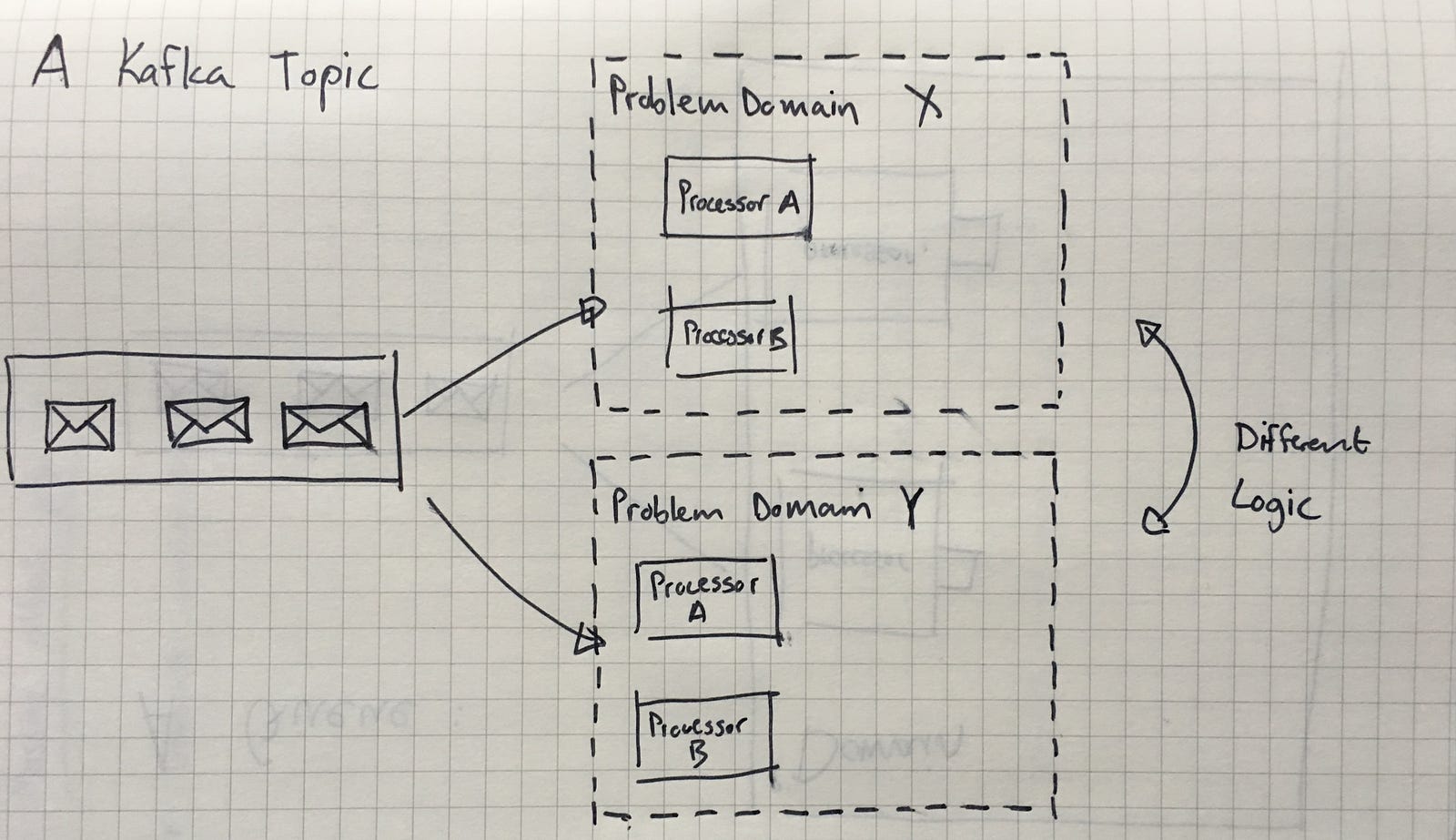
Different logic can be executed by different systems based on the same events
This is possible with Kafka due to the fact that messages are retained and the concept of consumer groups. Consumer groups in Kafka identify themselves to Kafka when they ask for messages on a topic. Kafka will record which messages (offset) were delivered to which consumer group, so that it doesn’t serve it up again. Actually, it is a bit more complex than that, because you have a bunch of configuration options available to control this, but we don’t need to explore the options fully just to understand Kafka at a high level.
Summary
There is a bunch more to Kafka, for example how it manages scaling out (partitions), configuration options for reliable messaging, etc. But my hope is that this article was good enough to let you understand why you would consider adopting Kafka over good ‘ol message queues.
快速比较 Kafka 与 Message Queue 的区别的更多相关文章
- 为什么要用Message Queue
摘录自博客:http://dataunion.org/9307.html?utm_source=tuicool&utm_medium=referral 为什么要用Message Queue 解 ...
- Message Queue的使用目的
为什么要用Message Queue 摘录自博客:http://dataunion.org/9307.html?utm_source=tuicool&utm_medium=referral ...
- 【转】快速理解Kafka分布式消息队列框架
from:http://blog.csdn.net/colorant/article/details/12081909 快速理解Kafka分布式消息队列框架 标签: kafkamessage que ...
- 消息队列(Message Queue)基本概念(转)
背景 之前做日志收集模块时,用到flume.另外也有的方案,集成kafaka来提升系统可扩展性,其中涉及到消息队列当时自己并不清楚为什么要使用消息队列.而在我自己提出的原始日志采集方案中不适用消息队列 ...
- Top 10 Uses For A Message Queue
We’ve been working with, building, and evangelising message queues for the last year, and it’s no se ...
- MSMQ(Microsoft Message Queue)
http://www.cnblogs.com/sk-net/archive/2011/11/25/2232341.html 利用 MSMQ(Microsoft Message Queue),应用程序开 ...
- 快速理解Kafka分布式消息队列框架
作者:刘旭晖 Raymond 转载请注明出处 Email:colorant at 163.com BLOG:http://blog.csdn.net/colorant/ ==是什么 == 简单的说,K ...
- [转载] 快速理解Kafka分布式消息队列框架
转载自http://blog.csdn.net/xiaolang85/article/details/18048631 ==是什么 == 简单的说,Kafka是由Linkedin开发的一个分布式的消息 ...
- 消息队列(Message Queue)简介及其使用
消息队列(Message Queue)简介及其使用 摘要:利用 MSMQ(Microsoft Message Queue),应用程序开发人员可以通过发送和接收消息方便地与应用程序进行快速可靠的通信.消 ...
随机推荐
- selenium中CSS选择器定位
selenium元素定位,CSS选择器定位效率会高很多. CSS选择器用于选择你想要的元素的样式的模式.表格摘自“菜鸟教程”,具体用法可去查阅 选择器 示例 示例说明 CSS .class .intr ...
- 线程(Thread,ThreadPool)、Task、Parallel
线程(Thread.ThreadPool) 线程的定义我想大家都有所了解,这里我就不再复述了.我这里主要介绍.NET Framework中的线程(Thread.ThreadPool). .NET Fr ...
- _string
-- 游戏提示字符串设置-- 小技巧:可以修改游戏的自定义表相关提示符 1 |cFFF49B00[世界聊天]|r%s:%s2 |cFFFC5900[登录公告]|r|cFFFBF326欢迎%s登录创世魔 ...
- @staticmethod和@classmethod
一般来说,要使用某个类的方法,需要先实例化一个对象再调用方法. 而使用@staticmethod或@classmethod,就可以不需要实例化,直接类名.方法名()来调用. 这有利于组织代码,把某些应 ...
- prometheus相关文章
prometheus book https://yunlzheng.gitbook.io/prometheus-book/ 开发自己的分布式监控Prometheus Exporter时遇到的坑 htt ...
- Python自学:第三章 使用方法pop()删除元素
motorcycle = ["honda", "yamaha", "suzuki"] last_owned = motorcycle.pop ...
- 【Mybatis】【3】mybatis Example Criteria like 模糊查询
正文: 在Java中使用Mybatis自动生成的方法,like需要自己写通配符 public List<TableA> query(String name) { Example examp ...
- Could not autowire. No beans of 'xxxx' type found的错误
在Idea的spring工程里,经常会遇到Could not autowire. No beans of 'xxxx' type found的错误提示.但程序的编译和运行都是没有问题的,这个错误提示并 ...
- 16、for-of循环
forEach不支持break for-in把数组当做对象来遍历,但是只能遍历出索引值 for-of循环可以遍历出数组的每一项值,支持break 1.for-in示范: 2.for-of示范 3.fo ...
- 【macOS】 在OpenCV下训练Haar特征分类器
本教程基于以下环境 macOS 10.12.6,OpenCV 3.3.0,python 3.6.由于网上基于masOS系统的教程太少,想出一篇相关教程造福大家-本文旨在学习如何在opencv中基于ha ...