
WICED -- Wireless Internet Connectivity for Embedded Devices


Broadcom's Wireless Internet Connectivity for Embedded Devices (WICED™) platform (pronounced "wik-id") eases development effort and simplifies the implementation of Internet connectivity in an array of consumer devices, especially those without existing support for networking.
Developers use the WICED platform to create secure wireless networking applications on a wide array of platforms encompassing Broadcom wireless connectivity technologies. The WICED platform encompasses:
- WICED™ Wi-Fi - a development system for Wi-Fi Connectivity
- WICED SMART™ - a development system for Bluetooth Smart (Bluetooth Low Energy) applications
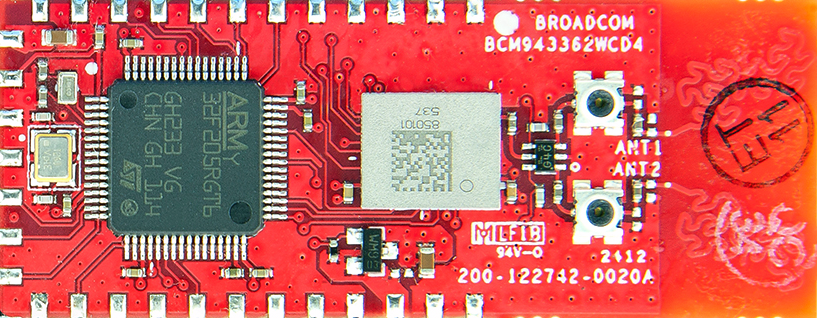
Use the WICED Development System to create secure embedded wireless networking applications on an existing product microcontroller, or on an additional WICED module that includes a microcontroller. Either way, the comprehensive and size-optimized WICED application library and embedded Wi-Fi driver work together with a Broadcom® embedded wireless LAN chip to provide seamless wireless connectivity.
If you need ultra low power wireless, use the included WICED SmartBridge™ API to provide seamless data aggregation and internet connectivity for WICED Smart devices too!
WICED™ Wi-Fi Development Kits
Broadcom provides a WICED Software Development Kit and is working with partners to deliver turnkey hardware solutions to enable Wi-Fi connectivity.
WICED™ Wi-Fi Software Development Kit
The WICED SDK includes
- An open source build system and toolchain based on GNU make (native IAR support coming soon!).
- A GUI Development Environment based on Eclipse CDT that seamlessly integrates with a JTAG programmer and single-step, thread-aware debugger based on OpenOCD and gdb.
- A comprehensive software stack with a choice of several RTOS/TCP stack options includingThreadX/NetX, ThreadX/NetX Duo and FreeRTOS/LwIP.
- Advanced security and networking features such as SSL/TLS, IPv4/IPv6 networking, and mDNS (Bonjour) device discovery.
- Bluetooth Low Energy SmartBridge™ to connect Bluetooth Smart devices to Wi-Fi
- WICED Application Framework including bootloader, flash storage API, over-the-air (OTA) upgrades, factory reset, and system monitor.
- Simple out-of-box device setup using Apple-licensed MFi technology or via a web browser and softAP/webserver.
- Production ready sample applications.
- Lots of application snippets demonstrating how to use the rich WICED API feature set.
- Various test applications to aid manufacturing and certification.
- All documentation included inside the WICED SDK.
The WICED™ Wi-Fi SDK and Documentation can be downloaded here after completing the registration process.
BCM943362WCD4_EVB --- WICED™ Wi-Fi Evaluation Kits

 What is WICED?
- WICED™ is a development system that vastly reduces the effort required to add wireless connectivity to embedded devices.
The SDK enables developers to quickly create network connected applications targeted for low-resource microcontrollers.
What is included in the WICED™ SDK?The WICED SDK includes :
- An open source build system and toolchain based on GNU make.
- A GUI IDE based on Eclipse CDT that seamlessly integrates with a programmer and single-step, thread-aware, debugger based on OpenOCD and gdb.
- A complete software stack that includes advanced security and networking features such as SSL/TLS, IPv4/IPv6 networking, and mDNS/Bonjour.
- Production ready example applications.
Which Operating Systems does the SDK run on?- The WICED SDK runs on all major operating systems including Windows®, Mac OS X and Linux.
How much does the SDK cost?- The SDK is available free when developing applications on microcontrollers connected to Broadcom Wi-Fi products.
Which RTOS & Network Stacks are available with the SDK?- Two options are available: a commercial option which is provided as linkable object files, and an open source option. Both options are free when used with microprocessors connected to a Broadcom Wi-Fi chip. The commercial option, ThreadX/NetXDuo from Express Logic, provides full IPv4 and IPv6 networking functionality. The open source option, FreeRTOS/LwiP only provides IPv4 networking functionality.
What if I want to use a different RTOS or Network Stack?- The WICED™ API abstracts the RTOS & networking stack in an attempt to avoid the need for developers to interact directly with these software components. The abstraction layer is written to minimize the effort required to port to other RTOS & Network Stacks if desired.
Does the SDK support Wi-Fi Protected Setup (WPS)?- Yes. WPS 1.0 and 2.0 are supported. The WPS supplicant runs on the microcontroller.
How much Flash and RAM does my application need?- Application resource requirements vary depending on networking and security features required by the application. Most applications require at least 512kB Flash memory and 64-128kB RAM.
Where do I buy WICED™ evaluation boards?- WICED™ modules and evaluation boards are available from Broadcom, ODMs and third-party distributors here.
Does WICED™ support SSL/TLS security?- Yes. WICED™ supports TLS up to version 1.1. Coupled with the included http client and http server modules, WICED™ supports full HTTPS encryption. The SSL/TLS supplicant runs on the microcontroller.
Which Microcontrollers are supported by the SDK?- The SDK supports a range of STM32 microprocessors from ST Microelectronics, the SAM4 series from Atmel and Kinetis K60 from Freescale. Support for microprocessors from additional vendors is in progress.
Does the WICED™ SDK support a SEP2.0 stack?- Yes. A SEP2.0 stack for WICED™ is available from one of Broadcom's partners. Please contact Broadcom sales to obtain further details.
Does the WICED™ SDK support Wi-Fi Direct?- Yes. The core features of Wi-Fi Direct (softAP, DHCP server and WPS) are available as part of the WICED™ SDK.
Does the Wi-Fi security supplicant run on the microcontroller?- No. The Wi-Fi security supplicant runs on the Broadcom Wi-Fi chip.
Where do I get support?- General support for the WICED Development System is available on the WICED forum.
WICED -- Wireless Internet Connectivity for Embedded Devices的更多相关文章
- 论文翻译:2020_Lightweight Online Noise Reduction on Embedded Devices using Hierarchical Recurrent Neural Networks
论文地址:基于分层递归神经网络的嵌入式设备轻量化在线降噪 引用格式:Schröter H, Rosenkranz T, Zobel P, et al. Lightweight Online Noise ...
- WM-N-BM-09 WM-N-BM-14
USI Delivers WICED Module to Gain Great Success Customers Broadcom’s Wireless Internet Connectivity ...
- [转]A Guide To using IMU (Accelerometer and Gyroscope Devices) in Embedded Applications.
原文地址http://www.starlino.com/imu_guide.html Introduction There’s now a FRENCH translation of this art ...
- Smart internet of things services
A method and apparatus enable Internet of Things (IoT) services based on a SMART IoT architecture by ...
- Single-stack real-time operating system for embedded systems
A real time operating system (RTOS) for embedded controllers having limited memory includes a contin ...
- 微软职位内部推荐-SW Engineer II for Embedded System
微软近期Open的职位: Do you have a passion for embedded devices and services?   Does the following m ...
- Methods for Using Message Queuing Telemetry Transport for Sensor Networks to Support Sleeping Devices
Methods support a sleep mode for an embedded device. Embedded devices like sensors and actuators use ...
- 无线电源传输 Wireless Power Consortium (WPC) Communication
Universally Compatible Wireless Power Using the Qi Protocol Wireless charging of portable electronic ...
- Using QEMU for Embedded Systems Development
http://www.opensourceforu.com/2011/06/qemu-for-embedded-systems-development-part-1/ http://www.opens ...
随机推荐
- UVA题解一
UVA 100 题目描述:经典3n+1问题在\(n \leq 10^6\)已经证明是可行的,现在记\(f[n]\)为从\(n\)开始需要多少步才能到\(1\),给出\(L, R\),问\(f[L], ...
- [ python ] 练习作业 - 3
1. 写出Python查找一个变量的顺序 提示:4中作用域的顺序 本地作用域(local) --> 当前作用域被嵌入的本地作用域(enclsing locals) --> 全局/模块作用域 ...
- hive中行转换成列以及hive相关知识
Hive语句: Join应该把大表放到最后 左连接时,左表中出现的JOIN字段都保留,右表没有连接上的都为空.对于带WHERE条件的JOIN语句,例如: 1 SELECT a.val, b.val F ...
- ASP.NET Core 2.0 MVC 发布部署--------- CentOS7 X64 具体操作
.Net Core 部署到 CentOS7 64 位系统中的步骤 1.安装工具 1.apache 2..Net Core(dotnet-sdk-2.0) 3.Supervisor(进程管理工具,目的是 ...
- hive学习(五) 应用案例
1.实现struct数据结构例子 1.1创建student表 create table student( id int, info struct<name:string,age:int> ...
- nginx文件类型错误解析漏洞
漏洞介绍:nginx是一款高性能的web服务器,使用非常广泛,其不仅经常被用作反向代理,也可以非常好的支持PHP的运行.80sec发现 其中存在一个较为严重的安全问题,默认情况下可能导致服务器错误的将 ...
- 如何去除decimal后面的零?
如何去除decimal后面的零? 1.260000m.ToString("G29") 不显示科学记数法? decimal.Parse("0.0000001",S ...
- day5时间复杂度
时间复杂度 (1)时间频度 一个算法执行所耗费的时间,从理论上是不能算出来的,必须上机运行测试才能知道.但我们不可能也没有必要对每个算法都上机测试,只需知道哪个算法花费的时间多,哪个算法花 ...
- 在LoadRunner中从数组类型的参数随机取值的方法
在LoadRunner中从数组类型的参数随机取值的方法 使用web_reg_save_param做关联后,有时候会有多个匹配值. 为了模仿用户行为随机取一个值为后续transcation所用,可以使用 ...
- karma+seajs
下面的介绍以karma能正常运行为前提,看karma系列文章:http://www.cnblogs.com/laixiangran/tag/Karma/ 目录结构 步骤 安装 npm install ...