
1、puppet基础
Puppet:IT基础设施自动化管理工具

参考文章:

https://yq.aliyun.com/articles/120228

http://www.51niux.com/?id=105

http://www.zsythink.net/archives/category/%E8%BF%90%E7%BB%B4%E7%9B%B8%E5%85%B3/puppet/

可以管理整个生命周期:

provisioning:自动化安装系统

configuration:配置

orchestration:编排

reporting:报告

Puppet是C/S架构的,所以需要在client端安装agent,那么在安装agent之前,client是不受server端控制的,那么该如何在大量的client上安装agent呢?

可以在自动部署系统的时候直接把puppet的agent加入到系统中,当部署好的系统启动时,client会自动去查找server端。

master/agent

master:puppet server

agent:接受每一个master发来的指令,接受指令后完成操作,agent端拥有管控功能,几乎可以实现所有功能;

      所以只要将需要实现的功能扔到master端,master就会分发到agent端,agent就会实现大部分功能,所以puppet的中心在agent上;

   所以agent是真正执行相应管理操作的核心部件。但是agent只能管理单个节点,所以需要master协调、管理agent端;

   agent会周期性的去master端请求与自己相关的配置,并根据master端提供的配置,确保本地(agent)的配置符合master端的要求;

master和agent两端通过逻辑认证,就可以通信,agent在本地(即client端)拥有权限。

puppet的工作模式:

声明性、基于模型的配置语言:

定义:puppet的master端要指明每一个agent,为每个agent提供配置,管理员使用puppet配置语言定义基础配置信息

模拟:master端定义完配置信息,puppet的agent就会在本地模拟、此时运行,没有错误后再执行;

强制:强制当前节点与定义的目标状态保持一致;

报告:执行完成后,agent端通过puppet api将执行结果发送给接收者

Puppet是如何工作的:

Configuration Language:配置语言

Transactional Layer:事务层,资源之间可能会有依赖关系

Resource Abstration Layer:资源抽象层

资源类型:例如用户、组、文件、服务、cron任务等等;

属性及状态 与 其实现方式是分离的:

期望状态:

puppet的核心组件:资源

资源清单:manifests

资源清单及清单中的资源定义的所依赖文件、模板等数据按特定结构组织起即为"模板"

Puppet本地工作模式

Puppet的master\agent工作模式

站点清单是为一个主机所定义的清单,即一个站点相当于一个主机;

清单主要是用来放资源的,

Puppet是如何工作的?

这里大致分为三个模块,紫色模块、黄色模块、蓝色模块

第一个主机用到了两个蓝色模块,说明这台主机用到了蓝色模块中的不同的资源资源清单

每一个agent到master端去请求与自己相关的配置的时候,将会将请求发送给master端,发送时还会报告自己的facter,master端收到报告后会查找此主机的名称,并找与主机名称相对应的站点清单文件,站点清单定义了这个主机需要的清单,master会把这些清单调出来进行编译,然后发给agent。

m

定义模块是为了代码重用的,模块可以理解为是清单的组合

学习puppet主要学习它的配置语言是如何使用的。puppet也可以在单机模式进行使用,即在agent上配置资源清单,直接在agent上执行
puppet的agent端安装配置
单机安装puppet时:
agent端需要安装puppet和facter,因为agent端链接master端需要报告自己的facter。
如果是C/S架构的话,master端则需要安装puppet-server,如果master端需要跟自己交互,也需要安装puppet
# yum list all | grep -i "puppet" //查看epel源中收录的rpm包
https://yum.puppet.com/index_by_lastModified_reverse.html

yum.repos.d]# wget https://yum.puppet.com/puppet-release-el-7.noarch.rpm

yum.repos.d]# rpm -ivh puppet-release-el-.noarch.rpm

warning: puppet-release-el-.noarch.rpm: Header V4 RSA/SHA256 Signature, key ID ef8d349f: NOKEY

Preparing...                          ################################# [%]

Updating / installing...

   :puppet-release-1.0.-.el7       ################################# [%]
yum.repos.d]# yum install puppet
# rpm -ql puppet-agent
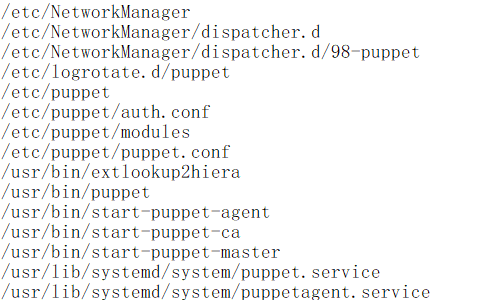
# puppet help //查看命令的用法格式
Usage: puppet <subcommand> [options] <action> [options]

Available subcommands:

  agent             The puppet agent daemon

  apply             Apply Puppet manifests locally

  ca                Local Puppet Certificate Authority management.

  catalog           Compile, save, view, and convert catalogs.

  cert              Manage certificates and requests

  certificate       Provide access to the CA for certificate management.

  certificate_request  Manage certificate requests.

  certificate_revocation_list  Manage the list of revoked certificates.

  config            Interact with Puppet's settings.

  describe          Display help about resource types

  device            Manage remote network devices

  doc               Generate Puppet documentation and references

  facts             Retrieve and store facts.

  file              Retrieve and store files in a filebucket

  filebucket        Store and retrieve files in a filebucket

  help              Display Puppet help.

  inspect           Send an inspection report

  instrumentation_data  Manage instrumentation listener accumulated data.

  instrumentation_listener  Manage instrumentation listeners.

  instrumentation_probe  Manage instrumentation probes.

  key               Create, save, and remove certificate keys.

  kick              Remotely control puppet agent

  man               Display Puppet manual pages.

  master            The puppet master daemon

  module            Creates, installs and searches for modules on the Puppet Forge.

  node              View and manage node definitions.

  parser            Interact directly with the parser.

  plugin            Interact with the Puppet plugin system.

  queue             Deprecated queuing daemon for asynchronous storeconfigs

  report            Create, display, and submit reports.

  resource          The resource abstraction layer shell

  resource_type     View classes, defined resource types, and nodes from all manifests.

  secret_agent      Mimics puppet agent.

  status            View puppet server status.

See 'puppet help <subcommand> <action>' for help on a specific subcommand action.

See 'puppet help <subcommand>' for help on a specific subcommand.

Puppet v3.6.2
# puppet describe -l
# puppet describe RESOURCE_TYPE
These are the types known to puppet:

augeas          - Apply a change or an array of changes to the  ...

computer        - Computer object management using DirectorySer ...

cron            - Installs and manages cron jobs

exec            - Executes external commands

file            - Manages files, including their content, owner ...

filebucket      - A repository for storing and retrieving file  ...

group           - Manage groups

host            - Installs and manages host entries

interface       - This represents a router or switch interface

k5login         - Manage the `.k5login` file for a user

macauthorization - Manage the Mac OS X authorization database

mailalias       - .. no documentation ..

maillist        - Manage email lists

mcx             - MCX object management using DirectoryService  ...

mount           - Manages mounted filesystems, including puttin ...

nagios_command  - The Nagios type command

nagios_contact  - The Nagios type contact

nagios_contactgroup - The Nagios type contactgroup

nagios_host     - The Nagios type host

nagios_hostdependency - The Nagios type hostdependency

nagios_hostescalation - The Nagios type hostescalation

nagios_hostextinfo - The Nagios type hostextinfo

nagios_hostgroup - The Nagios type hostgroup

nagios_service  - The Nagios type service

nagios_servicedependency - The Nagios type servicedependency

nagios_serviceescalation - The Nagios type serviceescalation

nagios_serviceextinfo - The Nagios type serviceextinfo

nagios_servicegroup - The Nagios type servicegroup

nagios_timeperiod - The Nagios type timeperiod

notify          - .. no documentation ..

package         - Manage packages

resources       - This is a metatype that can manage other reso ...

router          - .. no documentation ..

schedule        - Define schedules for Puppet

scheduled_task  - Installs and manages Windows Scheduled Tasks

selboolean      - Manages SELinux booleans on systems with SELi ...

selmodule       - Manages loading and unloading of SELinux poli ...

service         - Manage running services

ssh_authorized_key - Manages SSH authorized keys

sshkey          - Installs and manages ssh host keys

stage           - A resource type for creating new run stages

tidy            - Remove unwanted files based on specific crite ...

user            - Manage users

vlan            - .. no documentation ..

whit            - Whits are internal artifacts of Puppet's curr ...

yumrepo         - The client-side description of a yum reposito ...

zfs             - Manage zfs

zone            - Manages Solaris zones

zpool           - Manage zpools
1、puppet基础的更多相关文章
- Puppet基础应用
Puppet简介 IT基础设施自动化管理工具,作者:Luck Kanies,官方站点:www.puppetlabs.com 管理设施的整个生命周期: provisioning.configuratio ...
- Puppet基础
基础架构图介绍 自动化运维框架: 自动化监控: puppet介绍 常用的批量工具介绍: OS Provisioning:PXE,Cobbler OS Configuration:ansible,pu ...
- 自动化运维工具之Puppet基础入门
一.简介 puppet是什么?它能做什么? puppet是一个IT基础设施自动化运维工具,它能够帮助系统管理员管理基础设施的整个生命周期:比如,安装服务,提供配置文件,启动服务等等一系列操作:基于pu ...
- Advanced Puppet 系列的前言
什么是Advanced 在网络上,你能找到大量关于Puppet的安装,配置以及基础用法的文章和博客.你在通过一段时间的实战后,熟练掌握了Puppet基础用法,随着你管理的集群日益扩大,你的部署逻辑越来 ...
- puppet一个完整的实例
一个具体实例来简单说明puppet的具体结构 创建第一个配置 puppet的组成清单这主要包含这几个部分 资源,文件,模板,节点,类,定义 puppet中有个模块的定义,这个比较重要,基本是puppe ...
- ansible puppet saltstack三款自动化运维工具的对比
一.基础介绍 ansible基础介绍可参考:http://www.linuxidc.com/Linux/2017-12/149671.htm puppet基础介绍可参考:http://www.linu ...
- ansible超详细使用指南
在工作中有用到ansible用于自动部署和环境配置,这里整理了一份很详尽的使用指南,如果有用到的可以看看.关于使用ansible自动部署一个网站和docker化,将在下一篇文章中介绍,敬请期待.文章内 ...
- DveOps路线指南
学习DevOps所需的技能 1. 编程语言 python java javascrit 2. 学习不同的操作系统概念 进程管理,线程和兵法,套接字,I/O管理,虚拟化,内存储存储和文件系统. 3. ...
- [翻译]用 Puppet 搭建易管理的服务器基础架构(4)
我通过伯乐在线翻译了一个Puppet简明教程,一共分为四部分,这是第四部分. 原文地址:http://blog.jobbole.com/89214/ 本文由 伯乐在线 - Wing 翻译,黄利民 校稿 ...
随机推荐
- Rsync+Sersync实时同步数据目录
第1章 Rsync简介 1.1 Rsync基本概述 rsync是一款开源的备份工具,可以在不同主机之间进行同步,可实现全量备份与增量备份 全量:将全部数据,进行传输覆盖 增量:只传输差异部分的数据 1 ...
- 网络协议相关面试问题-http协议相关面试问题
HTTP协议简介: 一些基本概念: 协议:指计算机通信网络中两台计算机之间进行通信所必须共同遵守的规定或规则. HTTP协议:超文本传输协议(HTTP)是一种通信协议,它允许将超文本标记语言(HTML ...
- SAP选择屏幕下拉框实现
DATA:vid TYPE vrm_id , "屏幕字段(可以是单个的I/O空间或者是Table Control中的一个单元格) list TYPE vrm_values, value LI ...
- Python Module模块
模块 https://docs.python.org/zh-cn/3/tutorial/modules.html 模块的概念被高级语言广泛使用. Python的定义 一个包括Python定义和语句的文 ...
- [转]DSL-让你的 Ruby 代码更优秀
https://ruby-china.org/topics/38428 以下摘录 DSL和Gpl DSL : domain-specific language.比如HTML是用于组织网页的‘语言’, ...
- 2019CCPC秦皇岛(重现赛)-D
链接: http://acm.hdu.edu.cn/contests/contest_showproblem.php?pid=1004&cid=872 题意: 给定一个正整数 n,要求判断 1 ...
- 直接插入排序java代码
//直接插入排序(无哨兵) 通过测试 public class InsertSortTest{ public static void insertSort(int[] arr) { for (int ...
- 【数据库】-各类数据库链接驱动和URL的书写格式
oracle: driver="oracle.jdbc.driver.OracleDriver" url="jdbc:oracle:thin:@localhost:152 ...
- 快速拿下CSS盒子模型
下面的图片就是Chrome浏览器审查元素里的盒子情况展示,我们可以看到一个容器由4个颜色代表的内容组成:内容(content).填充(padding).边框(border).边界(margin),在这 ...
- maven打断点报错