
【BFS】Tester Program
| Time Limit: 1000MS | Memory Limit: 10000K | |
| Total Submissions: 2760 | Accepted: 981 |
Description
For this contest, we first designed the following problem (note that you do not have to solve it!):
Another Wall in the Maze
In ACM/ICPC contests, you'll often see questions such as "find the shortest path out of this maze." Let's turn this on its head and ask "given a path, find a maze for which the given path is the shortest path." Our paths will run vertically and horizontally between the regularly spaced points of a rectangular grid. The problem is to compute a set of unit-length baffles (walls) separating grid points that forces the given path to be the unique shortest path from its starting point to the end point. To make things more interesting, we will require that there should be no redundant walls constructed in the sense that it should not be possible to remove any wall and still have the given path as the unique shortest path. In the following figure for example, consider the path through the 8 ? 5 grid on the left maze of the top row. The wall placements in the two mazes to its right (top row) make that path unique. The two mazes on the lower row are faulty.
The path is not unique in the one on the left, and there are some redundant walls on the right. 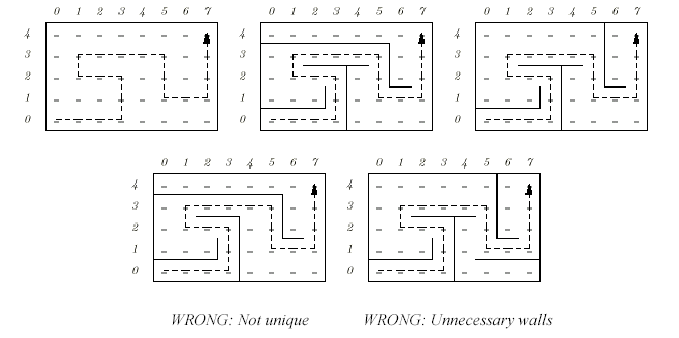
Input (of the original problem)
The first line of the input file contains a single integer t (1 ≤ t ≤ 10), the number of test cases, followed by the input data for each test case. The first line of each test case consists of two integers W and H (1 ≤ W, H ≤ 100) giving the width and height of the grid respectively. The second line of the test case contains a path. The path always starts in the lowerleft corner, (0, 0). It is specified as a string of U (up), D (down), L (left), and R (right) characters (with no embedded white space). You may assume that the path remains within the bounds of the maze and does not intersect itself. It may end anywhere in the maze (i.e., not necessarily in a corner or against a wall).
Output (of the original problem)
First line of the output for the i-th test case (starting from one) should contain an integer M, the number of walls used in the solution. Following the first line, there are M lines each containing a wall specification in the form of four consecutive integers corresponding to two pairs of (x, y) coordinates specifying adjacent grid points separated by the wall (0 ≤ x < W and 0 ≤ y < H). Note that the possible output is not unique. There should no blank line in the output.
Sample Input (of the original problem)
2
8 5
RRRUULLURRRRDDRRUUU
4 3
RRRUU
Sample Output (of the original problem)
19
0 0 0 1
1 0 1 1
2 0 2 1
2 1 3 1
3 0 4 0
3 1 4 1
3 2 4 2
3 2 3 3
2 2 2 3
4 2 4 3
0 3 0 4
1 3 1 4
2 3 2 4
3 3 3 4
4 3 4 4
5 3 5 4
5 3 6 3
5 2 6 2
6 1 6 2
2
2 2 3 2
2 2 2 1
This is the end of the original problem statement! Being lazy, we did not want to spend time to write a tester program for this problem, and decided to have you write this for us!
Write a program that receives both input and output as one input test case, and write as output CORRECT or INCORRECT to indicate whether or not the output is correct.
Input
Note that the output of original does not have formatting problems, i.e.,
The number of lines in the output file is correct and is as supposed to be.
There are no leading or trailing white space characters in output lines.
Wall specifications are correct, meaning that the four numbers correctly specify a possible wall within the boundary of the maze.
Output
Sample Input
2

8 5

RRRUULLURRRRDDRRUUU

19

0 0 0 1

1 0 1 1

2 0 2 1

2 1 3 1

3 0 4 0

3 1 4 1

3 2 4 2

3 2 3 3

2 2 2 3

4 2 4 3

0 3 0 4

1 3 1 4

2 3 2 4

3 3 3 4

4 3 4 4

5 3 5 4

5 3 6 3

5 2 6 2

6 1 6 2

4 3

RRRUU

2

2 2 3 2

2 2 2 1
Sample Output
CORRECT

INCORRECT
Source
#include<iostream>

#include<cstring>

#include<cstdio>

#include<algorithm>

using namespace std;

inline int read(){

    int x=0,f=1;char c=getchar();

    for(;!isdigit(c);c=getchar()) if(c=='-') f=-1;

    for(;isdigit(c);c=getchar()) x=x*10+c-'0';

    return x*f;

}

int T;

int N,M;

char str[100001];

bool path[101][101];

bool to[101][101][4];//0:up 1:do 2:lf 3:rt

int toed[101][101];

int tobg[101][101];

bool vis[101][101];

int stx,sty;

int W;

int a1[1001],b1[1001],c1[1001],d1[1001];

struct data{

    int x,y,st;

}Que[100001];

int dis[5][2]={{1,0},{0,1},{-1,0},{0,-1}};

void BFS(bool k){

    int l=1,r=1;

    Que[l].x=stx,Que[l].y=sty;

    vis[stx][sty]=true;

    while(l<=r){

        int a=Que[l].x,b=Que[l].y;

        //cout<<a<<" "<<b<<":"<<Que[l].st<<endl;

        for(int i=0;i<4;i++){

        	//cout<<to[a][b][i]<<endl;

            if(to[a][b][i]){continue;}

            int xx=a+dis[i][0];

            int yy=b+dis[i][1];

            if(xx<0||yy<0||xx>N-1||yy>M-1||vis[xx][yy]) continue;

            vis[xx][yy]=true;

            if(k==0)toed[xx][yy]=Que[l].st+1;

            else tobg[xx][yy]=Que[l].st+1;

            Que[++r].st=Que[l].st+1;

            Que[r].x=xx,Que[r].y=yy;

        }

        l++;

    }

    return ;

}

int main(){

    T=read();

    while(T--){

       N=read(),M=read();

       cin>>str;int len=strlen(str);

       memset(to,0,sizeof(to));

       memset(path,0,sizeof(path));

       memset(toed,0,sizeof(toed));

       memset(tobg,0,sizeof(tobg));

       for(int i=0;i<N;i++)

            to[i][0][3]=to[i][M-1][1]=1;

        for(int i=0;i<M;i++)

            to[0][i][2]=to[N-1][i][0]=1;

       stx=0,sty=0;

       path[stx][sty]=true;

       for(int i=0;i<len;i++){

           if(str[i]=='R') stx++;

           if(str[i]=='L') stx--;

           if(str[i]=='D') sty--;

           if(str[i]=='U') sty++;

           path[stx][sty]=true;

       }

       W=read();

       for(int i=1;i<=W;i++){

           int a=read(),b=read(),c=read(),d=read();

           if(b<d){

               to[a][b][1]=true;

               to[c][d][3]=true;

           }

           if(b>d){

               to[a][b][3]=true;

               to[c][d][1]=true;

           }

           if(a<c){

               to[a][b][0]=true;

               to[c][d][2]=true;

           }

           if(a>c){

               to[a][b][2]=true;

               to[c][d][0]=true;

           }

           a1[i]=a,b1[i]=b,c1[i]=c,d1[i]=d;

       }

       memset(vis,0,sizeof(vis));

       BFS(0);

       memset(vis,0,sizeof(vis));

       stx=0,sty=0;

       BFS(1);

       bool flag=false;

       for(int i=0;i<N;i++){

           for(int j=0;j<M;j++){

               if(!path[i][j]){

                   if(tobg[i][j]+toed[i][j]<=len){

                       flag=true;

                       //break;

                   }

               }

               //if(!path[i][j])cout<<i<<" "<<j<<":"<<tobg[i][j]<<" "<<toed[i][j]<<endl;

		   }

           //if(flag) break;

       }

       if(flag){

           puts("INCORRECT");

           continue;

       }

       for(int i=1;i<=W;i++){

           if((tobg[a1[i]][b1[i]]+toed[c1[i]][d1[i]]>len)&&(tobg[c1[i]][d1[i]]+toed[a1[i]][b1[i]]>len))

               {flag=true;break;}

       }

       if(flag){

           puts("INCORRECT");

           continue;

       }

       puts("CORRECT");

    }

}
【BFS】Tester Program的更多相关文章
- 【BFS】Help the Princess!
题目描述 The people of a certain kingdom make a revolution against the bad government of the princess. T ...
- 【bfs】抓住那头牛
[题目] 农夫知道一头牛的位置,想要抓住它.农夫和牛都位于数轴上,农夫起始位于点N(0≤N≤100000),牛位于点K(0≤K≤100000).农夫有两种移动方式: 1.从X移动到X-1或X+1,每次 ...
- 【bfs】拯救少林神棍(poj1011)
Description 乔治拿来一组等长的木棒,将它们随机地砍断,使得每一节木棍的长度都不超过50个长度单位.然后他又想把这些木棍恢复到为裁截前的状态,但忘记了初始时有多少木棒以及木棒的初始长度.请你 ...
- 【bfs】Knight Moves
[题目描述] 输入nn代表有个n×nn×n的棋盘,输入开始位置的坐标和结束位置的坐标,问一个骑士朝棋盘的八个方向走马字步,从开始坐标到结束坐标可以经过多少步. [输入] 首先输入一个nn,表示测试样例 ...
- 【bfs】1252 走迷宫
[题目描述] 一个迷宫由R行C列格子组成,有的格子里有障碍物,不能走:有的格子是空地,可以走. 给定一个迷宫,求从左上角走到右下角最少需要走多少步(数据保证一定能走到).只能在水平方向或垂直方向走,不 ...
- 【bfs】献给阿尔吉侬的花束
[题目描述] 阿尔吉侬是一只聪明又慵懒的小白鼠,它最擅长的就是走各种各样的迷宫.今天它要挑战一个非常大的迷宫,研究员们为了鼓励阿尔吉侬尽快到达终点,就在终点放了一块阿尔吉侬最喜欢的奶酪.现在研究员们想 ...
- 【bfs】迷宫问题
[题目描述] 定义一个二维数组: int maze[5][5] = { 0,1,0,0,0, 0,1,0,1,0, 0,0,0,0,0, 0,1,1,1,0, 0,0,0,1,0, }; 它表示一个迷 ...
- 【bfs】仙岛求药
[题目描述] 少年李逍遥的婶婶病了,王小虎介绍他去一趟仙灵岛,向仙女姐姐要仙丹救婶婶.叛逆但孝顺的李逍遥闯进了仙灵岛,克服了千险万难来到岛的中心,发现仙药摆在了迷阵的深处.迷阵由M×N个方格组成,有的 ...
- 【bfs】BZOJ1102- [POI2007]山峰和山谷Grz
最后刷个水,睡觉去.Bless All! [题目大意] 给定一个地图,为FGD想要旅行的区域,地图被分为n*n的网格,每个格子(i,j) 的高度w(i,j)是给定的.若两个格子有公共顶点,那么他们就是 ...
随机推荐
- input placeholder 兼容问题
placeholder是html5出的新特性,ie9以下是不兼容的, 那么为了兼容ie9 我们需要对他做处理 //jq的处理方式$(function(){ jQuery('[placeholder] ...
- spring boot web 入门
① 新建一个maven项目. ② pom中parent设为 spring-boot-starter-parent .建议使用最新的 RELEASE 版本.否则可能需要设置 <repositori ...
- python产生随机样本数据
一.产生X样本 x_train = np.random.random((5, 3)) 随机产生一个5行3列的样本矩阵,也就是5个维度为3的训练样本. array([[ 0.56644011, 0.75 ...
- Python中的subprocess模块
Subprocess干嘛用的? subprocess模块是python从2.4版本开始引入的模块.主要用来取代 一些旧的模块方法,如os.system.os.spawn*.os.popen*.comm ...
- Eclipse svn 忽略文件夹/ svn 设置不同步
Eclipse 开发中我们经常用到SVN插件, 但是对于某些文件的缓存来说, 我们只要有操作缓存便会保存一次, 每次提交很是麻烦, 小编这里教你一种不同步某个文件夹的方法 工具/原料 MyEclips ...
- Django之项目搭建和配置总结(一)
安装和创建虚拟环境 参考:linux系统下Python虚拟环境的安装和使用 安装Django包 先进入虚拟环境,在联网下执行: pip install django==1.8.7 1.8.7表示dja ...
- 配置连接的IP、端口、以及相应的数据库
解压后里面有:lib 源文件 .examples 例子.test测试 将lib目录拷贝到你的项目中,就可以开始你的predis操作了. //使用autoload加载相关库,这边重点就是为了requir ...
- net_device->uc_promisc
如果设备不支持单播过滤,并且要监听多个单播地址时,就要使用net_device->uc_count和net_device->uc_promisc来设置混杂模式,具体见__dev_set_r ...
- centos_7.1.1503_src_5
http://vault.centos.org/7.1.1503/os/Source/SPackages/ minicom-2.6.2-5.el7.src.rpm 05-Jul-2014 13:50 ...
- Shell脚本中引用、调用另一个脚本文件的2种方法
Shell脚本中引用.调用另一个脚本文件的2种方法 http://www.jb51.net/article/67903.htm