
JavaSE--Arrays.copyof
背景:
想偷懒一次数组赋值下面多个例子复制下数组就好了..
以为 Arrays.copyof(Arrays.copyof内部调用的是 System.copy, 所以同 Arrays.copy)拷贝出来的数组和原来的数组是独立不干扰的.
然后就悲剧了..
原来copy之后的数组指向原数组的地址.
例:https://blog.csdn.net/qq_27093465/article/details/54970538
/**
arraycopy(Object src, int srcPos, Object dest, int destPos, int length);
 * Copies an array from the specified source array, beginning at the
 * specified position, to the specified position of the destination array.
从指定的 源数组位置 复制到 指定的目标数组的位置 来复制源数组.

     * A subsequence of array components are copied from the source

     * array referenced by <code>src</code> to the destination array

     * referenced by <code>dest</code>. The number of components copied is

     * equal to the <code>length</code> argument. The components at
从 源数组src 中复制子序列到 目标数组dest, 子序列的长度由 length参数控制.

     * positions <code>srcPos</code> through

     * <code>srcPos+length-1</code> in the source array are copied into

     * positions <code>destPos</code> through

     * <code>destPos+length-1</code>, respectively, of the destination

     * array.
从 src 数组中的 srcPos, srcPos+length-1 的元素将会被复制到 dest 数组的 destPos, destPos+length-1 位置.

     * <p>

     * If the <code>src</code> and <code>dest</code> arguments refer to the

     * same array object, then the copying is performed as if the

     * components at positions <code>srcPos</code> through

     * <code>srcPos+length-1</code> were first copied to a temporary

     * array with <code>length</code> components and then the contents of

     * the temporary array were copied into positions

     * <code>destPos</code> through <code>destPos+length-1</code> of the

     * destination array.
如果 src 和 dest 引用的是相同的数组,那么复制的过程就是首先从 数组的 srcPos, srcPos+length-1 复制到 length 长度的临时数组,
然后在从临时数组中拷贝内容到这个数组的 destPos, destPos+length-1 的位置.

     * <p>

     * If <code>dest</code> is <code>null</code>, then a

     * <code>NullPointerException</code> is thrown.
如果 dest 是 null, 会抛出 NullPointerException 异常.
* <p>
* If <code>src</code> is <code>null</code>, then a
* <code>NullPointerException</code> is thrown and the destination
* array is not modified.
如果 src 是 null, 也将会抛出 NullPointException 异常,但是并不会改变 dest 的内容.
* <p>
* Otherwise, if any of the following is true, an
* <code>ArrayStoreException</code> is thrown and the destination is
* not modified:
另外,下面的情况都会抛出 ArrayStoreException 异常,且都不会修改 dest 的内容.
* <ul>
* <li>The <code>src</code> argument refers to an object that is not an
* array.
  src 引用的对象不是数组.
* <li>The <code>dest</code> argument refers to an object that is not an
* array.
  dest 引用的对象不是数组.
* <li>The <code>src</code> argument and <code>dest</code> argument refer
* to arrays whose component types are different primitive types.
  src 和 dest 原始类型不同.
* <li>The <code>src</code> argument refers to an array with a primitive
* component type and the <code>dest</code> argument refers to an array
* with a reference component type.

* <li>The <code>src</code> argument refers to an array with a reference
* component type and the <code>dest</code> argument refers to an array
* with a primitive component type.
另外,下面的情况都会抛出 IndexOutOfBoundsException 异常,且都不会修改 dest 的内容.
* </ul>
* <p>
* Otherwise, if any of the following is true, an
* <code>IndexOutOfBoundsException</code> is
* thrown and the destination is not modified:
* <ul>
* <li>The <code>srcPos</code> argument is negative.
  srcPos 是负数.
* <li>The <code>destPos</code> argument is negative.
  destPos 是负数.
* <li>The <code>length</code> argument is negative.
  length 是负数.
* <li><code>srcPos+length</code> is greater than
  srcPos+length 大于 src 数组的出长度
* <code>src.length</code>, the length of the source array.
* <li><code>destPos+length</code> is greater than
* <code>dest.length</code>, the length of the destination array.
  destPos+length 大于 dest 数组的长度
* </ul>
* <p>
* Otherwise, if any actual component of the source array from
* position <code>srcPos</code> through
* <code>srcPos+length-1</code> cannot be converted to the component
* type of the destination array by assignment conversion, an
* <code>ArrayStoreException</code> is thrown. In this case, let
另外,如果 src 的元素不能转换成 dest 目标的类型,也会抛出 ArrayStoreException 异常.
* <b><i>k</i></b> be the smallest nonnegative integer less than
* length such that <code>src[srcPos+</code><i>k</i><code>]</code>
* cannot be converted to the component type of the destination
* array; when the exception is thrown, source array components from
* positions <code>srcPos</code> through
* <code>srcPos+</code><i>k</i><code>-1</code>
* will already have been copied to destination array positions
* <code>destPos</code> through
* <code>destPos+</code><i>k</I><code>-1</code> and no other
* positions of the destination array will have been modified.
* (Because of the restrictions already itemized, this
* paragraph effectively applies only to the situation where both
* arrays have component types that are reference types.)
特奶奶的,天书也没说到点子上,白看了....
*
* @param src the source array.
* @param srcPos starting position in the source array.
* @param dest the destination array.
* @param destPos starting position in the destination data.
* @param length the number of array elements to be copied.
* @exception IndexOutOfBoundsException if copying would cause
* access of data outside array bounds.
* @exception ArrayStoreException if an element in the <code>src</code>
* array could not be stored into the <code>dest</code> array
* because of a type mismatch.
* @exception NullPointerException if either <code>src</code> or
* <code>dest</code> is <code>null</code>.

*/ public static native void arraycopy(Object src, int srcPos, Object dest, int destPos, int length);
 import java.util.Arrays;

 public class ArrayCopyThink {

     public static void main(String[] args) {

         User u1 = new User("test1");

         User u2 = new User("test2");

         User u3 = new User("test3");

         User u4 = new User("test4");

         User[] users = {u1, u2, u3, u4};

         User u5 = new User("ooo");

         System.out.println("源数组 users: " + Arrays.toString(users));

         User[] copyUsers = new User[5];

         copyUsers[0] = u5;

         System.out.println("目标数组 copyUsers: " + Arrays.toString(copyUsers));

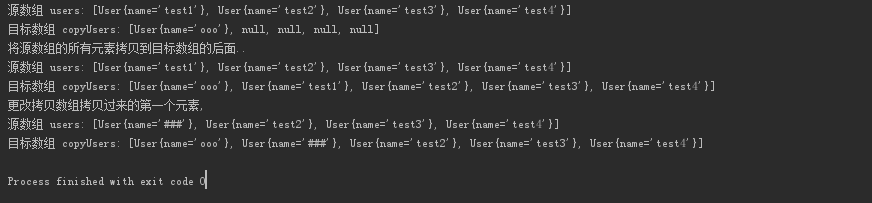
         System.out.println("将源数组的所有元素拷贝到目标数组的后面..");

         System.arraycopy(users, 0, copyUsers, 1, users.length);

         System.out.println("源数组 users: " + Arrays.toString(users));

         System.out.println("目标数组 copyUsers: " + Arrays.toString(copyUsers));

         System.out.println("更改拷贝数组拷贝过来的第一个元素,");

         copyUsers[1].setName("###");

         System.out.println("源数组 users: " + Arrays.toString(users));

         System.out.println("目标数组 copyUsers: " + Arrays.toString(copyUsers));

     }

     static class User {

         private String name;

         public User(String name) {

             this.name = name;

         }

         public String getName() {

             return name;

         }

         public void setName(String name) {

             this.name = name;

         }

         @Override

         public String toString() {

             return "User{" +

                     "name='" + name + '\'' +

                     '}';

         }

     }

 }
JavaSE--Arrays.copyof的更多相关文章
- System.arraycopy()和Arrays.copyOf()的区别
先看看System.arraycopy()的声明: public static native void arraycopy(Object src,int srcPos, Object dest, in ...
- Java-Java中System.arraycopy() 和 Arrays.copyOf()两者之间的区别
如果我们想拷贝一个数组,我们可能会使用System.arraycopy()或者Arrays.copyof()两种方式.在这里,我们将使用一个比较简单的示例来阐述两者之间的区别. 1.示例代码: Sys ...
- java数组的拷贝四种方法:for、clone、System.arraycopy、arrays.copyof
public class ArrayCopy{ public static void main(String []args){ int []a = {1,3,4,5}; toPrint(a); int ...
- Arrays.copyof
public static int[] copyOf(int[] original, int newLength) { int[] copy = new int[newLength]; System. ...
- System.arraycopy(src, srcPos, dest, destPos, length) 与 Arrays.copyOf(original, newLength)区别
//System.arraycopy,只拷贝已存在的数组元素 int[] src = {0, 1, 2}; int[] dest = new int[3]; System.arraycopy(src, ...
- 数组复制的五种方式(遍历循环一一赋值、System.arraycopy、地址赋值、克隆clone()、Arrays.copyof())
package com.Summer_0424.cn; import java.util.Arrays; import java.util.concurrent.CopyOnWriteArrayLis ...
- Arrays.copyOf() 和 System.arrayCopy()分析
java数组的拷贝四种方法:for.clone.System.arraycopy.Arrays.copyof public class Test1 { public static void main( ...
- Java中 System.arraycopy() 和 Arrays.copyOf()方法
System.arraycopy() 和 Arrays.copyOf()方法 阅读源码的话,我们就会发现 ArrayList 中大量调用了这两个方法.比如:我们上面讲的扩容操作以及add(int in ...
- System.arraycopy和arrays.copyOf
public static native void arraycopy(Object src, int srcPos, Object dest, int destPos, int length); 这 ...
- java.lang.System.arraycopy() 与java.util.Arrays.copyOf()的区别
java.lang.System.arraycopy() 与java.util.Arrays.copyOf()的区别 一.java.lang.System.arraycopy() 该方法的声明: /* ...
随机推荐
- 第2节 网站点击流项目(下):7、hive的级联求和
一.hive级联求和的简单例子: create table t_salary_detail(username string,month string,salary int)row format del ...
- jmeter抓取cnode网站token值
前置条件:已经登录 1.线程组下面先添加HTTP信息头管理器 1.1 jmeter向服务器发送http请求时,需要验证 cookie的等设置信息给到服务器去识别,因此,在发送请求前,我们一般会把相关需 ...
- dwr??
官方网站:http://directwebremoting.org/dwr/index.html http://m.blog.csdn.net/u013628152/article/details/5 ...
- Day4 - K - Ant Trip HDU - 3018
Ant Country consist of N towns.There are M roads connecting the towns. Ant Tony,together with his fr ...
- 获取选中行中的数据提取并且保存到txt
function getchcount(query: TADOQuery): Integer;var i:integer;begin i:=0; with Query do begin Query.F ...
- 八数码问题 双向BFS/Hsh链表存储
转自洛谷 作者EndSaH #include<iostream> #include<string> #include<cmath> #include<cstr ...
- 吴裕雄--天生自然java开发常用类库学习笔记:StringBuffer
public class StringBufferDemo01{ public static void main(String args[]){ StringBuffer buf = new Stri ...
- 吴裕雄 Bootstrap 前端框架开发——Bootstrap 字体图标(Glyphicons):glyphicon glyphicon-trash
<!DOCTYPE html> <html> <head> <meta charset="utf-8"> <meta name ...
- QEMU 配置网络
背景 为了 实现 uboot 中连接上 QEMU-host 的网络. 非常奇怪,本人的 系统中 存在/dev/net/tun驱动,但是 lsmod | grep tun 却没有任何结果,所以实际上,这 ...
- HihoCoder第八周:状态压缩 一
1044 : 状态压缩•一 时间限制:10000ms 单点时限:1000ms 内存限制:256MB 描述 小Hi和小Ho在兑换到了喜欢的奖品之后,便继续起了他们的美国之行,思来想去,他们决定乘坐火车前 ...