
Facebook Gradient boosting 梯度提升 separate the positive and negative labeled points using a single line 梯度提升决策树 Gradient Boosted Decision Trees (GBDT)
https://www.quora.com/Why-do-people-use-gradient-boosted-decision-trees-to-do-feature-transform
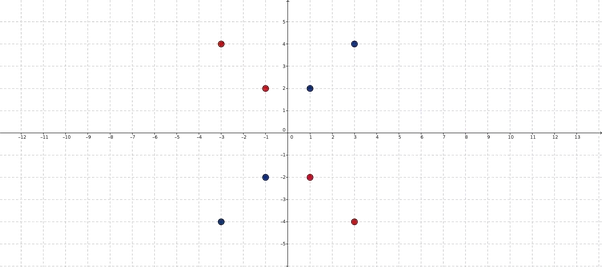





Why is linearity/non-linearity important?
Most of our classification models try to find a single line that separates the two sets of point. I say that they find a line (but a line makes sense for 2 dimensional space), but in higher dimensional space, "a line" is referred to as a Hyperplane. But, for the moment, we will work with 2 dimensional spaces since they are easy to visualize and hence we can simply think that the classifiers try to find lines in this 2D space which will separate the set of points. Now, since the above set of points cannot be separated by a single line, which means most of our classifiers will not work on the above dataset.
How to solve?
There are two ways to solve:
- One way is to explicitly use non-linear classifiers. Non linear classifiers are classifiers that do not try to separate the set of points with a single line but uses either a non-linear separator or a set of linear separators (to make a piece-wise non-linear separator).
- Another way is to transform the input space in such a way that the non-linearity is eliminated and we get a linear feature space.
Second Method
Let us try to find a transformation for the given set of points such that the non linearity is removed. If we carefully see the set of points given to us, we would note that the the label is negative exactly when one of the dimension is negative. If both dimensions are positive or negative, the label given is positive. Therefore, let x=(x1,x2)x=(x1,x2) be a 2D point and let ff be a function that transforms this 2D point to another 2D point as follows: f(x)=(x1,x1x2)f(x)=(x1,x1x2). Let us see what happens to the set of points given to us, when we pass it through the above transformation:
【升维 超线性 分割类】
Oh look at that! Now the two sets of points can be separated by a line! This tells us that now, all our linear classification models will work on this transformed space.
Is it easy to find such transformations?
No, while we were lucky to find a transformation for the above case, in general, it is not so easy to find such a transformation. However, in the above case, I mapped the points from 2D to 2D, but one can map these 2D points to some higher dimensional space as well. There is a theorem called Cover's theorem which states that if you map the points to sufficiently large and high dimensional space, then with high probability, the non-linearity would be erased and that the points will be separated by a line in that high dimensional space.
Evaluating boosted decision trees for billions of users
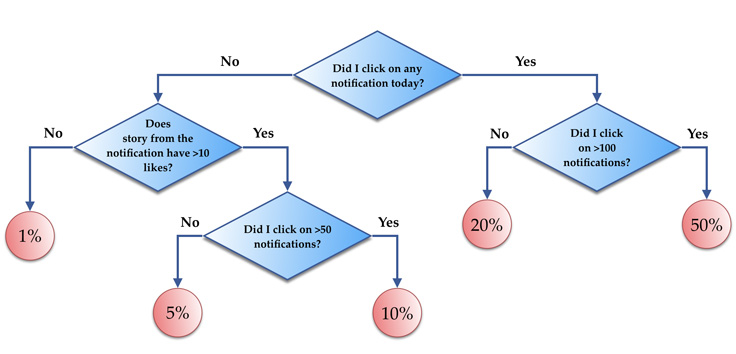
【Facebook点击预测 predicting the probability of clicking a notification】
We trained a boosted decision tree model for predicting the probability of clicking a notification using 256 trees, where each of the trees contains 32 leaves. Next, we compared the CPU usage for feature vector evaluations, where each batch was ranking 1,000 candidates on average. The batch size value N was tuned to be optimal based on the machine L1/L2 cache sizes. We saw the following performance improvements over the flat tree implementation:
- Plain compiled model: 2x improvement.
- Compiled model with annotations: 2.5x improvement.
- Compiled model with annotations, ranges and common/categorical features: 5x improvement.
The performance improvements were similar for different algorithm parameters (128 or 512 trees, 16 or 64 leaves).
Facebook's paper gives empirical results which show that stacking a logistic regression (LR) on top of gradient boosted decision trees (GBDT) beats just directly using the GBDT on their dataset. Let me try to provide some intuition on why that might be happening.
Facebook's paper gives empirical results which show that stacking a logistic regression (LR) on top of gradient boosted decision trees (GBDT) beats just directly using the GBDT on their dataset. Let me try to provide some intuition on why that might be happening.
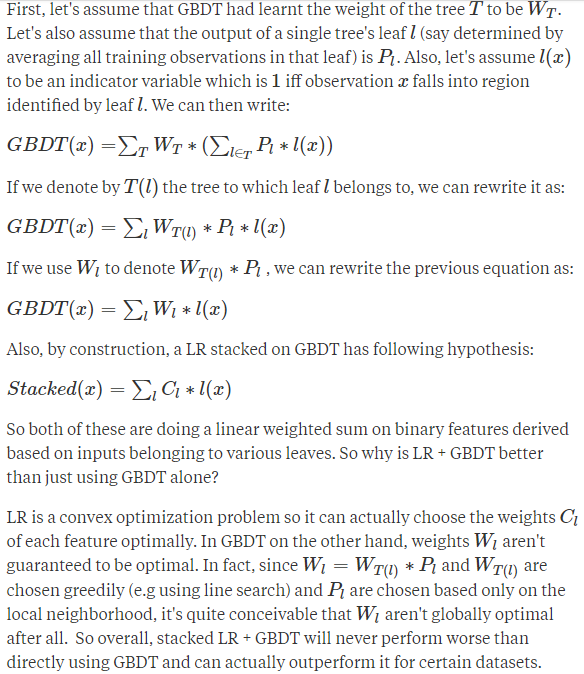
First, let's assume that GBDT had learnt the weight of the tree TT to be WTWT. Let's also assume that the output of a single tree's leaf ll (say determined by averaging all training observations in that leaf) is PlPl. Also, let's assume l(x)l(x)to be an indicator variable which is 11 iff observation xx falls into region identified by leaf ll. We can then write:
GBDT(x)=GBDT(x)=∑TWT∗(∑l∈TPl∗l(x))∑TWT∗(∑l∈TPl∗l(x))
If we denote by T(l)T(l) the tree to which leaf ll belongs to, we can rewrite it as:
GBDT(x)=∑lWT(l)∗Pl∗l(x)GBDT(x)=∑lWT(l)∗Pl∗l(x)
If we use WlWl to denote WT(l)∗PlWT(l)∗Pl , we can rewrite the previous equation as:
GBDT(x)=∑lWl∗l(x)GBDT(x)=∑lWl∗l(x)
Also, by construction, a LR stacked on GBDT has following hypothesis:
Stacked(x)=∑lCl∗l(x)Stacked(x)=∑lCl∗l(x)
So both of these are doing a linear weighted sum on binary features derived based on inputs belonging to various leaves. So why is LR + GBDT better than just using GBDT alone?
【堆积LR + GBDT性能优于GBDT 】
LR is a convex optimization problem so it can actually choose the weights ClClof each feature optimally. In GBDT on the other hand, weights WlWl aren't guaranteed to be optimal. In fact, since Wl=WT(l)∗PlWl=WT(l)∗Pl and WT(l)WT(l) are chosen greedily (e.g using line search) and PlPl are chosen based only on the local neighborhood, it's quite conceivable that WlWl aren't globally optimal after all. So overall, stacked LR + GBDT will never perform worse than directly using GBDT and can actually outperform it for certain datasets.
But there is another really important advantage of using the stacked model.
Facebook's paper also shows that data freshness is a very important factor for them and that prediction accuracy degrades as the delay between training and test set increases. It's unrealistic/costly to do online training of GBDT whereas online LR is much easier to do. By stacking an online LR over periodically computed batch GBDT, they are able to retain much of the benefits of online training in a pretty cheap way.
Overall, it's a pretty clever idea that works really well in real-world.
Facebook Gradient boosting 梯度提升 separate the positive and negative labeled points using a single line 梯度提升决策树 Gradient Boosted Decision Trees (GBDT)的更多相关文章
- CatBoost使用GPU实现决策树的快速梯度提升CatBoost Enables Fast Gradient Boosting on Decision Trees Using GPUs
python机器学习-乳腺癌细胞挖掘(博主亲自录制视频)https://study.163.com/course/introduction.htm?courseId=1005269003&ut ...
- How to Configure the Gradient Boosting Algorithm
How to Configure the Gradient Boosting Algorithm by Jason Brownlee on September 12, 2016 in XGBoost ...
- 梯度提升树 Gradient Boosting Decision Tree
Adaboost + CART 用 CART 决策树来作为 Adaboost 的基础学习器 但是问题在于,需要把决策树改成能接收带权样本输入的版本.(need: weighted DTree(D, u ...
- Ensemble Learning 之 Gradient Boosting 与 GBDT
之前一篇写了关于基于权重的 Boosting 方法 Adaboost,本文主要讲述 Boosting 的另一种形式 Gradient Boosting ,在 Adaboost 中样本权重随着分类正确与 ...
- Gradient Boosting Decision Tree学习
Gradient Boosting Decision Tree,即梯度提升树,简称GBDT,也叫GBRT(Gradient Boosting Regression Tree),也称为Multiple ...
- GBDT(Gradient Boosting Decision Tree) 没有实现仅仅有原理
阿弥陀佛.好久没写文章,实在是受不了了.特来填坑,近期实习了(ting)解(shuo)到(le)非常多工业界经常使用的算法.诸如GBDT,CRF,topic model的一些算 ...
- 集成学习之Boosting —— Gradient Boosting原理
集成学习之Boosting -- AdaBoost原理 集成学习之Boosting -- AdaBoost实现 集成学习之Boosting -- Gradient Boosting原理 集成学习之Bo ...
- Gradient Boosting算法简介
最近项目中涉及基于Gradient Boosting Regression 算法拟合时间序列曲线的内容,利用python机器学习包 scikit-learn 中的GradientBoostingReg ...
- 论文笔记:LightGBM: A Highly Efficient Gradient Boosting Decision Tree
引言 GBDT已经有了比较成熟的应用,例如XGBoost和pGBRT,但是在特征维度很高数据量很大的时候依然不够快.一个主要的原因是,对于每个特征,他们都需要遍历每一条数据,对每一个可能的分割点去计算 ...
随机推荐
- luogu P1651 塔
题目描述 小明很喜欢摆积木,现在他正在玩的积木是由N个木块组成的,他想用这些木块搭出两座高度相同的塔,一座塔的高度是搭建它的所有木块的高度和,并且一座塔至少要用一个木块.每个木块只能用一次,也可以不用 ...
- luogu P2949 [USACO09OPEN]工作调度Work Scheduling
题目描述 Farmer John has so very many jobs to do! In order to run the farm efficiently, he must make mon ...
- POJ 2128:Highways
Highways Time Limit: 2000MS Memory Limit: 65536K Total Submissions: 2730 Accepted: 1008 Specia ...
- Web编程前端之7:web.config详解 【转】
http://www.cnblogs.com/alvinyue/archive/2013/05/06/3063008.html 声明:这篇文章是摘抄周公(周金桥)的<asp.net夜话> ...
- 跨域问题解决方式(HttpClient安全跨域 & jsonp跨域)
1 错误场景 今天要把项目部署到外网的时候,出现了这种问题, 我把两个项目放到自己本机的tomcat下, 进行代码调试, 执行 都没有问题的, 一旦把我须要调用接口的项目B放到其它的server上, ...
- apache hadoop 2.4.0 64bit 在windows8.1下直接安装指南(无需虚拟机和cygwin)
工作须要.要開始搞hadoop了,又是大数据,自己感觉大数据.云.仅仅是ERP.SOAP风潮之后与智能地球一起诞生的概念炒作. 只是Apache是个奇妙的组织.Java假设没有它也不会如今如火中天.言 ...
- Node.js学习笔记(2)——关于异步编程风格
Node.js的异步编程风格是它的一大特点,在代码中就是体现在回调中. 首先是代码的顺序执行: function heavyCompute(n, callback) { var count = 0, ...
- Robot Framework ---Selenium API
一.浏览器驱动 通过不同的浏览器执行脚本. Open Browser Htpp://www.xxx.com chrome 浏览器对应的关键字: firefox FireFox ff internete ...
- 强大易用的日期和时间库 Joda Time
Joda-Time提供了一组Java类包用于处理包括ISO8601标准在内的date和time.可以利用它把JDK Date和Calendar类完全替换掉,而且仍然能够提供很好的集成,并且它是线程安全 ...
- ORACLE schedule job设置
--创建job begin DBMS_SCHEDULER.CREATE_JOB ( job_name => 'APICALL_LOG_INTERFACE_JOB', job_type => ...