
SpringMVC 和SpringBoot中的注解是如何起作用的,如何实现的
SpringMVC源码解读 - HandlerMapping - RequestMappingHandlerMapping初始化
RequestMappingHandlerMapping ,用于注解@Controller,@RequestMapping来定义controller.

 1 @Controller

 2 @RequestMapping(value = "books")

 3 public class BookController {

 4

 5     @RequestMapping(value = "/{id}")

 6     @ResponseBody

 7     public String getBook(@PathVariable("id") String id) {

 8         // ...

 9         return id;

10     }

11 }

初始化时,3个类的大致分工如下:
AbstractHandlerMethodMapping定义整个算法流程;
RequestMappingInfoHandlerMapping提供匹配条件RequestMappingInfo的解析处理;
RequestMappingHandlerMapping根据@RequestMapping注解生成 RequestMappingInfo,同时提供isHandler实现
整个初始化工作由AbstractHandlerMethodMapping的initHandlerMethods主导.
1. 使用BeanFactoryUtils扫描应用下的Object或者直接从容器中获取Object
2. 迭代类,分别判断isHandler判断目标类是否Handler
2.1 RequestMappingHandlerMapping.isHandler根据@Controller或@RequestMapping注解判断(有任意一个)
3. 对handler解析出所有需要分发的方法detectHandlerMethods
3.1 获取原始的Class<?>
3.2 使用HandlerMethodSelector.selectMethods过滤具体handler method,预留getMappingForMethod模板方法给子类
RequestMappingHandlerMapping.getMappingForMethod根据类,方法上的RequestMapping注解生成匹配条件RequestMappingInfo
3.3 对过滤到的每个method进行注册registerHandlerMethod
a, 使用createHandlerMethod封装处理器为HandlerMethod
b, 判断之前是否已经匹配条件对应的处理器是否冲突(相同的匹配条件只能有一个对应的处理器)
c, 设置匹配条件到handler method的映射关系
d, 从匹配条件中解析出url,并注册到urlMap(url到匹配条件的映射),这边由RequestMappingInfoHandlerMapping.getMappingPathPatterns实现
4. 对HandlerMethod进行初始化handlerMethodsInitialized,其实现在什么都没做
在讲初始化之前,我们先来聊聊使用到的一些概念
1. 映射关系,url到匹配条件RequestMappingInfo,匹配条件到HandlerMethod
2. 特殊的MultiValueMap,特别在value是个List
3. 使用到注解@Controller,@RequestMapping
4. 封装处理器信息的HandlerMethod
5. 封装各类匹配条件的RequestMappingInfo(诸如pattern,http method,request parameter等)
6. RequestCondition记录匹配条件
1. 进行request分发前,需要在初始化时准备好映射关系,这边AbstractHandlerMethodMapping中有两个属性保存了映射关系
// AbstractHandlerMethodMapping
1     // 匹配条件到HandlerMethod的映射

2     private final Map<T, HandlerMethod> handlerMethods = new LinkedHashMap<T, HandlerMethod>();

3     // url到匹配条件的映射

4     private final MultiValueMap<String, T> urlMap = new LinkedMultiValueMap<String, T>();
2. 这边的MultiValueMap其实挺简单,就是map的值是个list
1 public interface MultiValueMap<K, V> extends Map<K, List<V>> {

2   // ...

3 }
3. 我们再来看看这边使用到的两个注解:
// @Controller
 1     // org.springframework.stereotype.Controller

 2 @Target({ElementType.TYPE})

 3 @Retention(RetentionPolicy.RUNTIME)

 4 @Documented

 5 @Component

 6 public @interface Controller {

 7

 8     /**

 9      * The value may indicate a suggestion for a logical component name,

10      * to be turned into a Spring bean in case of an autodetected component.

11      * @return the suggested component name, if any

12      */

13     String value() default "";

14

15 }
// @RequestMapping
 1     // org.springframework.web.bind.annotation.RequestMapping

 2     @Target({ElementType.METHOD, ElementType.TYPE})

 3     @Retention(RetentionPolicy.RUNTIME)

 4     @Documented

 5     @Mapping

 6     public @interface RequestMapping {

 7

 8         /**

 9          * url路径,如/myPath/*.do

10          */

11         String[] value() default {};

12

13         /**

14          * HTTP request methods 如:GET, POST, HEAD, OPTIONS, PUT, PATCH, DELETE, TRACE.

15          */

16         RequestMethod[] method() default {};

17

18         /**

19          * requeset parameter 有3种匹配方式,是否包含某个参数,参数值相等,参数值不等于某个值,如myParam!=myValue

20          */

21         String[] params() default {};

22

23         /**

24          * request的header

25          */

26         String[] headers() default {};

27

28         /**

29          * request的content type

30          */

31         String[] consumes() default {};

32

33         /**

34          * 返回内容的content type

35          */

36         String[] produces() default {};

37

38     }

39 }
4. HandlerMethod封装了处理器相关的全部信息,如类Object,方法Method,BeanFactory,参数MethodParameter[],原始方法Method
// HandlerMethod
 1     // org.springframework.web.method.HandlerMethod

 2     private final Object bean;// 因为final不可修改,所以下面每次需要修改信息时,都需要new一个

 3

 4     private final Method method;

 5

 6     private final BeanFactory beanFactory;

 7

 8     private final MethodParameter[] parameters;

 9

10     private final Method bridgedMethod;
5. 这边匹配条件的范型只有一个实现,RequestMappingInfo.匹配条件里记录的是RequestCondition子类,用于诸如pattern,http method,request parameter等
// RequestMappingInfo
 1     // javax.servlet.http.HttpServletRequest.RequestMappingInfo

 2 public final class RequestMappingInfo implements RequestCondition<RequestMappingInfo> {

 3

 4     private final PatternsRequestCondition patternsCondition;

 5

 6     private final RequestMethodsRequestCondition methodsCondition;

 7

 8     private final ParamsRequestCondition paramsCondition;

 9

10     private final HeadersRequestCondition headersCondition;

11

12     private final ConsumesRequestCondition consumesCondition;

13

14     private final ProducesRequestCondition producesCondition;

15

16     private final RequestConditionHolder customConditionHolder;

17     // ...

18

19 }
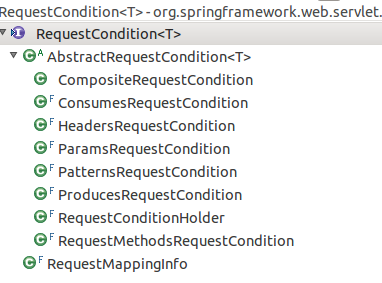
6. 最后再简单看看RequestCondition ,这边定义了3个方法
 1 package org.springframework.web.servlet.mvc.condition;

 2     public interface RequestCondition<T> {

 3         /**

 4          * 拼接条件

 5          */

 6         T combine(T other);

 7

 8         /**

 9          * 查找匹配的条件,并返回

10          */

11         T getMatchingCondition(HttpServletRequest request);

12

13         /**

14          * 用于排序

15          */

16         int compareTo(T other, HttpServletRequest request);

17     }
看看继承体系吧,老套路,定义接口,然后模板方法实现主要逻辑,具体算法留给子类实现,还有正事要做,还是后期再细化吧.
正文
整个初始化工作由AbstractHandlerMethodMapping的initHandlerMethods主导.copy一段,省得回去比对看
1. 使用BeanFactoryUtils扫描应用下的Object或者直接从容器中获取Object
2. 迭代类,分别判断isHandler判断目标类是否Handler
2.1 RequestMappingHandlerMapping.isHandler根据@Controller或@RequestMapping注解判断(有任意一个)
3. 对handler解析出所有需要分发的方法detectHandlerMethods
3.1 获取原始的Class<?>
3.2 使用HandlerMethodSelector.selectMethods过滤具体handler method,预留getMappingForMethod模板方法给子类
RequestMappingHandlerMapping.getMappingForMethod根据类,方法上的RequestMapping注解生成匹配条件RequestMappingInfo
3.3 对过滤到的每个method进行注册registerHandlerMethod
a, 使用createHandlerMethod封装处理器为HandlerMethod
b, 判断之前是否已经匹配条件对应的处理器是否冲突(相同的匹配条件只能有一个对应的处理器)
c, 设置匹配条件到handler method的映射关系
d, 从匹配条件中解析出url,并注册到urlMap(url到匹配条件的映射),这边由RequestMappingInfoHandlerMapping.getMappingPathPatterns实现
4. 对HandlerMethod进行初始化handlerMethodsInitialized,其实现在什么都没做
// AbstractHandlerMethodMapping
 1 /** 这个方法哪来的,具体看备注的InitializingBean

 2      * Detects handler methods at initialization.

 3      */

 4     public void afterPropertiesSet() {

 5         initHandlerMethods();

 6     }

 7

 8     /**扫描ApplicationContext中的bean,然后筛选handler method 并注册

 9      * Scan beans in the ApplicationContext, detect and register handler methods.

10      * @see #isHandler(Class)

11      * @see #getMappingForMethod(Method, Class)

12      * @see #handlerMethodsInitialized(Map)

13      */

14     protected void initHandlerMethods() {

15         if (logger.isDebugEnabled()) {

16             logger.debug("Looking for request mappings in application context: " + getApplicationContext());

17         }

18

19         String[] beanNames = (this.detectHandlerMethodsInAncestorContexts ?

20                 BeanFactoryUtils.beanNamesForTypeIncludingAncestors(getApplicationContext(), Object.class) :

21                 getApplicationContext().getBeanNamesForType(Object.class));

22

23         for (String beanName : beanNames) {

24             if (isHandler(getApplicationContext().getType(beanName))){

25                 detectHandlerMethods(beanName);

26             }

27         }

28         handlerMethodsInitialized(getHandlerMethods());

29     }
预留给子类实现的判断handler,实际是由RequestMappingHandlerMapping实现
// AbstractHandlerMethodMapping
1     /**

2      * Whether the given type is a handler with handler methods.

3      * @param beanType the type of the bean being checked

4      * @return "true" if this a handler type, "false" otherwise.

5      */

6     protected abstract boolean isHandler(Class<?> beanType);
// RequestMappingHandlerMapping
这边判断的逻辑很简单,类上使用Controller或RequestMapping其中至少一个注解就可以.
1     /**

2      * {@inheritDoc}

3      * Expects a handler to have a type-level @{@link Controller} annotation.

4      */

5     @Override

6     protected boolean isHandler(Class<?> beanType) {

7         return ((AnnotationUtils.findAnnotation(beanType, Controller.class) != null) ||

8                 (AnnotationUtils.findAnnotation(beanType, RequestMapping.class) != null));

9     }
// AbstractHandlerMethodMapping
 1     /**

 2      * Look for handler methods in a handler.

 3      * @param handler the bean name of a handler or a handler instance

 4      */

 5     protected void detectHandlerMethods(final Object handler) {

 6         Class<?> handlerType = (handler instanceof String) ?

 7                 getApplicationContext().getType((String) handler) : handler.getClass();

 8

 9         final Class<?> userType = ClassUtils.getUserClass(handlerType);

10

11         Set<Method> methods = HandlerMethodSelector.selectMethods(userType, new MethodFilter() {

12             public boolean matches(Method method) {

13                 return getMappingForMethod(method, userType) != null;

14             }

15         });

16

17         for (Method method : methods) {

18             T mapping = getMappingForMethod(method, userType);

19             registerHandlerMethod(handler, method, mapping);

20         }

21     }
// AbstractHandlerMethodMapping
这边具体的实现是由RequestMappingHandlerMapping实现,根据注解生产匹配关系,这边实现类是RequestMappingInfo,就是代码有点多,慢慢看
1     /**

2      * Provide the mapping for a handler method. A method for which no

3      * mapping can be provided is not a handler method.

4      * @param method the method to provide a mapping for

5      * @param handlerType the handler type, possibly a sub-type of the method's

6      * declaring class

7      * @return the mapping, or {@code null} if the method is not mapped

8      */

9     protected abstract T getMappingForMethod(Method method, Class<?> handlerType);
// RequestMappingHandlerMapping
 1     /**

 2      * Uses method and type-level @{@link RequestMapping} annotations to create

 3      * the RequestMappingInfo.

 4      *

 5      * @return the created RequestMappingInfo, or {@code null} if the method

 6      * does not have a {@code @RequestMapping} annotation.

 7      *

 8      * @see #getCustomMethodCondition(Method)

 9      * @see #getCustomTypeCondition(Class)

10      */

11     @Override

12     protected RequestMappingInfo getMappingForMethod(Method method, Class<?> handlerType) {

13         RequestMappingInfo info = null;

14         // 读取方法上的RequestMapping注解信息

15         RequestMapping methodAnnotation = AnnotationUtils.findAnnotation(method, RequestMapping.class);

16         if (methodAnnotation != null) {

17             // 读取自定义的条件,这边没有使用

18             RequestCondition<?> methodCondition = getCustomMethodCondition(method);

19             // 根据方法上的RequsetMapping注解和自定义条件,生成匹配条件.这边的匹配条件包括http method,request parameter,request header等

20             info = createRequestMappingInfo(methodAnnotation, methodCondition);

21             // 读取类上的RequestMapping注解信息

22             RequestMapping typeAnnotation = AnnotationUtils.findAnnotation(handlerType, RequestMapping.class);

23             if (typeAnnotation != null) {

24                 RequestCondition<?> typeCondition = getCustomTypeCondition(handlerType);

25                 // 生成类上的匹配条件,并合并方法上的

26                 info = createRequestMappingInfo(typeAnnotation, typeCondition).combine(info);

27             }

28         }

29         return info;

30     }
// RequestMappingHandlerMapping
 1     /**

 2      * Created a RequestMappingInfo from a RequestMapping annotation.

 3      */

 4     private RequestMappingInfo createRequestMappingInfo(RequestMapping annotation, RequestCondition<?> customCondition) {

 5         String[] patterns = resolveEmbeddedValuesInPatterns(annotation.value());

 6         return new RequestMappingInfo(

 7                 new PatternsRequestCondition(patterns, getUrlPathHelper(), getPathMatcher(),

 8                         this.useSuffixPatternMatch, this.useTrailingSlashMatch, this.fileExtensions),

 9                 new RequestMethodsRequestCondition(annotation.method()),

10                 new ParamsRequestCondition(annotation.params()),

11                 new HeadersRequestCondition(annotation.headers()),

12                 new ConsumesRequestCondition(annotation.consumes(), annotation.headers()),

13                 new ProducesRequestCondition(annotation.produces(), annotation.headers(), getContentNegotiationManager()),

14                 customCondition);

15     }

16

17     /**

18      * Resolve placeholder values in the given array of patterns.

19      * @return a new array with updated patterns

20      */

21     protected String[] resolveEmbeddedValuesInPatterns(String[] patterns) {

22         if (this.embeddedValueResolver == null) {

23             return patterns;

24         }

25         else {

26             String[] resolvedPatterns = new String[patterns.length];

27             for (int i=0; i < patterns.length; i++) {

28                 resolvedPatterns[i] = this.embeddedValueResolver.resolveStringValue(patterns[i]);

29             }

30             return resolvedPatterns;

31         }

32     }
// AbstractHandlerMethodMapping
 1 /**

 2      * Register a handler method and its unique mapping.

 3      * @param handler the bean name of the handler or the handler instance

 4      * @param method the method to register

 5      * @param mapping the mapping conditions associated with the handler method

 6      * @throws IllegalStateException if another method was already registered

 7      * under the same mapping

 8      */

 9     protected void registerHandlerMethod(Object handler, Method method, T mapping) {

10         HandlerMethod newHandlerMethod = createHandlerMethod(handler, method);

11         HandlerMethod oldHandlerMethod = handlerMethods.get(mapping);

12         if (oldHandlerMethod != null && !oldHandlerMethod.equals(newHandlerMethod)) {

13             throw new IllegalStateException("Ambiguous mapping found. Cannot map '" + newHandlerMethod.getBean()

14                     + "' bean method \n" + newHandlerMethod + "\nto " + mapping + ": There is already '"

15                     + oldHandlerMethod.getBean() + "' bean method\n" + oldHandlerMethod + " mapped.");

16         }

17

18         this.handlerMethods.put(mapping, newHandlerMethod);// 匹配条件requestMappingInfo 到处理器HandlerMethod

19         if (logger.isInfoEnabled()) {

20             logger.info("Mapped \"" + mapping + "\" onto " + newHandlerMethod);

21         }

22

23         Set<String> patterns = getMappingPathPatterns(mapping);

24         for (String pattern : patterns) {

25             if (!getPathMatcher().isPattern(pattern)) {

26                 this.urlMap.add(pattern, mapping);// url到匹配条件RequestMappingInfo

27             }

28         }

29     }
// AbstractHandlerMethodMapping
 1     /**

 2      * Create the HandlerMethod instance.

 3      * @param handler either a bean name or an actual handler instance

 4      * @param method the target method

 5      * @return the created HandlerMethod

 6      */

 7     protected HandlerMethod createHandlerMethod(Object handler, Method method) {

 8         HandlerMethod handlerMethod;

 9         if (handler instanceof String) {

10             String beanName = (String) handler;

11             handlerMethod = new HandlerMethod(beanName, getApplicationContext(), method);

12         }

13         else {

14             handlerMethod = new HandlerMethod(handler, method);

15         }

16         return handlerMethod;

17     }
// AbstractHandlerMethodMapping
1     /**

2      * Extract and return the URL paths contained in a mapping.

3      */

4     protected abstract Set<String> getMappingPathPatterns(T mapping);
RequestMappingInfoHandlerMapping会实现这个模板方法
// RequestMappingInfoHandlerMapping
1     /**

2      * Get the URL path patterns associated with this {@link RequestMappingInfo}.

3      */

4     @Override

5     protected Set<String> getMappingPathPatterns(RequestMappingInfo info) {

6         return info.getPatternsCondition().getPatterns();

7     }
备注:
1. 这边的afterPropertiesSet是因为实现了InitializingBean接口
// org.springframework.beans.factory.InitializingBean
 1 /**

 2  * Interface to be implemented by beans that need to react once all their

 3  * properties have been set by a BeanFactory: for example, to perform custom

 4  * initialization, or merely to check that all mandatory properties have been set.

 5  *

 6  * <p>An alternative to implementing InitializingBean is specifying a custom

 7  * init-method, for example in an XML bean definition.

 8  * For a list of all bean lifecycle methods, see the BeanFactory javadocs.

 9  *

10  * @author Rod Johnson

11  * @see BeanNameAware

12  * @see BeanFactoryAware

13  * @see BeanFactory

14  * @see org.springframework.beans.factory.support.RootBeanDefinition#getInitMethodName

15  * @see org.springframework.context.ApplicationContextAware

16  */

17 public interface InitializingBean {

18

19     /**

20      * Invoked by a BeanFactory after it has set all bean properties supplied

21      * (and satisfied BeanFactoryAware and ApplicationContextAware).

22      * <p>This method allows the bean instance to perform initialization only

23      * possible when all bean properties have been set and to throw an

24      * exception in the event of misconfiguration.

25      * @throws Exception in the event of misconfiguration (such

26      * as failure to set an essential property) or if initialization fails.

27      */

28     void afterPropertiesSet() throws Exception;

29

30 }
SpringMVC 和SpringBoot中的注解是如何起作用的,如何实现的的更多相关文章
- SpringBoot 中常用注解@Controller/@RestController/@RequestMapping的区别
SpringBoot中常用注解@Controller/@RestController/@RequestMapping的区别 @Controller 处理http请求 @Controller //@Re ...
- SpringBoot 中常用注解@Controller/@RestController/@RequestMapping介绍
原文 SpringBoot 中常用注解 @Controller/@RestController/@RequestMapping介绍 @Controller 处理http请求 @Controller / ...
- SpringBoot 中常用注解
本篇博文将介绍几种SpringBoot 中常用注解 其中,各注解的作用为: @PathVaribale 获取url中的数据 @RequestParam 获取请求参数的值 @GetMapping 组合注 ...
- SpringBoot 中常用注解@PathVaribale/@RequestParam/@GetMapping介绍
SpringBoot 中常用注解@PathVaribale/@RequestParam/@GetMapping介绍 本篇博文将介绍几种如何处理url中的参数的注解@PathVaribale/@Requ ...
- Springboot中PropertySource注解的使用
https://blog.csdn.net/qq_30739519/article/list/3 注解 https://blog.csdn.net/qq_30739519/article/detail ...
- springmvc以及springboot中的拦截器配置
拦截器两种实现 如果不同的controller中都需要拦截器,不能使用相同的拦截器,因为拦截器不能跨controller,这个时候只能为不同的controller配置不同的拦截器,每一个拦截器只能 ...
- spring----spring中的注解@service等的作用
service 是有用的相当于 xml配置中得bean id = service 也可以不指定 不指定相当于 bean id = com. service.service 就是这个类的全限定名 ...
- SpringBoot中常用注解@Controller/@RestController/@RequestMapping的区别
@Controller 处理http请求 @Controller //@ResponseBody public class HelloController { @RequestMapping(valu ...
- springboot中常用注解总结
1.@RestController(组合注解):标注在类上,等价于@Controller和@Responsebody @Controller:将该类标记为Controller层的类,并且注入到Spri ...
随机推荐
- AngularJS 打算开始学习
作为朋友推荐给我的一款框架 个人感觉还不错 打算开始学习
- 在windev中实现BS架构级的灵活排版
windev是CS架构,但却能够实现BS架构级的灵活排版.玩过CS架构的老铁们,感受应会都如我,如获新生!因为苦于没有一张好画皮久矣!在windev中,要实现灵活,专业,自适应和非常丰富的排版,可以关 ...
- 【C#反射】Type的用法
Type属性的应用 Type type = typeof(MyClass); Console.Write("$类型名:{ type.Name}"); Console.Write(& ...
- .大内高手专栏: NET中间语言(IL)
补充知识点:opcode 在前面我们已经知道了,由于计算机只认识0和1,所以,源代码"NOP"是无法直接运行的.当Assembler遇到"NOP"的时候,为了生 ...
- c# $ @特殊字符
c# @ 停止字符串中的转义字符,让字符串内的转义字符当正常字符输入. 因此,如果你需要类似"所见所得"效果的赋值,逐字字符串赋值方式会是你的首选!此外,需要注意的是,当使用符号 ...
- weblogic 升级bsu_Weblogic补丁升级之坑坑洼洼
转至:https://blog.csdn.net/weixin_30682635/article/details/111911952 [概述] 虽然当前国内去IOE波涛汹涌,但不可否认OracleWe ...
- linux shell脚本批量修改密码,无需交互输入
转至:https://blog.csdn.net/weixin_34409357/article/details/89833777?utm_medium=distribute.pc_relevant. ...
- Mysql基础学习第二天
Mysql基础学习第二天 函数 函数:是指一段可以直接被另一段程序调用的程序或代码. 字符串函数 数值函数 日期函数 流程函数 字符串函数 MySQL内置很多字符串函数,常用的几个如下: 函数 功能 ...
- GBDT 梯度提升决策树简述
首先明确一点,gbdt 无论用于分类还是回归一直都是使用的CART 回归树.不会因为我们所选择的任务是分类任务就选用分类树,这里面的核心是因为gbdt 每轮的训练是在上一轮的训练的残差基础之上进行训练 ...
- LeetCode-036-有效的数独
有效的数独 题目描述:请你判断一个 9x9 的数独是否有效.只需要 根据以下规则 ,验证已经填入的数字是否有效即可. 数字 1-9 在每一行只能出现一次. 数字 1-9 在每一列只能出现一次. 数字 ...