
技术架构:IT生存之道
Technical architecture: What IT does for a living (cio.com)
Technical architecture: What IT does for a living
Building effective IT 101: Technical architecture is what separates a hard-to-navigate pile of tech from accelerating IT’s ability to get things done.
Technical architecture is the sum and substance of what IT deploys to support the enterprise. As such, its management is a key IT practice. We talked about how to go about it in a previous article in this series.
Which leads to the question, What constitutes good technical architecture? Or more foundationally, What constitutes technical architecture, whether good, bad, or indifferent?
[ Learn the 10 old-school IT principles that still rule and the 12 ‘best practices’ IT should avoid at all costs. | Get the latest insights by signing up for our CIO newsletter. ]
In case you’re a purist, we’re talking about technical architecture, not enterprise architecture. The latter includes the business architecture as well as the technical architecture. Not that it’s possible to evaluate the technical architecture without understanding how well it supports the business architecture. It’s just that managing the health of the business architecture is Someone Else’s Problem.
Why technical architecture matters
IT always has a technical architecture. In some organizations it’s deliberate, the result of processes and practices that matter most to CIOs.
But far too often, technical architecture is accidental — a pile of stuff that’s accumulated over time without any overall plan.
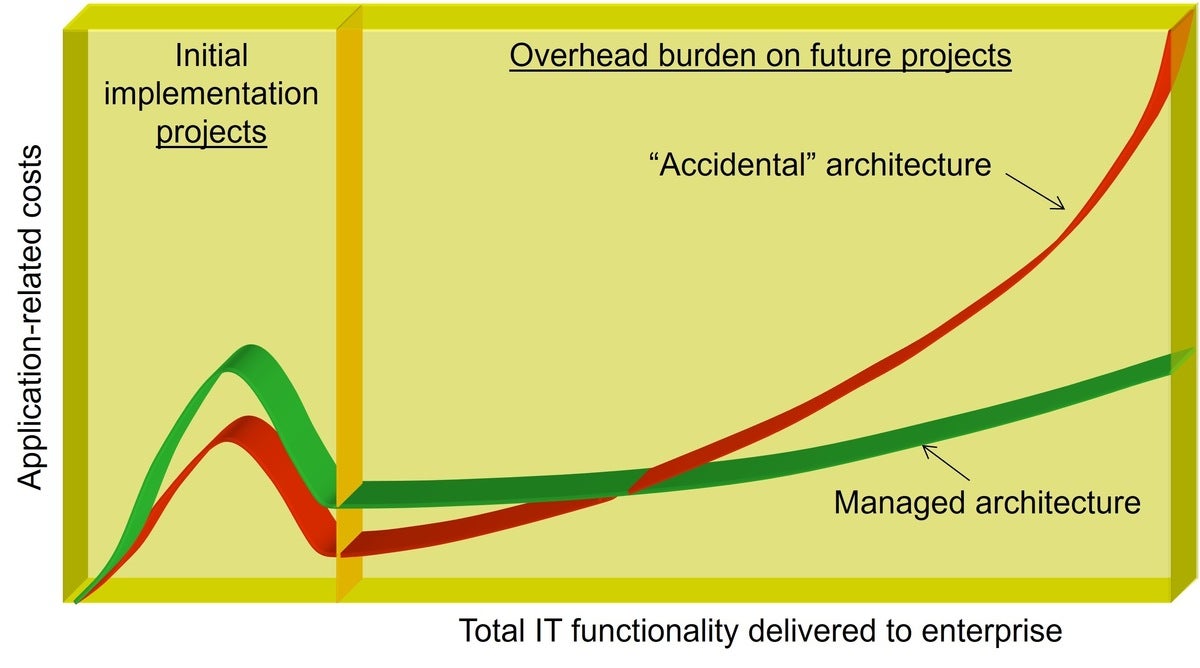
As Figure 1 shows, during initial IT implementations, managed architecture costs more than just ignoring the subject and hoping for the best, but pays for itself over time as the advantages of a well-managed architecture — reduced maintenance and support costs, easier and less-fragile integration, and overall improved flexibility in addressing new business challenges — dwarf the initial investment.
What constitutes technical architecture
Before we get started, no, what you’re about to see isn’t the well-known TOGAF architecture framework. It isn’t inconsistent, but I’ve found what follows to be more concrete and an easier fit to real-world IT portfolios. But whatever framework you use, its purpose is to sort the bits and pieces of stuff IT manages into portfolios of parallel components for ongoing analysis and planning.
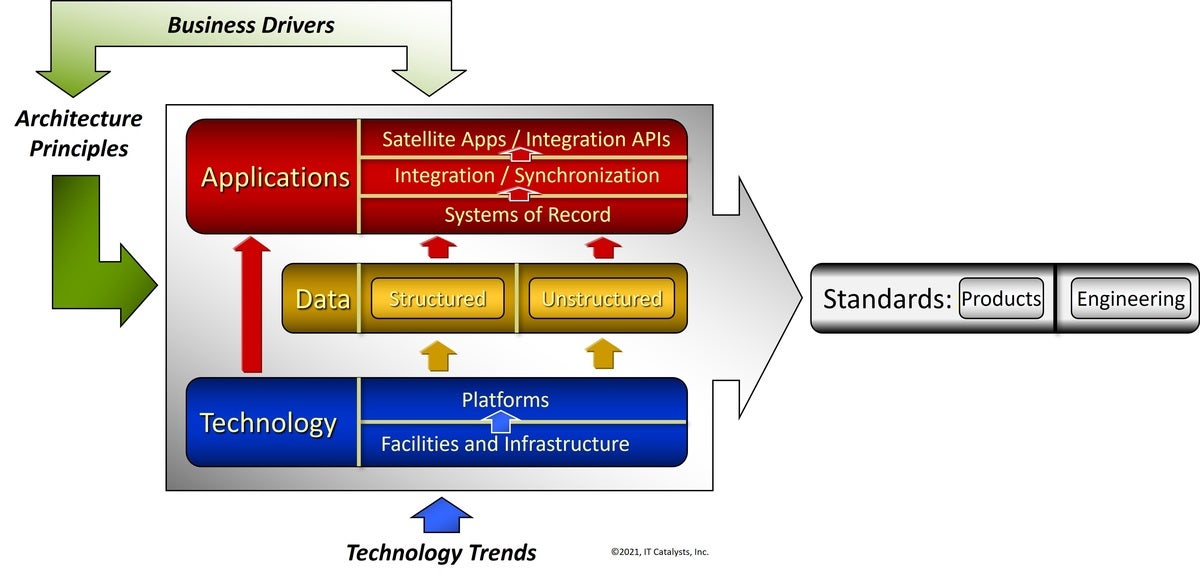
Figure 2 shows the components of technical architecture. It includes the external factors that influence it, its building blocks, and the standards it generates. One at a time:
External factors
These include business drivers, architecture principles, and technology trends:
- Business drivers: These are the broad IT capabilities the company will need, as inferred from its strategic goals. These aren’t requirements in the app dev sense. They’re broader than that. Examples might be machine learning, automated language translation, and facial recognition. Business drivers have a direct impact on the architecture; they also affect it indirectly by helping guide formulation of the architecture principles.
- Architecture principles: As explained in the last installment of this series, these are broad principles that define what constitutes “good” architecture in your business. They combine an overall knowledge of what constitutes good engineering with the company’s business drivers.
- Technology trends: No, you don’t have to be trendy. But you do need to recognize when a trend in the external technology marketplace will invalidate some components of your technical architecture or could create an opportunity to do something differently and better.
Technical architecture’s building blocks
IT architecture is layered and segmented. It’s comprised of applications, data, and technology. Drilling down, it consists of:
Applications: The portfolio of software programs business users make use of to do their jobs. The application layer is divided into three sublayers:
- Systems of record: The applications and application suites that serve as the authoritative source of information and business logic.
- Integration and synchronization: The inter-application interfaces that make sure applications whose data and business logic overlap agree with each other.
- Satellite apps and Integration APIs: By themselves, systems of record can be unwieldy ways to address all the fine-grained automation opportunities various business constituencies need addressed. Sometimes it’s better to implement specialty apps that connect to the systems of record, either directly through the integration sublayer or through APIs exposed by the integration layer that provide an integrated, idealized view of the underlying data and business logic.
Data: IT provides capabilities for managing two types of information: structured, aka data comfortably represented in tables and forms; and unstructured, aka content and documents more free-form in nature. Business users don’t, by the way, ever interact directly with data of any kind. They interact with applications that interact with data repositories, ingesting it, managing it, and representing it.
The data layer encompasses just the data themselves, not the DBMSes, content management systems (CMS), and document management systems (DMS) that contain them.
Technology: This consists of two sublayers:
- Infrastructure and facilities, which encompass: the data center itself (even if you’ve gone full cloud there’s a data center lurking around somewhere); networks; servers, whether physical or virtual; storage, whether SAN, NAS, or direct-attached; plus systems monitoring, management, and administration tools — stuff like that.
- Platforms: The software on which everything in the higher layers is built and run, including server operating systems, development languages and environments, DBMSes, CMSes, and DMSes, and enterprise service buses (ESBs) and equivalent integration systems.
Standards
As a result of evaluating the information technology deployed in the application, data, and technology portfolios, IT establishes standards — guidelines the portfolios must conform to. Standards fall into two categories:
- Product standards: The specific products approved for use for delivering each IT capability. MS Word, for example, is the word processing standard for most businesses today. Applications, data repositories, and technologies that are in use but aren’t approved for use violate an architectural product standard.
- Engineering standards: In addition to specific products, the technical architecture also consists of approved ways to structure its various components. As an example, most IT shops consider normalization to be their standard way of organizing structured data; many are in the process of establishing microservices as their standard way of organizing application logic.
Moving from primer to practicality
So far we’ve covered how to classify the bits and pieces of information technology you have into portfolios. That’s everything except what matters. The next articles in this series will cover using the results to evaluate the architecture you have and plan how to morph from it to the architecture you need.
技术架构:IT生存之道的更多相关文章
- 软件架构设计学习总结(3):QQ空间技术架构之详解
QQ空间作为腾讯海量互联网服务产品,经过近七年的发展,实现了从十万级到亿级同时在线的飞跃.在这个过程中,QQ空间团队遇到了哪些技术挑战?其站点前后台架构随着业务规模的变化又进行了怎样的演进与变迁?成长 ...
- [置顶]
QQ空间技术架构之深刻揭密
QQ空间作为腾讯海量互联网服务产品,经过近七年的发展,实现了从十万级到亿级同时在线的飞跃.在这个过程中,QQ空间团队遇到了哪些技术挑战?其站点前后台架构随着业务规模的变化又进行了怎样的演进与变迁?成长 ...
- QQ空间技术架构之深刻揭秘
QQ空间技术架构之深刻揭秘 来源: 腾讯大讲堂 发布时间: 2012-05-17 17:24 阅读: 7822 次 推荐: 4 [收藏] QQ 空间作为腾讯海量互联网服务产品,经过近七年 ...
- 一个美国小券商的生存之道Tradestation
转自:证券时报记者 张欣然 桂衍民 中国互联网金融的口号喊了十几年,众多证券公司仍然苦于找不到新的蓝海,研究大西洋彼岸的美国TradeStation公司的业务模式,也许对国内的证券公司会有一些启迪. ...
- Hive技术架构
一.Hive概念 Facebook为了解决海量日志数据的分析而开发了Hive,Hive是一种用SQL语句来读写.管理存储在分布式存储设备上的大数据集的数据仓库框架. 1. 数据是存储在HDFS上的,H ...
- Web高级征程:《大型网站技术架构》读书笔记系列
一.此书到底何方神圣? <大型网站技术架构:核心原理与案例分析>通过梳理大型网站技术发展历程,剖析大型网站技术架构模式,深入讲述大型互联网架构设计的核心原理,并通过一组典型网站技术架构设计 ...
- Worktile 技术架构概要
其实早就该写这篇博客了,一直说忙于工作没有时间,其实时间挤挤总会有的,可能就是因为懒吧!从2013年11月一直拖到现在,今天就简单谈谈 Worktile 的技术架构吧 . Worktile 自上线到现 ...
- 聚光灯下的熊猫TV技术架构演进
2015年开始的百播大战,熊猫TV是其中比较特别的一员. 说熊猫TV是含着金钥匙出生的公子哥不为过.还未上线,就频频曝光,科技号,微博稿,站上风口浪尖.内测期间更是有不少淘宝店高价倒卖邀请码,光内测时 ...
- eaby技术架构变迁
如果你对项目管理.系统架构有兴趣,请加微信订阅号"softjg",加入这个PM.架构师的大家庭 最近在infoq上面看到 ebay介绍其系统架构变迁以及系统设计分享方面的讲座,其中 ...
- 大型网站技术架构介绍--squid
一.大型网站技术架构介绍 1.pv高 ip高 并发量 2.大型网站架构重点 1. 高性能:响应时间,TPS,系统性能计数器.缓存,消息队列等. 高可用性High Availabilit ...
随机推荐
- Atcoder 229
Atcoder 229 \(D.\)Longest X 题意 给定一个长度为\(N\)的字符串\(S\),\(S\)中包含$\ .\ \(和\)\ X\ \(两种字符,现在你可以将其中\)K\(个\) ...
- Qt:QFile、QIODevice
QFile 0.说明 QFile是读写文件的类,这里的文件包括文本文件.二进制文件.资源文件. 通常情况下,文件读写使用QFile.QTextStream.QDataStream就够了. file n ...
- KETTLE使用中的错误集锦
1.违反唯一主键约束条件:问题是表中有俩个主键,将备用主键替换成真正的主 键或者是没有对数据做出处理加这句话and cft.DEL_FLAG!='1'或者要到的库有此数据 2.field 某列 is ...
- oracle 中的decode函数
decode(条件,值1,返回值1,值2,返回值2,...值n,返回值n,缺省值) 该函数的含义如下:IF 条件=值1 THEN RETURN(翻译值1)ELSIF 条件=值2 THEN RETURN ...
- Bugku CTF_web5
1.打开网页,得到信息如下 2.打开hackbar,在body里传入post参数. 3.得到flag如下 4.主要考察以下几点: ->php无论是通过get请求还是post请求得到的数据都是字符 ...
- 构造方法__construct()与析构方法__destruct() 构造方法:刚出生时婴儿的啼哭 析构方法:老人临终时的遗言
<?phpclass person{ var $name; var $sex; var $age;//构造方法 function __construct($name, $sex, $age) { ...
- MYSQL安装后自带用户的作用
user表中host列的值的意义% 匹配所有主机localhost localhost不会被解析成IP地址,直接通过UNIXsocket连接127.0.0 ...
- pandas常用操作详解——info()与descirbe()
概述 df.info():主要介绍数据集各列的数据类型,是否为空值,内存占用情况: df.describe(): 主要介绍数据集各列的数据统计情况(最大值.最小值.标准偏差.分位数等等). df.in ...
- vue js计算精度问题处理,兼容XP系统
js计算精度问题(浮点数误差,大数计算出错) JavaScript 运算时经常遇到会 0.000000001 和 0.999999999 这样奇怪的结果. 网上教程一大篇,原理请百度,抄作业往下看!! ...
- hadoop学习笔记 一
Hadoop 2.x * common * HDFS 存储数据 NameNode 主从结构 * 存储文件系统的元数据,命名空间namespace DataNode * 存储数据 SecondaryNa ...