
CountDownLatch原理分析
CountDownLatch原理分析
CountDownLatch是一个同步工具类,它允许一个或多个线程一直等待,直到其他线程执行完后再执行。例如,应用程序的主线程希望在负责启动框架服务的线程已经启动所有框架服务之后执行。
CountDownLatch使用示例:
首先我们写一个示例,看看怎么使用CountDownLatch工具类
CountDownLatchTest.java
package com.study.thread.juc_thread.base;

import java.util.concurrent.CountDownLatch;

/**

 * <p>Description: CountDownLatch 在所有任务结束之前,一个或者多线线程可以一直等待(通过计数器来判断) </p>

 * @author duanfeixia

 * @date 2019年8月12日

 */

public class CountDownLatchTest {

	static CountDownLatch countDown = new CountDownLatch(10);//10个线程任务

	/**

	 * <p>Description: 主线程执行任务</p>

	 * @author duanfeixia

	 * @date 2019年8月12日

	 */

	static class BossThread extends Thread{

		public void run(){

			System.out.println("boss已经到达会议室,共有"+countDown.getCount()+"人参加会议...");

			//等待人齐

			try {

				countDown.await();//进入阻塞队列

			} catch (InterruptedException e) {

				e.printStackTrace();

			}

			System.out.println("人已经到齐啦,开会啦...");

		}

	}

	/**

	 * <p>Description:子线程执行任务 </p>

	 * @author duanfeixia

	 * @date 2019年6月24日

	 */

	static class EmployThread extends Thread{

		@Override

		public void run() {

			System.out.println(Thread.currentThread().getName()+"到达会议室,还有"+countDown.getCount()+"人未到");

			countDown.countDown();//计数器-1

		}

	}

	/*测试启动*/

	public static void main(String args[]){

		new BossThread().start();

		int len=(int) countDown.getCount();

		for(int i=0;i<len;i++){

			new EmployThread().start();

		}

	}

}
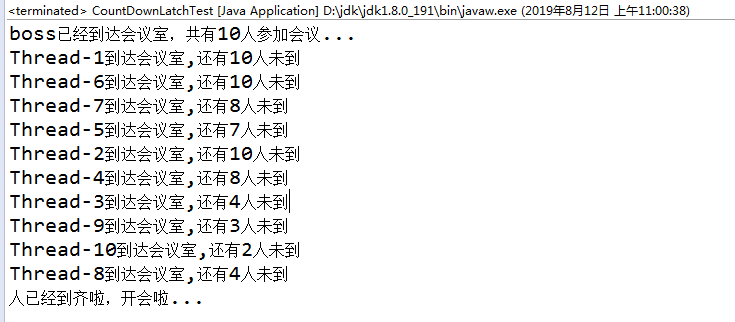
测试结果如下:(每次执行的结果都会不一样哦)
CountDownLatch原理解析
CountDownLatch内部依赖Sync实现,而Sync继承AQS。
CountDownLatch主要分析以下三点:
1. 构造方法 (创建CountDownLatch对象时指定线程个数)
2. await()方法的实现 (当前线程计数器为0之前一致等待,除非线程被中断)
3. countDown()方法的实现 (每执行一个线程方法就将计数器减一,当计数为0时 启用当前线程)
CountDownLatch的静态内部类 Sync (这里我们需要特别注意的一点是 Sync 继承了 AbstractQueuedSynchronizer 类, 重要方法会被重写)
 private static final class Sync extends AbstractQueuedSynchronizer {

        private static final long serialVersionUID = 4982264981922014374L;

        Sync(int count) {

            setState(count);

        }

        int getCount() {

            return getState();

        }

        protected int tryAcquireShared(int acquires) {

            return (getState() == 0) ? 1 : -1;

        }

        protected boolean tryReleaseShared(int releases) {

            // Decrement count; signal when transition to zero

            for (;;) {

                int c = getState();

                if (c == 0)

                    return false;

                int nextc = c-1;

                if (compareAndSetState(c, nextc))

                    return nextc == 0;

            }

        }

    }
>> CountDownLatch只提供了一个有参构造方法: (参数计数器总量)
  public CountDownLatch(int count) {

        if (count < 0) throw new IllegalArgumentException("count < 0");

        this.sync = new Sync(count);

    }
>> await() 方法 [注释: 以下 AQS 均表示 AbstractQueuedSynchronizer ]
初步进入我们会发现调用的是 CountDownLacth 的 await() -- >> 获取共享锁
 public void await() throws InterruptedException {

        sync.acquireSharedInterruptibly(1);

    }
acquireSharedInterruptibly() 方法是父类 AQS 中定义的,这里会发现此方法是被final修饰的,无法被重写,但是子类可以重写里面调用的 tyAcquireShared(arg) 方法
    public final void acquireSharedInterruptibly(int arg)

            throws InterruptedException {

        if (Thread.interrupted())

            throw new InterruptedException();

        if (tryAcquireShared(arg) < 0)

            doAcquireSharedInterruptibly(arg);

    }
先来看看 AQS 中 默认对 tryAcquireShared方法的默认实现
   protected int tryAcquireShared(int arg) {

        throw new UnsupportedOperationException();

    }
CountDownLatch中的内部类 Sync对 AQS 的 tryAcquireShared方法进行了复写
当前计数器的值为0的时候 返回 1 #获取锁成功,直接返回 线程可继续操作
当前计数器的值不为0的时候 返回 -1. #获取锁失败 ,开始进入队列中排队等待。接下来就会继续按照 AQS acquireSharedInterruptibly 方法中的逻辑,执行 doAcquireSharedInterruptibly(int arg)
 protected int tryAcquireShared(int acquires) {

      return (getState() == 0) ? 1 : -1;

 }
AQS 中 doAcquireSharedInterruptibly(int arg) 实现如下 (该方法为一个自旋方法会尝试一直去获取同步状态)
 /**

     * Acquires in shared interruptible mode.

     * @param arg the acquire argument

     */

    private void doAcquireSharedInterruptibly(int arg)

        throws InterruptedException {

        final Node node = addWaiter(Node.SHARED);

        boolean failed = true;

        try {

            for (;;) {

                final Node p = node.predecessor();

                if (p == head) {

                    int r = tryAcquireShared(arg);

                    if (r >= 0) {

                        setHeadAndPropagate(node, r);

                        p.next = null; // help GC

                        failed = false;

                        return;

                    }

                }

                if (shouldParkAfterFailedAcquire(p, node) &&

                    parkAndCheckInterrupt())

                    throw new InterruptedException();

            }

        } finally {

            if (failed)

                cancelAcquire(node);

        }

    }
这里需要进一步说明的是方法 parkAndCheckInterrupt ,调用 LockSupport的park方法,禁用当前线程
LockSupport是JDK中比较底层的类,用来创建锁和其他同步工具类的基本线程阻塞原语。
  private final boolean parkAndCheckInterrupt() {

        LockSupport.park(this);

        return Thread.interrupted();

    }
>> countDown()方法的实现
CountDownLatch方法中实现如下,方法递减锁存器的计数,如果计数到达零,则释放所有等待的线程。 -->> 释放共享锁
   public void countDown() {

        sync.releaseShared(1);

    }
AQS中 releaseShared方法的实现如下:(同样 releaseShared方法被final修饰 不能被重写 但是我们CountDownLatch的内部类 Sync重写了 tryReleaseShared方法)
 public final boolean releaseShared(int arg) {

        if (tryReleaseShared(arg)) {

            doReleaseShared();

            return true;

        }

        return false;

    }
Sync中 tryReleaseShared方法的实现
protected boolean tryReleaseShared(int releases) {

            // Decrement count; signal when transition to zero

            for (;;) {

                int c = getState();//获取锁状态

                if (c == 0)

                    return false; //计数器为0的时候 说明释放锁成功 直接返回

                int nextc = c-1; //将计数器减一 使用CAS更新计算器的值

                if (compareAndSetState(c, nextc))

                    return nextc == 0;

            }

        }
然后执行 AQS 中 releaseShared方法中的 doReleaseShared方法 去释放锁信息
 private void doReleaseShared() {

        /*

         * Ensure that a release propagates, even if there are other

         * in-progress acquires/releases.  This proceeds in the usual

         * way of trying to unparkSuccessor of head if it needs

         * signal. But if it does not, status is set to PROPAGATE to

         * ensure that upon release, propagation continues.

         * Additionally, we must loop in case a new node is added

         * while we are doing this. Also, unlike other uses of

         * unparkSuccessor, we need to know if CAS to reset status

         * fails, if so rechecking.

         */

        for (;;) {

            Node h = head;

            if (h != null && h != tail) {

                int ws = h.waitStatus;

                if (ws == Node.SIGNAL) {

                    if (!compareAndSetWaitStatus(h, Node.SIGNAL, 0))

                        continue;            // loop to recheck cases

                    unparkSuccessor(h);

                }

                else if (ws == 0 &&

                         !compareAndSetWaitStatus(h, 0, Node.PROPAGATE))

                    continue;                // loop on failed CAS

            }

            if (h == head)                   // loop if head changed

                break;

        }

    }
这里需要特别说明的是 unparkSuccessor(h)方法,调用 LockSupport的unpark方法 启动当前线程
  /**

     * Wakes up node's successor, if one exists.

     *

     * @param node the node

     */

    private void unparkSuccessor(Node node) {

        /*

         * If status is negative (i.e., possibly needing signal) try

         * to clear in anticipation of signalling.  It is OK if this

         * fails or if status is changed by waiting thread.

         */

        int ws = node.waitStatus;

        if (ws < 0)

            compareAndSetWaitStatus(node, ws, 0);

        /*

         * Thread to unpark is held in successor, which is normally

         * just the next node.  But if cancelled or apparently null,

         * traverse backwards from tail to find the actual

         * non-cancelled successor.

         */

        Node s = node.next;

        if (s == null || s.waitStatus > 0) {

            s = null;

            for (Node t = tail; t != null && t != node; t = t.prev)

                if (t.waitStatus <= 0)

                    s = t;

        }

        if (s != null)

            LockSupport.unpark(s.thread);

    }
总结:
CountDownLatch内部通过共享锁实现。在创建CountDownLatch实例时,需要传递一个int型的参数:count,该参数为计数器的初始值,也可以理解为该共享锁可以获取的总次数。
当某个线程调用await()方法,程序首先判断count的值是否为0,如果不会0的话则会一直等待直到为0为止。
当其他线程调用countDown()方法时,则执行释放共享锁状态,使count值 – 1。
当在创建CountDownLatch时初始化的count参数,必须要有count线程调用countDown方法才会使计数器count等于0,锁才会释放,前面等待的线程才会继续运行。注意CountDownLatch不能回滚重置。
参考博客地址:http://cmsblogs.com/?p=2253
CountDownLatch原理分析的更多相关文章
- Java 线程同步组件 CountDownLatch 与 CyclicBarrier 原理分析
1.简介 在分析完AbstractQueuedSynchronizer(以下简称 AQS)和ReentrantLock的原理后,本文将分析 java.util.concurrent 包下的两个线程同步 ...
- java并发包&线程池原理分析&锁的深度化
java并发包&线程池原理分析&锁的深度化 并发包 同步容器类 Vector与ArrayList区别 1.ArrayList是最常用的List实现类,内部是通过数组实现的, ...
- AQS工作原理分析
AQS工作原理分析 一.大致介绍1.前面章节讲解了一下CAS,简单讲就是cmpxchg+lock的原子操作:2.而在谈到并发操作里面,我们不得不谈到AQS,JDK的源码里面好多并发的类都是通过Sy ...
- Redisson 实现分布式锁的原理分析
写在前面 在了解分布式锁具体实现方案之前,我们应该先思考一下使用分布式锁必须要考虑的一些问题. 互斥性:在任意时刻,只能有一个进程持有锁. 防死锁:即使有一个进程在持有锁的期间崩溃而未能主动释放锁, ...
- Redisson 实现分布式锁原理分析
Redisson 实现分布式锁原理分析 写在前面 在了解分布式锁具体实现方案之前,我们应该先思考一下使用分布式锁必须要考虑的一些问题. 互斥性:在任意时刻,只能有一个进程持有锁. 防死锁:即使有 ...
- Handler系列之原理分析
上一节我们讲解了Handler的基本使用方法,也是平时大家用到的最多的使用方式.那么本节让我们来学习一下Handler的工作原理吧!!! 我们知道Android中我们只能在ui线程(主线程)更新ui信 ...
- Java NIO使用及原理分析(1-4)(转)
转载的原文章也找不到!从以下博客中找到http://blog.csdn.net/wuxianglong/article/details/6604817 转载自:李会军•宁静致远 最近由于工作关系要做一 ...
- 原子类java.util.concurrent.atomic.*原理分析
原子类java.util.concurrent.atomic.*原理分析 在并发编程下,原子操作类的应用可以说是无处不在的.为解决线程安全的读写提供了很大的便利. 原子类保证原子的两个关键的点就是:可 ...
- Android中Input型输入设备驱动原理分析(一)
转自:http://blog.csdn.net/eilianlau/article/details/6969361 话说Android中Event输入设备驱动原理分析还不如说Linux输入子系统呢,反 ...
随机推荐
- Orleans[NET Core 3.1] 学习笔记(三)( 2 )客户端配置
客户端配置 通过一个ClientBuilder和多个补充选项类,以编程方式配置一个用于连接Silo集群并将请求发送至Grain的客户端. 客户端配置示例: var client = new Clien ...
- Nginx热升级流程,看这篇就够了
在之前做过 Nginx 热升级的演示,他能保证nginx在不停止服务的情况下更换他的 binary 文件,这个功能非常有用,但我们在执行 Nginx 的 binary 文件升级过程中,还是会遇到很多问 ...
- CCF-CSP题解 201712-3 Crontab
做完一定要仔仔细细地看一遍题目再交,之后发现坑点只能追悔莫及.比如这次"英文缩写(不区分大小写)"\(OwQ\). 给定多个周期性执行的任务,每个任务调度执行有时间的要求.求给定时 ...
- C语言笔记 08_函数指针&回调函数&字符串&结构体&位域
函数指针 函数指针是指向函数的指针变量. 通常我们说的指针变量是指向一个整型.字符型或数组等变量,而函数指针是指向函数. 函数指针可以像一般函数一样,用于调用函数.传递参数. 函数指针变量的声明: / ...
- impala-shell导出数据存在中文异常问题
由于查询在impala-shell 中没有问题,在导出数据的时候才有问题,这是impala-shell的客户端是由python编写的,而Python无法自动将unicode对象写入没有设置默认编码的输 ...
- Cesium专栏-百度地图加载(附源码下载)
Cesium 是一款面向三维地球和地图的,世界级的JavaScript开源产品.它提供了基于JavaScript语言的开发包,方便用户快速搭建一款零插件的虚拟地球Web应用,并在性能,精度,渲染质量以 ...
- JDK1.8新特性-Lambda表达式
Lambda 表达式 Lambda 表达式,也可称为闭包,它是推动 Java 8 发布的最重要新特性. Lambda 允许把函数作为一个方法的参数(函数作为参数传递进方法中). 使用 Lambda 表 ...
- Splash 学习笔记
一.介绍 Splash 跟之前我们介绍的 Selenium ( 参考 Selenium 与自动化测试 -- <Selenium 2 自动化测试实战>读书笔记) 很类似,都可以理解成一个浏览 ...
- 分布式图数据库 Nebula RC2 发布:增强了 CSV Importer 功能
Nebula Graph 是开源的分布式图数据库,可应用于知识图谱.社交推荐.风控.IoT 等场景. 本次 RC2 主要新增 GO FROM ... REVERSELY 和 GROUP BY 等语句, ...
- LeetCode H2O 生成
第1117题 现在有两种线程,氢 oxygen 和氧 hydrogen,你的目标是组织这两种线程来产生水分子. 存在一个屏障(barrier)使得每个线程必须等候直到一个完整水分子能够被产生出来. 氢 ...