
201871010114-李岩松《面向对象程序设计(java)》第七周学习总结
|
项目 |
内容 |
|
这个作业属于哪个课程 |
https://www.cnblogs.com/nwnu-daizh/ |
|
这个作业的要求在哪里 |
https://www.cnblogs.com/nwnu-daizh/p/11435127.html |
|
作业学习目标 |
|
实验六 Object类、ArrayList类与枚举类
实验时间 2019-10-11
1、实验目的与要求
(1) 掌握四种访问权限修饰符的使用特点;
(2) 掌握Object类的用途及常用API;
(3) 掌握ArrayList类的定义方法及用法;
(4)掌握枚举类定义方法及用途;
(5)结合本章实验内容,理解继承与多态性两个面向对象程序设计特征,并体会其优点。
2、实验内容和步骤
实验1: 在“System.out.println(...);”语句处按注释要求设计代码替换...,观察代码录入中IDE提示,以验证四种权限修饰符的用法。
package hello;

class Parent {

    private String p1 = "这是Parent的私有属性";

    public String p2 = "这是Parent的公有属性";

    protected String p3 = "这是Parent受保护的属性";

    String p4 = "这是Parent的默认属性";

    private void pMethod1() {

        System.out.println("我是Parent用private修饰符修饰的方法");

    }

    public void pMethod2() {

        System.out.println("我是Parent用public修饰符修饰的方法");

    }

    protected void pMethod3() {

        System.out.println("我是Parent用protected修饰符修饰的方法");

    }

    void pMethod4() {

        System.out.println("我是Parent无修饰符修饰的方法");

    }

}

class Son extends Parent{

    private String s1 = "这是Son的私有属性";

    public String s2 = "这是Son的公有属性";

    protected String s3 = "这是Son受保护的属性";

    String s4 = "这是Son的默认属性";

    public void sMethod1() {

        System.out.println(p2);

        System.out.println(p3);

        System.out.println(p4);

        //分别尝试显示Parent类的p1、p2、p3、p4值

        System.out.println("我是Son用public修饰符修饰的方法");

    }

    private void sMethod2() {

        System.out.println("我是Son用private修饰符修饰的方法");

    }

    protected void sMethod() {

        System.out.println("我是Son用protected修饰符修饰的方法");

    }

    void sMethod4() {

        System.out.println("我是Son无修饰符修饰的方法");

    }

}

public class multiplication {

    public static void main(String[] args) {

        Parent parent=new Parent();

        Son son=new Son();

        //System.out.println();

        parent.pMethod2();//用parent调用parent类的方法

        parent.pMethod3();//

        parent.pMethod4();//

        son.sMethod1();//用son调用son类的方法

        son.sMethod4();

        son.sMethod();

        son.pMethod2();//用son类调用parent类的方法

        son.pMethod4();

        son.pMethod3();

    }

}
输出结果: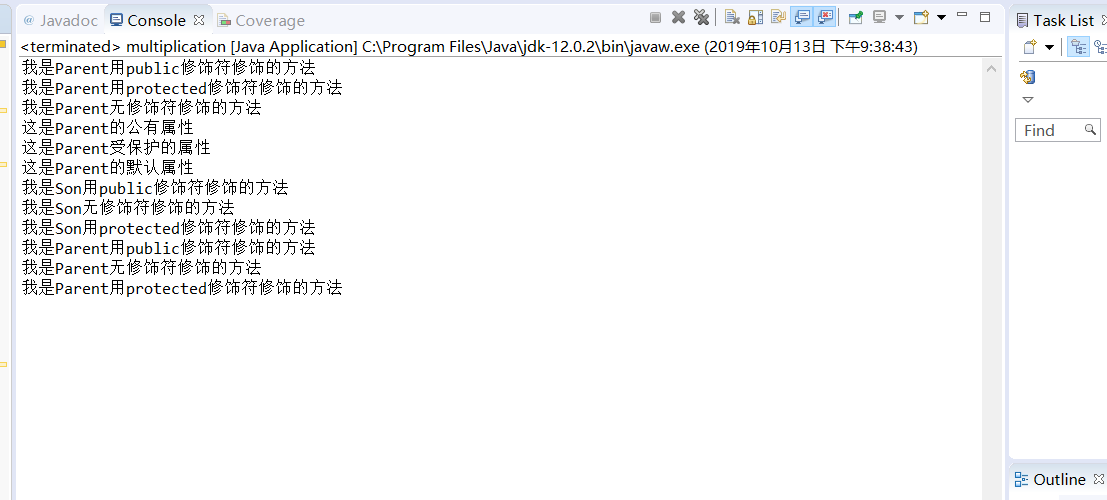
实验2:导入第5章以下示例程序,测试并进行代码注释。
测试程序1:
l 运行教材程序5-8、5-9、5-10,结合程序运行结果理解程序(教材174页-177页);
l 删除程序中Employee类、Manager类中的equals()、hasCode()、toString()方法,背录删除方法,在代码录入中理解类中重写Object父类方法的技术要点。
5-8
package equals;

/**

 * This program demonstrates the equals method.

 * @version 1.12 2012-01-26

 * @author Cay Horstmann

 */

public class EqualsTest

{

   public static void main(String[] args)

   {

      Employee alice1 = new Employee("Alice Adams", 75000, 1987, 12, 15);

      Employee alice2 = alice1;

      Employee alice3 = new Employee("Alice Adams", 75000, 1987, 12, 15);

      Employee bob = new Employee("Bob Brandson", 50000, 1989, 10, 1);

      System.out.println("alice1 == alice2: " + (alice1 == alice2));

      System.out.println("alice1 == alice3: " + (alice1 == alice3));

      System.out.println("alice1.equals(alice3): " + alice1.equals(alice3));

      System.out.println("alice1.equals(bob): " + alice1.equals(bob));

      System.out.println("bob.toString(): " + bob);

      Manager carl = new Manager("Carl Cracker", 80000, 1987, 12, 15);

      Manager boss = new Manager("Carl Cracker", 80000, 1987, 12, 15);

      boss.setBonus(5000);

      System.out.println("boss.toString(): " + boss);

      System.out.println("carl.equals(boss): " + carl.equals(boss));

      System.out.println("alice1.hashCode(): " + alice1.hashCode());

      System.out.println("alice3.hashCode(): " + alice3.hashCode());

      System.out.println("bob.hashCode(): " + bob.hashCode());

      System.out.println("carl.hashCode(): " + carl.hashCode());

   }

}
5-9
package equals;

import java.time.*;

import java.util.Objects;

public class Employee

{

   private String name;

   private double salary;

   private LocalDate hireDay;

   public Employee(String name, double salary, int year, int month, int day)

   {

      this.name = name;

      this.salary = salary;

      hireDay = LocalDate.of(year, month, day);

   }

   public String getName()

   {

      return name;

   }

   public double getSalary()

   {

      return salary;

   }

   public LocalDate getHireDay()

   {

      return hireDay;

   }

   public void raiseSalary(double byPercent)

   {

      double raise = salary * byPercent / 100;

      salary += raise;

   }

   public boolean equals(Object otherObject)

   {

      // a quick test to see if the objects are identical

      if (this == otherObject) return true;

      // must return false if the explicit parameter is null

      if (otherObject == null) return false;

      // if the classes don't match, they can't be equal

      if (getClass() != otherObject.getClass()) return false;

      // now we know otherObject is a non-null Employee

      Employee other = (Employee) otherObject;

      // test whether the fields have identical values

      return Objects.equals(name, other.name) && salary == other.salary && Objects.equals(hireDay, other.hireDay);

   }

   public int hashCode()

   {

      return Objects.hash(name, salary, hireDay);

   }

   public String toString()

   {

      return getClass().getName() + "[name=" + name + ",salary=" + salary + ",hireDay=" + hireDay

            + "]";

   }

}
5-10
package equals;

import java.time.*;

import java.util.Objects;

public class Employee

{

   private String name;

   private double salary;

   private LocalDate hireDay;

   public Employee(String name, double salary, int year, int month, int day)

   {

      this.name = name;

      this.salary = salary;

      hireDay = LocalDate.of(year, month, day);

   }

   public String getName()

   {

      return name;

   }

   public double getSalary()

   {

      return salary;

   }

   public LocalDate getHireDay()

   {

      return hireDay;

   }

   public void raiseSalary(double byPercent)

   {

      double raise = salary * byPercent / 100;

      salary += raise;

   }

   public boolean equals(Object otherObject)

   {

      // a quick test to see if the objects are identical

      if (this == otherObject) return true;

      // must return false if the explicit parameter is null

      if (otherObject == null) return false;

      // if the classes don't match, they can't be equal

      if (getClass() != otherObject.getClass()) return false;

      // now we know otherObject is a non-null Employee

      Employee other = (Employee) otherObject;

      // test whether the fields have identical values

      return Objects.equals(name, other.name) && salary == other.salary && Objects.equals(hireDay, other.hireDay);

   }

   public int hashCode()

   {

      return Objects.hash(name, salary, hireDay);

   }

   public String toString()

   {

      return getClass().getName() + "[name=" + name + ",salary=" + salary + ",hireDay=" + hireDay

            + "]";

   }

}
运行结果
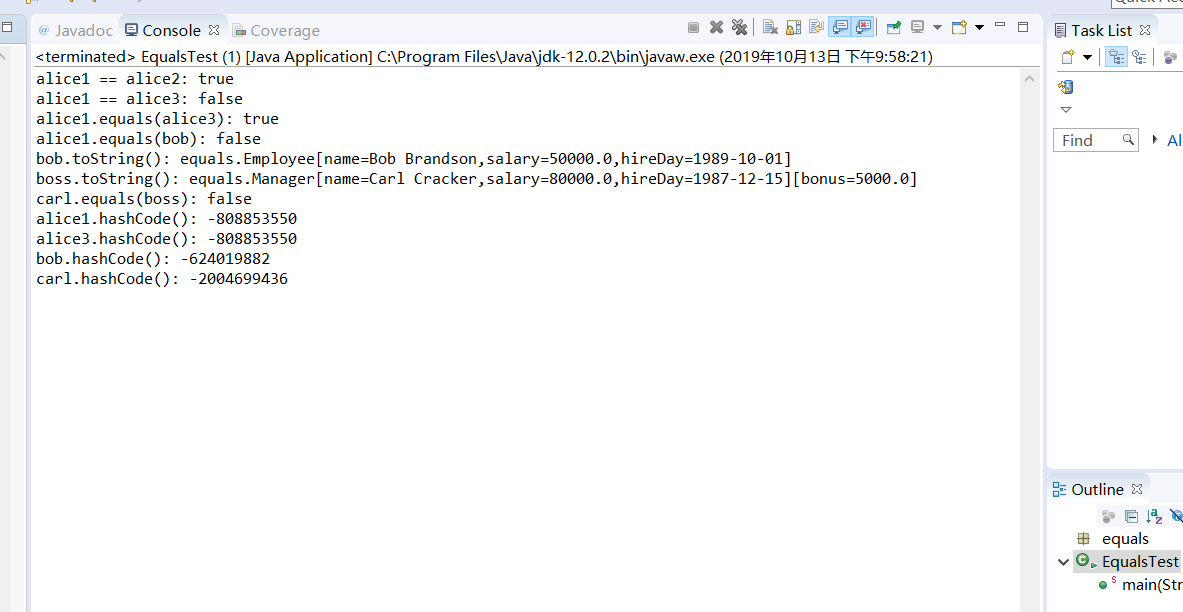
总结:Object是所有类的父类,它有很多类对象会用到的方法,例如比较常用的toString 、equals,当你新建xx类时,你可以重写Object已经定义的方法,也可以直接调用Object中的方法,如果你写一个封装的方法,不确定传进来的是什么类型的值,就可以使用Object作为一个笼统类。
测试程序2:
l 在elipse IDE中调试运行程序5-11(教材182页),结合程序运行结果理解程序;
l 掌握ArrayList类的定义及用法;
l 在程序中相关代码处添加新知识的注释;
l 设计适当的代码,测试ArrayList类的set()、get()、remove()、size()等方法的用法。
package arrayList;

import java.util.*;

/**

 * This program demonstrates the ArrayList class.

 * @version 1.11 2012-01-26

 * @author Cay Horstmann

 */

public class ArrayListTest

{

   public static void main(String[] args)

   {

      // fill the staff array list with three Employee objects

      ArrayList<Employee> staff = new ArrayList<>();

      staff.add(new Employee("Carl Cracker", 75000, 1987, 12, 15));

      staff.add(new Employee("Harry Hacker", 50000, 1989, 10, 1));

      staff.add(new Employee("Tony Tester", 40000, 1990, 3, 15));

      // 把每个员工的薪资提高5%

      for (Employee e : staff)

         e.raiseSalary(5);

      //打印所有雇员对象的信息

      for (Employee e : staff)

         System.out.println("name=" + e.getName() + ",salary=" + e.getSalary() + ",hireDay="

               + e.getHireDay());

   }

}
运行结果:

设计适当的代码,测试ArrayList类的set()、get()、remove()、size()等方法的用法
package arrayList;

import java.util.*;

/**

 * This program demonstrates the ArrayList class.

 * @version 1.11 2012-01-26

 * @author Cay Horstmann

 */

public class ArrayListTest

{

   public static void main(String[] args)

   {

      // 用三个Employee对象填充staff数组列表

      var staff = new ArrayList<Employee>();

      staff.add(new Employee("Carl Cracker", 75000, 1987, 12, 15));

      staff.add(new Employee("Harry Hacker", 50000, 1989, 10, 1));

      staff.add(new Employee("Tony Tester", 40000, 1990, 3, 15));

      System.out.println(staff.get(1));

      staff.set(1, new Employee("liyansong", 20000, 2018, 10, 10));

      System.out.println(staff.size());

      staff.remove(2);

      // 把每个人的薪水提高5%

      for (Employee e : staff)

         e.raiseSalary(5);

      // 打印所有Employee对象的信息

      for (Employee e : staff)

         System.out.println("name=" + e.getName() + ",salary=" + e.getSalary() + ",hireDay="

            + e.getHireDay());

   }

}
测试结果:
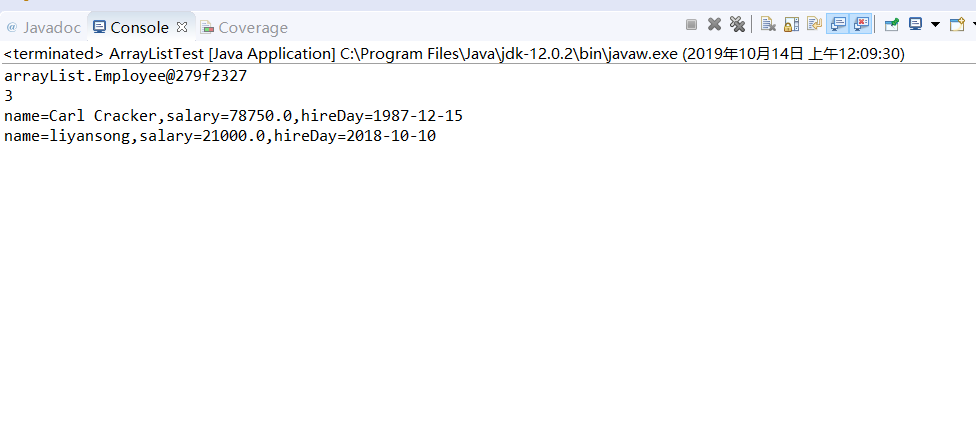
总结:ArrayList就是传说中的动态数组,动态的增加和减少元素 ,ArrayList内部封装了一个Object类型的数组,从一般的意义来说,它和数组没有本质的差别,
并且可以灵活的设置数组的大小。
测试程序3:
l 编辑、编译、调试运行程序5-12(教材189页),结合运行结果理解程序;
l 掌握枚举类的定义及用法;
l 在程序中相关代码处添加新知识的注释;
l 删除程序中Size枚举类,背录删除代码,在代码录入中掌握枚举类的定义要求。
5-12
package enums;

import java.util.*;

/**

 * This program demonstrates enumerated types.

 * @version 1.0 2004-05-24

 * @author Cay Horstmann

 */

public class EnumTest

{

   public static void main(String[] args)

   {

      var in = new Scanner(System.in);

      System.out.print("Enter a size: (SMALL, MEDIUM, LARGE, EXTRA_LARGE) ");

      String input = in.next().toUpperCase();

      Size size = Enum.valueOf(Size.class, input);

      System.out.println("size=" + size);

      System.out.println("abbreviation=" + size.getAbbreviation());

      if (size == Size.EXTRA_LARGE)

         System.out.println("Good job--you paid attention to the _.");

   }

}

enum Size

{

   SMALL("S"), MEDIUM("M"), LARGE("L"), EXTRA_LARGE("XL");

   private Size(String abbreviation) { this.abbreviation = abbreviation; }

   public String getAbbreviation() { return abbreviation; }

   private String abbreviation;

}

运行结果:
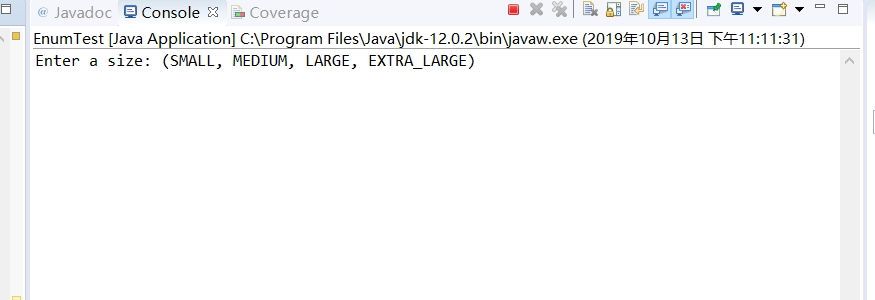
总结:枚举是一种特殊的数据类型,之所以特殊是因为它既是一种类(class)类型却又比类型多了些特殊的约束,但是这些约束的存在也造就了枚举类型的简洁,安全性以及便捷性。创建枚举类型要使用enum关键字,隐含了所创建的类型都是java.lang.Enum类的子类(java.lang.Enum是一个抽象类)。
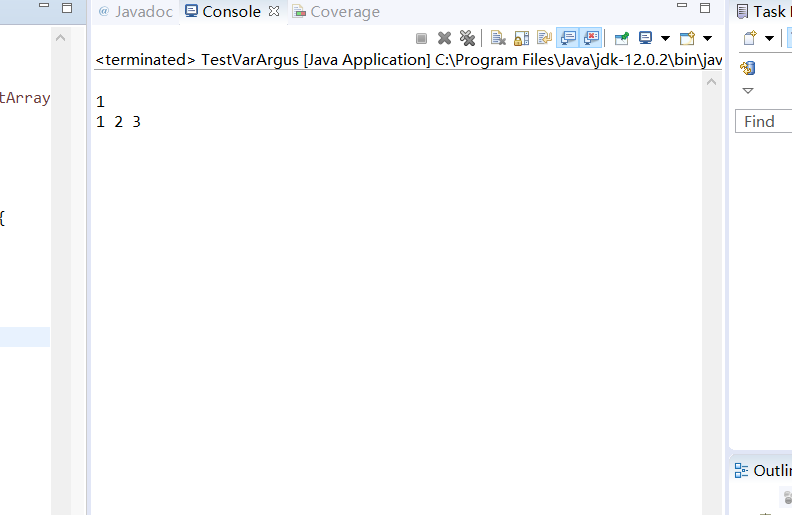
测试程序4:录入以下代码,结合程序运行结果了解方法的可变参数用法:
代码:
public class TestVarArgus {

    public static void dealArray(int... intArray){

        for (int i : intArray)

            System.out.print(i +" ");

        System.out.println();

    }

    public static void main(String args[]){

        dealArray();

        dealArray(1);

        dealArray(1, 2, 3);

    }

}
运行结果:
实验:3:编程练习:参照输出样例
public class Demo {

    public static void main(String[] args) {

        Son son = new Son();

        son.method();

    }

}

class Parent {

    Parent() {

        System.out.println("Parent's Constructor without parameter");

    }

    Parent(boolean b) {

        System.out.println("Parent's Constructor with a boolean parameter");

    }

    public void method() {

        System.out.println("Parent's method()");

    }

}

class Son extends Parent {

//补全本类定义

}
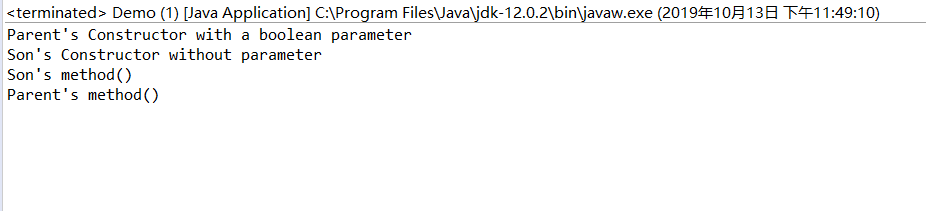
补全程序,使程序输出结果与输出样例一致。
程序运行结果如下:
Parent's Constructor with a boolean parameter
Son's Constructor without parameter
Son's method()
Parent's method()
补全代码:
package enums;

public class Demo {

    public static void main(String[] args) {

        Son son = new Son();

        son.method();

    }

}

class Parent {

    Parent() {

        System.out.println("Parent's Constructor without parameter");

    }

    Parent(boolean b) {

        System.out.println("Parent's Constructor with a boolean parameter");

    }

    public void method() {

        System.out.println("Parent's method()");

    }

}

class Son extends Parent {

    Son()

    {

        super(true);

    }

    public void method() {

        System.out.println("Son's Constructor without parameter");

        System.out.println("Son's method()");

        super.method();

//补全本类定义

}

}
运行结果:
第三部分:总结
通过这周的实验,使我更进一步的理解了继承的相关知识,尤其是对四种权限修饰符的理解,还有Object类的常用API用法;ArrayList类用法与常用API,枚举类使用方法;在本章知识中,继承与多态性两个面向对象程序设计特征,利用已掌握Java语言程序设计知识,通过一次一次的练习,我觉得阅读已有的代码,理解其中的方法,并将其转化为自己的知识,是一种很重要的能力,编程没有捷径,只有不断地训练。
201871010114-李岩松《面向对象程序设计(java)》第七周学习总结的更多相关文章
- 201771010134杨其菊《面向对象程序设计java》第九周学习总结
第九周学习总结 第一部分:理论知识 异常.断言和调试.日志 1.捕获 ...
- 扎西平措 201571030332《面向对象程序设计 Java 》第一周学习总结
<面向对象程序设计(java)>第一周学习总结 正文开头: 项目 内容 这个作业属于哪个课程 https://www.cnblogs.com/nwnu-daizh/ 这个作业的要求在哪里 ...
- 201871010132-张潇潇《面向对象程序设计(java)》第一周学习总结
面向对象程序设计(Java) 博文正文开头 项目 内容 这个作业属于哪个课程 https://www.cnblogs.com/nwnu-daizh/ 这个作业的要求在哪里 https://www.cn ...
- 杨其菊201771010134《面向对象程序设计Java》第二周学习总结
第三章 Java基本程序设计结构 第一部分:(理论知识部分) 本章主要学习:基本内容:数据类型:变量:运算符:类型转换,字符串,输入输出,控制流程,大数值以及数组. 1.基本概念: 1)标识符:由字母 ...
- 201871010124 王生涛《面向对象程序设计JAVA》第一周学习总结
项目 内容 这个作业属于哪个课程 https://www.cnblogs.com/nwnu-daizh/ 这个作业的要求在哪里 https://edu.cnblogs.com/campus/xbsf/ ...
- 201871010115——马北《面向对象程序设计JAVA》第二周学习总结
项目 内容 这个作业属于哪个课程 https://www.cnblogs.com/nwnu-daizh/ 这个作业的要求在哪里 https://www.cnblogs.com/nwnu-daizh/p ...
- 201777010217-金云馨《面向对象程序设计(Java)》第二周学习总结
项目 内容 这个作业属于哪个课程 https://www.cnblogs.com/nwnu-daizh/ 这个作业的要求在哪里 https://www.cnblogs.com/nwnu-daizh/p ...
- 201871010132——张潇潇《面向对象程序设计JAVA》第二周学习总结
项目 内容 这个作业属于哪个课程 https://www.cnblogs.com/nwnu-daizh/ 这个作业的要求在哪里 https://www.cnblogs.com/nwnu-daizh/p ...
- 201771010123汪慧和《面向对象程序设计Java》第二周学习总结
一.理论知识部分 1.标识符由字母.下划线.美元符号和数字组成, 且第一个符号不能为数字.标识符可用作: 类名.变量名.方法名.数组名.文件名等.第二部分:理论知识学习部分 2.关键字就是Java语言 ...
- 201521123061 《Java程序设计》第七周学习总结
201521123061 <Java程序设计>第七周学习总结 1. 本周学习总结 2. 书面作业 ArrayList代码分析 1.1 解释ArrayList的contains源代码 贴上源 ...
随机推荐
- Uber Go 语言编程规范
目录 Uber Go 语言编程规范 1. 介绍 2. 编程指南 3. 性能相关 4. 编程风格 5. 编程模式(Patterns) 6. 总结 Uber Go 语言编程规范 相信很多人前两天都看到 U ...
- Docker 学习入门
一.Docker 简介 1.什么是 Docker Docker 是使用最广泛的开源容器引擎,它彻底释放了计算虚拟化的威力,极大提高了应用的运行效率,降低了云计算资源供应的成本! 使用 Docker,可 ...
- VPGAME 的 Kubernetes 迁移实践
作者 | 伍冲斌 VPGAME 运维开发工程师 导读:VPGAME 是集赛事运营.媒体资讯.大数据分析.玩家社群.游戏周边等为一体的综合电竞服务平台.总部位于中国杭州,在上海和美国西雅图分别设立了电 ...
- Java8新特性之Lambda
为什么要Lambda Java8应该是目前最大的一次更新了,更新后我们迎来了很多新特性,其中便包括Lambda表达式,函数式编程的思想正式进入Java,让我们看一个经典案例. 例1 按照两个人的年龄排 ...
- 自学web前端达到什么水平,才能满足求职的标准?
大多数野生程序员最棘手的问题就是如何依靠技术解决温饱,通俗来讲就是技术折现的问题. 如果是单纯出于兴趣,或者只是为了突击某一阶段或者某一项目技术壁垒,不跟就业挂钩的自学倒也是无关痛痒.但是当上岗成为自 ...
- Fiddler的基本使用
目录 清空历史请求 请求所消耗的时间 发送的数据在 设置fiddler过滤请求 模拟弱网环境 Ctrl+R 拦截数据,拦截数据又称"打断点" fiddler开启的时候就是默认开始抓 ...
- Neo4j:图数据库GraphDB(二)高级查找
接着上一篇,继续介绍图数据库Neo4j: http://www.cnblogs.com/rongyux/p/5537028.html 三 高级查找操作 1过滤 name = "Tom H ...
- 04 Node.js学习笔记之模块的加载
A文件代码: //1.require是一个方法,它的作用就是用来加载模块的 console.log("执行 B ") require('./b.js'); console.log( ...
- Gstreamer基础教程10 - Streaming
摘要 我们把直接从网络播放一个媒体文件的方式称为在线播放(Online Streaming),我们已经在以往的例子中体验了GStreamer的在线播放功能,当我们指定播放URI为 http:// 时, ...
- spring boot 日志收集整理
spring boot 日志 1. 选择那种日志框架 slf4j 是抽像的接口层.也是spring boot 默认采用的接口层. util.logging,log4j,logback,commons- ...