
泡泡一分钟:Towards real-time unsupervised monocular depth estimation on CPU
Towards real-time unsupervised monocular depth estimation on CPU
Matteo Poggi , Filippo Aleotti , Fabio Tosi , Stefano Mattoccia
在CPU上进行实时无监督单目深度估计
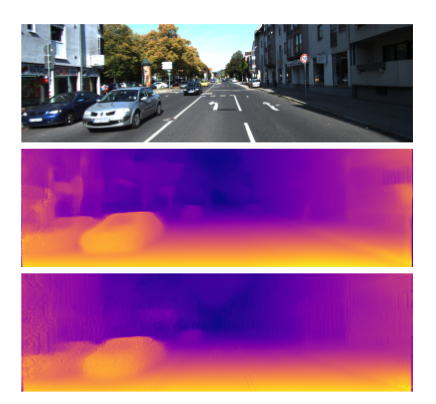
Abstract— Unsupervised depth estimation from a single image is a very attractive technique with several implications in robotic, autonomous navigation, augmented reality and so on.This topic represents a very challenging task and the advent of deep learning enabled to tackle this problem with excellent results. However, these architectures are extremely deep and complex. Thus, real-time performance can be achieved only by leveraging power-hungry GPUs that do not allow to infer depth maps in application fields characterized by low-power constraints. To tackle this issue, in this paper we propose a novel architecture capable to quickly infer an accurate depth map on a CPU, even of an embedded system, using a pyramid of features extracted from a single input image. Similarly to state-of-the-art, we train our network in an unsupervised manner casting depth estimation as an image reconstruction problem.Extensive experimental results on the KITTI dataset show that compared to the top performing approach our network has similar accuracy but a much lower complexity (about 6% of parameters) enabling to infer a depth map for a KITTI image in about 1.7 s on the Raspberry Pi 3 and at more than 8 Hz on a standard CPU. Moreover, by trading accuracy for efficiency, our network allows to infer maps at about 2 Hz and 40 Hz respectively, still being more accurate than most state-of-the-art slower methods. To the best of our knowledge, it is the first method enabling such performance on CPUs paving the way for effective deployment of unsupervised monocular depth estimation even on embedded systems.
单个图像的无监督深度估计是一种非常有吸引力的技术,在机器人,自主导航,增强现实等方面具有多种意义。本主题代表了一项非常具有挑战性的任务,深度学习的出现使得能够以优异的成绩解决这一问题。但是,这些架构非常深刻和复杂。 因此,仅通过利用耗电量大的GPU可以实现实时性能,所述GPU不允许在以低功率约束为特征的应用领域中推断深度图。为了解决这个问题,在本文中,我们提出了一种新颖的架构,能够使用从单个输入图像中提取的特征金字塔,在CPU甚至是嵌入式系统上快速推断出精确的深度图。与现有技术类似,我们以无人监督的方式训练我们的网络,将深度估计作为图像重建问题。此外,通过交易效率的准确性,我们的网络允许分别推断大约2 Hz和40 Hz的地图,仍然比大多数最先进的慢速方法更准确。据我们所知,这是第一种在CPU上实现这种性能的方法,即使在嵌入式系统上也能为有效部署无监督单眼深度估计铺平道路。
泡泡一分钟:Towards real-time unsupervised monocular depth estimation on CPU的更多相关文章
- 泡泡一分钟:Stabilize an Unsupervised Feature Learning for LiDAR-based Place Recognition
Stabilize an Unsupervised Feature Learning for LiDAR-based Place Recognition Peng Yin, Lingyun Xu, Z ...
- 泡泡一分钟:GEN-SLAM - Generative Modeling for Monocular Simultaneous Localization and Mapping
张宁 GEN-SLAM - Generative Modeling for Monocular Simultaneous Localization and Mapping GEN-SLAM - 单 ...
- 泡泡一分钟:Perception-aware Receding Horizon Navigation for MAVs
作为在空中抛掷四旋翼飞行器后恢复的第一步,它需要检测它使用其加速度计的发射.理想的情况下,在飞行中,加速度计理想地仅测量由于施加的转子推力引起的加速度,即.因此,当四旋翼飞行器发射时,我们可以检测到测 ...
- 泡泡一分钟: Deep-LK for Efficient Adaptive Object Tracking
Deep-LK for Efficient Adaptive Object Tracking "链接:https://pan.baidu.com/s/1Hn-CVgiR7WV0jvaYBv5 ...
- 泡泡一分钟:Cooperative Object Transportation by Multiple Ground and Aerial Vehicles: Modeling and Planning
张宁 Cooperative Object Transportation by Multiple Ground and Aerial Vehicles: Modeling and Planning 多 ...
- 泡泡一分钟:Semantic Labeling of Indoor Environments from 3D RGB Maps
张宁 Semantic Labeling of Indoor Environments from 3D RGB Maps Manuel Brucker, Maximilian Durner, Ra ...
- 泡泡一分钟:Cubic Range Error Model for Stereo Vision with Illuminators
Cubic Range Error Model for Stereo Vision with Illuminators 带有照明器的双目视觉的三次范围误差模型 "链接:https://pan ...
- 泡泡一分钟:Exploiting Points and Lines in Regression Forests for RGB-D Camera Relocalization
Exploiting Points and Lines in Regression Forests for RGB-D Camera Relocalization 利用回归森林中的点和线进行RGB-D ...
- 泡泡一分钟:Automatic Parameter Tuning of Motion Planning Algorithms
Automatic Parameter Tuning of Motion Planning Algorithms 运动规划算法的自动参数整定 Jos´e Cano, Yiming Yang, Brun ...
随机推荐
- (原)ubuntu中使用conda安装tensorflow-gpu
转载请注明出处: https://www.cnblogs.com/darkknightzh/p/9834567.html 参考网址: https://www.anaconda.com/blog/dev ...
- gcc/g++ disable warnings in particular include files
当在编译一个大项目的时候,你想打开所有的Warning,但是打开后发现一堆公共库文件都出现了warning报错.此时如果你想忽略公共库头文件中的warning报错,只需要在编译的时候,将公共库头文件的 ...
- tmux的复制粘贴
tmux有面板的概念,这导致普通终端下的ctrl+shift+C的模式复制出来的文本会串行.如果面板只有一列当然没有问题,但当面板有多列时,复制就会出问题.于是tmux提出了类似vim的复制模式.因此 ...
- asp.net 逻辑操作符与(&&),或(||),非(!)
逻辑操作符与(&&),或(||),非(!)能根据参数的关系返回布尔值 public class bool{ public static void main(string [] args ...
- JAVA(三)JAVA常用类库/JAVA IO
成鹏致远 | lcw.cnblog.com |2014-02-01 JAVA常用类库 1.StringBuffer StringBuffer是使用缓冲区的,本身也是操作字符串的,但是与String类不 ...
- 9最好的JavaScript压缩工具
削减是一个从源代码中删除不必要的字符的技术使它看起来简单而整洁.这种技术也被称为代码压缩和最小化.在这里,我们为你收集了10个最好的JavaScript压缩工具将帮助您删除不必要的空格,换行符,评论, ...
- 【emWin】例程十一:GIF图像显示
介绍: 本例程介绍gif格式图像显示的方法以及在GMT70,iCore3_ADP,7寸液晶模块.4.3寸液晶模块, VGA模块上的移植. 实验指导书及代码包下载: 链接:http://pan.baid ...
- winserver2012 自启动软件
开始->运行->输入shell:startup 在打开的启动文件夹中,将需要启动程序的快捷方式复制进去,完工 重启试试吧
- centos7中端口及服务对应情况(笔记)
25 postfix服务 111 rpcbind.socket服务
- Java知多少(18)类的定义及其实例化
类必须先定义才能使用.类是创建对象的模板,创建对象也叫类的实例化. 下面通过一个简单的例子来理解Java中类的定义: public class Dog{ String name; int age; v ...