
梯度下降法VS随机梯度下降法 (Python的实现)
 # -*- coding: cp936 -*-

 import numpy as np

 from scipy import stats

 import matplotlib.pyplot as plt

 # 构造训练数据

 x = np.arange(0., 10., 0.2)

 m = len(x)                                      # 训练数据点数目

 x0 = np.full(m, 1.0)

 input_data = np.vstack([x0, x]).T               # 将偏置b作为权向量的第一个分量

 target_data = 2 * x + 5 + np.random.randn(m)

 # 两种终止条件

 loop_max = 10000   # 最大迭代次数(防止死循环)

 epsilon = 1e-3

 # 初始化权值

 np.random.seed(0)

 w = np.random.randn(2)

 #w = np.zeros(2)

 alpha = 0.001      # 步长(注意取值过大会导致振荡,过小收敛速度变慢)

 diff = 0.

 error = np.zeros(2)

 count = 0          # 循环次数

 finish = 0         # 终止标志

 # -------------------------------------------随机梯度下降算法----------------------------------------------------------

 '''

 while count < loop_max:

     count += 1

     # 遍历训练数据集,不断更新权值

     for i in range(m):

         diff = np.dot(w, input_data[i]) - target_data[i]  # 训练集代入,计算误差值

         # 采用随机梯度下降算法,更新一次权值只使用一组训练数据

         w = w - alpha * diff * input_data[i]

         # ------------------------------终止条件判断-----------------------------------------

         # 若没终止,则继续读取样本进行处理,如果所有样本都读取完毕了,则循环重新从头开始读取样本进行处理。

     # ----------------------------------终止条件判断-----------------------------------------

     # 注意:有多种迭代终止条件,和判断语句的位置。终止判断可以放在权值向量更新一次后,也可以放在更新m次后。

     if np.linalg.norm(w - error) < epsilon:     # 终止条件:前后两次计算出的权向量的绝对误差充分小

         finish = 1

         break

     else:

         error = w

 print 'loop count = %d' % count,  '\tw:[%f, %f]' % (w[0], w[1])

 '''

 # -----------------------------------------------梯度下降法-----------------------------------------------------------

 while count < loop_max:

     count += 1

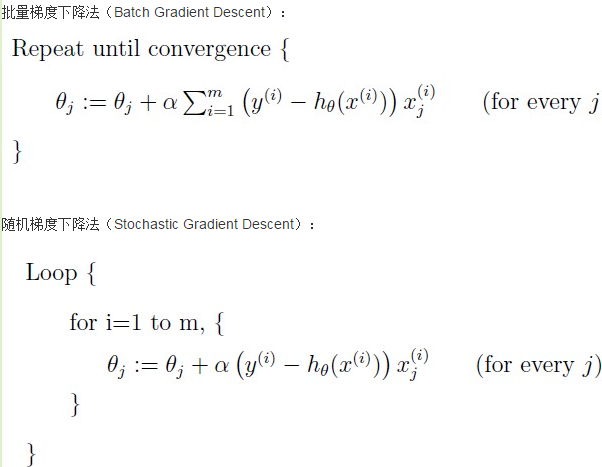
     # 标准梯度下降是在权值更新前对所有样例汇总误差,而随机梯度下降的权值是通过考查某个训练样例来更新的

     # 在标准梯度下降中,权值更新的每一步对多个样例求和,需要更多的计算

     sum_m = np.zeros(2)

     for i in range(m):

         dif = (np.dot(w, input_data[i]) - target_data[i]) * input_data[i]

         sum_m = sum_m + dif     # 当alpha取值过大时,sum_m会在迭代过程中会溢出

     w = w - alpha * sum_m       # 注意步长alpha的取值,过大会导致振荡

     #w = w - 0.005 * sum_m      # alpha取0.005时产生振荡,需要将alpha调小

     # 判断是否已收敛

     if np.linalg.norm(w - error) < epsilon:

         finish = 1

         break

     else:

         error = w

 print 'loop count = %d' % count,  '\tw:[%f, %f]' % (w[0], w[1])

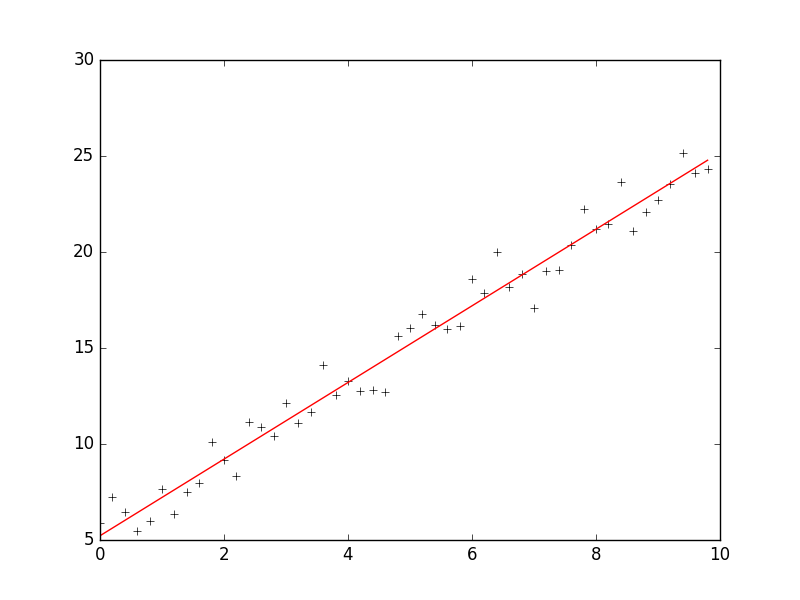
 # check with scipy linear regression

 slope, intercept, r_value, p_value, slope_std_error = stats.linregress(x, target_data)

 print 'intercept = %s slope = %s' %(intercept, slope)

 plt.plot(x, target_data, 'k+')

 plt.plot(x, w[1] * x + w[0], 'r')

 plt.show()
The Learning Rate
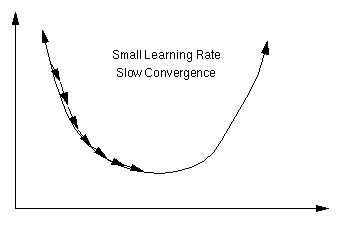
An important consideration is the learning rate µ, which determines by how much we change the weights w at each step. If µ is too small, the algorithm will take a long time to converge .
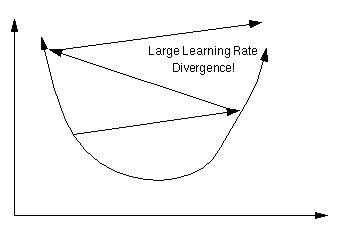
Conversely, if µ is too large, we may end up bouncing around the error surface out of control - the algorithm diverges. This usually ends with an overflow error in the computer's floating-point arithmetic.
Batch vs. Online Learning
Above we have accumulated the gradient contributions for all data points in the training set before updating the weights. This method is often referred to as batch learning. An alternative approach is online learning, where the weights are updated immediately after seeing each data point. Since the gradient for a single data point can be considered a noisy approximation to the overall gradient, this is also called stochastic gradient descent.
Online learning has a number of advantages:
- it is often much faster, especially when the training set is redundant (contains many similar data points),
- it can be used when there is no fixed training set (new data keeps coming in),
- it is better at tracking nonstationary environments (where the best model gradually changes over time),
- the noise in the gradient can help to escape from local minima (which are a problem for gradient descent in nonlinear models)
These advantages are, however, bought at a price: many powerful optimization techniques (such as: conjugate and second-order gradient methods, support vector machines, Bayesian methods, etc.) are batch methods that cannot be used online.A compromise between batch and online learning is the use of "mini-batches": the weights are updated after every n data points, where n is greater than 1 but smaller than the training set size.
参考:http://www.tuicool.com/articles/MRbee2i
https://www.willamette.edu/~gorr/classes/cs449/linear2.html
http://www.bogotobogo.com/python/python_numpy_batch_gradient_descent_algorithm.php
梯度下降法VS随机梯度下降法 (Python的实现)的更多相关文章
- 对数几率回归法(梯度下降法,随机梯度下降与牛顿法)与线性判别法(LDA)
本文主要使用了对数几率回归法与线性判别法(LDA)对数据集(西瓜3.0)进行分类.其中在对数几率回归法中,求解最优权重W时,分别使用梯度下降法,随机梯度下降与牛顿法. 代码如下: #!/usr/bin ...
- 机器学习算法(优化)之一:梯度下降算法、随机梯度下降(应用于线性回归、Logistic回归等等)
本文介绍了机器学习中基本的优化算法—梯度下降算法和随机梯度下降算法,以及实际应用到线性回归.Logistic回归.矩阵分解推荐算法等ML中. 梯度下降算法基本公式 常见的符号说明和损失函数 X :所有 ...
- NN优化方法对照:梯度下降、随机梯度下降和批量梯度下降
1.前言 这几种方法呢都是在求最优解中常常出现的方法,主要是应用迭代的思想来逼近.在梯度下降算法中.都是环绕下面这个式子展开: 当中在上面的式子中hθ(x)代表.输入为x的时候的其当时θ參数下的输出值 ...
- 机器学习(ML)十五之梯度下降和随机梯度下降
梯度下降和随机梯度下降 梯度下降在深度学习中很少被直接使用,但理解梯度的意义以及沿着梯度反方向更新自变量可能降低目标函数值的原因是学习后续优化算法的基础.随后,将引出随机梯度下降(stochastic ...
- 线性回归(最小二乘法、批量梯度下降法、随机梯度下降法、局部加权线性回归) C++
We turn next to the task of finding a weight vector w which minimizes the chosen function E(w). Beca ...
- online learning,batch learning&批量梯度下降,随机梯度下降
以上几个概念之前没有完全弄清其含义及区别,容易混淆概念,在本文浅析一下: 一.online learning vs batch learning online learning强调的是学习是实时的,流 ...
- 梯度下降之随机梯度下降 -minibatch 与并行化方法
问题的引入: 考虑一个典型的有监督机器学习问题,给定m个训练样本S={x(i),y(i)},通过经验风险最小化来得到一组权值w,则现在对于整个训练集待优化目标函数为: 其中为单个训练样本(x(i),y ...
- 梯度下降VS随机梯度下降
样本个数m,x为n维向量.h_theta(x) = theta^t * x梯度下降需要把m个样本全部带入计算,迭代一次计算量为m*n^2 随机梯度下降每次只使用一个样本,迭代一次计算量为n^2,当m很 ...
- 梯度下降、随机梯度下降、方差减小的梯度下降(matlab实现)
梯度下降代码: function [ theta, J_history ] = GradinentDecent( X, y, theta, alpha, num_iter ) m = length(y ...
随机推荐
- sql语句删除数据表重复字段的方法
大家都可能遇到字段重复的情况,网上很多人在找方法,也给出了一些方法,但是有的方法是误导大家,铁牛写出以下方法,方便大家使用 1.通过group by把重复的字段筛选出来,并建立临时表tmp 1 cre ...
- 使用node-webkit开发exe窗口程序
首发:个人博客,更新&纠错&回复 ====关于原生程序与壳中程序的议论begin==== 在所有用户windows机器上都能直接跑的程序,如果不采用微软系的语言,如VB,C++,C#等 ...
- listview中item 有checkbox多选防止滑动 listview页面 出现checkbox错位问题
checkbox点击切换背景 <CheckBox android:id="@+id/checkbox" android:layout_width="40dp&quo ...
- 在Dll中使用 TFDQuery 的 LoadFromStream 方法注意问题
今天又遇到一怪事, FDQuery 在服务器 savestream 传回了客户端. 客户端接收后 loadfromstream 接收都正常. 但当我把客户端封装成 dll 时,loadfromst ...
- ftp 终端命令
近期使用 macbook,并与新买的路由器折腾, 先备着... http://blog.csdn.net/qinde025/article/details/7595102 ftp使用的内部命令如下(其 ...
- JSP页面显示乱码
下面的显示页面(display.jsp)就出现乱码: <html> <head> <title>JSP的中文处理</title> <meta ht ...
- xtjh
<div onkeydown="javascript:if(event.keyCode==13) search()"> <br > ISBN<span ...
- linux正则表达式使用
首先介绍下正则表达式,它是由一串字符和元字符构成的字符串,简称RE(Regular Expression),它的主要功能是文本查询和字符串操作,它可以匹配一个文本的字符和字符集,达到数据过滤的效果. ...
- c# 遍历子控件,比如Form下的group,或者panel
方法很好用.目的是遍历所有容器的子控件... 方法1private void GetControl(Control.ControlCollection ctc, ref int checkNull) ...
- linux修改mac地址
先禁用网卡ifconfig eth0 down 再用ifconfig eth0 hw ether 新地址 这样就可以了 要想永久修改的话,在/etc/rc.d/rc.local里加上下面三句(/etc ...