
Top 10 Mistakes Java Developers Make--reference
This list summarizes the top 10 mistakes that Java developers frequently make.
#1. Convert Array to ArrayList
To convert an array to an ArrayList, developers often do this:
List<String> list = Arrays.asList(arr); |
Arrays.asList() will return an ArrayList which is a private static class inside Arrays, it is not the java.util.ArrayList class. The java.util.Arrays.ArrayList class has set(),get(), contains() methods, but does not have any methods for adding elements, so its size is fixed. To create a real ArrayList, you should do:
ArrayList<String> arrayList = new ArrayList<String>(Arrays.asList(arr)); |
The constructor of ArrayList can accept a Collection type, which is also a super type forjava.util.Arrays.ArrayList.
#2. Check If an Array Contains a Value
Developers often do:
Set<String> set = new HashSet<String>(Arrays.asList(arr)); |
The code works, but there is no need to convert a list to set first. Converting a list to a set requires extra time. It can as simple as:
Arrays.asList(arr).contains(targetValue); |
or
for(String s: arr){
|
The first one is more readable than the second one.
#3. Remove an Element from a List Inside a Loop
Consider the following code which removes elements during iteration:
ArrayList<String> list = new ArrayList<String>(Arrays.asList("a", "b", "c", "d"));
|
The output is:
[b, d]
There is a serious problem in this method. When an element is removed, the size of the list shrinks and the index changes. So if you want to delete multiple elements inside a loop by using the index, that will not work properly.
You may know that using iterator is the right way to delete elements inside loops, and you know foreach loop in Java works like an iterator, but actually it is not. Consider the following code:
ArrayList<String> list = new ArrayList<String>(Arrays.asList("a", "b", "c", "d"));
|
It will throw out ConcurrentModificationException.
Instead the following is OK:
ArrayList<String> list = new ArrayList<String>(Arrays.asList("a", "b", "c", "d"));
|
.next() must be called before .remove(). In the foreach loop, compiler will make the .next()called after the operation of removing element, which caused theConcurrentModificationException. You may want to take a look at the source code ofArrayList.iterator().
#4. Hashtable vs HashMap
By conventions in algorithm, Hashtable is the name of the data structure. But in Java, the data structure's name is HashMap. One of the key differences between Hashtable and HashMap is thatHashtable is synchronized. So very often you don't need Hashtable, instead HashMap should be used.
HashMap vs. TreeMap vs. Hashtable vs. LinkedHashMap
Top 10 questions about Map
#5. Use Raw Type of Collection
In Java, raw type and unbounded wildcard type are easy to mixed together. Take Set for example, Setis raw type, while Set<?> is unbounded wildcard type.
Consider the following code which uses a raw type List as a parameter:
public static void add(List list, Object o){
|
This code will throw an exception:
Exception in thread "main" java.lang.ClassCastException: java.lang.Integer cannot be cast to java.lang.String

	at ...
Using raw type collection is dangerous as the raw type collections skip the generic type checking and not safe. There are huge differences between Set, Set<?>, and Set<Object>. Check out
Raw type vs. Unbounded wildcard and Type Erasure.
#6. Access Level
Very often developers use public for class field. It is easy to get the field value by directly referencing, but this is a very bad design. The rule of thumb is giving access level for members as low as possible.
public, default, protected, and private
#7. ArrayList vs. LinkedList
When developers do not know the difference between ArrayList and LinkedList, they often useArrayList, because it looks familiar. However, there is a huge performance difference between them. In brief, LinkedList should be preferred if there are a large number of add/remove operations and there are not a lot of random access operations. Check out ArrayList vs. LinkedList to get more information about their performance if this is new to you.
#8. Mutable vs. Immutable
Immutable objects have many advantages such simplicity, safety, etc. But it requires a separate object for each distinct value, and too many objects might cause high cost of garbage collection. There should be a balance when choosing between mutable and immutable.
In general, mutable objects are used to avoid producing too many intermediate objects. One classic example is concatenating a large number of strings. If you use an immutable string, you would produce a lot of objects that are eligible for garbage collection immediately. This wastes time and energy on the CPU, using a mutable object the right solution (e.g. StringBuilder).
String result=""; |
There are other situations when mutable objects are desirable. For example passing mutable objects into methods lets you collect multiple results without jumping through too many syntactic hoops. Another example is sorting and filtering: of course, you could make a method that takes the original collection, and returns a sorted one, but that would become extremely wasteful for larger collections. (From dasblinkenlight's answer on Stack Overflow)
#9. Constructor of Super and Sub
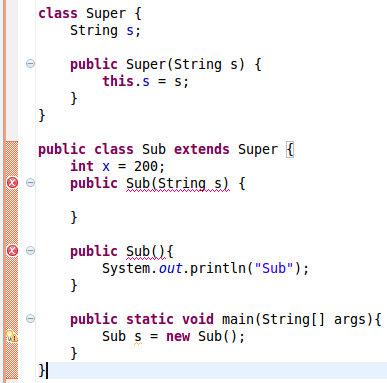
This compilation error occurs because the default super constructor is undefined. In Java, if a class does not define a constructor, compiler will insert a default no-argument constructor for the class by default. If a constructor is defined in Super class, in this case Super(String s), compiler will not insert the default no-argument constructor. This is the situation for the Super class above.
The constructors of the Sub class, either with-argument or no-argument, will call the no-argument Super constructor. Since compiler tries to insert super() to the 2 constructors in the Sub class, but the Super's default constructor is not defined, compiler reports the error message.
To fix this problem, simply 1) add a Super() constructor to the Super class like
public Super(){
|
, or 2) remove the self-defined Super constructor, or 3) add super(value) to sub constructors.
#10. "" or Constructor?
String can be created by two ways:
//1. use double quotes |
What is the difference?
The following examples can provide a quick answer:
String a = "abcd"; |
For more details about how they are allocated in memory, check out Create Java String Using ” ” or Constructor?.
Future Work
The list is based on my analysis of a large number of open source projects on GitHub, Stack Overflow questions, and popular Google queries. There is no evaluation to prove that they are precisely the top 10, but definitely they are very common. Please leave your comment, if you don’t agree with any part. I would really appreciate it if you could point out some other mistakes that are more common.
reference from:http://www.programcreek.com/2014/05/top-10-mistakes-java-developers-make/
Top 10 Mistakes Java Developers Make--reference的更多相关文章
- Top 10 Mistakes Java Developers Make(转)
文章列出了Java开发者最常犯的是个错误. 1.将数组转换为ArrayList 为了将数组转换为ArrayList,开发者经常会这样做: ? 1 List<String> list = A ...
- Yet Another 10 Common Mistakes Java Developers Make When Writing SQL (You Won’t BELIEVE the Last One)--reference
(Sorry for that click-bait heading. Couldn’t resist ;-) ) We’re on a mission. To teach you SQL. But ...
- 100 high quality blogs from java developers
This list collects 100 high quality blogs from Java developers from all over the world. Some of thes ...
- 2016年排名Top 100的Java类库——在分析了47,251个依赖之后得出的结论(16年文章)
本文由HollisChuang 翻译自 The Top 100 Java Libraries in 2016 – After Analyzing 47,251 Dependencies . 原作者:H ...
- 2016 年排名 Top 100 的 Java 类库
我们分析了GitHub中47,251个依赖,从中找出了排名前一百的Java类库,让我们看看谁在前面,谁在后面. 我们在漫长的周末的消遣方式就是浏览GitHub并且搜索流行的Java类库.我们决定把其中 ...
- Top 10 Books For Advanced Level Java Developers
Java is one of the most popular programming language nowadays. There are plenty of books for beginne ...
- Top 10 Questions about Java Exceptions--reference
reference from:http://www.programcreek.com/2013/10/top-10-questions-about-java-exceptions/ This arti ...
- Top 10 Methods for Java Arrays
作者:X Wang 出处:http://www.programcreek.com/2013/09/top-10-methods-for-java-arrays/ 转载文章,转载请注明作者和出处 The ...
- Watch out for these 10 common pitfalls of experienced Java developers & architects--转
原文地址:http://zeroturnaround.com/rebellabs/watch-out-for-these-10-common-pitfalls-of-experienced-java- ...
随机推荐
- !!对python列表学习整理列表及数组详细介绍
1.Python的数组分三种类型:(详细见 http://blog.sina.com.cn/s/blog_6b783cbd0100q2ba.html) (1) list 普通的链表,初始化后可以通过特 ...
- linux进程间通信方式
(1)管道(Pipe):管道可用于具有亲缘关系进程间的通信,允许一个进程和另一个与它有共同祖先的进程之间进行通信. (2)命名管道(named pipe):命名管道克服了管道没有名字的限制,因此,除具 ...
- Android开发之异步消息处理机制AsyncTask
转自:Android AsyncTask完全解析,带你从源码的角度彻底理解 另外一篇比较详细的博文:http://blog.csdn.net/liuhe688/article/details/6532 ...
- 利用if else判断是否及格
static void Main(string[] args) { while (true) { string ...
- Automator一键生成所需的iOS 图片icon
iOS到8了, 终于受不了它的各种尺寸的icon了. 写一个Finder服务来一键生成吧. 拖放几次再重复, 无技术含量, 但很有用. // 存放目录 ~/资源库/Services/
- 用Eclipse和GDB构建ARM交叉编译和在线调试环境
我们在 Linux 主机中搭建我们的开发环境,使用 Ubuntu 10.04 LTS 为例. 搭建应用开发环境 安装 JRE Eclipse 依赖于Java 环境,所以必须先安装 JRE 或 JD ...
- python解析AMF协议
最近看公司同事在玩页游<斗破乾坤>我也进去完了一把,感觉画面还不错,就是不停的点鼠标做任务,一会就烦了,看了下前端配置文件,我们以error.json_3e30为例,这个肯定是记录错误码的 ...
- FZU2224 An exciting GCD problem 区间gcd预处理+树状数组
分析:(别人写的) 对于所有(l, r)区间,固定右区间,所有(li, r)一共最多只会有log个不同的gcd值, 可以nlogn预处理出所有不同的gcd区间,这样区间是nlogn个,然后对于询问离线 ...
- [liu yanling]测试小结
编写测试用例,业务了解是基础,结合业务编写测试用例,重要的逻辑一定要覆盖
- C++之编码问题(Unicode,ASCII,本地默认)
本篇文章试图回答的问题: 1.char* pStr="我aa";这句代码执行后,pStr指向的内存区域中存储的字节到底是根据什么码表而来的呢?该字符串占几个字节? 2.将一个VS2 ...