
EM and GMM(Code)
In EM and GMM(Theory), I have introduced the theory of em algorithm for gmm. Now lets practice it in matlab!
1. Generate 1000 pieces of random 2-dimention data which obey 5 gaussian distribution.
function X = GenerateData

    Sigma = [1, 0; 0, 1];

    mu1 = [1, -1];

    x1 = mvnrnd(mu1, Sigma, 200);

    mu2 = [5.5, -4.5];

    x2 = mvnrnd(mu2, Sigma, 200);

    mu3 = [1, 4];

    x3 = mvnrnd(mu3, Sigma, 200);

    mu4 = [6, 4.5];

    x4 = mvnrnd(mu4, Sigma, 200);

    mu5 = [9, 0.0];

    x5 = mvnrnd(mu5, Sigma, 200);

    % obtain the 1000 data points to be clustered

    X = [x1; x2; x3; x4; x5];

end
2. Complete em algorithm.
function [Mu, Sigma, Pi, r_nk] = EmForGmm(Data, classNum, initVal)

    % Data : Matrix(n * d), n is the quantity of the data and d is the data

    %        dimention

    % classNum : Scale

    % initVal : Cell(3 * 1), initial value for Mu, Sigma and Pi

    %           cell 1: Mu

    %           cell 2: Sigma

    %           cell 3: Pi

    [sampleNum, sampleDim] = size(Data);

    indexPoint = zeros(sampleNum, 1);

    while(1)

        for n = 1 : sampleNum

            x = Data(n, :);

            px_nk_sumk = 0;

            for k = 1 : classNum

                Sigma_k = initVal{2}(:,:,k);

                Mu_k = initVal{1}(k,:);

                Pi_k = initVal{3}(k);

                px(n,k) = (1/(2*pi^(sampleDim/2)*det(Sigma_k)^(0.5))) ...

                    * exp(-0.5 * (x - Mu_k)*inv(Sigma_k)*(x - Mu_k)');

                px_nk_sumk = px_nk_sumk + Pi_k * px(n, k);

            end

            for k = 1 : classNum

                Sigma_k = initVal{2}(:,:,k);

                Mu_k = initVal{1}(k,:);

                Pi_k = initVal{3}(k);

                r(n, k) = Pi_k * px(n, k) / px_nk_sumk;

            end

        end

        Nk = sum(r)';

        newMuK = r' * Data;

        Nkk = repmat(Nk,1,2);

        newMuK = newMuK ./ Nkk;

        for i = 1 : classNum

            nk = Nk(i);

            MuT = repmat(newMuK(i,:),sampleNum,1);

            xT = Data - MuT;

            rT = r(:,i);

            rT = repmat(rT,1,2);

            newSigma(:,:,i) = xT' * (xT .* rT) / nk;

        end

        newPiK = Nk / sampleNum;

        indexPointT = indexPoint;

        [aa,indexPoint] = max(r,[],2);

        j1 = sum(sum(abs(newMuK - initVal{1}))) < 1e-6;

        j2 = sum(sum(sum(abs(newSigma - initVal{2})))) < 1e-6;

        j3 = sum(abs(newPiK - initVal{3})) < 1e-6;

        clf;

        if (j1 && j2 && j3)

            for i = 1:sampleNum

                if (indexPoint(i)==1)

                    plot(Data(i,1), Data(i,2), 'r.')

                end

                if (indexPoint(i)==2)

                    plot(Data(i,1), Data(i,2), 'b.')

                end

                if (indexPoint(i)==3)

                    plot(Data(i,1), Data(i,2), 'k.')

                end

                if (indexPoint(i)==4)

                    plot(Data(i,1), Data(i,2), 'g.')

                end

                if (indexPoint(i)==5)

                    plot(Data(i,1), Data(i,2), 'm.')

                end

                hold on;

            end

            break;

        else

            initVal{1} = newMuK;

            initVal{2} = newSigma;

            initVal{3} = newPiK;

        end

    end

    Mu = newMuK;

    Sigma = newSigma;

    Pi = newPiK;

    r_nk = r;

end
3. Complete main function.
clear,clc,clf

Data = GenerateData;

classNum = 5;

[sampleNum, sampleDia] = size(Data);

%% Initial value

% indexNum = floor(1 + (sampleNum - 1) * rand(1,classNum));

indexNum = [50,300,500,700,900];

initMu = Data(indexNum,:);

initSigmaT = [1 0.2;0.2 1];

initSigma = zeros(2,2,classNum);

for i = 1 : classNum

    initSigma(:,:,i) = initSigmaT;

    initPi(i,1) = 1 / classNum;

end

initVal = cell(3,1);

initVal{1} = initMu;

initVal{2} = initSigma;

initVal{3} = initPi;

%% EM algorithm

[Mu, Sigma, Pi, r_nk] = EmForGmm(Data, classNum, initVal);
4. Result.
The cluster result can be show as figure 3.
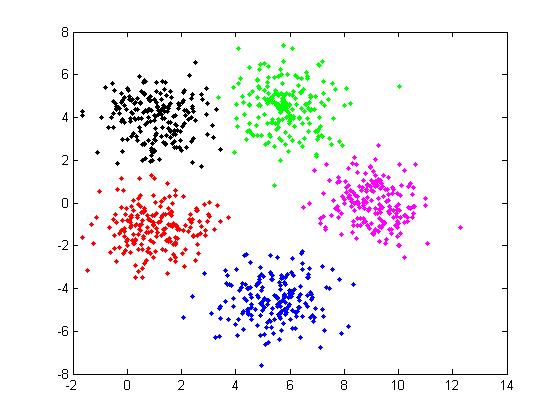
Figure 3
The probality distribution function can be writen as:
\[ p(\mathbf{x}) = \sum_{k=1}^{K}\pi_kp(\mathbf{x}|\mu_k\Sigma_k) \]
where,
$\mu_1 = (1.028, -1.158) $, $\mu_2 = (5.423, -4.538) $, $\mu_3 = (1.036, 3.975) $, $\mu_4 = (5.835, 4.474) $, $\mu_5 = (9.074, -0.063) $
Notice that, when generate the data:
$\mu_1 = (1, -1) $, $\mu_2 = (5.5, -4.5) $, $\mu_3 = (1, 4) $, $\mu_4 = (6, 4.5) $, $\mu_5 = (9, 0) $)
\[
\Sigma_1 = \left(
\begin{array}{cc}
1.0873& 0.0376\\
0.0376& 0.8850
\end{array}
\right),
\Sigma_2 = \left(
\begin{array}{cc}
1.1426& 0.0509\\
0.0509& 0.9192
\end{array}
\right),
\Sigma_3 = \left(
\begin{array}{cc}
0.9752& -0.0712\\
-0.0712& 0.9871
\end{array}
\right),
\Sigma_4 = \left(
\begin{array}{cc}
1.0111& -0.0782\\
-0.0782& 1.2034
\end{array}
\right),
\Sigma_5 = \left(
\begin{array}{cc}
0.8665& -0.1527\\
-0.1527& 0.9352
\end{array}
\right)
\]
Notice that, when generate the data:
\[\Sigma = \left(
\begin{array}{cc}
1& 0\\
0& 1
\end{array}
\right)
\]
$\pi_1 = 0.1986$, $\pi_2 = 0.2004 $, $\pi_3 = 0.1992$, $\pi_4 = 0.2015 $, $\pi_5 = 0.2002$
Notice that, when generate the data: each guassian components occupy 20% of all data. (1000 data point, 200 for each guassian components)
EM and GMM(Code)的更多相关文章
- EM and GMM(Theory)
Part 1: Theory 目录: What's GMM? How to solve GMM? What's EM? Explanation of the result What's GMM? GM ...
- 微信小程序API登录凭证(code),获得的用户登录态拥有一定的时效性
调用接口获取登录凭证(code)进而换取用户登录态信息,包括用户的唯一标识(openid) 及本次登录的 会话密钥(session_key).用户数据的加解密通讯需要依赖会话密钥完成. OBJECT参 ...
- 三维卷积:全景图像Spherical CNNs(Code)
卷积神经网络(CNN)可以很好的处理二维平面图像的问题.然而,对球面图像进行处理需求日益增加.例如,对无人机.机器人.自动驾驶汽车.分子回归问题.全球天气和气候模型的全方位视觉处理问题. 将球形信号的 ...
- css里px em rem特点(转)
1.px特点: 1.IE无法调整px作为单位的字体大小: 2.Firefox能够调整px.em和rem. px是像素,是相对长度单位,是相对于显示器屏幕分辨率而言的. 2.em特点: 1.em的值并不 ...
- PCL:描述三维离散点的ROPS特征(Code)
前言: 三维点云为三维欧式空间点的集合.对点云的形状描述若使用局部特征,则可分为两种:固定世界坐标系的局部描述和寻找局部主方向的局部描述,ROPS特征为寻找局部主方向的特征描述. 1.寻找主方向(对X ...
- Python:Matplotlib 画曲线和柱状图(Code)
原文链接:http://blog.csdn.net/ikerpeng/article/details/20523679 参考资料:http://matplotlib.org/gallery.html ...
- Qt:&OpenCV—Q图像处理基本操作(Code)
原文链接:http://www.cnblogs.com/emouse/archive/2013/03/31/2991333.html 作者写作一系列:http://www.cnblogs.com/em ...
- 编码(Code)
很遗憾,直接搜索Code或者编码是很难得找到这本书的,我也是无意中才接触到本书. 第一次读本书,对各方面的知识都不算很懂,觉得很多地方都写的太多浅显,好像本该就是这样子,一个编码系统说的那么麻烦干嘛, ...
- px和em的区别(转)
在国内网站中,包括三大门户,以及“引领”中国网站设计潮流的蓝色理想,ChinaUI等都是使用了px作为字体单位.只有百度好歹做了个可调的表率.而 在大洋彼岸,几乎所有的主流站点都使用em作为字体单位, ...
随机推荐
- iOS开发——生成条形码,二维码
- (void)viewDidLoad { [super viewDidLoad]; self.imageView.image = [self generateBarCode:@"15248 ...
- 【转】10款GitHub上最火爆的国产开源项目
将开源做到极致,提高效率方便更多用户 接触开源时间虽然比较短但是后续会努力为开源社区贡献自己微薄的力量 衡量一个开源产品好不好,看看产品在 GitHub 的 Star 数量就知道了.由此可见,GitH ...
- 编译uboot提示libasm-offsets.c10 error bad value (armv5)解决方法
编译uboot-2016.09提示如下错误: lib/asm-offsets.c:1:0: error: bad value (armv5) for -march= switch 解决方法: 1.在命 ...
- 游标使用 和sp_executesql动态sql
/****** Script for SelectTopNRows command from SSMS ******/ declare @oid int declare @cid int declar ...
- IOS软件国际化(本地化Localizable)
IOS软件国际化(本地化Localizable) iPhone是支持语言最多的手机,它支持各国语言及中国少数名族如蒙古等语言,这也是好多少数名族都用苹果的原因.在这一点上我们自主品牌还是要多学习学习. ...
- web前端好学吗?
最近这段时间许多学生讨论关于WEB前端工程师这个职位的问题.比如:关于前端难不难?好不好找工作?有没有用?好不好学?待遇好不好?好不好转其他的职位? 针对这个问题,课工场露露老师想跟大家谈谈自己对前端 ...
- 为mysql 表重新设置自增的主键id
1,删除原有主键: ALTER TABLE `table_name` DROP `id`; 2,添加新主键字段: ALTER TABLE `table_name` ADD `id` INT NOT N ...
- chrome的功能Copy as cURL
https://segmentfault.com/q/1010000002508961
- 关于mysql中触发器old和new如何更好的区别我有话要说?
1.当使用insert语句的时候,如果原表中没有数据的话,那么对于插入数据后表来说新插入的那条数据就是new,如图所示: 2.当使用delete语句的时候,删除的那一条数据相对于删除数据后表的数据来说 ...
- 3. 托管对象模型的迁移(Core Data 应用程序实践指南)
本章介绍如何添加模型版本及模型映射,演示几种迁移技术,供在升级模型时使用. 3.1. 修改托管对象模型 3.2. 添加模型版本 3.3. 轻量级迁移方式 3.4. 默认的迁移方式 3.5. 通过迁移管 ...