
Benelux Algorithm Programming Contest 2014 Final(第二场)
B:Button Bashing
You recently acquired a new microwave, and noticed that it provides a large number of buttons to be able to quickly specify the time that the microwave should be running for. There are buttons both for adding time, and for subtracting time. You wonder how efficient you can be when entering cooking times: you want to minimize the number of required button presses.
The microwave can be running for at least 0 seconds, and at most 1 hour. If a button press would result in a cooking time of less than 0 seconds, the microwave will set the cooking time to 0 seconds. If a button press would result in a cooking time of more than 1 hour, the microwave will set the cooking time to 1 hour. Initially, the microwave will run for 0 seconds. There will always be a button adding at least 1 second to the cooking time.
Given the buttons that the microwave provides for entering cooking times, determine the least amount of button presses required to let the microwave run for a certain amount of time. If it is not possible to enter the desired cooking time precisely, determine the smallest achievable cooking time above the target, and the minimum number of button presses required for that cooking time, instead. The microwave does not allow to adjust the cooking time once it has started cooking.
Input Format
On the first line one positive number: the number of test cases, at most 100. After that per test case:
- one line with two space-separated integers n and t (1≤n≤16,0≤t≤3600): the number of buttons available to change the cooking time, and the desired cooking time in seconds, respectively.
- one line with n space-separated integers bi (−3600≤bi≤3600): the number of seconds added to the cooking time when button iii is pressed.
Output Format
Per test case:
- one line with two space-separated integers: the minimum number of button presses required to reach the required cooking time, and the minimum number of extra seconds that the microwave must be running for, respectively.
样例输入
2

3 50

-10 10 60

1 50

20
样例输出
2 0

3 10
不够0秒作为0秒处理,超过3600秒当做3600秒处理,是一个背包问题,要求的是在超过m最小的情况下,按的字数最小
#include <iostream>

#include <algorithm>

#include <cstring>

#include <cstdio>

#include <vector>

#include <queue>

#include <stack>

#include <cstdlib>

#include <iomanip>

#include <cmath>

#include <cassert>

#include <ctime>

#include <map>

#include <set>

using namespace std;

#pragma comment(linker, "/stck:1024000000,1024000000")

#define lowbit(x) (x&(-x))

#define max(x,y) (x>=y?x:y)

#define min(x,y) (x<=y?x:y)

#define MAX 100000000000000000

#define MOD 1000

#define pi acos(-1.0)

#define ei exp(1)

#define PI 3.1415926535897932384626433832

#define ios() ios::sync_with_stdio(true)

#define INF 0x3f3f3f3f

#define mem(a) (memset(a,0,sizeof(a)))

typedef long long ll;

int t,n,m,a[],dp[<<];

struct node

{

    int step,time;

}ans,pos,cnt,inf;

int main()

{

    scanf("%d",&t);

    while(t--)

    {

        scanf("%d%d",&n,&m);

        for(int i=;i<=n;i++)

            scanf("%d",&a[i]);

        memset(dp,INF,sizeof(dp));

        dp[]=;

        queue<node>q;

        pos.step=,pos.time=;

        ans.step=INF,ans.time=INF;

        q.push(pos);

        while(!q.empty())

        {

            pos=q.front();

            q.pop();

            if(pos.time>=m)

            {

                if(ans.time>pos.time) ans=pos;

                else if(ans.time==pos.time && ans.step>pos.step) ans=pos;

            }

            for(int i=;i<=n;i++)

            {

                int nex=pos.time+a[i];

                if(nex<) nex=;

                if(nex>) nex=;

                if(dp[nex]>=INF)

                {

                    dp[nex]=dp[pos.time]+;

                    cnt.step=dp[nex];

                    cnt.time=nex;

                    q.push(cnt);

                }

            }

        }

        printf("%d %d\n",ans.step,ans.time-m);

    }

    return ;

}
G:Growling Gears
The Best Acceleration Production Company specializes in multi-gear engines. The performance of an engine in a certain gear, measured in the amount of torque produced, is not constant: the amount of torque depends on the RPM of the engine. This relationship can be described using a torque-RPM curve.
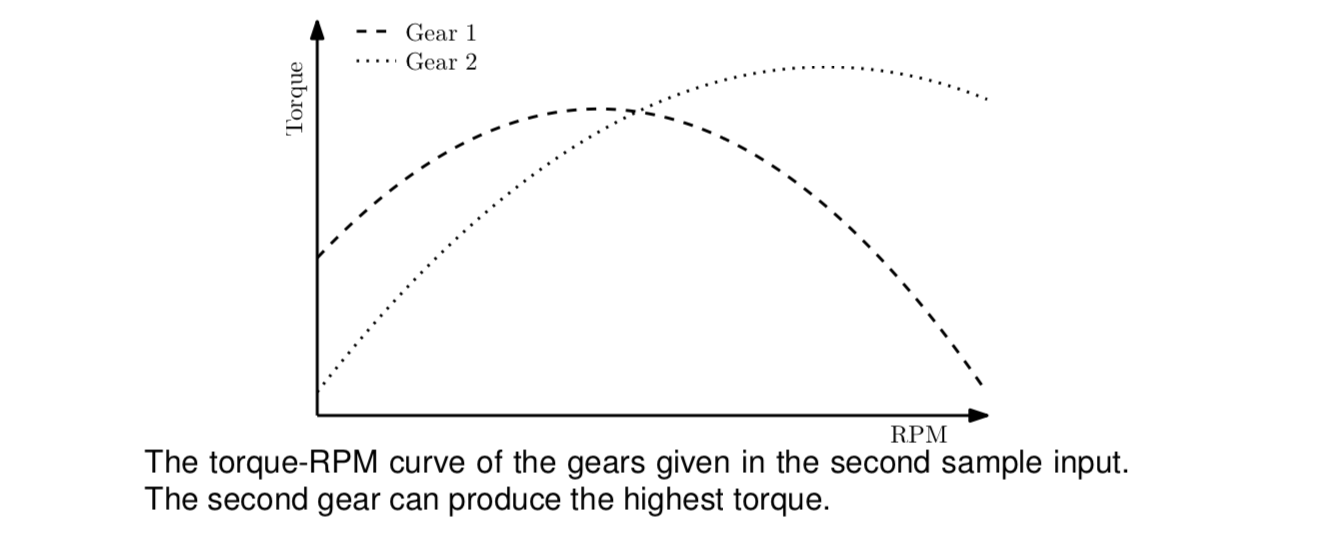
For the latest line of engines, the torque-RPM curve of all gears in the engine is a parabola of the form T=−aR2+bR+c,where R is the RPM of the engine,and T is the resulting torque.
Given the parabolas describing all gears in an engine, determine the gear in which the highest torque is produced. The first gear is gear 1, the second gear is gear 2, etc. There will be only one gear that produces the highest torque: all test cases are such that the maximum torque is at least 1 higher than the maximum torque in all the other gears.
Input Format
On the first line one positive number: the number of test cases, at most 100. After that per test case:
- one line with a single integer n (1≤n≤10): the number of gears in the engine.
- n lines, each with three space-separated integers a, b and c (1≤a,b,c≤104): the parameters of the parabola T=−aR2+bR+c describing the torque-RPM curve of each engine.
Output Format
Per test case:
- one line with a single integer: the gear in which the maximum torque is generated.
样例输入
3

1

1 4 2

2

3 126 1400

2 152 208

2

3 127 1400

2 154 208
样例输出
1

2

2
数学问题,求给定方程的最大顶点
#include <iostream>

#include <algorithm>

#include <cstring>

#include <cstdio>

#include <vector>

#include <queue>

#include <stack>

#include <cstdlib>

#include <iomanip>

#include <cmath>

#include <cassert>

#include <ctime>

#include <map>

#include <set>

using namespace std;

#pragma comment(linker, "/stck:1024000000,1024000000")

#define lowbit(x) (x&(-x))

#define max(x,y) (x>=y?x:y)

#define min(x,y) (x<=y?x:y)

#define MAX 100000000000000000

#define MOD 1000

#define pi acos(-1.0)

#define ei exp(1)

#define PI 3.1415926535897932384626433832

#define ios() ios::sync_with_stdio(true)

#define inf 0x3f3f3f3f

#define mem(a) (memset(a,0,sizeof(a)))

typedef long long ll;

int t,n;

int main()

{

    scanf("%d",&t);

    while(t--)

    {

        scanf("%d",&n);

        double ans;

        int pos=;

        for(int i=,a,b,c;i<n;i++)

        {

            scanf("%d%d%d",&a,&b,&c);

            double x=-*a*c-b*b;

            double y=-*a;

            if(i==) ans=x/y;

            else if(ans<x/y)

            {

                ans=x/y;

                pos=i;

            }

        }

        printf("%d\n",pos+);

    }

    return ;

}
I:Interesting Integers
Undoubtedly you know of the Fibonacci numbers. Starting with F1=1 and F2=1,every next number is the sum of the two previous ones. This results in the sequence 1,1,2,3,5,8,13,⋅⋅⋅
Now let us consider more generally sequences that obey the same recursion relation
Gi=Gi−1+Gi−2 for i>2
but start with two numbers G1≤G2of our own choice. We shall call these Gabonacci sequences. For example, if one uses G1=1 and G2=3, one gets what are known as the Lucas numbers: 1,3,4,7,11,18,29,⋅⋅⋅ . These numbers are – apart from 1 and 3 – different from the Fibonacci numbers.
By choosing the first two numbers appropriately, you can get any number you like to appear in the Gabonacci sequence. For example, the number n appears in the sequence that starts with 1 and n−1, but that is a bit lame. It would be more fun to start with numbers that are as small as possible, would you not agree?
Input Format
On the first line one positive number: the number of test cases, at most 100. After that per test case:
- one line with a single integer n (2≤n≤109): the number to appear in the sequence.
Output Format
Per test case:
- one line with two integers a and b (0<a≤b),such that,for G1 and G2=b,Gk= for some k. These numbers should be the smallest possible, i.e., there should be no numbers a and b′ with the same property, for which b′<b, or for which b′=b and a′<a.
样例输入
5

89

123

1000

1573655

842831057
样例输出
1 1

1 3

2 10

985 1971

2 7
首先可以退出时任意组合,所以根据斐波那契数列,可得af[i-1]+b[f[i-2]=n,解即可
#include <iostream>

#include <algorithm>

#include <cstring>

#include <cstdio>

#include <vector>

#include <queue>

#include <stack>

#include <cstdlib>

#include <iomanip>

#include <cmath>

#include <cassert>

#include <ctime>

#include <map>

#include <set>

using namespace std;

#pragma comment(linker, "/stck:1024000000,1024000000")

#define lowbit(x) (x&(-x))

#define max(x,y) (x>=y?x:y)

#define min(x,y) (x<=y?x:y)

#define MAX 100000000000000000

#define MOD 1000

#define pi acos(-1.0)

#define ei exp(1)

#define PI 3.1415926535897932384626433832

#define ios() ios::sync_with_stdio(true)

#define INF 0x3f3f3f3f

#define mem(a) (memset(a,0,sizeof(a)))

typedef long long ll;

ll n,fic[],t;

void init()

{

    fic[]=,fic[]=;

    for(int i=;i<=;i++)

        fic[i]=fic[i-]+fic[i-];

}

ll exgcd(ll a,ll b,ll &x,ll &y)

{

    if(b==){

        x=;

        y=;

        return a;

    }

    ll tmp=exgcd(b,a%b,y,x);

    y=y-(a/b)*x;

    return tmp;

}

int main()

{

    init();

    scanf("%lld",&t);

    while(t--)

    {

        scanf("%lld",&n);

        ll l=,r=n;

        for(int i=;i<=;i++)

        {

            if(fic[i]>n) break;

            ll x,y;

            ll tmp=exgcd(fic[i-],fic[i-],x,y);

            x*=n;

            y*=n;

            ll ans=(y-x)/fic[i];

            x+=ans*fic[i-];

            y-=ans*fic[i-];

            if(x>y) x-=fic[i-],y+=fic[i-];

            if(x<= || y<=) continue;

            if(r>y) r=y,l=x;

            else if(r==y && l>x) l=x;

        }

        printf("%lld %lld\n",l,r);

    }

    return ;

}
J:Jury Jeopardy
What would a programming contest be without a problem featuring an ASCII-maze? Do not despair: one of the judges has designed such a problem.
The problem is about a maze that has exactly one entrance/exit, contains no cycles and has no empty space that is completely enclosed by walls. A robot is sent in to explore the entire maze. The robot always faces the direction it travels in. At every step, the robot will try to turn right. If there is a wall there, it will attempt to go forward instead. If that is not possible, it will try to turn left. If all three directions are unavailable, it will turn back.
The challenge for the contestants is to write a program that describes the path of the robot, starting from the entrance/exit square until it finally comes back to it. The movements are described by a single letter: 'F' means forward, 'L' is left, 'R' is right and 'B' stands for backward.Each of 'L', 'R' and 'B' does not only describe the change in orientation of the robot, but also the advancement of one square in that direction. The robot's initial direction is East. In addition, the path of the robot always ends at the entrance/exit square.
The judge responsible for the problem had completed all the samples and testdata, when disaster struck: the input file got deleted and there is no way to recover it! Fortunately the output and the samples are still there. Can you reconstruct the input from the output? For your convenience, he has manually added the number of test cases to both the sample output and the testdata output.
Input Format
On the first line one positive number: the number of test cases. After that per test case:
- one line with a single string: the movements of the robot through the maze.
Output Format
On the first line one positive number: the number of test cases, at most 100. After that per test case:
- one line with two space-separated integers h and w (3≤h,w≤100): the height and width of the maze, respectively.
- h lines, each with w characters, describing the maze: a
'#'indicates a wall and a'.'represents an empty square.
The entire contour of the maze consists of walls, with the exception of one square on the left: this is the entrance. The maze contains no cycles (i.e. paths that would lead the robot back to a square it had left in another direction) and no empty squares that cannot be reached from the entrance. Every row or column – with the exception of the top row, bottom row and right column – contains at least one empty square.
样例输入
3

FFRBLF

FFRFRBRFBFRBRFLF

FRLFFFLBRFFFRFFFRFRFBRFLBRFRLFLFFR
样例输出
3

4 4

####

...#

##.#

####

7 5

#####

...##

##.##

#...#

##.##

##.##

#####

7 7

#######

#...#.#

#.#...#

#.#.###

..###.#

#.....#

#######
模拟题。
#include <iostream>

#include <algorithm>

#include <cstring>

#include <cstdio>

#include <vector>

#include <queue>

#include <stack>

#include <cstdlib>

#include <iomanip>

#include <cmath>

#include <cassert>

#include <ctime>

#include <map>

#include <set>

using namespace std;

#pragma comment(linker, "/stck:1024000000,1024000000")

#define lowbit(x) (x&(-x))

#define max(x,y) (x>=y?x:y)

#define min(x,y) (x<=y?x:y)

#define MAX 100000000000000000

#define MOD 1000

#define pi acos(-1.0)

#define ei exp(1)

#define PI 3.1415926535897932384626433832

#define ios() ios::sync_with_stdio(true)

#define INF 0x3f3f3f3f

#define mem(a) (memset(a,0,sizeof(a)))

typedef long long ll;

int a[][],t;

string s;

int main()

{

    scanf("%d",&t);

    printf("%d\n",t);

    while(t--)

    {

        cin>>s;

        memset(a,,sizeof(a));

        int k=s.size();

        int row=,col=,visl=,visr=,visu=,visd=;

        int ok=;

        a[row][col]=;

        for(int i=;i<k;i++)

        {

            if(s[i]=='F')

            {

                if(ok==) col+=;

                else if(ok==) row+=;

                else if(ok==) col-=;

                else if(ok==) row-=;

                ok=(ok+)%;

            }

            if(s[i]=='R')

            {

                if(ok==) row+=;

                if(ok==) col-=;

                if(ok==) row-=;

                if(ok==) col+=;

                ok=(ok+)%;

            }

            if(s[i]=='L')

            {

                if(ok==) row-=;

                if(ok==) col+=;

                if(ok==) row+=;

                if(ok==) col-=;

                ok=(ok+)%;

            }

            if(s[i]=='B')

            {

                if(ok==) col-=;

                if(ok==) row-=;

                if(ok==) col+=;

                if(ok==) row+=;

                ok=(ok+)%;

            }

            a[row][col]=;

            visl=min(visl,col);

            visr=max(visr,col);

            visu=min(visu,row);

            visd=max(visd,row);

        }

        visu--,visd++,visr++;

        printf("%d %d\n",visd-visu+,visr-visl+);

        for(int i=visu;i<=visd;i++)

        {

            for(int j=visl;j<=visr;j++)

                printf("%c",a[i][j]?'.':'#');

            printf("\n");

        }

    }

    return ;

}
Benelux Algorithm Programming Contest 2014 Final(第二场)的更多相关文章
- 计蒜客 28319.Interesting Integers-类似斐波那契数列-递推思维题 (Benelux Algorithm Programming Contest 2014 Final ACM-ICPC Asia Training League 暑假第一阶段第二场 I)
I. Interesting Integers 传送门 应该是叫思维题吧,反正敲一下脑壳才知道自己哪里写错了.要敢于暴力. 这个题的题意就是给你一个数,让你逆推出递推的最开始的两个数(假设一开始的两个 ...
- 计蒜客 28317.Growling Gears-一元二次方程的顶点公式 (Benelux Algorithm Programming Contest 2014 Final ACM-ICPC Asia Training League 暑假第一阶段第二场 G)
G. Growling Gears 传送门 此题为签到题,直接中学的数学知识点,一元二次方程的顶点公式(-b/2*a,(4*a*c-b*b)/4*a):直接就可以得到结果. 代码: #include& ...
- 计蒜客 28315.Excellent Engineers-线段树(单点更新、区间最值) (Benelux Algorithm Programming Contest 2014 Final ACM-ICPC Asia Training League 暑假第一阶段第二场 E)
先写这几道题,比赛的时候有事就只签了个到. 题目传送门 E. Excellent Engineers 传送门 这个题的意思就是如果一个人的r1,r2,r3中的某一个比已存在的人中的小,就把这个人添加到 ...
- Benelux Algorithm Programming Contest 2014 Final
// Button Bashing (bfs) 1 #include <iostream> #include <cstdio> #include <cstring> ...
- 2014 Benelux Algorithm Programming Contest (BAPC 14)E
题目链接:https://vjudge.net/contest/187496#problem/E E Excellent Engineers You are working for an agency ...
- Gym -102007 :Benelux Algorithm Programming Contest (BAPC 18) (寒假自训第5场)
A .A Prize No One Can Win 题意:给定N,S,你要从N个数中选最多是数,使得任意两个之和不大于S. 思路:排序,然后贪心的选即可. #include<bits/stdc+ ...
- 2020.3.14--训练联盟周赛 Preliminaries for Benelux Algorithm Programming Contest 2019
1.A题 题意:给定第一行的值表示m列的最大值,第m行的值表示n行的最大值,问是否会行列冲突 思路:挺简单的,不过我在一开始理解题意上用了些时间,按我的理解是输入两组数组,找出每组最大数,若相等则输出 ...
- 2015 Benelux Algorithm Programming Contest I- Interesting Integers
题目大意:给你一个数字n(n<=1e9) ,让你求一个能包含这个数的斐波那契数列的第一项a 和第二项b,找出b最小的那个. 帮我复习了一下扩展欧几里得.... 思路:a,b,a+b,a+2b…… ...
- 2017 Benelux Algorithm Programming Contest (BAPC 17) Solution
A - Amsterdam Distance 题意:极坐标系,给出两个点,求最短距离 思路:只有两种方式,取min 第一种,先走到0点,再走到终点 第二种,走到同一半径,再走过去 #include ...
随机推荐
- 三种SVM的对偶问题
一.SVM原问题及要变成对偶问题的解决办法 对于SVM的,我们知道其终于目的是求取一分类超平面,然后将新的数据带入这一分类超平面的方程中,推断输出结果的符号,从而推断新的数据的正负. 而求解svm分类 ...
- LeetCode 437. Path Sum III (STL map前缀和)
找遍所有路径,特判以根为起点的串即可. 代码: /** * Definition for a binary tree node. * struct TreeNode { * int val; * Tr ...
- HDU 1548 A strange lift【BFS】
题意:给出一个电梯,给出它的层数f,给出起点s,终点g,以及在每一层能够上或者下w[i]层,问至少需要按多少次按钮到达终点. 和POJ catch that cow一样,直接用了那一题的代码,发现一直 ...
- 前端换行显示,后端返回<br>
- js的onclick和jq的click以及on和bind的区别
onclick和click,只能静态绑定点击事件:bind的可以一次绑定多个事件(click/onmouseover等):on可以动态的绑定事件,当页面加载完成调用on即可
- kissy延迟加载demo
<!doctype html><html><head> <meta charset="gbk"/> <title& ...
- [转载]vim常用命令总结
内容出处https://www.jianshu.com/p/a8ab13cff1ea 如有侵权请告知 移动.跳转 h.j.k.l:分别对应左.下.上.右.按键盘分布,从左到右,逆时针. w:移动到下一 ...
- NodeJS 第一天学习
NodeJS 第一天学习 严格模式 ECMAScript 5的严格模式是采用具有限制性JavaScript变体的一种方式,从而使代码显示地 脱离"马虎模式/稀松模式/懒散模式"(s ...
- Java里的各种队列
以下翻译来自java8的官方文档: 1.LinkedBlockingQueue:基于链接节点的可选限定的blocking queue . 这个队列排列元素FIFO(先进先出). 队列的头部是队列中最长 ...
- js php 数组比較
php 与 javascript 数组除了定义以及 操作上有非常大的差别,还有非常多其他的差别.如今我们就来讨论讨论. 1.大家都知道php比較两个数组是否全相等(值,索引)相等 $a=arra ...