
POJ 3020 Antenna Placement【二分匹配——最小路径覆盖】
链接:
| Time Limit: 1000MS | Memory Limit: 65536K | |
| Total Submissions: 5500 | Accepted: 2750 |
Description
comes in four types. Each type can only transmit and receive signals in a direction aligned with a (slightly skewed) latitudinal and longitudinal grid, because of the interacting electromagnetic field of the earth. The four types correspond to antennas operating
in the directions north, west, south, and east, respectively. Below is an example picture of places of interest, depicted by twelve small rings, and nine 4DAir antennas depicted by ellipses covering them.
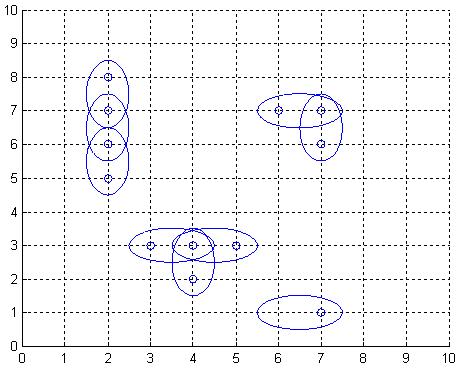
Obviously, it is desirable to use as few antennas as possible, but still provide coverage for each place of interest. We model the problem as follows: Let A be a rectangular matrix describing the surface of Sweden, where an entry of A either is a point of interest,
which must be covered by at least one antenna, or empty space. Antennas can only be positioned at an entry in A. When an antenna is placed at row r and column c, this entry is considered covered, but also one of the neighbouring entries (c+1,r),(c,r+1),(c-1,r),
or (c,r-1), is covered depending on the type chosen for this particular antenna. What is the least number of antennas for which there exists a placement in A such that all points of interest are covered?
Input
the points of interest in Sweden in the form of h lines, each containing w characters from the set ['*','o']. A '*'-character symbolises a point of interest, whereas a 'o'-character represents open space.
Output
Sample Input
2

7 9

ooo**oooo

**oo*ooo*

o*oo**o**

ooooooooo

*******oo

o*o*oo*oo

*******oo

10 1

*

*

*

o

*

*

*

*

*

*
Sample Output
17

5
题意:
'o'代表空地
要求你用最小的无线电雷达来覆盖所有的城市
雷达只可以建立在城市上
每一个雷达,只可以覆盖它自己所在的位置和与它相邻的一个位置
【上 || 下 || 左】
注意:也就是说一个雷达只可以覆盖两个城市
算法:二分图的匹配 ———— 最小路径覆盖
最小路径覆盖=最小路径覆盖=|G|-最大匹配数
思路:
具体分析还是看这篇博客学去吧,不能比她说的更好了Orz
http://blog.csdn.net/lyy289065406/article/details/6647040
PS:感觉还是分不怎么清什么时候用最小路径覆盖,什么时候用最大匹配
(╯▽╰)╭先记住直接匹配的就用最大匹配
要拆点的就用最小路径覆盖好了,水菜伤不起
code:
/*********************************************************************

题意:‘*’代表城市

       'o'代表空地

       要求你用最小的无线电雷达来覆盖所有的城市

       雷达只可以建立在城市上

       每一个雷达,只可以覆盖它自己所在的位置和与它相邻的一个位置

       【上 || 下 || 左】

       注意:也就是说一个雷达只可以覆盖两个城市

算法:二分图的匹配 ———— 最小路径覆盖

      最小路径覆盖=最小路径覆盖=|G|-最大匹配数

思路:拆点,把每一个城市看成是两个点

      具体分析还是看这篇博客学去吧,不能比她说的更好了Orz

      http://blog.csdn.net/lyy289065406/article/details/6647040

PS:感觉还是分不怎么清什么时候用最小路径覆盖,什么时候用最大匹配

    ╮(╯▽╰)╭先记住直接匹配的就用最大匹配

    要拆点的就用最小路径覆盖好了,水菜伤不起

**********************************************************************/

#include<stdio.h>

#include<string.h>

#include<algorithm>

#include<iostream>

using namespace std;

const int maxn = 40*10+10;

int map[45][15];

int g[maxn][maxn];

int linker[maxn];

int vis[maxn];

int uN,vN;

bool dfs(int u)

{

    for(int v = 1; v <= vN; v++)

    {

        if(!vis[v] && g[u][v])

        {

            vis[v] = 1;

            if(linker[v] == -1 || dfs(linker[v]))

            {

                linker[v] = u;

                return true;

            }

        }

    }

    return false;

}

int hungary()

{

    int sum = 0;

    memset(linker,-1,sizeof(linker));

    for(int u = 1; u <= uN; u++)

    {

        memset(vis,0,sizeof(vis));

        if(dfs(u))

            sum++;

    }

    return sum;

}

int main()

{

    int T;

    int row,col;

    scanf("%d", &T);

    while(T--)

    {

        scanf("%d%d%*c", &row,&col);

        char c;

        int num = 0; //记录有多少个点

        memset(map,0,sizeof(map));

        memset(g,0,sizeof(g));

        for(int i = 1; i <= row; i++) //从 1 开始, map[][]周围加边

        {

            for(int j = 1; j <= col; j++)

            {

                scanf("%c", &c);

                if(c == '*') map[i][j] = ++num;

            }

            getchar();

        }

        uN = vN = num;

        for(int i = 1; i <= row; i++) //建图

        {

            for(int j = 1; j <= col; j++)

            {

                if(map[i][j])

                {

                    if(map[i][j+1])

                        g[map[i][j]][map[i][j+1]] = 1;

                    if(map[i][j-1])

                        g[map[i][j]][map[i][j-1]] = 1;

                    if(map[i+1][j])

                        g[map[i][j]][map[i+1][j]] = 1;

                    if(map[i-1][j])

                        g[map[i][j]][map[i-1][j]] = 1;

                }

            }

        }

        printf("%d\n", num-hungary()/2); //最小路径覆盖数

    }

    return 0;

}
POJ 3020 Antenna Placement【二分匹配——最小路径覆盖】的更多相关文章
- POJ-3020 Antenna Placement---二分图匹配&最小路径覆盖&建图
题目链接: https://vjudge.net/problem/POJ-3020 题目大意: 一个n*m的方阵 一个雷达可覆盖两个*,一个*可与四周的一个*被覆盖,一个*可被多个雷达覆盖问至少需要多 ...
- 二分图最大匹配(匈牙利算法) POJ 3020 Antenna Placement
题目传送门 /* 题意:*的点占据后能顺带占据四个方向的一个*,问最少要占据多少个 匈牙利算法:按坐标奇偶性把*分为两个集合,那么除了匹配的其中一方是顺带占据外,其他都要占据 */ #include ...
- poj 3020 Antenna Placement(最小路径覆盖 + 构图)
http://poj.org/problem?id=3020 Antenna Placement Time Limit: 1000MS Memory Limit: 65536K Total Sub ...
- POJ 3020——Antenna Placement——————【 最小路径覆盖、奇偶性建图】
Antenna Placement Time Limit:1000MS Memory Limit:65536KB 64bit IO Format:%I64d & %I64u S ...
- poj 3020 Antenna Placement (最小路径覆盖)
链接:poj 3020 题意:一个矩形中,有n个城市'*'.'o'表示空地,如今这n个城市都要覆盖无线,若放置一个基站, 那么它至多能够覆盖本身和相邻的一个城市,求至少放置多少个基站才干使得全部的城市 ...
- poj 3020 Antenna Placement (最小路径覆盖)
二分图题目 当时看到网上有人的博客写着最小边覆盖,也有人写最小路径覆盖,我就有点方了,斌哥(kuangbin)的博客上只给了代码,没有解释,但是现在我还是明白了,这是个最小路径覆盖(因为我现在还不知道 ...
- POJ 3020 Antenna Placement (二分图最小路径覆盖)
<题目链接> 题目大意:一个矩形中,有N个城市’*’,现在这n个城市都要覆盖无线,每放置一个基站,至多可以覆盖相邻的两个城市.问至少放置多少个基站才能使得所有的城市都覆盖无线? 解题分析: ...
- poj 3020 Antenna Placement(二分无向图 匈牙利)
Antenna Placement Time Limit: 1000MS Memory Limit: 65536K Total Submissions: 6438 Accepted: 3176 ...
- POJ 3020 Antenna Placement 【最小边覆盖】
传送门:http://poj.org/problem?id=3020 Antenna Placement Time Limit: 1000MS Memory Limit: 65536K Total ...
随机推荐
- java 解析webservice 中的soapheader
//从MessageContet中获取头域中的值 public HeaderBean getBeanFromRequest(org.apache.axis2.context.MessageContex ...
- NOIP2007:纪念品分组
#include<stdio.h> #include<stdlib.h> int a[100]; int main(){ int i,j,k,m,n,w; scanf(&quo ...
- Scroller应用:ListView滑动删除
1.设计思路 在Scroller的应用--滑屏实现中使用Scroller实现滑屏效果,这里使用Scroller与ListView实现相似QQ滑动.然后点击删除功能.设计思路是Item使用Scrolle ...
- Source Insight 项目简单使用说明
SI(Source Insight) 是我一直写代码的好伙伴, 相信这强大的软件也是广大程序猿编写软件的利器. 正所谓" 工欲善其事, 必先利其器", 我们要学会利用这款软件. 先 ...
- Oracle之比较NVARCHAR2字符串
一.引言 昨天遇到一个问题,一直想不通是为什么,我在pl/sql里面执行sql语句,选出字段值等于某个值的的行: '; 用select * from test;是可以查到该值的,但是用这条语句却没有结 ...
- JDK 6 目录结构介绍以及JDK中的工具研究
要想深入了解Java必须对JDK的组成, 本文对JDK6里的目录做了基本的介绍,主要还是讲解 了下JDK里的各种可执行程序或工具的用途 Java(TM) 有两个平台 JRE 运行平台,包括Jav ...
- java @override 报错处理
转载自:http://blog.sina.com.cn/s/blog_9c7605530101kl9r.html 一.java @override 报错处理 做项目的时候,同事那边电脑上编译通过的ja ...
- NGUI3.7.4实现循环拖动
前段时间下了NGUI新版本3.7.4,看到例子Endless Scroll Views,实现了循环拖动,可能会用到,先把实现步骤贴出来跟大家分享一下. 1.首先新建一个背景. 2.添加所需控件,类似滑 ...
- 【揭秘】什么是不对称秘钥和CA证书
密钥交换简单的说就是利用非对称加密算法来加密对称密钥保证传输的安全性,之后用对称密钥来加密数据. ★方案1--单纯用"对称加密算法"的可行性 首先简单阐述一下,"单纯用对 ...
- DpQuery.js
(function (window) { //添加事件的方法通用所有 function addevent(evetname, fn, obj) { if (document.attachEvent) ...