
servlet开发(四)之ServletContext
接上一篇。
2.3.4 利用ServletContext对象读取资源文件
比如我们要读取web项目中的配置文件。
项目目录结构如下:
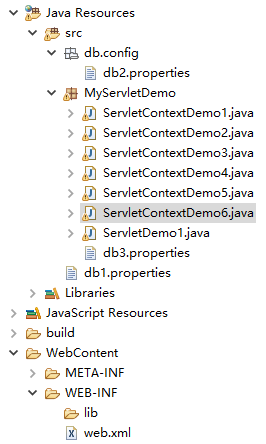
使用ServletContext对象读取资源文件的示例代码如下:
package MyServletDemo;

import java.io.FileInputStream;

import java.io.FileNotFoundException;

import java.io.IOException;

import java.io.InputStream;

import java.text.MessageFormat;

import java.util.Properties;

import javax.servlet.ServletException;

import javax.servlet.http.HttpServlet;

import javax.servlet.http.HttpServletRequest;

import javax.servlet.http.HttpServletResponse;

public class ServletContextDemo6 extends HttpServlet{

	public void doGet(HttpServletRequest request, HttpServletResponse response)

            throws ServletException, IOException {

		response.setContentType("text/html;charset=UTF-8");

		response.setHeader("content-type","text/html;charset=UTF-8");

		//读取src目录下的properties配置文件

        readSrcDirPropCfgFile(response);

        response.getWriter().println("<hr/>");

        //readWebRootDirPropCfgFile(response);//读取WebRoot目录下的properties配置文件

        response.getWriter().println("<hr/>");

        readPropCfgFile(response);//读取src目录下的db.config包中的db3.properties配置文件

        response.getWriter().println("<hr/>");

        readPropCfgFile2(response);//读取src目录下的gacl.servlet.study包中的db4.properties配置文件

	}

	 private void readPropCfgFile2(HttpServletResponse response)

	            throws IOException {

	        InputStream in = this.getServletContext().getResourceAsStream("/WEB-INF/classes/MyServletDemo/db3.properties");

	        Properties prop = new Properties();

	        prop.load(in);

	        String driver = prop.getProperty("driver");

	        String url = prop.getProperty("url");

	        String username = prop.getProperty("username");

	        String password = prop.getProperty("password");

	        response.getWriter().println("读取src目录下的MyServletDemo包中的db4.properties配置文件:");

	        response.getWriter().println(

	                MessageFormat.format(

	                        "driver={0},url={1},username={2},password={3}",

	                        driver,url, username, password));

	    }

	private void readPropCfgFile(HttpServletResponse response)

            throws FileNotFoundException, IOException {

        //通过ServletContext获取web资源的绝对路径

        String path = this.getServletContext().getRealPath("/WEB-INF/classes/db/config/db2.properties");

        InputStream in = new FileInputStream(path);

        Properties prop = new Properties();

        prop.load(in);

        String driver = prop.getProperty("driver");

        String url = prop.getProperty("url");

        String username = prop.getProperty("username");

        String password = prop.getProperty("password");

        response.getWriter().println("读取src目录下的db.config包中的db3.properties配置文件:");

        response.getWriter().println(

                MessageFormat.format(

                        "driver={0},url={1},username={2},password={3}",

                        driver,url, username, password));

    }

	 private void readSrcDirPropCfgFile(HttpServletResponse response) throws IOException {

	        /**

	         * 通过ServletContext对象读取src目录下的db1.properties配置文件

	         */

	        InputStream in = this.getServletContext().getResourceAsStream("/WEB-INF/classes/db1.properties");

	        Properties prop = new Properties();

	        prop.load(in);

	        String driver = prop.getProperty("driver");

	        String url = prop.getProperty("url");

	        String username = prop.getProperty("username");

	        String password = prop.getProperty("password");

	        response.getWriter().println("读取src目录下的db1.properties配置文件:");

	        response.getWriter().println(

	                MessageFormat.format(

	                        "driver={0},url={1},username={2},password={3}",

	                        driver,url, username, password));

	    }

	 public void doPost(HttpServletRequest request, HttpServletResponse response)

	            throws ServletException, IOException {

	        this.doGet(request, response);

	    }

}
上面的代码中,src目录都换成了WEB-INF/classes。这是因为当我们将项目以war的方式发布到tomcat上的时候,启动tomcat,tamcat会自动解压war包项目,之后我们在src目录下面所有的Java文件会编译成class字节码文件,然后存放到WEB-INF/classes目录,如果有其他文件也会相对于src的目录等级存放到相对于WEB-INF/classes相同目录等级下。所以src要替换成WEB-INF/classes。
void setContentType(String type) 设置发送到客户端的响应的内容类型,例如字符编码规范,text/html;charset=UTF-8。
setHeader(String name, String value) 设置具有给定名称和值的响应头。
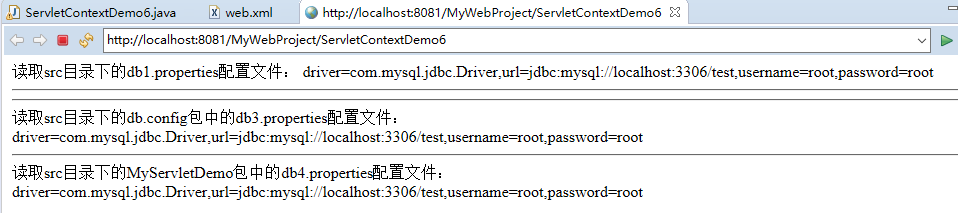
运行之前还是在web.xml中进行servlet的配置。运行后输出结果:
2.3.5 使用类装载器读取资源文件
资源文件可以通过类加载器的方式加载到内存中,这种方式的好处是程序不用明确制定配置文件的具体所在目录。程序可以自动的在src目录下搜索该文件,并加载。即类加载器只能加载src目录下的资源文件,其它目录无法加载 ,此时/表示:/WEB-INF/classes/目录 。但是这种方法有一个弊端,通过类加载器加载进来的配置文件不能太大,否则会导致JVM内存溢出。 还有,类加载器加载类,类只加载一次,所以当该类被加载进内存后,如果此时有人修改了配置文件里面的配置信息,当再次访问该类时,得到的配置信息并没有改变,还是原来的,如果我们要得到更新后的配置信息就不能够用这种方法来加载配置信息。
使用类装载器读取资源文件的示例代码如下:
package MyServletDemo;

import java.io.IOException;

import java.io.InputStream;

import java.text.MessageFormat;

import java.util.Properties;

import javax.servlet.ServletException;

import javax.servlet.http.HttpServlet;

import javax.servlet.http.HttpServletRequest;

import javax.servlet.http.HttpServletResponse;

public class ServletContextDemo7 extends HttpServlet {

    public void doGet(HttpServletRequest request, HttpServletResponse response)

            throws ServletException, IOException {

        response.setHeader("content-type","text/html;charset=UTF-8");

        test1(response);

        response.getWriter().println("<hr/>");

        test2(response);

        response.getWriter().println("<hr/>");

    }

    /**

     * 读取类路径下的资源文件

     * @param response

     * @throws IOException

     */

    private void test1(HttpServletResponse response) throws IOException {

        //获取到装载当前类的类装载器

        ClassLoader loader = ServletContextDemo7.class.getClassLoader();

        //用类装载器读取src目录下的db1.properties配置文件

        InputStream in = loader.getResourceAsStream("db1.properties");

        Properties prop = new Properties();

        prop.load(in);

        String driver = prop.getProperty("driver");

        String url = prop.getProperty("url");

        String username = prop.getProperty("username");

        String password = prop.getProperty("password");

        response.getWriter().println("用类装载器读取src目录下的db1.properties配置文件:");

        response.getWriter().println(

                MessageFormat.format(

                        "driver={0},url={1},username={2},password={3}",

                        driver,url, username, password));

    }

    private void test2(HttpServletResponse response) throws IOException {

        //获取到装载当前类的类装载器

        ClassLoader loader = ServletContextDemo7.class.getClassLoader();

        //用类装载器读取src目录下的gacl.servlet.study包中的db4.properties配置文件

        InputStream in = loader.getResourceAsStream("MyServletDemo/db3.properties");

        Properties prop = new Properties();

        prop.load(in);

        String driver = prop.getProperty("driver");

        String url = prop.getProperty("url");

        String username = prop.getProperty("username");

        String password = prop.getProperty("password");

        response.getWriter().println("用类装载器读取src目录下的gacl.servlet.study包中的db4.properties配置文件:");

        response.getWriter().println(

                MessageFormat.format(

                        "driver={0},url={1},username={2},password={3}",

                        driver,url, username, password));

    }

    public void doPost(HttpServletRequest request, HttpServletResponse response)

            throws ServletException, IOException {

        this.doGet(request, response);

    }

}
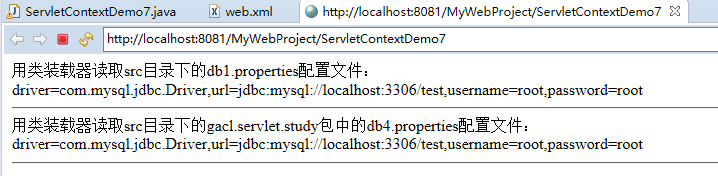
在web.xml中配置servlet,运行后输出:
3. 在客户端缓存servlet的输出
对于不经常变化的数据,在servlet中可以为其设置合理的缓存时间值,以避免浏览器频繁向服务器发送请求,提升服务器的性能。
package MyServletDemo;

import java.io.IOException;

import javax.servlet.ServletException;

import javax.servlet.http.HttpServlet;

import javax.servlet.http.HttpServletRequest;

import javax.servlet.http.HttpServletResponse;

public class ServletDemo2 extends HttpServlet {

    public void doGet(HttpServletRequest request, HttpServletResponse response)

            throws ServletException, IOException {

        String data = "23623276172";

        /**

         * 设置数据合理的缓存时间值,以避免浏览器频繁向服务器发送请求,提升服务器的性能

         * 这里是将数据的缓存时间设置为1天

         */

        response.setDateHeader("expires",System.currentTimeMillis() + 24 * 3600 * 1000);

        response.getOutputStream().write(data.getBytes());

    }

    public void doPost(HttpServletRequest request, HttpServletResponse response)

            throws ServletException, IOException {

        this.doGet(request, response);

    }

}
wx搜索“程序员考拉”,专注java领域,一个伴你成长的公众号!

servlet开发(四)之ServletContext的更多相关文章
- day05 Servlet 开发和 ServletConfig 与 ServletContext 对象
day05 Servlet 开发和 ServletConfig 与 ServletContext 对象 1. Servlet 开发入门 - hello world 2. Servlet 的调用过程和生 ...
- Servlet开发(三)之ServletConfig,ServletContext
1. ServletConfig Servlet是开发动态web的技术,而web.xml是Tomcat工程中最基础也最重要的配置文件,Tomcat启动项目的时候会加载并读取这个文件,其中web.xml ...
- JavaWeb学习总结第四篇--Servlet开发
Servlet开发 用户在浏览器中输入一个网址并回车,浏览器会向服务器发送一个HTTP请求.服务器端程序接受这个请求,并对请求进行处理,然后发送一个回应.浏览器收到回应,再把回应的内容显示出来.这种请 ...
- javaweb学习之Servlet开发(二)
javaweb学习总结(六)--Servlet开发(二) 一.ServletConfig讲解 1.1.配置Servlet初始化参数 在Servlet的配置文件web.xml中,可以使用一个或多个< ...
- java web 学习六(servlet开发2)
一.ServletConfig讲解 1.1.配置Servlet初始化参数 在Servlet的配置文件web.xml中,可以使用一个或多个<init-param>标签为servlet配置一些 ...
- Servlet开发笔记(一)
一.Servlet简介 Servlet是sun公司提供的一门用于开发动态web资源的技术. Sun公司在其API中提供了一个servlet接口,用户若想用发一个动态web资源(即开发一个Java程序向 ...
- Java第三阶段学习(十一、Servlet基础、servlet中的方法、servlet的配置、ServletContext对象)
一.Servlet简介 1.什么是servlet: sun公司提供的一套规范(接口),用来处理客户端请求.响应给浏览器的动态资源.但servlet的实质就是java代码,通过java的API动态的向 ...
- Servlet开发-----基础及MVC设计模式
一.Servlet介绍 Servlet本身只是普通的Java类,只有当容器为他创建了ServletConfig和ServletContext时才成为了一个Servlet: Servlet简单的 ...
- 【JAVA EE企业级开发四步走完全攻略】
本文是J2EE企业级开发四步走完全攻略索引,因内容比较广泛,涉及整个JAVA EE开发相关知识,这是一个长期的计划,单个发blog比较零散,所以整理此索引,决定以后每发一季JAVA EE blog后会 ...
- JavaWeb -- 服务器传递给Servlet的对象 -- ServletConfig, ServletContext,Request, Response
1. ServletConfig 有一些东西不合适在程序中写死,应该写在web.xml中,比如 文字怎么显示, 访问数据库名 和 密码, servlet要读取的配置文件 等等.. l在Servle ...
随机推荐
- ArrayList用法详解
1.什么是ArrayList ArrayList就是传说中的动态数组,用MSDN中的说法,就是Array的复杂版本,它提供了如下一些好处: 动态的增加和减少元素 实现了ICollection和ILis ...
- NOI2014起床困难综合症
Description 21 世纪,许多人得了一种奇怪的病:起床困难综合症,其临床表现为:起床难,起床后精神不佳.作为一名青春阳光好少年,atm 一直坚持与起床困难综合症作斗争.通过研究相关文献,他找 ...
- iOS 键盘的监听 调整view的位置
iOS在处理键盘的出现和消失时需要监听UIKeyboardWillChangeFrameNotifications/UIKeyboardDidHideNotifications - (void)vie ...
- java多线程那点事
屌丝程序员们对自己的技术能力总是毫不掩饰的高调,更有甚者每当完成一个简单的功能或算法实现,恨不得从工位上跳起来,生怕谁不知道一样,心情能理解,但个人完全鄙视这种行为.说到底,大家日常的coding,大 ...
- Spark - 经典案例
初识 Spark 大数据处理,目前还只是小白阶段,初步搭建起运行环境,慢慢学习之. 本文熟悉下 Spark 数据处理的几个经典案例. 首先将 Scala SDK 的源码导入 IDEA,方便查看和调试代 ...
- POJ1330 Nearest Common Ancestors (JAVA)
经典LCA操作.. 贴AC代码 import java.lang.reflect.Array; import java.util.*; public class POJ1330 { // 并查集部分 ...
- 2016级算法第二次上机-C.AlvinZH的儿时梦想——坦克篇
872 AlvinZH的儿时梦想----坦克篇 思路 简单题.仔细看题,题目意在找到直线穿过的矩形数最小,不能从两边穿过.那么我们只要知道每一行矩形之间的空隙位置就可以了. 如果这里用二维数组记住每一 ...
- js 正则常用方法
定义正则: 1 var re = new RegExp(“a”); //RegExp对象.参数就是我们想要制定的规则.有一种情况必须用这种方式,下面会提到. 2 var re = /a/; // 简写 ...
- (一)使用appium之前为什么要安装nodejs???
很多人在刚接触appium自动化时,可能会像我一样,按照教程搭建好环境后,却不知道使用appium之前为什么要用到node.js,nodejs到底和appium是什么关系,对nodejs也不是很了解, ...
- C#集合之不变的集合
如果对象可以改变其状态,就很难在多个同时运行的任务中使用.这些集合必须同步.如果对象不能改变器状态,就很容易在多个线程中使用. Microsoft提供了一个新的集合库:Microsoft Immuta ...