
POJ 1273 - Drainage Ditches - [最大流模板题] - [EK算法模板][Dinic算法模板 - 邻接表型]
题目链接:http://poj.org/problem?id=1273
Description
Farmer John knows not only how many gallons of water each ditch can transport per minute but also the exact layout of the ditches, which feed out of the pond and into each other and stream in a potentially complex network.
Given all this information, determine the maximum rate at which water can be transported out of the pond and into the stream. For any given ditch, water flows in only one direction, but there might be a way that water can flow in a circle.
Input
Output
Sample Input
5 4

1 2 40

1 4 20

2 4 20

2 3 30

3 4 10
Sample Output
50
Source
 #include<cstdio>

 #include<cstring>

 #include<vector>

 #include<queue>

 #define MAX 203

 #define INF 0x3f3f3f3f

 using namespace std;

 int n,m;//n条边,m个点

 struct Edge{

     int u,v,c,f;

 };

 struct EdmondsKarp{

     vector<Edge> E;

     vector<int> G[MAX];

     int aug[MAX];//源点到i的可增广量

     int pre[MAX];//记录当前路径中点i的入弧编号

     void init(int n)

     {

         E.clear();

         for(int i=;i<n;i++) G[i].clear();

     }

     void addedge(int from,int to,int cap)

     {

         E.push_back((Edge){from,to,cap,});

         E.push_back((Edge){to,from,,});

         G[from].push_back(E.size()-);

         G[to].push_back(E.size()-);

     }

     int maxflow(int s,int t)

     {

         int flow=;

         while()

         {

             memset(aug,,sizeof(aug));

             queue<int> q;

             q.push(s);

             aug[s]=INF;

             while(!q.empty())

             {

                 int now=q.front(); q.pop();

                 for(int i=;i<G[now].size();i++)

                 {

                     Edge edge=E[G[now][i]];

                     if(!aug[edge.v] && edge.c>edge.f)

                     {

                         pre[edge.v]=G[now][i];

                         aug[edge.v]=min(aug[now],edge.c-edge.f);

                         q.push(edge.v);

                     }

                 }

                 if(aug[t]) break;

             }

             if(!aug[t]) break;

             for(int i=t;i!=s;i=E[(pre[i])].u)

             {

                 E[pre[i]].f+=aug[t];

                 E[pre[i]^].f-=aug[t];

             }

             flow+=aug[t];

         }

         return flow;

     }

 }EK;

 int main()

 {

     while(scanf("%d%d",&n,&m)!=EOF)

     {

         EK.init(m);

         for(int from,to,cap,i=;i<=n;i++)

         {

             scanf("%d%d%d",&from,&to,&cap);

             EK.addedge(from,to,cap);

         }

         printf("%d\n",EK.maxflow(,m));

     }

 }
注:
①代码第51行:“if(aug[t]) break;”语句,由于我们一次BFS只找到一条增广路径,所以aug[]数组每次BFS之前都进行初始化为零,因此一旦aug[t]不为零,那么必然我们已经找到了一条增广路径,这是就没必要继续进行BFS,直接跳出循环,节省时间。
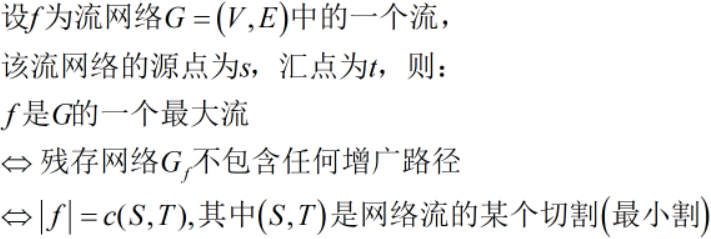
②代码第53行:“if(!aug[t]) break;”语句,这是在BFS循环外的判断语句,因为若是当我们进行完一遍BFS,未找到一条增广路径,那么根据最大流最小割定理,当前已经是最大流情况,所以立即跳出即可。
最大流最小割定理:
嗯,然后再补一个Dinic算法版的:
 #include<cstdio>

 #include<cstring>

 #include<vector>

 #include<queue>

 #define MAX 203

 #define INF 0x3f3f3f3f

 using namespace std;

 int n,m;//n条边,m个点

 struct Dinic

 {

     struct Edge{

         int u,v,c,f;

     };

     int s,t;

     vector<Edge> E;

     vector<int> G[MAX];

     bool vis[MAX]; //BFS使用

     int lev[MAX];//记录层次

     int cur[MAX]; //当前弧下标

     void init(int n)

     {

         E.clear();

         for(int i=;i<n;i++) G[i].clear();

     }

     void addedge(int from,int to,int cap)

     {

         E.push_back((Edge){from,to,cap,});

         E.push_back((Edge){to,from,,});

         G[from].push_back(E.size()-);

         G[to].push_back(E.size()-);

     }

     bool bfs()

     {

         memset(vis,,sizeof(vis));

         queue<int> q;

         q.push(s);

         lev[s]=;

         vis[s]=;

         while(!q.empty())

         {

             int now=q.front(); q.pop();

             for(int i=,_size=G[now].size();i<_size;i++)

             {

                 Edge edge=E[G[now][i]];

                 int nex=edge.v;

                 if(!vis[nex] && edge.c>edge.f)//属于残存网络的边

                 {

                     lev[nex]=lev[now]+;

                     q.push(nex);

                     vis[nex]=;

                 }

             }

         }

         return vis[t];

     }

     int dfs(int now,int aug)//now表示当前结点,aug表示目前为止的最小残量

     {

         if(now==t || aug==) return aug;//aug等于0时及时退出,此时相当于断路了

         int flow=,f;

         for(int& i=cur[now],_size=G[now].size();i<_size;i++)//从上次考虑的弧开始,注意要使用引用,同时修改cur[now]

         {

             Edge& edge=E[G[now][i]];

             int nex=edge.v;

             if(lev[now]+ == lev[nex] && (f=dfs(nex,min(aug,edge.c-edge.f)))>)

             {

                 edge.f+=f;

                 E[G[now][i]^].f-=f;

                 flow+=f;

                 aug-=f;

                 if(!aug) break;//aug等于0及时退出,当aug!=0,说明当前节点还存在另一个增广路分支

             }

         }

         return flow;

     }

     int maxflow(int s,int t)//主过程

     {

         int flow=;

         while(bfs())//不停地用bfs构造分层网络,然后用dfs沿着阻塞流增广

         {

             memset(cur,,sizeof(cur));

             flow+=dfs(s,INF);

         }

         return flow;

     }

 }dinic;

 int main()

 {

     while(scanf("%d%d",&n,&m)!=EOF)

     {

         dinic.init(m);

         for(int from,to,cap,i=;i<=n;i++)

         {

             scanf("%d%d%d",&from,&to,&cap);

             dinic.addedge(from,to,cap);

         }

         dinic.s=, dinic.t=m;

         printf("%d\n",dinic.maxflow(,m));

     }

 }
具体Dinic算法是个什么操作可以参见:王欣上《浅谈基于分层思想的网络流算法》.pdf
模板:
 #include<cstring>

 #include<vector>

 #include<queue>

 #define MAX 100

 #define INF 0x3f3f3f3f

 struct Edge{

     int u,v,c,f;

 };

 struct Dinic

 {

     int s,t;

     vector<Edge> E;

     vector<int> G[MAX];

     bool vis[MAX];

     int lev[MAX];

     int cur[MAX];

     void init(int l,int r)

     {

         E.clear();

         for(int i=l;i<=r;i++) G[i].clear();

     }

     void addedge(int from,int to,int cap)

     {

         E.push_back((Edge){from,to,cap,});

         E.push_back((Edge){to,from,,});

         int m=E.size();

         G[from].push_back(m-);

         G[to].push_back(m-);

     }

     bool bfs()

     {

         memset(vis,,sizeof(vis));

         queue<int> q;

         q.push(s);

         lev[s]=;

         vis[s]=;

         while(!q.empty())

         {

             int now=q.front(); q.pop();

             for(int i=,_size=G[now].size();i<_size;i++)

             {

                 Edge edge=E[G[now][i]];

                 int nex=edge.v;

                 if(!vis[nex] && edge.c>edge.f)

                 {

                     lev[nex]=lev[now]+;

                     q.push(nex);

                     vis[nex]=;

                 }

             }

         }

         return vis[t];

     }

     int dfs(int now,int aug)

     {

         if(now==t || aug==) return aug;

         int flow=,f;

         for(int& i=cur[now],_size=G[now].size();i<_size;i++)

         {

             Edge& edge=E[G[now][i]];

             int nex=edge.v;

             if(lev[now]+ == lev[nex] && (f=dfs(nex,min(aug,edge.c-edge.f)))>)

             {

                 edge.f+=f;

                 E[G[now][i]^].f-=f;

                 flow+=f;

                 aug-=f;

                 if(!aug) break;

             }

         }

         return flow;

     }

     int maxflow()

     {

         int flow=;

         while(bfs())

         {

             memset(cur,,sizeof(cur));

             flow+=dfs(s,INF);

         }

         return flow;

     }

 }dinic;
POJ 1273 - Drainage Ditches - [最大流模板题] - [EK算法模板][Dinic算法模板 - 邻接表型]的更多相关文章
- poj 1273 Drainage Ditches 最大流入门题
题目链接:http://poj.org/problem?id=1273 Every time it rains on Farmer John's fields, a pond forms over B ...
- Poj 1273 Drainage Ditches(最大流 Edmonds-Karp )
题目链接:poj1273 Drainage Ditches 呜呜,今天自学网络流,看了EK算法,学的晕晕的,留个简单模板题来作纪念... #include<cstdio> #include ...
- POJ 1273 Drainage Ditches | 最大流模板
#include<cstdio> #include<algorithm> #include<cstring> #include<queue> #defi ...
- POJ 1273 Drainage Ditches(最大流Dinic 模板)
#include<cstdio> #include<cstring> #include<algorithm> using namespace std; int n, ...
- POJ 1273 Drainage Ditches 最大流
这道题用dinic会超时 用E_K就没问题 注意输入数据有重边.POJ1273 dinic的复杂度为O(N*N*M)E_K的复杂度为O(N*M*M)对于这道题,复杂度是相同的. 然而dinic主要依靠 ...
- poj 1273 Drainage Ditches(最大流)
http://poj.org/problem?id=1273 Drainage Ditches Time Limit: 1000MS Memory Limit: 10000K Total Subm ...
- POJ 1273 Drainage Ditches (网络最大流)
http://poj.org/problem? id=1273 Drainage Ditches Time Limit: 1000MS Memory Limit: 10000K Total Sub ...
- POJ 1273 Drainage Ditches(网络流dinic算法模板)
POJ 1273给出M条边,N个点,求源点1到汇点N的最大流量. 本文主要就是附上dinic的模板,供以后参考. #include <iostream> #include <stdi ...
- 网络流最经典的入门题 各种网络流算法都能AC。 poj 1273 Drainage Ditches
Drainage Ditches 题目抽象:给你m条边u,v,c. n个定点,源点1,汇点n.求最大流. 最好的入门题,各种算法都可以拿来练习 (1): 一般增广路算法 ford() #in ...
随机推荐
- ios学习之UIWebView网页视图调整
//先来一个可行的小Demo程序:结合searchBar的google搜索 #import <UIKit/UIKit.h> @interface ViewController : UIVi ...
- [转]如何配置和使用Tomcat访问日志
配置位置在log下的server.xml,(tomcat容器) <Engine defaultHost="localhost" name="Catalina&quo ...
- 小物件之checkbox复选框
有时候需要输出一组checkbox复选框,并且做根据选定元素将其选中的功能,以往都要在模板中循环输出checkbox标签,同时加以判断是否需要选中,这样就会造成很多开始闭合标签 以前都是这样写 现在我 ...
- lua 注释
1. 单行注释 -- 功能等同于C++中的// 2. 多行注释 --[[ 注释的内容 ]] 功能等同于C++中的 /**/ 3. 多行注释 --[====[ 注释和内容 ]=== ...
- 【Postgres】PostgreSQL配置远程连接
1.开启相应的防火墙端口,缺省是5432 2.访问权限配置,D:\Program Files (x86)\PostgreSQL\9.2\data/pg_hba.conf中加入如下配置,开启远程访问 3 ...
- 【数据分析】Superset 之四 直接安装
apt install python-pip pip install --upgrade pip apt-get install build-essential libssl-dev libffi-d ...
- [Command] lrzsz - 文件传输工具包
lrzsz 是一个支持 XMODEM.YMODEM.ZMODEM 文件传输协议的 Unix 程序包.它是 Omen Technologies 公司所有的 rzsz 程序包的公开发行增强版,遵守 GNU ...
- js中的假值
undefined null 0 NaN 空字符串
- Ubuntu下安装MySQL及简单操作
Ubuntu上安装MySQL非常简单只需要几条命令就可以完成. 1. sudo apt-get install mysql-server 2. apt-get isntall mysql-client ...
- php curl那点事儿
curl是最常用功能之一初始化句柄 $ch = curl_init(); post 传$data 1. 如果$data是字符串,则Content-Type是application/x-www-form ...