
OpenACC Julia 图形
▶ 书上的代码,逐步优化绘制 Julia 图形的代码
● 无并行优化(手动优化了变量等)
 #include <stdio.h>

 #include <stdlib.h>

 #include <openacc.h>

 #define N   (1024 * 8)

 int julia(const float cre, const float cim, float zre, float zim, const int maxIter)// 计算单点迭代次数

 {

     float zre2 = 0.0f, zim2 = 0.0f;

     for (int iter = ; iter < maxIter; iter += )   // 一个迭代里计算两次

     {

         zre2 = zre * zre - zim * zim + cre, zim2 =  * zre * zim + cim;

         if (zre2 * zre2 + zim2 * zim2 > 4.0f)

             return iter;

         zre = zre2 * zre2 - zim2 * zim2 + cre, zim =  * zre2 * zim2 + cim;

         if (zre * zre + zim * zim > 4.0f)

             return iter;

     }

     return maxIter +  + (maxIter % );

 }

 int main()

 {

     const int maxIter = ;                                // 最大迭代次数

     const float cre = -0.8350, cim = -0.2321, h = 4.0f / N; // 迭代常数和画幅步长

     int *image = (int *)malloc(sizeof(int) * N * N);

     FILE *pf = fopen("R:/output.txt", "w");

     for (int i = ; i < N; i++)

     {

         for (int j = ; j < N; j++)

             fprintf(pf, "%d ", julia(cre, cim, i * h - 2.0f, j * h - 2.0f, maxIter));

         fprintf(pf, "\n");

     }

     fclose(pf);

     free(image);

     //getchar();

     return ;

 }
● 输出结果(后面所有代码的输出都相同,不再写了)

● 改进 1,计算并行化
 #include <stdio.h>

 #include <stdlib.h>

 #include <openacc.h>

 #define N   (1024 * 8)

 #pragma acc routine seq

 int julia(const float cre, const float cim, float zre, float zim, const int maxIter)

 {

     float zre2 = 0.0f, zim2 = 0.0f;

     for (int iter = ; iter < maxIter; iter += )

     {

         zre2 = zre * zre - zim * zim + cre, zim2 =  * zre * zim + cim;

         if (zre2 * zre2 + zim2 * zim2 > 4.0f)

             return iter;

         zre = zre2 * zre2 - zim2 * zim2 + cre, zim =  * zre2 * zim2 + cim;

         if (zre * zre + zim * zim > 4.0f)

             return iter;

     }

     return maxIter +  + (maxIter % );

 }

 int main()

 {

     const int maxIter = ;

     const float cre = -0.8350, cim = -0.2321, h = 4.0f / N;

     int *image = (int *)malloc(sizeof(int) * N * N);

 #pragma acc data copyout(image[0:N * N])    // 数据域

     {

 #pragma acc kernels loop independent        // loop 并行化,强制独立

         for (int i = ; i < N; i++)

         {

             for (int j = ; j < N; j++)

                 image[i * N + j] = julia(cre, cim, i * h - 2.0f, j * h - 2.0f, maxIter);

         }

     }

     /*// 注释掉写入文件的部分,防止 Nvvp 加入分析

     FILE *pf = fopen("R:/output.txt", "w");

     for (int i = 0; i < N; i++)

     {

         for (int j = 0; j < N; j++)

             fprintf(pf, "%d ", image[i * N + j]);

         fprintf(pf, "\n");

     }

     fclose(pf);

     */

     free(image);

     //getchar();

     return ;

 }
● 输出结果
D:\Code\OpenACC\OpenACCProject\OpenACCProject>pgcc -acc -Minfo main.c -o main_acc.exe

julia:

      , Generating acc routine seq

         Generating Tesla code

     , FMA (fused multiply-add) instruction(s) generated

     , FMA (fused multiply-add) instruction(s) generated

main:

     , Generating copyout(image[:])

     , Loop is parallelizable

         FMA (fused multiply-add) instruction(s) generated

     , Loop is parallelizable

         Accelerator kernel generated

         Generating Tesla code

         , #pragma acc loop gang, vector(4) /* blockIdx.y threadIdx.y */

         , #pragma acc loop gang, vector(32) /* blockIdx.x threadIdx.x */

     , FMA (fused multiply-add) instruction(s) generated

D:\Code\OpenACC\OpenACCProject\OpenACCProject>main_acc.exe

launch CUDA kernel  file=D:\Code\OpenACC\OpenACCProject\OpenACCProject\main.c function=main

line= device= threadid= num_gangs= num_workers= vector_length= grid=256x128 block=32x4

PGI: "acc_shutdown" not detected, performance results might be incomplete.

 Please add the call "acc_shutdown(acc_device_nvidia)" to the end of your application to ensure that the performance results are complete.

Accelerator Kernel Timing data

D:\Code\OpenACC\OpenACCProject\OpenACCProject\main.c

  main  NVIDIA  devicenum=

    time(us): ,

    : data region reached  times

        : data copyout transfers:

             device time(us): total=, max=, min= avg=,

    : compute region reached  time

        : kernel launched  time

            grid: [256x128]  block: [32x4]

             device time(us): total= max= min= avg=

● 改进 2,分块计算,没有明显性能提升,为异步做准备
 #include <stdio.h>

 #include <stdlib.h>

 #include <openacc.h>

 #define N   (1024 * 8)

 #pragma acc routine seq

 int julia(const float cre, const float cim, float zre, float zim, const int maxIter)

 {

     float zre2 = 0.0f, zim2 = 0.0f;

     for (int iter = ; iter < maxIter; iter += )

     {

         zre2 = zre * zre - zim * zim + cre, zim2 =  * zre * zim + cim;

         if (zre2 * zre2 + zim2 * zim2 > 4.0f)

             return iter;

         zre = zre2 * zre2 - zim2 * zim2 + cre, zim =  * zre2 * zim2 + cim;

         if (zre * zre + zim * zim > 4.0f)

             return iter;

     }

     return maxIter +  + (maxIter % );

 }

 int main()

 {

     const int maxIter = ;

     const float cre = -0.8350, cim = -0.2321, h = 4.0f / N;

     int *image = (int *)malloc(sizeof(int) * N * N);

 #pragma acc data copyout(image[0:N * N])

     {

         const int numblock = ;                         // 指定分块数量

         for (int block = ; block < numblock; block++)  // 每次计算一块

         {

             const int start = block * (N / numblock), end = start + N / numblock;   // 每块的始末下标

 #pragma acc kernels loop independent

             for (int i = start; i < end; i++)

             {

                 for (int j = ; j < N; j++)

                     image[i * N + j] = julia(cre, cim, i * h - 2.0f, j * h - 2.0f, maxIter);

             }

         }

     }

     /*

     FILE *pf = fopen("R:/output.txt", "w");

     for (int i = 0; i < N; i++)

     {

         for (int j = 0; j < N; j++)

             fprintf(pf, "%d ", image[i * N + j]);

         fprintf(pf, "\n");

     }

     fclose(pf);

     */

     free(image);

     //getchar();

     return ;

 }
● 输出结果
D:\Code\OpenACC\OpenACCProject\OpenACCProject>pgcc -acc -Minfo main.c -o main_acc.exe

julia:

      , Generating acc routine seq

         Generating Tesla code

     , FMA (fused multiply-add) instruction(s) generated

     , FMA (fused multiply-add) instruction(s) generated

main:

     , Generating copyout(image[:])

     , Loop is parallelizable

         FMA (fused multiply-add) instruction(s) generated

     , Loop is parallelizable

         Accelerator kernel generated

         Generating Tesla code

         , #pragma acc loop gang, vector(4) /* blockIdx.y threadIdx.y */

         , #pragma acc loop gang, vector(32) /* blockIdx.x threadIdx.x */

     , FMA (fused multiply-add) instruction(s) generated

D:\Code\OpenACC\OpenACCProject\OpenACCProject>main_acc.exe

launch CUDA kernel  file=D:\Code\OpenACC\OpenACCProject\OpenACCProject\main.c function=main

line= device= threadid= num_gangs= num_workers= vector_length= grid=256x128 block=32x4

launch CUDA kernel  file=D:\Code\OpenACC\OpenACCProject\OpenACCProject\main.c function=main

= device= threadid= num_gangs= num_workers= vector_length= grid=256x128 block=32x4

launch CUDA kernel  file=D:\Code\OpenACC\OpenACCProject\OpenACCProject\main.c function=main

line= device= threadid= num_gangs= num_workers= vector_length= grid=256x128 block=32x4

launch CUDA kernel  file=D:\Code\OpenACC\OpenACCProject\OpenACCProject\main.c function=main

line= device= threadid= num_gangs= num_workers= vector_length= grid=256x128 block=32x4

PGI: "acc_shutdown" not detected, performance results might be incomplete.

 Please add the call "acc_shutdown(acc_device_nvidia)" to the end of your application to ensure that the performance results are complete.

Accelerator Kernel Timing data

D:\Code\OpenACC\OpenACCProject\OpenACCProject\main.c

  main  NVIDIA  devicenum=

    time(us): ,

    : data region reached  times

        : data copyout transfers:

             device time(us): total=, max=, min= avg=,

    : compute region reached  times

        : kernel launched  times

            grid: [256x128]  block: [32x4]

             device time(us): total= max= min= avg=

● 改进 3,分块传输,没有明显性能提升,为异步做准备
 #include <stdio.h>

 #include <stdlib.h>

 #include <openacc.h>

 #define N   (1024 * 8)

 #pragma acc routine seq

 int julia(const float cre, const float cim, float zre, float zim, const int maxIter)

 {

     float zre2 = 0.0f, zim2 = 0.0f;

     for (int iter = ; iter < maxIter; iter += )

     {

         zre2 = zre * zre - zim * zim + cre, zim2 =  * zre * zim + cim;

         if (zre2 * zre2 + zim2 * zim2 > 4.0f)

             return iter;

         zre = zre2 * zre2 - zim2 * zim2 + cre, zim =  * zre2 * zim2 + cim;

         if (zre * zre + zim * zim > 4.0f)

             return iter;

     }

     return maxIter +  + (maxIter % );

 }

 int main()

 {

     const int maxIter = ;

     const float cre = -0.8350, cim = -0.2321, h = 4.0f / N;

     int *image = (int *)malloc(sizeof(int) * N * N);

 #pragma acc data create(image[0:N * N])                         // 改成 create,不需要从主机拷贝初始数据

     {

         const int numBlock = , blockSize = N * N / numBlock;   // 仍然分块计算

         for (int block = ; block < numBlock; block++)

         {

             const int start = block * (N / numBlock), end = start + N / numBlock;

 #pragma acc kernels loop independent

             for (int i = start; i < end; i++)

             {

                 for (int j = ; j < N; j++)

                     image[i * N + j] = julia(cre, cim, i * h - 2.0f, j * h - 2.0f, maxIter);

             }

 #pragma acc update host(image[block * blockSize : blockSize])   // 每计算完一块就向主机回传数据

         }

     }

     /*

     FILE *pf = fopen("R:/output.txt", "w");

     for (int i = 0; i < N; i++)

     {

         for (int j = 0; j < N; j++)

             fprintf(pf, "%d ", image[i * N + j]);

         fprintf(pf, "\n");

     }

     fclose(pf);

     */

     free(image);

     //getchar();

     return ;

 }
● 输出结果
D:\Code\OpenACC\OpenACCProject\OpenACCProject>pgcc -acc -Minfo main.c -o main_acc.exe

julia:

      , Generating acc routine seq

         Generating Tesla code

     , FMA (fused multiply-add) instruction(s) generated

     , FMA (fused multiply-add) instruction(s) generated

main:

     , Generating create(image[:])

     , Loop is parallelizable

         FMA (fused multiply-add) instruction(s) generated

     , Loop is parallelizable

         Accelerator kernel generated

         Generating Tesla code

         , #pragma acc loop gang, vector(4) /* blockIdx.y threadIdx.y */

         , #pragma acc loop gang, vector(32) /* blockIdx.x threadIdx.x */

     , FMA (fused multiply-add) instruction(s) generated

     , Generating update self(image[block*blockSize:blockSize])

D:\Code\OpenACC\OpenACCProject\OpenACCProject>main_acc.exe

launch CUDA kernel  file=D:\Code\OpenACC\OpenACCProject\OpenACCProject\main.c function=main

line= device= threadid= num_gangs= num_workers= vector_length= grid=256x128 block=32x4

launch CUDA kernel  file=D:\Code\OpenACC\OpenACCProject\OpenACCProject\main.c function=main

line= device= threadid= num_gangs= num_workers= vector_length= grid=256x128 block=32x4

launch CUDA kernel  file=D:\Code\OpenACC\OpenACCProject\OpenACCProject\main.c function=main

line= device= threadid= num_gangs= num_workers= vector_length= grid=256x128 block=32x4

launch CUDA kernel  file=D:\Code\OpenACC\OpenACCProject\OpenACCProject\main.c function=main

line= device= threadid= num_gangs= num_workers= vector_length= grid=256x128 block=32x4

PGI: "acc_shutdown" not detected, performance results might be incomplete.

 Please add the call "acc_shutdown(acc_device_nvidia)" to the end of your application to ensure that the performance results are complete.

Accelerator Kernel Timing data

D:\Code\OpenACC\OpenACCProject\OpenACCProject\main.c

  main  NVIDIA  devicenum=

    time(us): ,

    : data region reached  times

    : compute region reached  times

        : kernel launched  times

            grid: [256x128]  block: [32x4]

            elapsed time(us): total=, max=, min= avg=,

    : update directive reached  times

        : data copyout transfers:

             device time(us): total=, max=, min= avg=,

● 改进 4,异步计算 - 双向传输
 #include <stdio.h>

 #include <stdlib.h>

 #include <openacc.h>

 #define N   (1024 * 8)

 #pragma acc routine seq

 int julia(const float cre, const float cim, float zre, float zim, const int maxIter)

 {

     float zre2 = 0.0f, zim2 = 0.0f;

     for (int iter = ; iter < maxIter; iter += )

     {

         zre2 = zre * zre - zim * zim + cre, zim2 =  * zre * zim + cim;

         if (zre2 * zre2 + zim2 * zim2 > 4.0f)

             return iter;

         zre = zre2 * zre2 - zim2 * zim2 + cre, zim =  * zre2 * zim2 + cim;

         if (zre * zre + zim * zim > 4.0f)

             return iter;

     }

     return maxIter +  + (maxIter % );

 }

 int main()

 {

     const int maxIter = ;

     const float cre = -0.8350, cim = -0.2321, h = 4.0f / N;

     int *image = (int *)malloc(sizeof(int) * N * N);

 #pragma acc data create(image[0:N * N])

     {

         const int numBlock = , blockSize = N / numBlock * N;

         for (int block = ; block < numBlock; block++)

         {

             const int start = block * (N / numBlock), end = start + N / numBlock;

 #pragma acc kernels loop independent async(block + 1)                           // 异步计算,用块编号作标记

             for (int i = start; i < end; i++)

             {

                 for (int j = ; j < N; j++)

                     image[i * N + j] = julia(cre, cim, i * h - 2.0f, j * h - 2.0f, maxIter);

             }

 #pragma acc update host(image[block * blockSize : blockSize]) async(block + 1)  // 计算完一块就异步传输

         }

 #pragma acc wait

     }

     /*

     FILE *pf = fopen("R:/output.txt", "w");

     for (int i = 0; i < N; i++)

     {

         for (int j = 0; j < N; j++)

             fprintf(pf, "%d ", image[i * N + j]);

         fprintf(pf, "\n");

     }

     fclose(pf);

     */

     free(image);

     //getchar();

     return ;

 }
● 输出结果
D:\Code\OpenACC\OpenACCProject\OpenACCProject>pgcc -acc -Minfo main.c -o main_acc.exe

julia:

      , Generating acc routine seq

         Generating Tesla code

     , FMA (fused multiply-add) instruction(s) generated

     , FMA (fused multiply-add) instruction(s) generated

main:

     , Generating create(image[:])

     , Loop is parallelizable

         FMA (fused multiply-add) instruction(s) generated

     , Loop is parallelizable

         Accelerator kernel generated

         Generating Tesla code

         , #pragma acc loop gang, vector(4) /* blockIdx.y threadIdx.y */

         , #pragma acc loop gang, vector(32) /* blockIdx.x threadIdx.x */

     , FMA (fused multiply-add) instruction(s) generated

     , Generating update self(image[block*blockSize:blockSize])

D:\Code\OpenACC\OpenACCProject\OpenACCProject>main_acc.exe

launch CUDA kernel  file=D:\Code\OpenACC\OpenACCProject\OpenACCProject\main.c function=main

line= device= threadid= queue= num_gangs= num_workers= vector_length= grid=256x128 block=32x4

launch CUDA kernel  file=D:\Code\OpenACC\OpenACCProject\OpenACCProject\main.c function=main

line= device= threadid= queue= num_gangs= num_workers= vector_length= grid=256x128 block=32x4

launch CUDA kernel  file=D:\Code\OpenACC\OpenACCProject\OpenACCProject\main.c function=main

line= device= threadid= queue= num_gangs= num_workers= vector_length= grid=256x128 block=32x4

launch CUDA kernel  file=D:\Code\OpenACC\OpenACCProject\OpenACCProject\main.c function=main

line= device= threadid= queue= num_gangs= num_workers= vector_length= grid=256x128 block=32x4

PGI: "acc_shutdown" not detected, performance results might be incomplete.

 Please add the call "acc_shutdown(acc_device_nvidia)" to the end of your application to ensure that the performance results are complete.

Accelerator Kernel Timing data

    Timing may be affected by asynchronous behavior

    set PGI_ACC_SYNCHRONOUS to  to disable async() clauses

D:\Code\OpenACC\OpenACCProject\OpenACCProject\main.c

  main  NVIDIA  devicenum=

    time(us): ,

    : data region reached  times

    : compute region reached  times

        : kernel launched  times

            grid: [256x128]  block: [32x4]

             device time(us): total= max= min= avg=

    : update directive reached  times

        : data copyout transfers:

             device time(us): total=, max=, min= avg=,

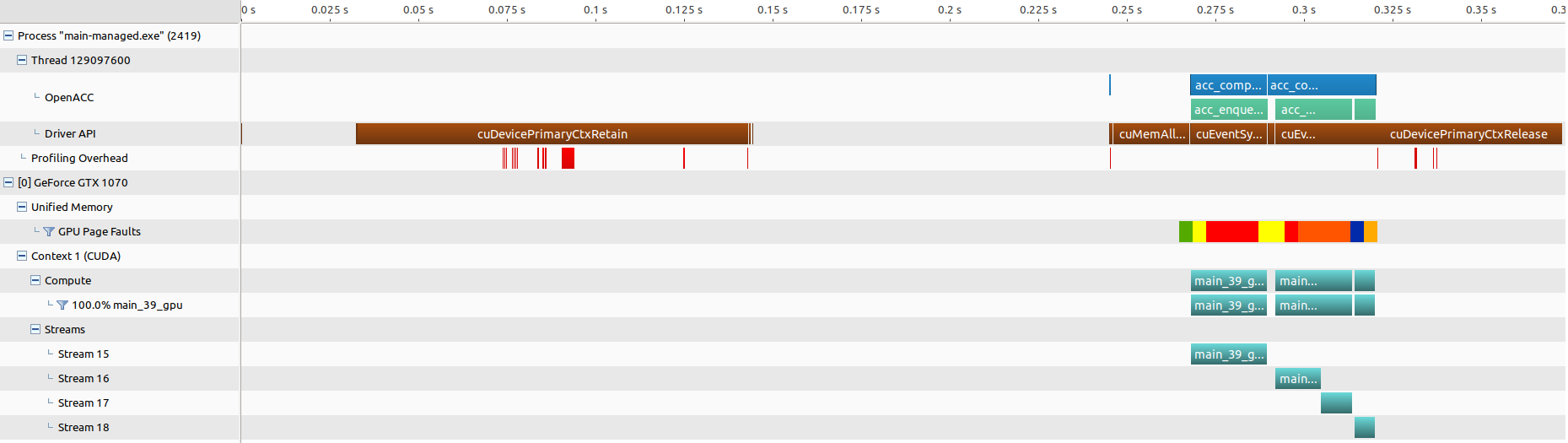
● 使用统一内存访址(Ubuntu,win64 不支持)
● 改进 4,多设备版本 1,使用 OpenMP
 #include <stdio.h>

 #include <stdlib.h>

 #include <omp.h>

 #include <openacc.h>

 #define N   (1024 * 8)

 #pragma acc routine seq

 int julia(const float cre, const float cim, float zre, float zim, const int maxIter)

 {

     float zre2 = 0.0f, zim2 = 0.0f;

     for (int iter = ; iter < maxIter; iter += )

     {

         zre2 = zre * zre - zim * zim + cre, zim2 =  * zre * zim + cim;

         if (zre2 * zre2 + zim2 * zim2 > 4.0f)

             return iter;

         zre = zre2 * zre2 - zim2 * zim2 + cre, zim =  * zre2 * zim2 + cim;

         if (zre * zre + zim * zim > 4.0f)

             return iter;

     }

     return maxIter +  + (maxIter % );

 }

 int main()

 {

     const int maxIter = ;

     const int numBlock = acc_get_num_devices(acc_device_nvidia), blockSize = N / numBlock * N;  // 使用 OpenMP 检测目标设备数量,以此作为分块数

     const float cre = -0.8350, cim = -0.2321, h = 4.0f / N;

     int *image = (int *)malloc(sizeof(int) * N * N);

     acc_init(acc_device_nvidia);                                    // 一次性初始化全部目标设备

 #pragma omp parallel num_threads(numBlock)                          // 使用多个线程,分别向目标设备发送任务

     {

         acc_set_device_num(omp_get_thread_num(), acc_device_nvidia);// 标记目标设备

 #pragma omp for

         for (int block = ; block < numBlock; block++)

         {

             const int start = block * (N / numBlock), end = start + N / numBlock;

 #pragma acc data copyout(image[block * blockSize : blockSize])

             {

 #pragma acc kernels loop independent

                 for (int i = start; i < end; i++)

                 {

                     for (int j = ; j < N; j++)

                         image[i * N + j] = julia(cre, cim, i * h - 2.0f, j * h - 2.0f, maxIter);

                 }

             }

         }

     }

     /*

     FILE *pf = fopen("R:/output.txt", "w");

     for (int i = 0; i < N; i++)

     {

         for (int j = 0; j < N; j++)

             fprintf(pf, "%d ", image[i * N + j]);

         fprintf(pf, "\n");

     }

     fclose(pf);

     */

     free(image);

     //getchar();

     return ;

 }
● 输出结果
D:\Code\OpenACC\OpenACCProject\OpenACCProject>pgcc -acc -mp -Minfo main.c -o main_acc.exe

julia:

     , Generating acc routine seq

         Generating Tesla code

     , FMA (fused multiply-add) instruction(s) generated

     , FMA (fused multiply-add) instruction(s) generated

main:

     , Parallel region activated

     , Parallel loop activated with static block schedule

     , Generating copyout(image[block*blockSize:blockSize])

     , Loop is parallelizable

         FMA (fused multiply-add) instruction(s) generated

     , Loop is parallelizable

         Accelerator kernel generated

         Generating Tesla code

         , #pragma acc loop gang, vector(4) /* blockIdx.y threadIdx.y */

         , #pragma acc loop gang, vector(32) /* blockIdx.x threadIdx.x */

     , FMA (fused multiply-add) instruction(s) generated

     , Barrier

     , Parallel region terminated

D:\Code\OpenACC\OpenACCProject\OpenACCProject>main_acc.exe

launch CUDA kernel  file=D:\Code\OpenACC\OpenACCProject\OpenACCProject\main.c function=main

line= device= threadid= num_gangs= num_workers= vector_length= grid=256x128 block=32x4

PGI: "acc_shutdown" not detected, performance results might be incomplete.

 Please add the call "acc_shutdown(acc_device_nvidia)" to the end of your application to ensure that the performance results are complete.

Accelerator Kernel Timing data

D:\Code\OpenACC\OpenACCProject\OpenACCProject\main.c

  main  NVIDIA  devicenum=

    time(us): ,

    : data region reached  times

        : data copyout transfers:

             device time(us): total=, max=, min= avg=,

    : compute region reached  time

        : kernel launched  time

            grid: [256x128]  block: [32x4]

             device time(us): total= max= min= avg=
● 改进 5,多设备版本 2,调整 OpenMP
 #include <stdio.h>

 #include <stdlib.h>

 #include <omp.h>

 #include <openacc.h>

 #define N   (1024 * 8)

 #pragma acc routine seq

 int julia(const float cre, const float cim, float zre, float zim, const int maxIter)

 {

     float zre2 = 0.0f, zim2 = 0.0f;

     for (int iter = ; iter < maxIter; iter += )

     {

         zre2 = zre * zre - zim * zim + cre, zim2 =  * zre * zim + cim;

         if (zre2 * zre2 + zim2 * zim2 > 4.0f)

             return iter;

         zre = zre2 * zre2 - zim2 * zim2 + cre, zim =  * zre2 * zim2 + cim;

         if (zre * zre + zim * zim > 4.0f)

             return iter;

     }

     return maxIter +  + (maxIter % );

 }

 int main()

 {

     const int maxIter = ;

     const int numBlock = acc_get_num_devices(acc_device_nvidia), blockSize = N / numBlock * N;

     const float cre = -0.8350, cim = -0.2321, h = 4.0f / N;

     int *image = (int *)malloc(sizeof(int) * N * N);

     acc_init(acc_device_nvidia);

 #pragma omp parallel for num_threads(numBlock)          // 把函数 acc_set_device_num 单独放在一起

     for(int block = ;block<numBlock;block++)

         acc_set_device_num(block, acc_device_nvidia);

 #pragma omp for num_threads(numBlock)

     for (int block = ; block < numBlock; block++)

     {

         const int start = block * (N / numBlock), end = start + N / numBlock;

 #pragma acc data copyout(image[block * blockSize : blockSize])

         {

 #pragma acc kernels loop independent

             for (int i = start; i < end; i++)

             {

                 for (int j = ; j < N; j++)

                     image[i * N + j] = julia(cre, cim, i * h - 2.0f, j * h - 2.0f, maxIter);

             }

         }

     }

     /*

     FILE *pf = fopen("R:/output.txt", "w");

     for (int i = 0; i < N; i++)

     {

         for (int j = 0; j < N; j++)

             fprintf(pf, "%d ", image[i * N + j]);

         fprintf(pf, "\n");

     }

     fclose(pf);

     */

     free(image);

     //getchar();

     return ;

 }
● 输出结果
D:\Code\OpenACC\OpenACCProject\OpenACCProject>pgcc main.c -acc -Minfo -o main_acc.exe

julia:

     , Generating acc routine seq

         Generating Tesla code

     , FMA (fused multiply-add) instruction(s) generated

     , FMA (fused multiply-add) instruction(s) generated

main:

     , Generating copyout(image[block*blockSize:blockSize])

     , Loop is parallelizable

         FMA (fused multiply-add) instruction(s) generated

     , Loop is parallelizable

         Accelerator kernel generated

         Generating Tesla code

         , #pragma acc loop gang, vector(4) /* blockIdx.y threadIdx.y */

         , #pragma acc loop gang, vector(32) /* blockIdx.x threadIdx.x */

     , FMA (fused multiply-add) instruction(s) generated

D:\Code\OpenACC\OpenACCProject\OpenACCProject>main_acc.exe

launch CUDA kernel  file=D:\Code\OpenACC\OpenACCProject\OpenACCProject\main.c function=main

line= device= threadid= num_gangs= num_workers= vector_length= grid=256x128 block=32x4

PGI: "acc_shutdown" not detected, performance results might be incomplete.

 Please add the call "acc_shutdown(acc_device_nvidia)" to the end of your application to ensure that the performance results are complete.

Accelerator Kernel Timing data

D:\Code\OpenACC\OpenACCProject\OpenACCProject\main.c

  main  NVIDIA  devicenum=

    time(us): ,

    : data region reached  times

        : data copyout transfers:

             device time(us): total=, max=, min= avg=,

    : compute region reached  time

        : kernel launched  time

            grid: [256x128]  block: [32x4]

            elapsed time(us): total=, max=, min=, avg=,
OpenACC Julia 图形的更多相关文章
- OpenCV绘制朱利亚(Julia)集合图形
朱利亚集合是一个在复平面上形成分形的点的集合.以法国数学家加斯顿·朱利亚(Gaston Julia)的名字命名. 朱利亚集合可以由下式进行反复迭代得到: 对于固定的复数c,取某一z值(如z = z0) ...
- CUDA+OpenCV 绘制朱利亚(Julia)集合图形
Julia集中的元素都是经过简单的迭代计算得到的,很适合用CUDA进行加速.对一个600*600的图像,需要进行360000次迭代计算,所以在CUDA中创建了600*600个线程块(block),每个 ...
- OpenACC 云水参数化方案
▶ 书上第十三章,用一系列步骤优化一个云水参数化方案.用于熟悉 Fortran 以及 OpenACC 在旗下的表现 ● 代码,文件较多,放在一起了 ! main.f90 PROGRAM main US ...
- 详解 CUDA By Example 中的 Julia Set 绘制GPU优化
笔者测试环境VS2019. 基本介绍 原书作者引入Julia Sets意在使用GPU加速图形的绘制.Julia Set 是指满足下式迭代收敛的复数集合 \[ Z_{n+1}=Z_{n}^2+C \] ...
- 现代3D图形编程学习-基础简介(3)-什么是opengl (译)
本书系列 现代3D图形编程学习 OpenGL是什么 在我们编写openGL程序之前,我们首先需要知道什么是OpenGL. 将OpenGL作为一个API OpenGL 通常被认为是应用程序接口(API) ...
- 超全面的.NET GDI+图形图像编程教程
本篇主题内容是.NET GDI+图形图像编程系列的教程,不要被这个滚动条吓到,为了查找方便,我没有分开写,上面加了目录了,而且很多都是源码和图片~ (*^_^*) 本人也为了学习深刻,另一方面也是为了 ...
- Ubuntu设置root用户登录图形界面
Ubuntu默认的是root用户不能登录图形界面的,只能以其他用户登录图形界面.这样就很麻烦,因为权限的问题,不能随意复制删除文件,用gedit编辑文件时经常不能保存,只能用vim去编辑. 解决的办法 ...
- 第六代智能英特尔® 酷睿™ 处理器图形 API 开发人员指南
欢迎查看第六代智能英特尔® 酷睿™ 处理器图形 API 开发人员指南,该处理器可为开发人员和最终用户提供领先的 CPU 和图形性能增强.各种新特性和功能以及显著提高的性能. 本指南旨在帮助软件开发人员 ...
- 通过Matrix进行二维图形仿射变换
Affine Transformation是一种二维坐标到二维坐标之间的线性变换,保持二维图形的"平直性"和"平行性".仿射变换可以通过一系列的原子变换的复合来 ...
随机推荐
- 微信小程序开发过程中出现问题及解答
1.wx.uploadFile上传图片,控制台抛出错误"uploadFile:fail Error:Hostname/IP doesn't match certificate's altna ...
- 51Nod:1085 背包问题
1085 背包问题 基准时间限制:1 秒 空间限制:131072 KB 分值: 0 难度:基础题 收藏 关注 在N件物品取出若干件放在容量为W的背包里,每件物品的体积为W1,W2--Wn(Wi为 ...
- hdu2602 DP (01背包)
题意:有一个容量 volume 的背包,有一个个给定体积和价值的骨头,问最多能装价值多少. 经典的 01 背包问题不谈,再不会我就要面壁了. 终于有一道题可以说水过了 ……心好累 #include&l ...
- gevent和tornado异步
阅读目录 从 Tornado 说起 再来看下 Gevent 总要总结一下 原文:http://www.pywave.com/2012/08/17/about-gevent-and-tornado/ 还 ...
- 【转】实战USB接口手机充电 看3.0/2.0谁更快
原文网址:http://mb.it168.com/a2012/0816/1385/000001385641_all.shtml [IT168 应用]当下,越来越多的电脑都已普及USB 3.0接口,新买 ...
- java编译需要文件后缀名.java 而运行不需要后缀名.class
对于java源文件HelloWorld.java编译命令:javac HelloWorld.java运行命令:java HelloWorld 编译需要文件后缀名.java 而运行不需要后缀名.clas ...
- Tomcat 去除项目名称
再tomcat的conf下server.xml 里, 再<host>...</host>的标签之间添加 <Context path="" docBa ...
- You Arent Gonna Need It 理解
软件开发是一项无法驾驭全局的工作,其工作效率,工作精神都高度依赖需求反馈. 开发不存在需求的功能,实际上是除了要开发软件,还要构思需求,这样一正一反,严重消耗了脑力资源. 如果是自己开发软件,需求来自 ...
- bzoj4232: [Neerc2011 Northern]Kids Like Cakes
Description 给定一个n个点的严格凸多边形(各个内角<180°),现在要切出两个非退化三角形(三点不共线),要求两个三角形顶点必须是凸多边形的顶点,且三角形不可相交(但是点或边可以重合 ...
- DOM操作之获取HTML、文本和值
在前面的知识中,我们有提到一个text()方法用来获取文本,其实,在jQuery中,获取HTML和文本的方法有很多,下面依次演示这些方法. 在开始操作前,我们先在html中添加如下代码,后期所有的操作 ...