
Summary: Lowest Common Ancestor in a Binary Tree & Shortest Path In a Binary Tree
转自:Pavel's Blog
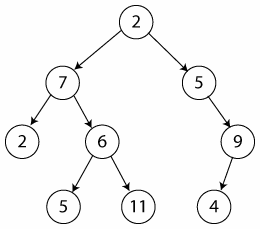 |
 public static Node lowestCommonAncestor(Node root, Node a, Node b) {

     if (root == null) {

         return null;

     }

     if (root.equals(a) || root.equals(b)) {

         // if at least one matched, no need to continue

         // this is the LCA for this root

         return root;

     }

     Node l = lowestCommonAncestor(root.left, a, b);

     Node r = lowestCommonAncestor(root.right, a, b);

     if (l != null && r != null) {

         return root;  // nodes are each on a seaparate branch

     }

     // either one node is on one branch,

     // or none was found in any of the branches

     return l != null ? l : r;

 }
For the node used we will use the following class:
 public class Node {

     public int data;

     public Node right;

     public Node left;

     public Node(int data) {

         this.data = data;

     }

 }
这个问题再follow up一下,就是要找到shortest path in a binary tree between two nodes
 public class Solution {

     public static List<Node> shortestPath(Node root, Node a, Node b) {

         ArrayList<Node> path1 = new ArrayList<Node>();

         ArrayList<Node> path2 = new ArrayList<Node>();

         Node LCA = lowestCommonAncestor(root, a, b);

         helper(LCA.left, a, b, path1, new ArrayList<Node>());

         helper(LCA.right, a, b, path2, new ArrayList<Node>());

         Collections.reverse(path1);

         path1.add(LCA);

         path1.addAll(new ArrayList<Node>(path2));

         return path1;

     }

     public void helper(Node root, Node a, Node b, ArrayList<Node> outpath, ArrayList<Node> temp) {

         if (root == null) return;

         temp.add(root);

         if (root == a || root == b) {

             outpath = new ArrayList<Node>(temp);

             return;

         }

         helper(root.left, a, b, outpath, temp);

         helper(root.right, a, b, outpath, temp);

         temp.remove(temp.size()-1);

     }

 }
别人的Stack做法,未深究 他说First stack is not really needed, a simple list would do - I just like symmetry.
 public static <V> void shortestpath(

         Node<V> root, Node<V> a, Node<V> b,

         Stack<Node<V>> outputPath) {

     if (root == null) {

         return;

     }

     if (root.data.equals(a.data) || root.data.equals(b.data)) {

         outputPath.push(root);

         return;

     }

     shortestpath(root.left, a, b, outputPath);

     shortestpath(root.right, a, b, outputPath);

     outputPath.push(root);

 }

 public static List<Node> shortestPath(Node root, Node a, Node b) {

     Stack<Node> path1 = new Stack<>();

     Stack<Node> path2 = new Stack<>();

     Node lca = lowestCommonAncestor(root, a, b);

     // This is to handle the case where one of the nodes IS the LCA

     Node r = lca.equals(a) ? a : (lca.equals(b) ? b : lca);

     shortestpath(r.left, a, b, path1);

     shortestpath(r.right, a, b, path2);

     path1.push(r);

     // invert the second path

     while (!path2.isEmpty()) {

         path1.push(path2.pop());

     }

     return path1;

 }
Summary: Lowest Common Ancestor in a Binary Tree & Shortest Path In a Binary Tree的更多相关文章
- Range Minimum Query and Lowest Common Ancestor
作者:danielp 出处:http://community.topcoder.com/tc?module=Static&d1=tutorials&d2=lowestCommonAnc ...
- A1143. Lowest Common Ancestor
The lowest common ancestor (LCA) of two nodes U and V in a tree is the deepest node that has both U ...
- PAT A1143 Lowest Common Ancestor (30 分)——二叉搜索树,lca
The lowest common ancestor (LCA) of two nodes U and V in a tree is the deepest node that has both U ...
- 1143 Lowest Common Ancestor
The lowest common ancestor (LCA) of two nodes U and V in a tree is the deepest node that has both U ...
- PAT 甲级 1143 Lowest Common Ancestor
https://pintia.cn/problem-sets/994805342720868352/problems/994805343727501312 The lowest common ance ...
- PAT 1143 Lowest Common Ancestor[难][BST性质]
1143 Lowest Common Ancestor(30 分) The lowest common ancestor (LCA) of two nodes U and V in a tree is ...
- [PAT] 1143 Lowest Common Ancestor(30 分)
1143 Lowest Common Ancestor(30 分)The lowest common ancestor (LCA) of two nodes U and V in a tree is ...
- 1143. Lowest Common Ancestor (30)
The lowest common ancestor (LCA) of two nodes U and V in a tree is the deepest node that has both U ...
- PAT 1143 Lowest Common Ancestor
The lowest common ancestor (LCA) of two nodes U and V in a tree is the deepest node that has both U ...
随机推荐
- [PHP] Compile an extension on Windows
https://wiki.php.net/internals/windows/stepbystepbuildhttp://blog.benoitblanchon.fr/build-php-extens ...
- php strpos(), stripos(),strrpos(), strripos()的区别
strpos(), 左边开始,字符出现第一个位置,区分大小写: stripos(),不区分大小写: strrpos(), 左边开始,字符出现,最后一个位置,区分大小写: strripos()不区分大小 ...
- 记住密码, 不需要默认填写的input框中设置 autocomplete="new-password"
- docker报错“net/http: TLS handshake timeout”的解决方法
为了永久性保留更改,您可以修改 /etc/docker/daemon.json 文件并添加上 registry-mirrors 键值. { "registry-mirrors": ...
- 【转】Android四大基本组件介绍与生命周期
转自:http://www.cnblogs.com/bravestarrhu/archive/2012/05/02/2479461.html Android四大基本组件分别是Activity,Serv ...
- Transient修饰符的使用
如果一个类没有继承Serilizable接口,那么它就不能被序列化,写入文件的时候会报异常.如果一个类继承了Serilizable接口,那么这个类的所有属性和方法都可以自动被序列化,而现实中我们又希望 ...
- codeforces 894C - Marco and GCD Sequence - [有关gcd数学题]
题目链接:https://cn.vjudge.net/problem/CodeForces-894C In a dream Marco met an elderly man with a pair o ...
- easyui-combotree个人实例
<%@ page language="java" contentType="text/html; charset=UTF-8" pageEncoding= ...
- 通过qemu复现路由器漏洞
目录 简介 环境搭建 固件解包 复现漏洞,IDA调试 参考资料 简介 qemu和vmware一样,一种虚拟机软件,只不过qemu能够虚拟的平台更加丰富一些.能够虚拟很多嵌入式平台的设备. 工作上需要向 ...
- TensorFlow基础1:reduce_sum()函数和reduce_mean()函数
https://blog.csdn.net/chengshuhao1991/article/details/78545723 在计算损失时,通常会用到reduce_sum()函数来进行求和,但是在使用 ...