
MySQL 5.7: Enhanced Multi-threaded slaves
http://geek.rohitkalhans.com/2013/09/enhancedMTS-deepdive.html 科学上网
Introduction
The infamous out of order commit problem
On Master we apply T1 and T2 in that order.
State0: x= 1, y= 1 T2: { y:= Read(x);
|
On the slave however these two transactions commit out of order (Say T2 and then T1).
State0: x= 1, y= 1 T1: { x:= Read(y);
|
As we see above the final state state 2 is different in the two cases. Needless to say that we need to control the transactions that can execute in parallel.
Controlled parallelization
The process of committing: On the slave we need to make sure that the transactions that we schedule for parallel execution will be the one which do not have conflicting read and write set. This is the only and the necessary requirement for the slave workers to work without conflicts. This also implies that if the transactions being executed in parallel do not have intersecting read and write sets, we don't care if they are committed out of order. Since MySQL uses lock based scheduling, all the transactions that have entered the prepared stage but not as yet committed will have disjoint read and write sets and hence can be executed in parallel.
Logical clock and commit parent
The pseudo code is as follows.
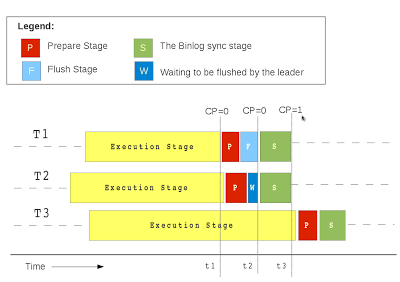
Another thing to note here is that the "group" of transactions that are being executed in parallel are not bounded by binlog commit group. There is a possibility that a transaction have entered the binlog prepare stage but could not make it to the current binlog group. Our approach takes care of such cases and makes sure that we relax the boundary of the group being executed in parallel on the slave.
Conclusion
This feature provides the great enhancement to the existing MySQL replication. To know more about the configuration options of this enhancement refer to this post.
This feature is available inMySQL 5.7.2 release. You can try it out and let us know the feedback.
About the author

Rohit Kalhans is a Software Development Engineer based out of Banglore India. His area of focus revolves around Row-based replication and Multi-threaded parallel slave. His interests include system programming, highly-available and scalable systems. In his free time, he plays guitar and piano and loves to write short stories and poems. More Information can be found on his homepage.
MySQL 5.7: Enhanced Multi-threaded slaves的更多相关文章
- MySQL复制配置(多主一从)
复制多主一从 replicaion 原理 复制有三个步骤:(分为三个线程 slave:io线程 sql线程 master:io线程) 1.master将改变记录到二进制日志(binary log)中( ...
- MySql集群FAQ----mysql主从配置与集群区别、集群中需要多少台计算机呢?为什么? 等
抽取一部分显示在这里,如下, What's the difference in using Clustervs using replication? 在复制系统中,一个MySQL主服务器会更新一个或多 ...
- MySQL数据很大的时候
众所周知,mysql在数据量很大的时候查询的效率是很低的,因为假如你需要 OFFSET 100000 LIMIT 5 这样的数据,数据库就需要跳过前100000条数据,才能返回给你你需要的5条数据.由 ...
- mysql 2006
1.在my.ini文件中添加或者修改以下两个变量:wait_timeout=2880000interactive_timeout = 2880000 关于两个变量的具体说明可以google或者看官方手 ...
- MySQL高可用架构:mysql+keepalived实现
系统环境及架构 #主机名 系统版本 mysql版本 ip地址 mysqlMaster <a href="https://www.linuxprobe.com/" title= ...
- MySQL之备份
MySQL备份和备份 备份/还原 冷备:需要停止当前正在运行mysqld,然后直接拷贝或打包数据文件. 半热备:mysqldump+binlog --适合数据量比较小的应用 在线热备:AB复制 --实 ...
- linux MySql 的主从复制部署
MySql 复制 mysql 复制:将某一台主机上的 Mysql 数据复制到其它主机(slaves)上,并重新执行一遍从而实现 当前主机上的 mysql 数据与(master)主机上数据保持一致的过程 ...
- java面试一日一题:讲对mysql的MVCC的理解
问题:请讲下对mysql中MVCC的理解 分析:这个问题要回答的是对MVCC的理解,以及MVCC解决了什么问题这几个方面入手. 回答要点: 主要从以下几点去考虑, 1.什么是MVCC? 2.MVCC用 ...
- BlackArch-Tools
BlackArch-Tools 简介 安装在ArchLinux之上添加存储库从blackarch存储库安装工具替代安装方法BlackArch Linux Complete Tools List 简介 ...
随机推荐
- 常见设计模式解析和实现(C++)Prototype模式(原型模式)
作用:用原型实例指定创建对象的种类,并且通过拷贝这些原型创建新的对象. UML结构图: 抽象基类: 1) Prototype:虚拟基类,所有原型的基类,提供Clone接口函数 接口函数: 1) P ...
- 前言:关于nagios监控
前言,关于nagios监控. 这段时间一直在做关于nagios监控,不停的做实验,从而也忽略了书写这方面,今天写一份安装文档花了四个多小时,看来写文档也是一件很麻烦的事情,不过,做过的事情还是需要留下 ...
- MVC中的ActionResult
ActionResult是控制器方法执行后返回的结果类型,控制器方法可以返回一个直接或间接从ActionResult抽象类继承的类型,如果返回的是非ActionResult类型,控制器将会将结果转换为 ...
- JavaScript中的重载解读
在JavaScript中有一种特殊的数据类型---Function类型,JavaScript的每个函数都是Function类型的实例.由于函数是对象,因此函数名实际上也是一个指向函数对象的指针,不会与 ...
- mybatis系列-07-输出映射
7.1 resultType 使用resultType进行输出映射,只有查询出来的列名和pojo中的属性名一致,该列才可以映射成功. 如果查询出来的列名和pojo中的属性名全部不一致,没有创建 ...
- 题目1437:To Fill or Not to Fill:贪心算法解决加油站选择问题(未解决)
//贪心算法解决加油站选择问题 //# include<iostream> # include<stdio.h> using namespace std; # include& ...
- 重新执笔,已是大三!Jekyll自定义主题开发
前言 “一转眼忘了时间 丢了感觉 黑了世界 再逞强 再疯狂 也会伤 不知 不觉 后知 后觉 然后 发现 失去 知觉 ”——<一吻不天荒> 感言 时间是把双刃剑,什么解决不了,忧烦的,慢慢变 ...
- ini_set /ini_get函数功能-----PHP
配置PHP环境时,我们记得最初的一步就是修改php.ini文件,但是当我们在虚拟机中运行脚本,或者是我们因为其他的原因没有修改php.ini的权限时,我们该怎么办? ini_set()函数提供了在脚本 ...
- ArrayList、LinkedList、HashMap的遍历及遍历过程中增、删元素
ArrayList.LinkedList.HashMap是Java中常用到的几种集合类型,遍历它们是时常遇到的情况.当然还有一些变态的时候,那就是在遍历的过程中动态增加或者删除其中的元素. 下面的例子 ...
- linux 下载软件
wget 软件地址 eg: 下载tomcat : wget http://apache.fayea.com/apache-mirror/tomcat/tomcat-7/v7.0.52/bin/apac ...