
POJ - 1251
| Time Limit: 1000MS | Memory Limit: 10000K | |
| Total Submissions: 20024 | Accepted: 9234 |
Description
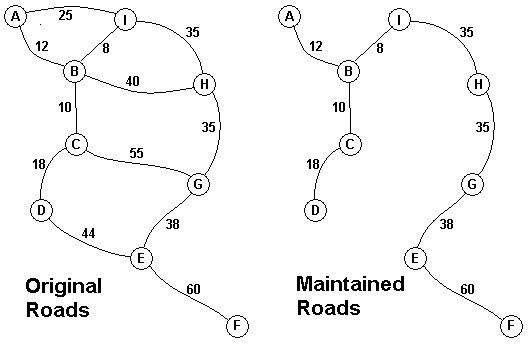
The Head Elder of the tropical island of Lagrishan has a problem. A
burst of foreign aid money was spent on extra roads between villages
some years ago. But the jungle overtakes roads relentlessly, so the
large road network is too expensive to maintain. The Council of Elders
must choose to stop maintaining some roads. The map above on the left
shows all the roads in use now and the cost in aacms per month to
maintain them. Of course there needs to be some way to get between all
the villages on maintained roads, even if the route is not as short as
before. The Chief Elder would like to tell the Council of Elders what
would be the smallest amount they could spend in aacms per month to
maintain roads that would connect all the villages. The villages are
labeled A through I in the maps above. The map on the right shows the
roads that could be maintained most cheaply, for 216 aacms per month.
Your task is to write a program that will solve such problems.
Input
input consists of one to 100 data sets, followed by a final line
containing only 0. Each data set starts with a line containing only a
number n, which is the number of villages, 1 < n < 27, and the
villages are labeled with the first n letters of the alphabet,
capitalized. Each data set is completed with n-1 lines that start with
village labels in alphabetical order. There is no line for the last
village. Each line for a village starts with the village label followed
by a number, k, of roads from this village to villages with labels later
in the alphabet. If k is greater than 0, the line continues with data
for each of the k roads. The data for each road is the village label for
the other end of the road followed by the monthly maintenance cost in
aacms for the road. Maintenance costs will be positive integers less
than 100. All data fields in the row are separated by single blanks. The
road network will always allow travel between all the villages. The
network will never have more than 75 roads. No village will have more
than 15 roads going to other villages (before or after in the alphabet).
In the sample input below, the first data set goes with the map above.
Output
output is one integer per line for each data set: the minimum cost in
aacms per month to maintain a road system that connect all the villages.
Caution: A brute force solution that examines every possible set of
roads will not finish within the one minute time limit.
Sample Input
9

A 2 B 12 I 25

B 3 C 10 H 40 I 8

C 2 D 18 G 55

D 1 E 44

E 2 F 60 G 38

F 0

G 1 H 35

H 1 I 35

3

A 2 B 10 C 40

B 1 C 20

0
Sample Output
216

30
Source
#include<iostream>

#include<stdio.h>

#include<string.h>

#include<cmath>

#include<algorithm>

#define maxn 110

#define INF 1000000

using namespace std;

int n;

int Edge[maxn][maxn];

int path[maxn];

int vis[maxn];

int sum = ;

void prime(int u0)

{

    memset(vis,,sizeof(vis));

    for(int i=; i<=n; i++)

    {

        path[i] = Edge[u0][i];

    }

    vis[u0] = ;

    sum = ;

    for(int i=; i<=n; i++)

    {

        int tt,mmin = INF;

        for(int j=; j<=n; j++)

        {

            if(vis[j] ==  && path[j] < mmin)

            {

                mmin = path[j];

                tt = j;

            }

        }

        if(mmin == INF) break;

        sum += path[tt];

        vis[tt] = ;

        for(int k=; k<=n; k++)

        {

            if(vis[k] ==  && path[k] > Edge[tt][k])

            {

                path[k] = Edge[tt][k];

            }

        }

    }

    printf("%d\n",sum);

}

int main()

{

#ifndef ONLINE_JUDGE

    freopen("in.txt","r",stdin);

#endif // ONLINE_JUDGE

    while(~scanf("%d",&n))

    {

        if(n == ) break;

        char ch,ch1;

        int u,v;

        int w,Q;

        memset(Edge,INF,sizeof(Edge));

        memset(path,INF,sizeof(path));

        for(int i=; i<n; i++)

        {

            cin>>ch1>>Q;

            u = ch1 - ;

            for(int j=; j<=Q; j++)

            {

                cin>>ch1>>w;

                v = ch1 - ;

                Edge[u][v] = w;

                Edge[v][u] = w;

            }

        }

        prime();

    }

    return ;

}
POJ - 1251的更多相关文章
- poj 1251 Jungle Roads (最小生成树)
poj 1251 Jungle Roads (最小生成树) Link: http://poj.org/problem?id=1251 Jungle Roads Time Limit: 1000 ...
- POJ 1251 Jungle Roads (prim)
D - Jungle Roads Time Limit:1000MS Memory Limit:10000KB 64bit IO Format:%I64d & %I64u Su ...
- poj 1251 poj 1258 hdu 1863 poj 1287 poj 2421 hdu 1233 最小生成树模板题
poj 1251 && hdu 1301 Sample Input 9 //n 结点数A 2 B 12 I 25B 3 C 10 H 40 I 8C 2 D 18 G 55D 1 E ...
- Poj(1251),Prim字符的最小生成树
题目链接:http://poj.org/problem?id=1251 字符用%s好了,方便一点. #include <stdio.h> #include <string.h> ...
- OpenJudge/Poj 1251 丛林中的路/Jungle Roads
1.链接地址: http://bailian.openjudge.cn/practice/1251/ http://poj.org/problem?id=1251 2.题目: 总时间限制: 1000m ...
- (最小生成树) Jungle Roads -- POJ -- 1251
链接: http://poj.org/problem?id=1251 Time Limit: 1000MS Memory Limit: 10000K Total Submissions: 2177 ...
- POJ 1251 Jungle Roads (zoj 1406) MST
传送门: http://poj.org/problem?id=1251 http://acm.zju.edu.cn/onlinejudge/showProblem.do?problemId=406 P ...
- POJ 1251 Jungle Roads - C语言 - Kruskal算法
Description The Head Elder of the tropical island of Lagrishan has a problem. A burst of foreign aid ...
- poj 1251 统计难题(字典树)
题目链接:http://acm.hdu.edu.cn/showproblem.php?pid=1251 AC代码: #include<iostream> #include<algor ...
- kuangbin_MST A (POJ 1251)
模板题 Kruskal直接过 调试时候居然在sort(edge + 1, edge + 1 + m)上浪费好多时间... 不过本着ACMer的心态自然要测试一下两种方法分别的速度 Kruskal : ...
随机推荐
- Splay 的区间操作
学完Splay的查找作用,发现和普通的二叉查找树没什么区别,只是用了splay操作节省了时间开支. 而Splay序列之王的称号可不是白给的. Splay真正强大的地方是他的区间操作. 怎么实现呢? 我 ...
- linux系统启动自动激活网卡的解决方法
linux每次启动的时候网卡都需要激活才能上网,实在是很麻烦. 上网找了找资料,最后是这样解决的: # vi /etc/sysconfig/network-scripts/ifcfg-eth0 ...
- Hive(六)hive执行过程实例分析与hive优化策略
一.Hive 执行过程实例分析 1.join 对于 join 操作:SELECT pv.pageid, u.age FROM page_view pv JOIN user u ON (pv.useri ...
- 洛谷P1106 删数问题
题目描述 键盘输入一个高精度的正整数N,去掉其中任意k个数字后剩下的数字按原左右次序将组成一个新的正整数.编程对给定的N和k,寻找一种方案使得剩下的数字组成的新数最小. 输出应包括所去掉的数字的位置和 ...
- 题解【bzoj3240 [NOI2013]矩阵游戏】
挖坑2333 等我把代码写完了再写
- duilib 增加gif控件(基于gdi+,可控制播放暂停,自动设置大小)
转载请说明原出处,谢谢~~:http://blog.csdn.net/zhuhongshu/article/details/42502081 因为项目需要我需要给duilib增加一个gif控件,目前已 ...
- windows7中用vitualbox安装OS X 10.11 El Capitan 及 Xcode 7.0--转载
在 Win 7或8 下使用 VirtualBOX 虚拟机安装 OS X 10.11 El Capitan 及 Xcode 7.0 来源:http://bbs.feng.com/read-htm-tid ...
- git安装和简单配置
http://pan.baidu.com/share/link?shareid=4291215660&uk=219947478 直接贴网盘的地址了
- 2017国庆 清北学堂 北京综合强化班 Day1
期望得分:60+ +0=60+ 实际得分:30+56+0=86 时间规划极端不合理,T2忘了叉积计算,用解析几何算,还有的情况很难处理,浪费太多时间,最后gg 导致T3只剩50分钟,20分钟写完代码, ...
- 2-sat HDU 1814
题解来自于:http://www.cnblogs.com/kuangbin/archive/2012/10/05/2712622.html 和平委员会 根据宪法,Byteland民主共和国的公众和平委 ...