
GBDT,随机森林
author:yangjing
time:2018-10-22
Gradient boosting decision tree
1.main diea
The main idea behind GBDT is to combine many simple models(also known as week kernels),like shallow trees.Each tree can only provide good predictions on part of the data,and so more and more trees are added to iteratively improve performance.
2.parameters setting
the algorithm is a bit more sensitive to parameter settings than random forests,but can provide better accuracy if the parameters are set correctly.
- number of trees
By increasing n_estimators ,also increasing the model complexity,as the model has more chances to correct misticks on the training set. - learning rate
controns how strongly each tree tries to correct the misticks of the previous trees.A higher learning rate means each tree can make stronger correctinos,allowing for more complex models. - max_depth
or alternatively max_leaf_nodes.Usyally max_depth is set very low for gradient-boosted models,often not deeper than five splits.
3.code
from sklearn.ensemble import GradientBoostingClassifier

from sklearn.model_selection import train_test_split

from sklearn.datasets import load_breast_cancer

cancer=load_breast_cancer()

X_train,X_test,y_train,y_test=train_test_split(cancer.data,cancer.target,random_state=0)

gbrt=GradientBoostingClassifier(random_state=0)

gbrt.fit(X_train,y_train)

gbrt.score(X_test,y_test)
In [261]: X_train,X_test,y_train,y_test=train_test_split(cancer.data,cancer.target,random_state=0)

     ...: gbrt=GradientBoostingClassifier(random_state=0)

     ...: gbrt.fit(X_train,y_train)

     ...: gbrt.score(X_test,y_test)

     ...:

Out[261]: 0.958041958041958

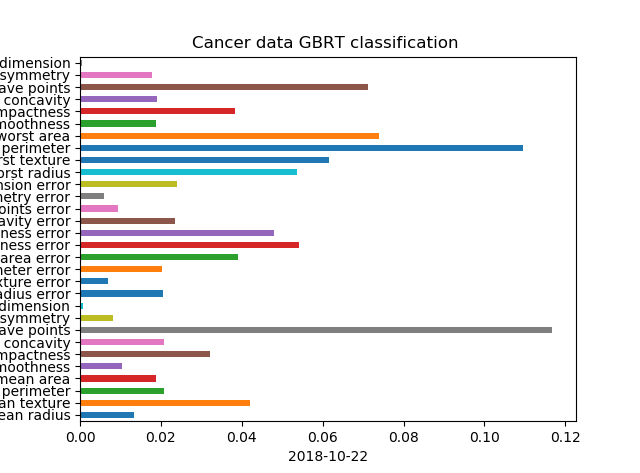
In [262]: gbrt.feature_importances_

Out[262]:

array([0.01337291, 0.04201687, 0.0208666 , 0.01889077, 0.01028091,

       0.03215986, 0.02074619, 0.11678956, 0.00820024, 0.00074312,

       0.02042134, 0.00680047, 0.02023052, 0.03907398, 0.05406751,

       0.04795741, 0.02358101, 0.00934718, 0.00593481, 0.0239241 ,

       0.05354265, 0.06160083, 0.10961728, 0.07395201, 0.01867851,

       0.03842953, 0.01915824, 0.07128703, 0.01773659, 0.00059199])

In [263]: gbrt.learning_rate

Out[263]: 0.1

In [264]: gbrt.max_depth

Out[264]: 3

In [265]: len(gbrt.estimators_)

Out[266]: 100

In [272]: gbrt.get_params()

Out[272]:

{'criterion': 'friedman_mse',

 'init': None,

 'learning_rate': 0.1,

 'loss': 'deviance',

 'max_depth': 3,

 'max_features': None,

 'max_leaf_nodes': None,

 'min_impurity_decrease': 0.0,

 'min_impurity_split': None,

 'min_samples_leaf': 1,

 'min_samples_split': 2,

 'min_weight_fraction_leaf': 0.0,

 'n_estimators': 100,

 'presort': 'auto',

 'random_state': 0,

 'subsample': 1.0,

 'verbose': 0,

 'warm_start': False}
Random forest
In [230]: y

Out[230]:

array([1, 1, 0, 1, 1, 1, 1, 0, 0, 0, 1, 0, 1, 1, 0, 1, 1, 0, 1, 0, 1, 0,

       0, 0, 1, 1, 0, 1, 0, 1, 0, 0, 0, 0, 1, 0, 1, 1, 0, 0, 0, 0, 0, 0,

       1, 1, 1, 1, 1, 0, 1, 1, 1, 1, 0, 1, 1, 1, 1, 1, 0, 1, 1, 1, 0, 1,

       0, 0, 0, 0, 0, 1, 1, 0, 1, 1, 0, 1, 1, 0, 1, 0, 1, 0, 0, 0, 0, 0,

       0, 1, 0, 0, 1, 0, 0, 0, 1, 1, 0, 0], dtype=int64)

In [231]: axes.ravel()

Out[231]:

array([<matplotlib.axes._subplots.AxesSubplot object at 0x000001F46F3694A8>,

       <matplotlib.axes._subplots.AxesSubplot object at 0x000001F46C099F28>,

       <matplotlib.axes._subplots.AxesSubplot object at 0x000001F46E6E3BE0>,

       <matplotlib.axes._subplots.AxesSubplot object at 0x000001F46BEB72E8>,

       <matplotlib.axes._subplots.AxesSubplot object at 0x000001F46ED67198>,

       <matplotlib.axes._subplots.AxesSubplot object at 0x000001F46F292C88>],

      dtype=object)

In [232]: from sklearn.model_selection import train_test_split

In [233]: X_trai,X_test,y_train,y_test=train_test_split(X,y,stratify=y,random_state=42)

In [234]: len(X_trai)

Out[234]: 75

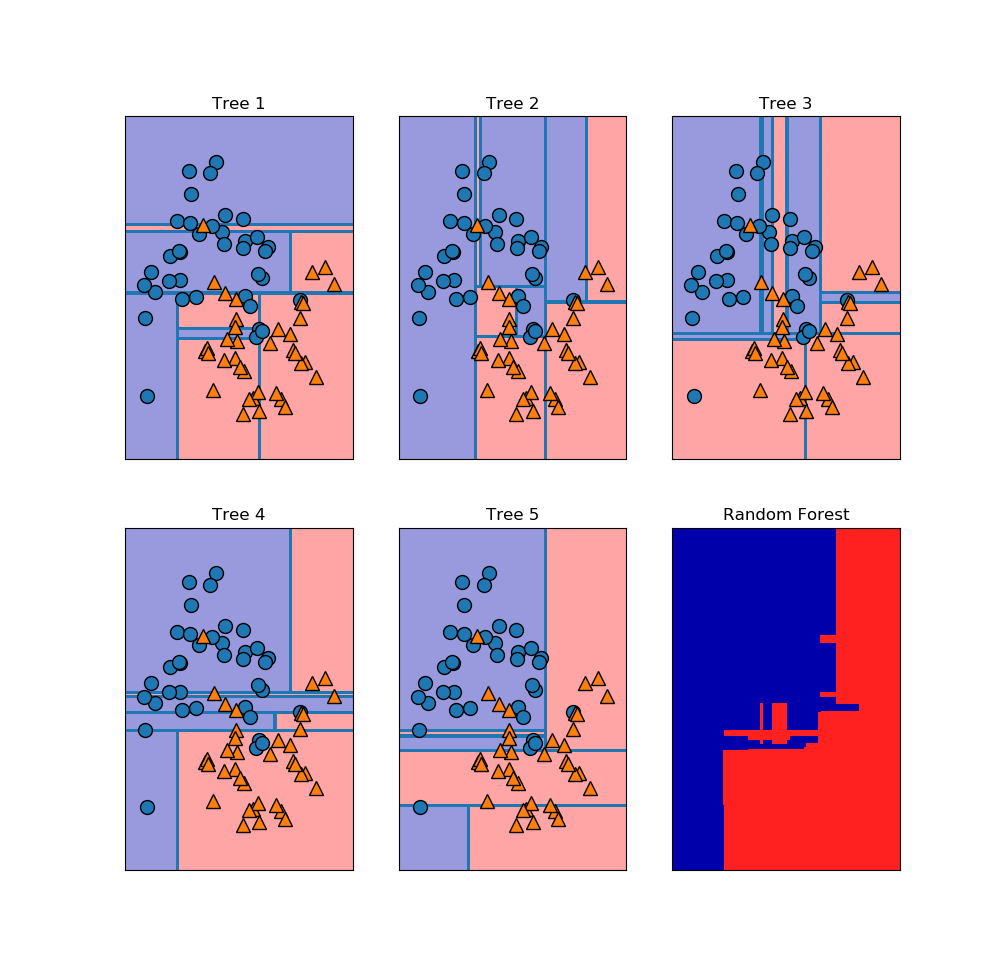
In [235]: fores=RandomForestClassifier(n_estimators=5,random_state=2)

In [236]: fores.fit(X_trai,y_train)

Out[236]:

RandomForestClassifier(bootstrap=True, class_weight=None, criterion='gini',

            max_depth=None, max_features='auto', max_leaf_nodes=None,

            min_impurity_decrease=0.0, min_impurity_split=None,

            min_samples_leaf=1, min_samples_split=2,

            min_weight_fraction_leaf=0.0, n_estimators=5, n_jobs=1,

            oob_score=False, random_state=2, verbose=0, warm_start=False)

In [237]: fores.score(X_test,y_test)

Out[237]: 0.92

In [238]: fores.estimators_

Out[238]:

[DecisionTreeClassifier(class_weight=None, criterion='gini', max_depth=None,

             max_features='auto', max_leaf_nodes=None,

             min_impurity_decrease=0.0, min_impurity_split=None,

             min_samples_leaf=1, min_samples_split=2,

             min_weight_fraction_leaf=0.0, presort=False,

             random_state=1872583848, splitter='best'),

 DecisionTreeClassifier(class_weight=None, criterion='gini', max_depth=None,

             max_features='auto', max_leaf_nodes=None,

             min_impurity_decrease=0.0, min_impurity_split=None,

             min_samples_leaf=1, min_samples_split=2,

             min_weight_fraction_leaf=0.0, presort=False,

             random_state=794921487, splitter='best'),

 DecisionTreeClassifier(class_weight=None, criterion='gini', max_depth=None,

             max_features='auto', max_leaf_nodes=None,

             min_impurity_decrease=0.0, min_impurity_split=None,

             min_samples_leaf=1, min_samples_split=2,

             min_weight_fraction_leaf=0.0, presort=False,

             random_state=111352301, splitter='best'),

 DecisionTreeClassifier(class_weight=None, criterion='gini', max_depth=None,

             max_features='auto', max_leaf_nodes=None,

             min_impurity_decrease=0.0, min_impurity_split=None,

             min_samples_leaf=1, min_samples_split=2,

             min_weight_fraction_leaf=0.0, presort=False,

             random_state=1853453896, splitter='best'),

 DecisionTreeClassifier(class_weight=None, criterion='gini', max_depth=None,

             max_features='auto', max_leaf_nodes=None,

             min_impurity_decrease=0.0, min_impurity_split=None,

             min_samples_leaf=1, min_samples_split=2,

             min_weight_fraction_leaf=0.0, presort=False,

             random_state=213298710, splitter='best')]
GBDT,随机森林的更多相关文章
- ObjectT5:在线随机森林-Multi-Forest-A chameleon in track in
原文::Multi-Forest:A chameleon in tracking,CVPR2014 下的蛋...原文 使用随机森林的优势,在于可以使用GPU把每棵树分到一个流处理器里运行,容易并行化 ...
- 机器学习中的算法(1)-决策树模型组合之随机森林与GBDT
版权声明: 本文由LeftNotEasy发布于http://leftnoteasy.cnblogs.com, 本文可以被全部的转载或者部分使用,但请注明出处,如果有问题,请联系wheeleast@gm ...
- 机器学习中的算法——决策树模型组合之随机森林与GBDT
前言: 决策树这种算法有着很多良好的特性,比如说训练时间复杂度较低,预测的过程比较快速,模型容易展示(容易将得到的决策树做成图片展示出来)等.但是同时,单决策树又有一些不好的地方,比如说容易over- ...
- 决策树模型组合之(在线)随机森林与GBDT
前言: 决策树这种算法有着很多良好的特性,比如说训练时间复杂度较低,预测的过程比较快速,模型容易展示(容易将得到的决策树做成图片展示出来)等.但是同时, 单决策树又有一些不好的地方,比如说容易over ...
- 机器学习中的算法-决策树模型组合之随机森林与GBDT
机器学习中的算法(1)-决策树模型组合之随机森林与GBDT 版权声明: 本文由LeftNotEasy发布于http://leftnoteasy.cnblogs.com, 本文可以被全部的转载或者部分使 ...
- 随机森林与GBDT
前言: 决策树这种算法有着很多良好的特性,比如说训练时间复杂度较低,预测的过程比较快速,模型容易展示(容易将得到的决策树做成图片展示出来)等.但是同时,单决策树又有一些不好的地方,比如说容易over- ...
- 决策树模型组合之随机森林与GBDT
版权声明: 本文由LeftNotEasy发布于http://leftnoteasy.cnblogs.com, 本文可以被全部的转载或者部分使用,但请注明出处,如果有问题,请联系wheeleast@gm ...
- 随机森林和GBDT
1. 随机森林 Random Forest(随机森林)是Bagging的扩展变体,它在以决策树 为基学习器构建Bagging集成的基础上,进一步在决策树的训练过程中引入了随机特征选择,因此可以概括RF ...
- 随机森林RF、XGBoost、GBDT和LightGBM的原理和区别
目录 1.基本知识点介绍 2.各个算法原理 2.1 随机森林 -- RandomForest 2.2 XGBoost算法 2.3 GBDT算法(Gradient Boosting Decision T ...
随机推荐
- POJ 1240 Pre-Post-erous! && East Central North America 2002 (由前序后序遍历序列推出M叉树的种类)
题目链接:http://poj.org/problem?id=1240 本文链接:http://www.cnblogs.com/Ash-ly/p/5482520.html 题意: 通过一棵二叉树的中序 ...
- 训练指南 UVA - 11478(最短路BellmanFord+ 二分+ 差分约束)
layout: post title: 训练指南 UVA - 11478(最短路BellmanFord+ 二分+ 差分约束) author: "luowentaoaa" catal ...
- 【数形结合】Gym - 100923I - Por Costel and the Pairs
perechi3.in / perechi3.out We don't know how Por Costel the pig arrived at FMI's dance party. All we ...
- 使用eclipse调试MR程序
1)点击菜单中的“运行按钮”,然后选择调试配置 2) 3) 这里配置输入路径和输出路径,注意在eclipse上只是在单机模式下Hadoop不会使用HDFS,也不会开启任何Hadoop守护进程,所有程序 ...
- Java架构师之路 Spring学习笔记(一) Spring介绍
前言 这是一篇原创的Spring学习笔记.主要记录我学习Spring4.0的过程.本人有四年的Java Web开发经验,最近在面试中遇到面试官总会问一些简单但我不会的Java问题,让我觉得有必要重新审 ...
- Delphi 使窗体Showmodal后可以操作其他窗体
对话框ShowModal之后不能操作其它窗口,实际上是因为Windows Disable了其它窗口.所以当你需要在模态对话框中访问其它已经可见的窗口时,需要用EnableWindow API来激活对应 ...
- zk删除node模式
检查状态 状态描述指定的znode的元数据.它包含时间戳,版本号,ACL,数据长度和子znode等细项. 语法 stat /path 示例 stat /FirstZnode 输出 [zk: local ...
- python中单星号(*)和双星号(**)的使用
1.单星号*:对元组解包:接收可变参数 2.双星号**:对字典解包:接收可变参数 python函数的五类参数类型及出现顺序:必选参数.默认参数.可变参数.命名关键字参数.关键字参数 参考: https ...
- Webpack安装和配置
一.安装和配置webpack 1.全局安装webpack 这样就安装好了webpack,可以再全局通过webpack -v来查看是否安装成功. 2.先创建项目目录结构,根目录是mywebpack.进入 ...
- Android实现二维码扫描登录网页
之前写过一个二维码扫描demo,用的Zxing的框架,点击下载.兴许扫描二维码中出现一些问题,比方解决压缩图片.调整扫描窗体大小等等. 兴许单位要求做扫描登录实现,发现难点就是怎么知道你扫描的 ...