
基于直接最小二乘的椭圆拟合(Direct Least Squares Fitting of Ellipses)
算法思想:
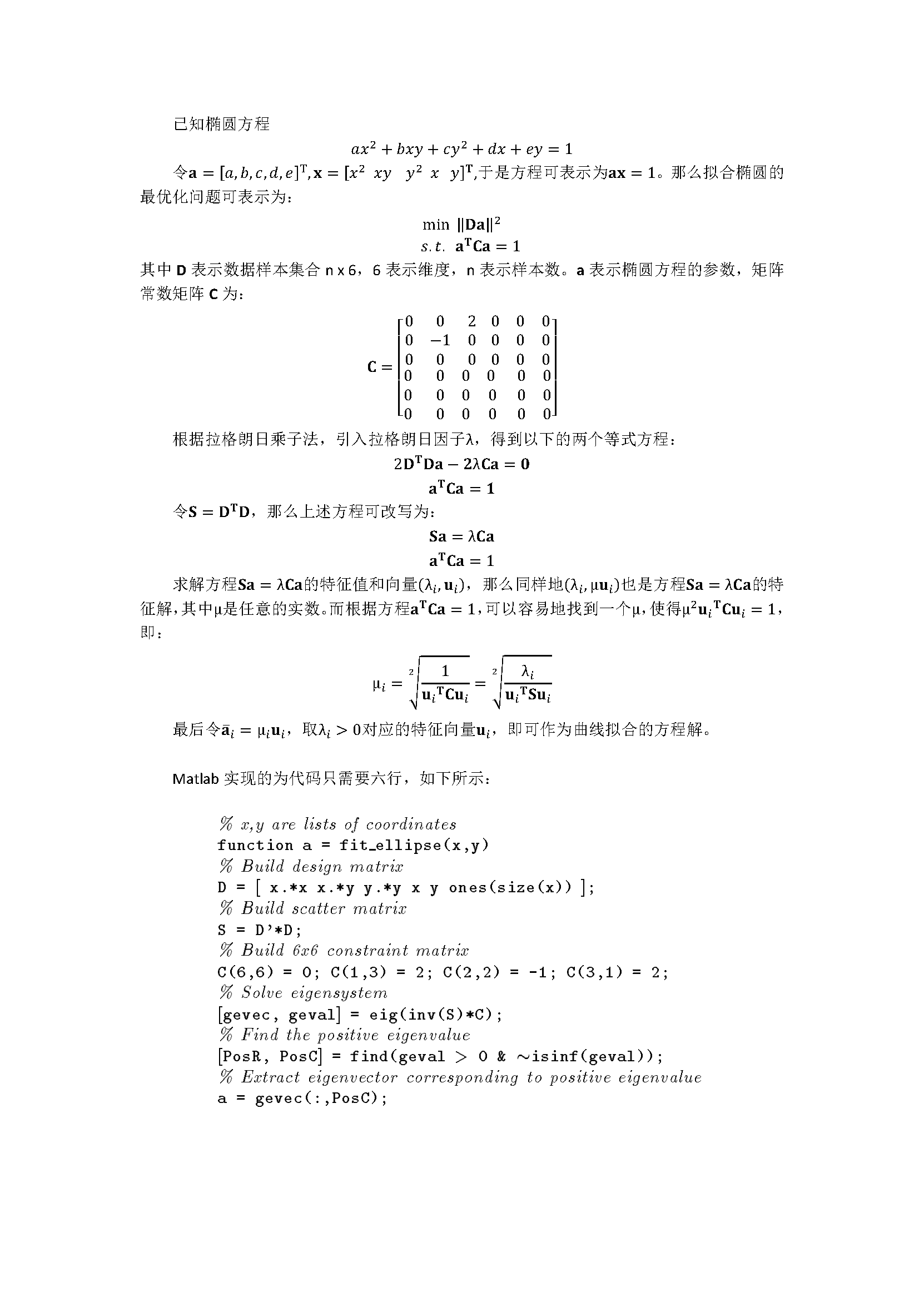
算法通过最小化约束条件4ac-b^2 = 1,最小化距离误差。利用最小二乘法进行求解,首先引入拉格朗日乘子算法获得等式组,然后求解等式组得到最优的拟合椭圆。
算法的优点:
a、椭圆的特异性,在任何噪声或者遮挡的情况下都会给出一个有用的结果;
b、不变性,对数据的Euclidean变换具有不变性,即数据进行一系列的Euclidean变换也不会导致拟合结果的不同;
c、对噪声具有很高的鲁棒性;
d、计算高效性。
算法原理:
代码实现(Matlab):
 %

 function a = fitellipse(X,Y)

 % FITELLIPSE  Least-squares fit of ellipse to 2D points.

 %        A = FITELLIPSE(X,Y) returns the parameters of the best-fit

 %        ellipse to 2D points (X,Y).

 %        The returned vector A contains the center, radii, and orientation

 %        of the ellipse, stored as (Cx, Cy, Rx, Ry, theta_radians)

 %

 % Authors: Andrew Fitzgibbon, Maurizio Pilu, Bob Fisher

 % Reference: "Direct Least Squares Fitting of Ellipses", IEEE T-PAMI,

 %

 %  @Article{Fitzgibbon99,

 %   author = "Fitzgibbon, A.~W.and Pilu, M. and Fisher, R.~B.",

 %   title = "Direct least-squares fitting of ellipses",

 %   journal = pami,

 %   year = 1999,

 %   volume = 21,

 %   number = 5,

 %   month = may,

 %   pages = "476--480"

 %  }

 %

 % This is a more bulletproof version than that in the paper, incorporating

 % scaling to reduce roundoff error, correction of behaviour when the input

 % data are on a perfect hyperbola, and returns the geometric parameters

 % of the ellipse, rather than the coefficients of the quadratic form.

 %

 %  Example:  Run fitellipse without any arguments to get a demo

 if nargin ==

   % Create an ellipse

   t = linspace(,);

   Rx = ;

   Ry = ;

   Cx = ;

   Cy = ;

   Rotation = .; % Radians

   NoiseLevel = .; % Will add Gaussian noise of this std.dev. to points

   x = Rx * cos(t);

   y = Ry * sin(t);

   nx = x*cos(Rotation)-y*sin(Rotation) + Cx + randn(size(t))*NoiseLevel;

   ny = x*sin(Rotation)+y*cos(Rotation) + Cy + randn(size(t))*NoiseLevel;

   % Clear figure

   clf

   % Draw it

   plot(nx,ny,'o');

   % Show the window

   figure(gcf)

   % Fit it

   params = fitellipse(nx,ny);

   % Note it may return (Rotation - pi/) and swapped radii, this is fine.

   Given = round([Cx Cy Rx Ry Rotation*])

   Returned = round(params.*[    ])

   % Draw the returned ellipse

   t = linspace(,pi*);

   x = params() * cos(t);

   y = params() * sin(t);

   nx = x*cos(params())-y*sin(params()) + params();

   ny = x*sin(params())+y*cos(params()) + params();

   hold on

   plot(nx,ny,'r-')

   return

 end

 % normalize data

 mx = mean(X);

 my = mean(Y);

 sx = (max(X)-min(X))/;

 sy = (max(Y)-min(Y))/;

 x = (X-mx)/sx;

 y = (Y-my)/sy;

 % Force to column vectors

 x = x(:);

 y = y(:);

 % Build design matrix

 D = [ x.*x  x.*y  y.*y  x  y  ones(size(x)) ];

 % Build scatter matrix

 S = D'*D;

 % Build 6x6 constraint matrix

 C(,) = ; C(,) = -; C(,) = ; C(,) = -;

 % Solve eigensystem

 if

   % Old way, numerically unstable if not implemented in matlab

   [gevec, geval] = eig(S,C);

   % Find the negative eigenvalue

   I = find(real(diag(geval)) < 1e-8 & ~isinf(diag(geval)));

   % Extract eigenvector corresponding to negative eigenvalue

   A = real(gevec(:,I));

 else

   % New way, numerically stabler in C [gevec, geval] = eig(S,C);

   % Break into blocks

   tmpA = S(:,:);

   tmpB = S(:,:);

   tmpC = S(:,:);

   tmpD = C(:,:);

   tmpE = inv(tmpC)*tmpB';

   [evec_x, eval_x] = eig(inv(tmpD) * (tmpA - tmpB*tmpE));

   % Find the positive (as det(tmpD) < ) eigenvalue

   I = find(real(diag(eval_x)) < 1e-8 & ~isinf(diag(eval_x)));

   % Extract eigenvector corresponding to negative eigenvalue

   A = real(evec_x(:,I));

   % Recover the bottom half...

   evec_y = -tmpE * A;

   A = [A; evec_y];

 end

 % unnormalize

 par = [

   A()*sy*sy,   ...

       A()*sx*sy,   ...

       A()*sx*sx,   ...

       -*A()*sy*sy*mx - A()*sx*sy*my + A()*sx*sy*sy,   ...

       -A()*sx*sy*mx - *A()*sx*sx*my + A()*sx*sx*sy,   ...

       A()*sy*sy*mx*mx + A()*sx*sy*mx*my + A()*sx*sx*my*my   ...

       - A()*sx*sy*sy*mx - A()*sx*sx*sy*my   ...

       + A()*sx*sx*sy*sy   ...

       ]';

 % Convert to geometric radii, and centers

 thetarad = 0.5*atan2(par(),par() - par());

 cost = cos(thetarad);

 sint = sin(thetarad);

 sin_squared = sint.*sint;

 cos_squared = cost.*cost;

 cos_sin = sint .* cost;

 Ao = par();

 Au =   par() .* cost + par() .* sint;

 Av = - par() .* sint + par() .* cost;

 Auu = par() .* cos_squared + par() .* sin_squared + par() .* cos_sin;

 Avv = par() .* sin_squared + par() .* cos_squared - par() .* cos_sin;

 % ROTATED = [Ao Au Av Auu Avv]

 tuCentre = - Au./(.*Auu);

 tvCentre = - Av./(.*Avv);

 wCentre = Ao - Auu.*tuCentre.*tuCentre - Avv.*tvCentre.*tvCentre;

 uCentre = tuCentre .* cost - tvCentre .* sint;

 vCentre = tuCentre .* sint + tvCentre .* cost;

 Ru = -wCentre./Auu;

 Rv = -wCentre./Avv;

 Ru = sqrt(abs(Ru)).*sign(Ru);

 Rv = sqrt(abs(Rv)).*sign(Rv);

 a = [uCentre, vCentre, Ru, Rv, thetarad];
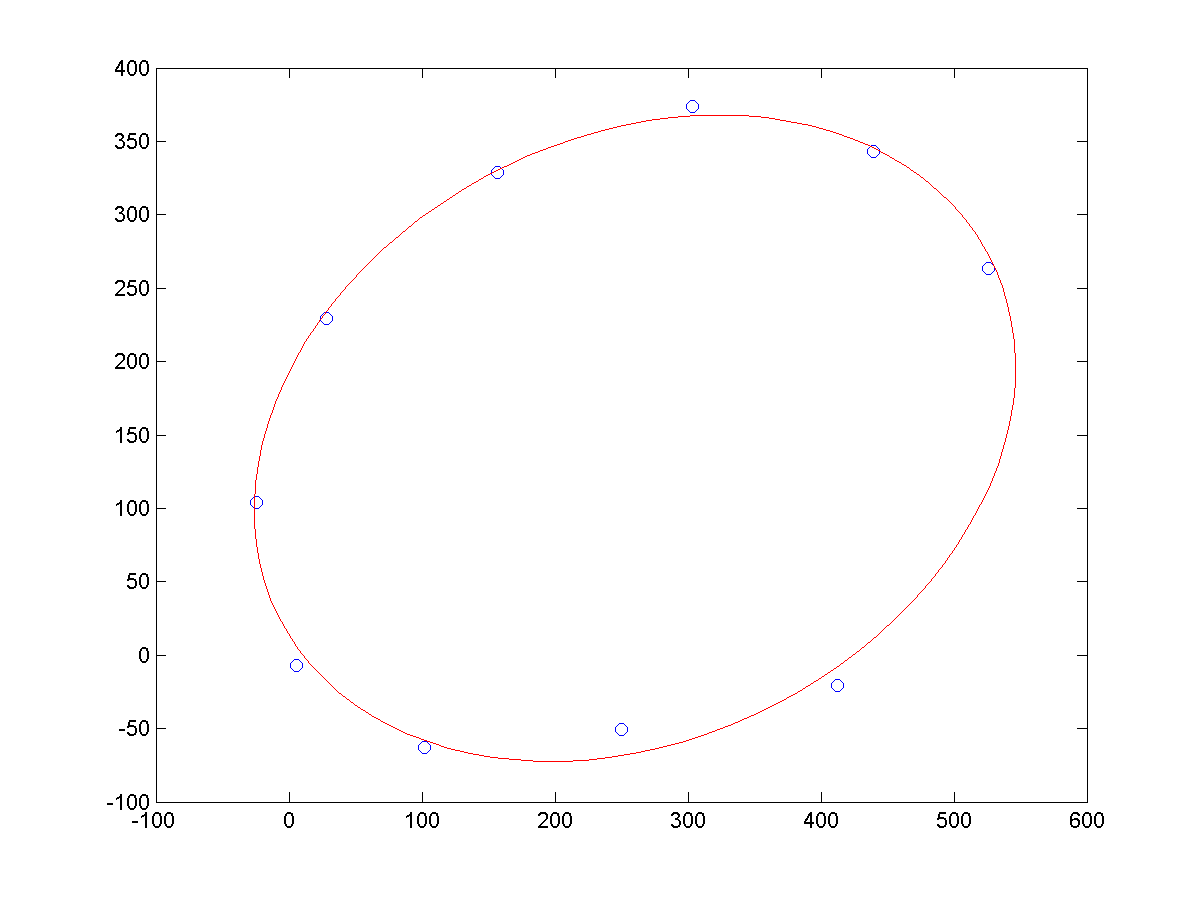
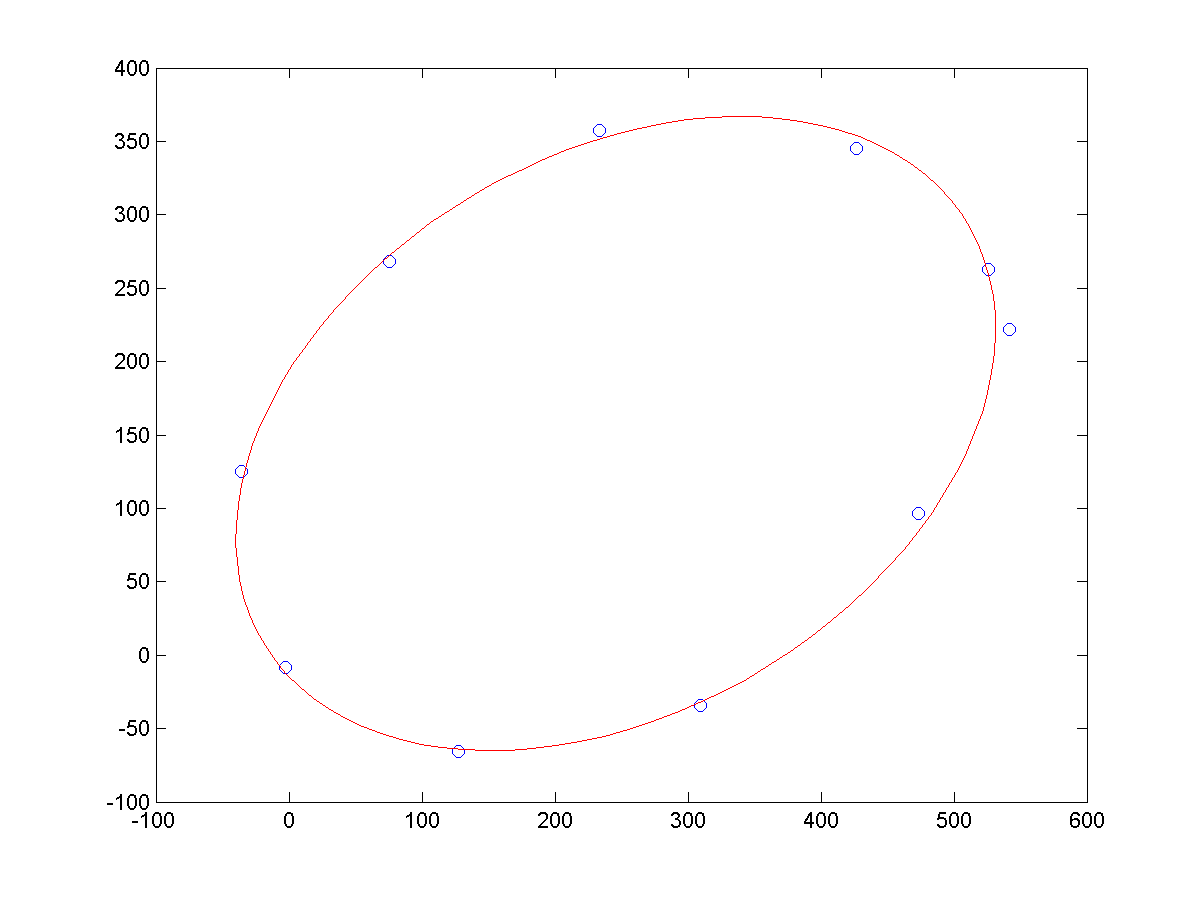
实验效果:
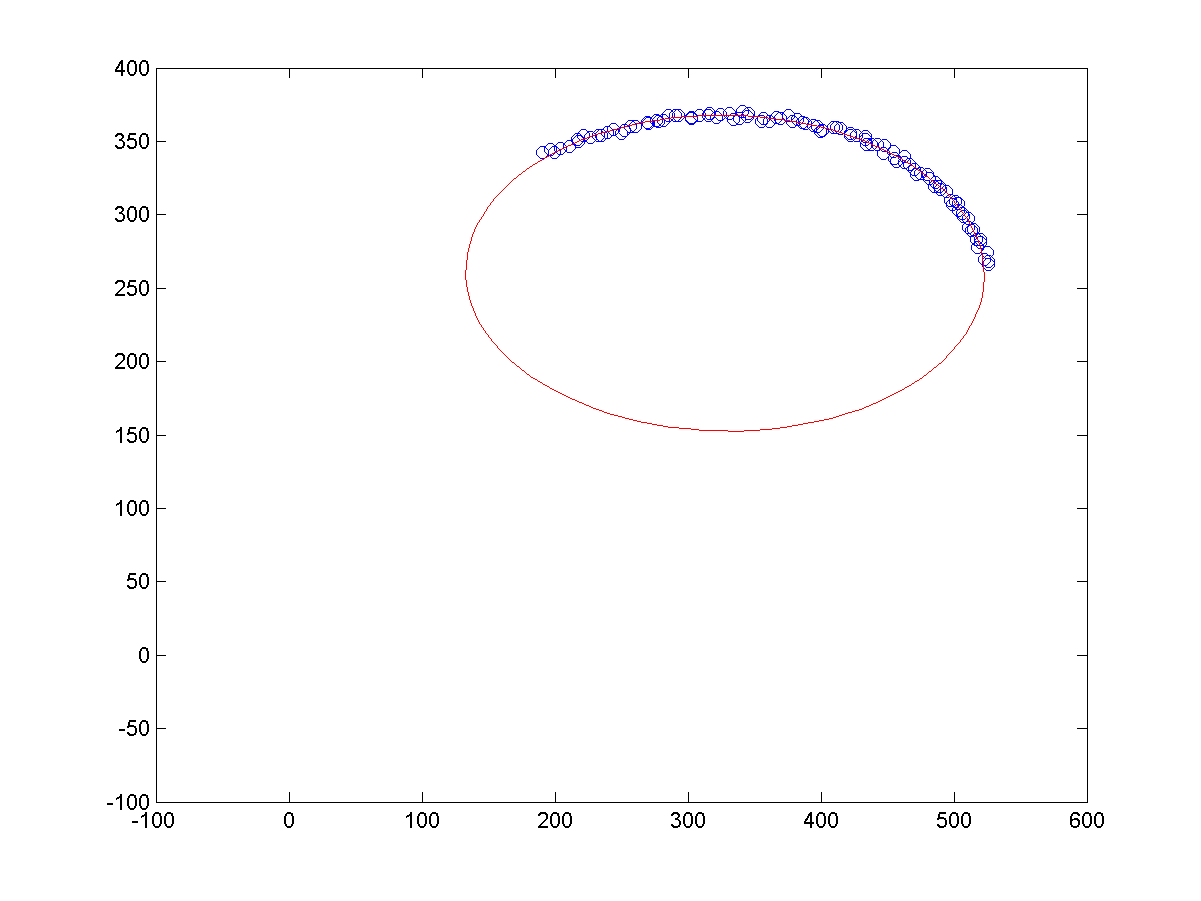
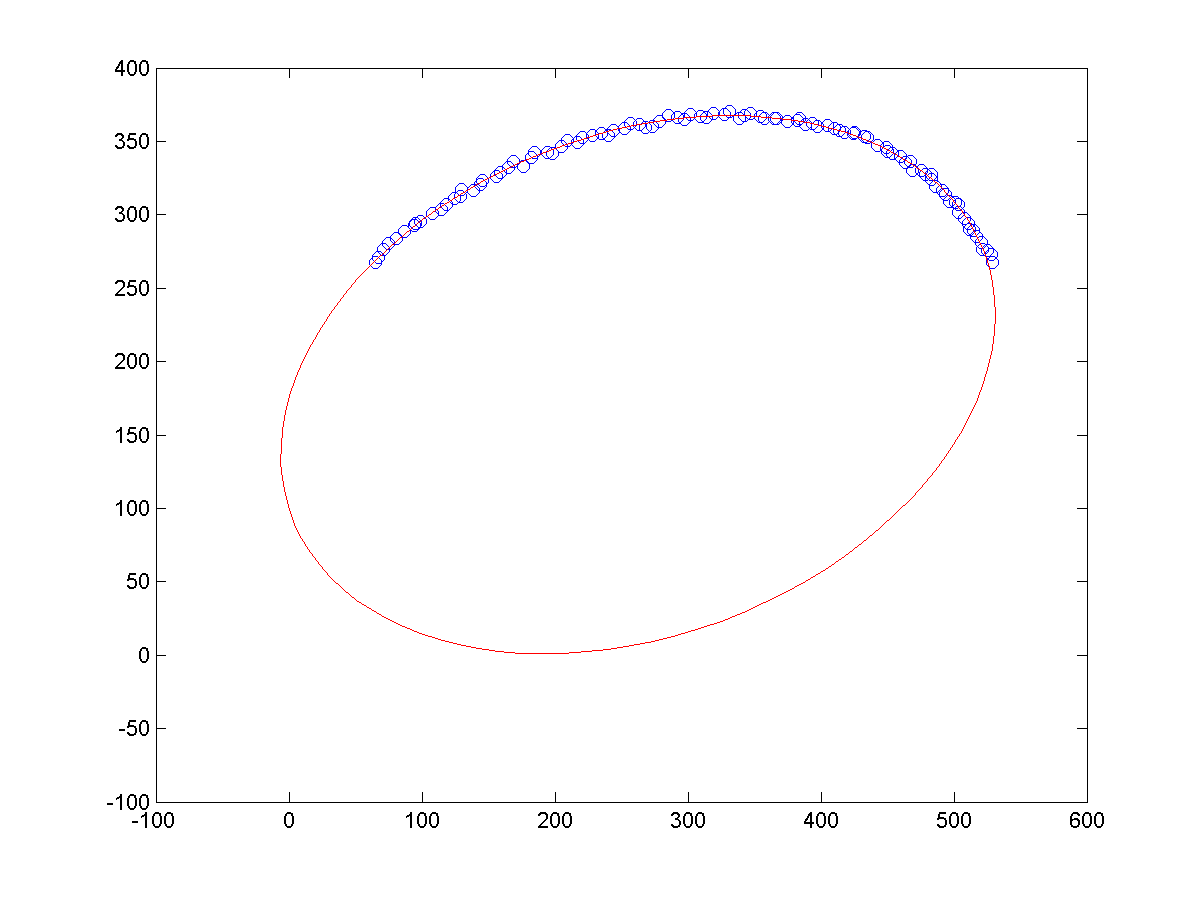
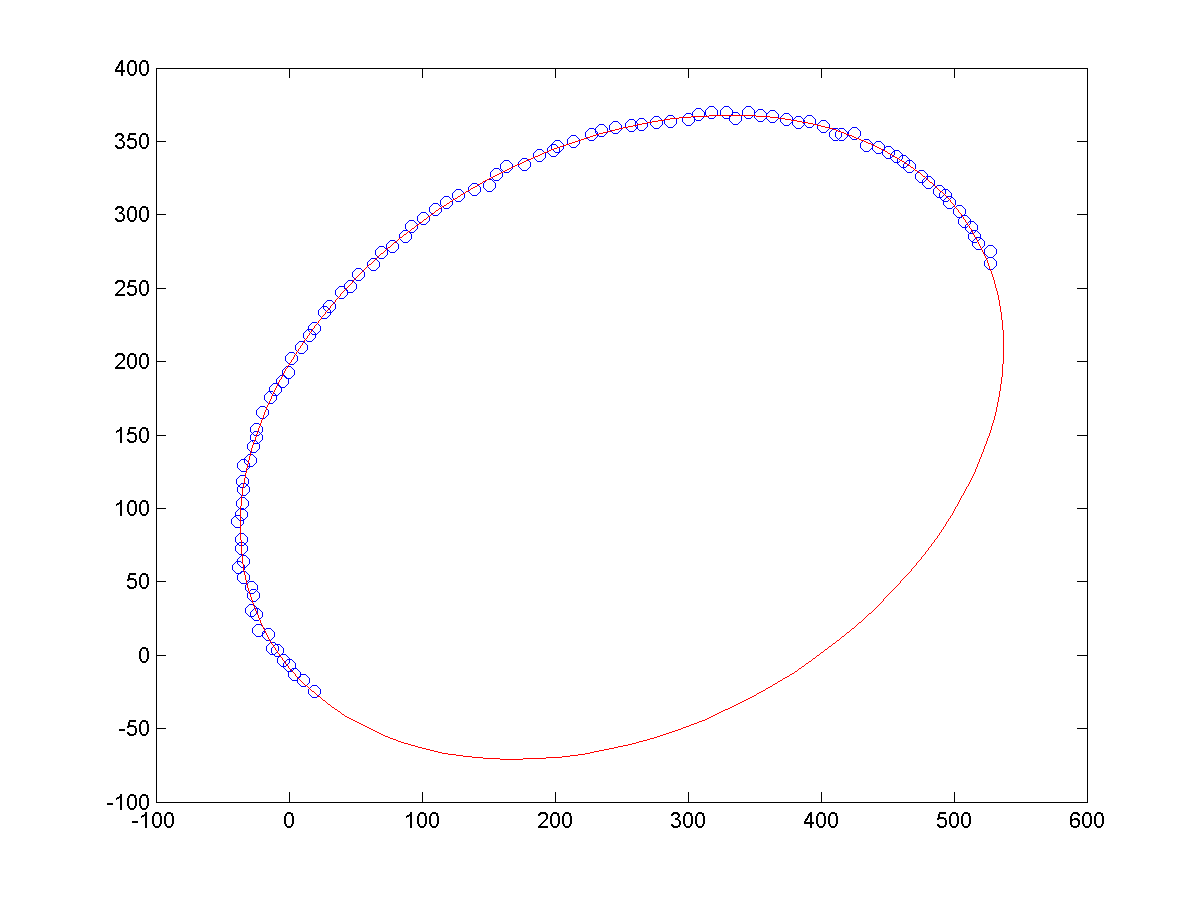
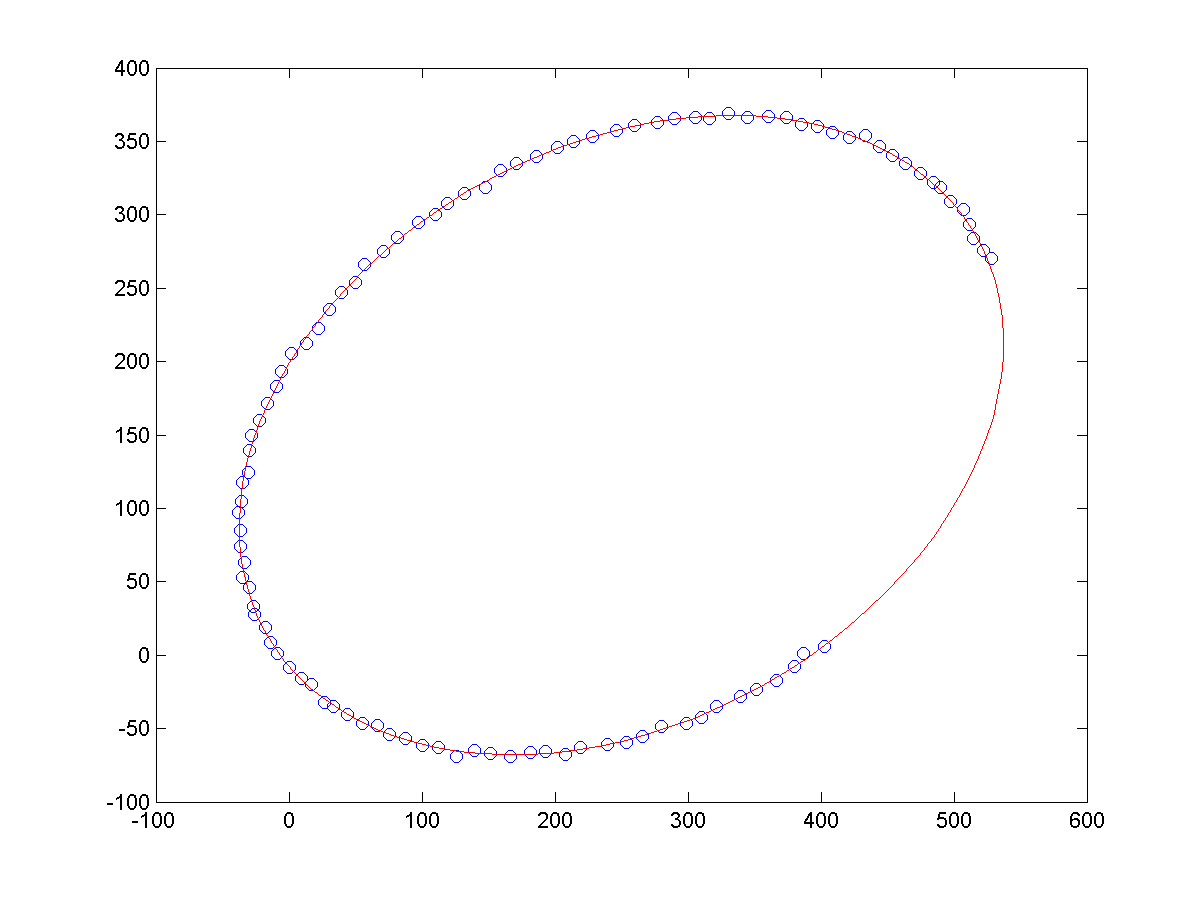
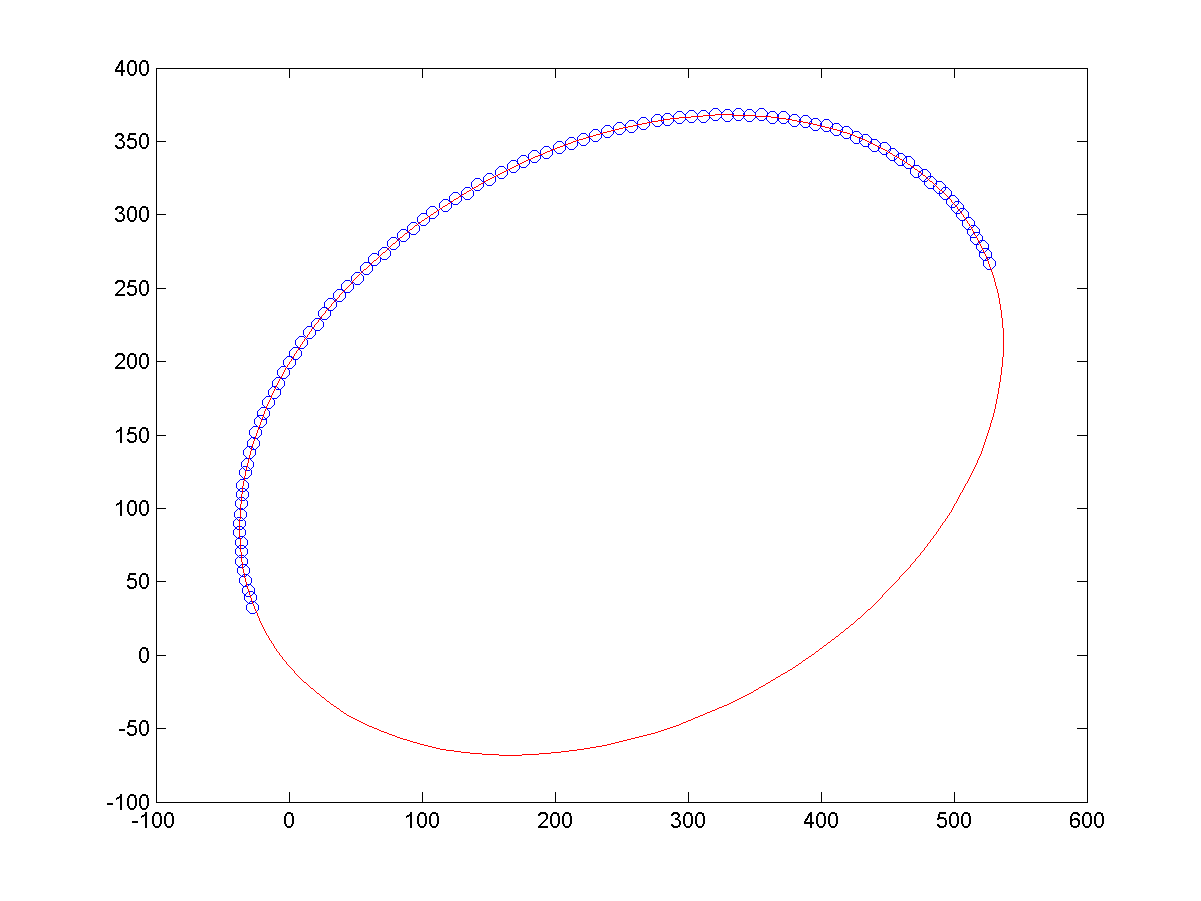
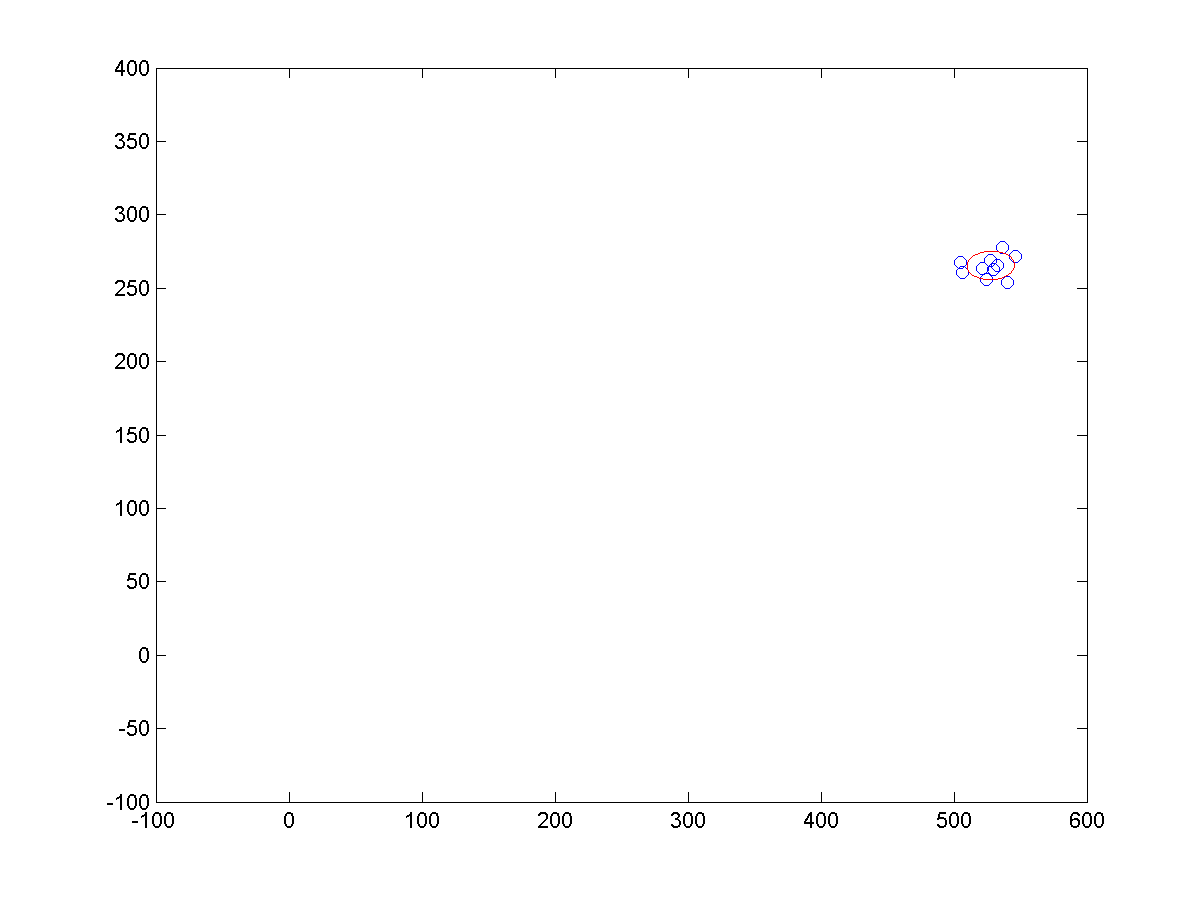
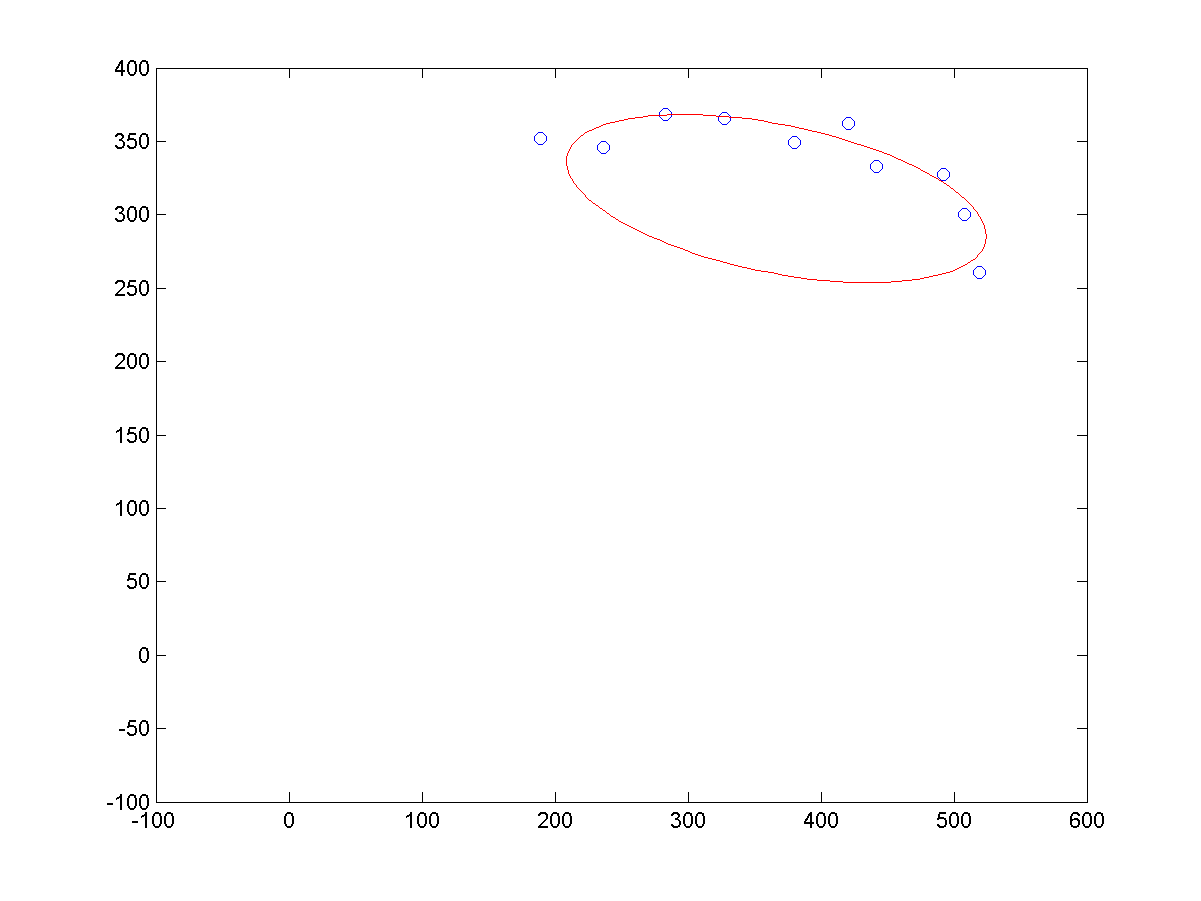
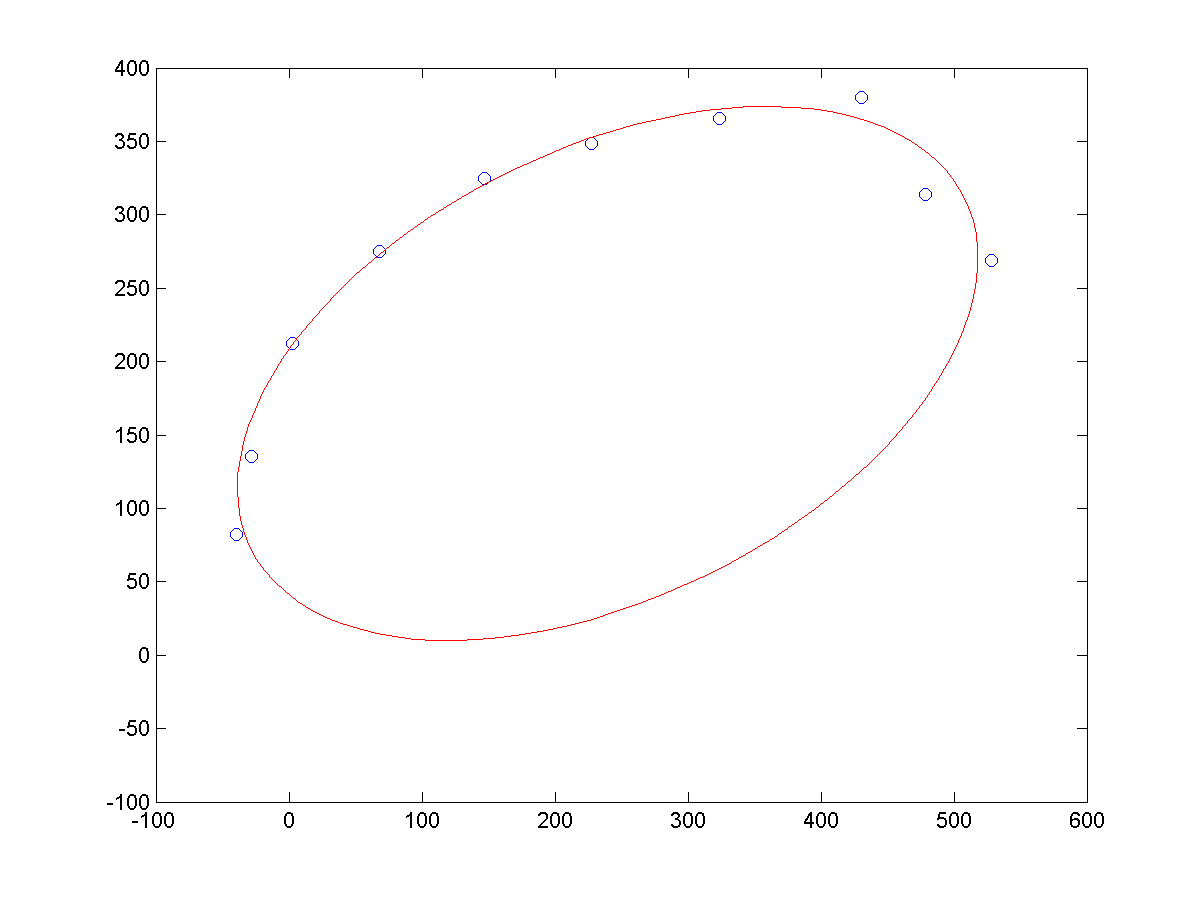
a、同等噪声条件下,不同长度的样本点,导致的拟合结果,如下所示:


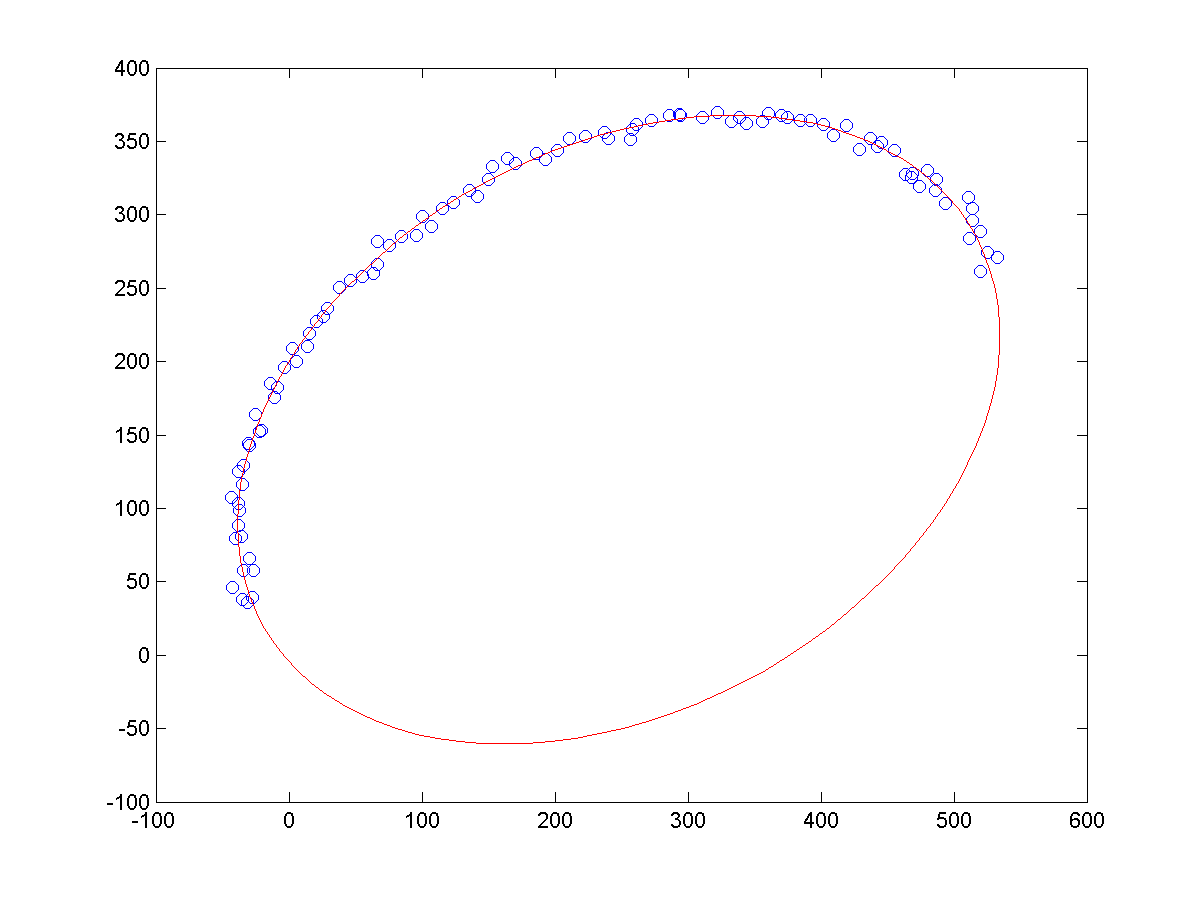
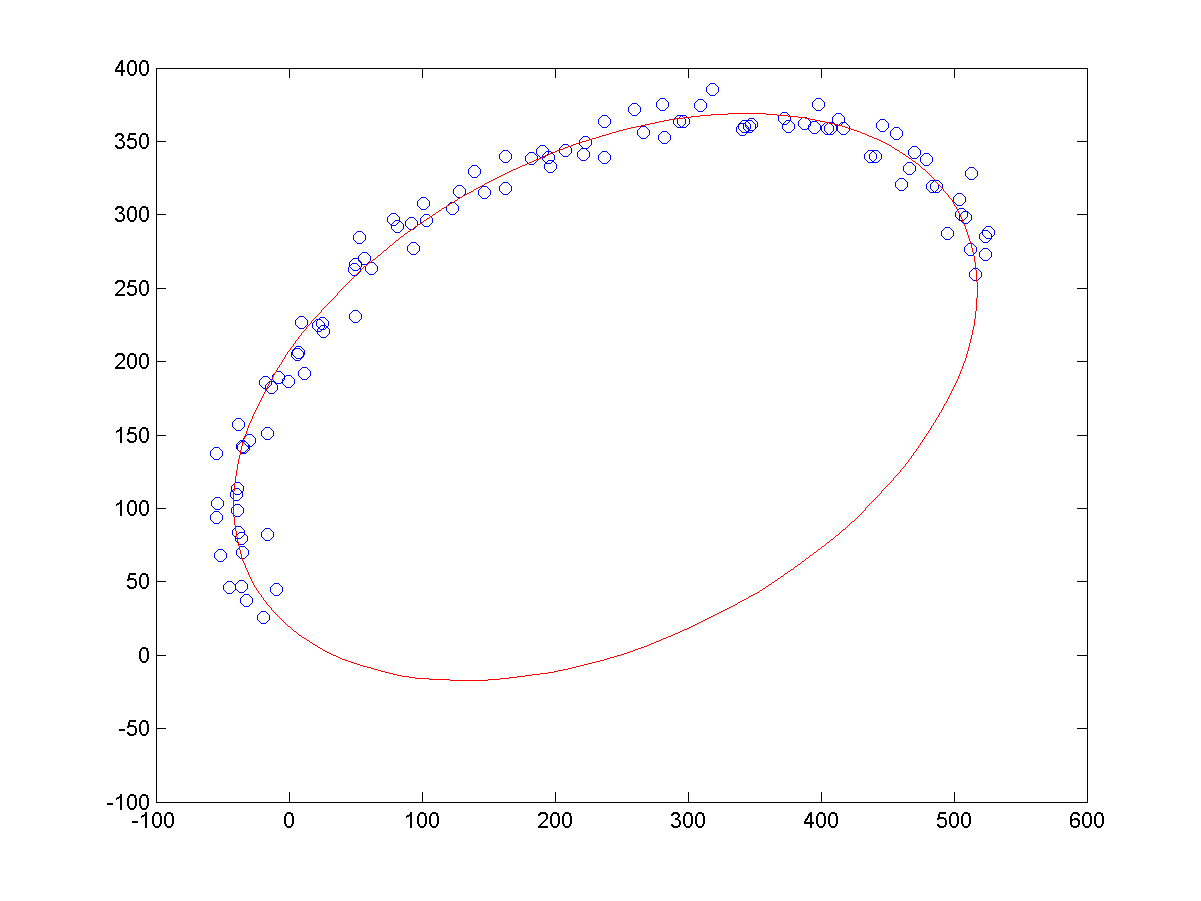
b、相同长度的样本点下,不同噪声的样本点,导致的拟合结果,如下所示:
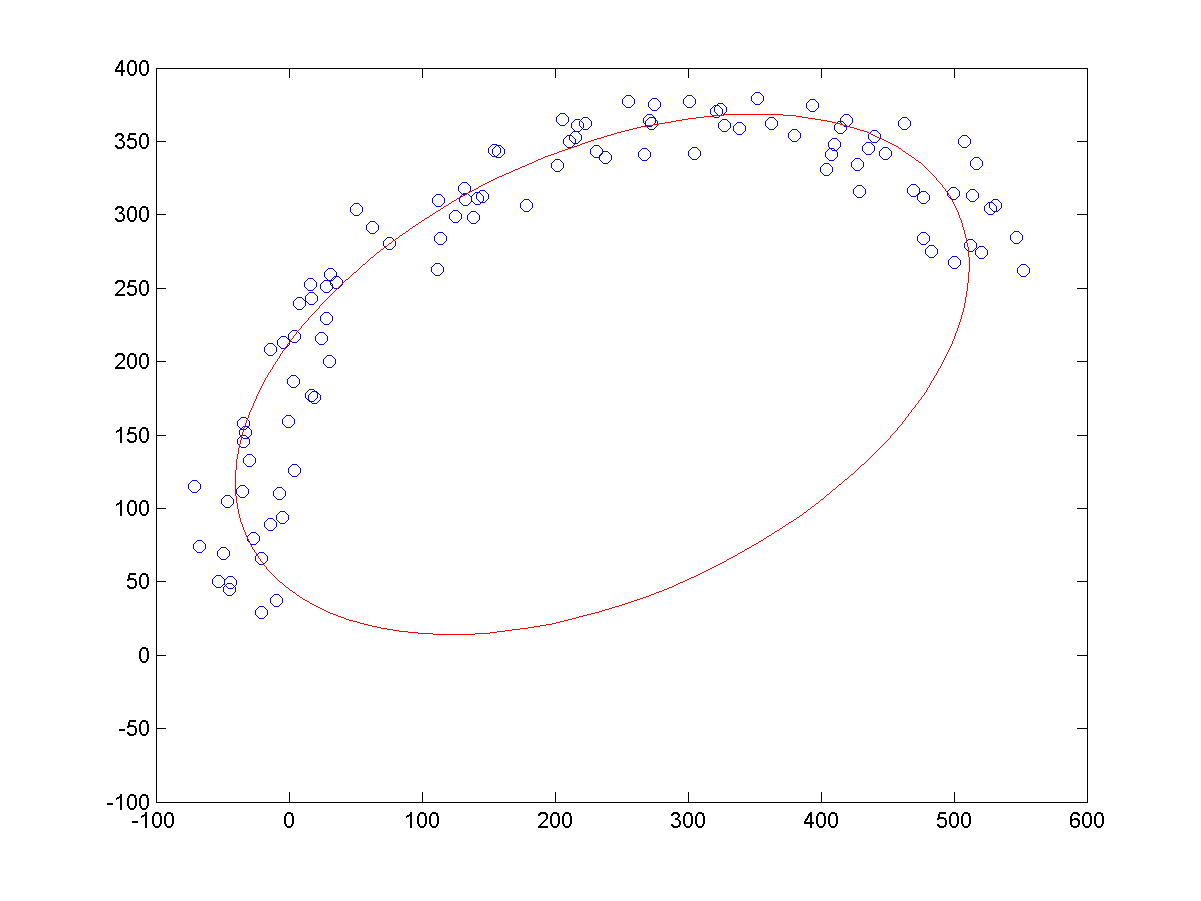

c、少样本点下,拟合结果如下:
源码下载:
地址: FitEllipse
参考文献:
[1]. Andrew W. Fitzgibbon, Maurizio Pilu and Robert B. Fisher. Direct Least Squares Fitting of Ellipses. 1996.
[2]. http://research.microsoft.com/en-us/um/people/awf/ellipse/
基于直接最小二乘的椭圆拟合(Direct Least Squares Fitting of Ellipses)的更多相关文章
- 基于MATLAB的多项式数据拟合方法研究-毕业论文
摘要:本论文先介绍了多项式数据拟合的相关背景,以及对整个课题做了一个完整的认识.接下来对拟合模型,多项式数学原理进行了详细的讲解,通过对文献的阅读以及自己的知识积累对原理有了一个系统的认识.介绍多项式 ...
- opencv学习之路(27)、轮廓查找与绘制(六)——外接圆、椭圆拟合、逼近多边形曲线、计算轮廓面积及长度、提取不规则轮廓
一.最小外接圆 #include "opencv2/opencv.hpp" #include<iostream> using namespace std; using ...
- 【Matlab&Mathematica】对三维空间上的点进行椭圆拟合
问题是这样:比如有一个地心惯性系的轨道,然后从轨道上取了几个点,问能不能根据这几个点把轨道还原了? 当然,如果知道轨道这几个点的速度的情况下,根据轨道六根数也是能计算轨道的,不过真近点角是随时间变动的 ...
- 基于EM的多直线拟合
作者:桂. 时间:2017-03-22 06:13:50 链接:http://www.cnblogs.com/xingshansi/p/6597796.html 声明:欢迎被转载,不过记得注明出处哦 ...
- 基于EM的多直线拟合实现及思考
作者:桂. 时间:2017-03-22 06:13:50 链接:http://www.cnblogs.com/xingshansi/p/6597796.html 声明:欢迎被转载,不过记得注明出处哦 ...
- Dlib Opencv cv2.fitEllipse用于人眼轮廓椭圆拟合
dlib库的安装以及人脸特征点的识别分布分别在前两篇博文里面 Dlib Python 检测人脸特征点 Face Landmark Detection Mac OSX下安装dlib (Python) 这 ...
- 6、基于highcharts实现的线性拟合,计算部分在java中实现,画的是正态概率图
1.坐标点类 package cn.test.domain; public class Point { double x; double y; public Point(){ } public Poi ...
- C# + Matlab 实现计件工时基于三层BP神经网络的拟合--真实项目
工序工时由该工序的工艺参数决定,有了工时后乘以固定因子就是计件工资.一般参考本地小时工资以及同类小时工资并考虑作业的风险等因素给出固定因子 采用的VS2010 , Matlab2015a 64, 开 ...
- 【翻译】拟合与高斯分布 [Curve fitting and the Gaussian distribution]
参考与前言 英文原版 Original English Version:https://fabiandablander.com/r/Curve-Fitting-Gaussian.html 如何通俗易懂 ...
随机推荐
- C 数据结构堆
引言 - 数据结构堆 堆结构都很耳熟, 从堆排序到优先级队列, 我们总会看见它的身影. 相关的资料太多了, 堆 - https://zh.wikipedia.org/wiki/%E5%A0%86%E7 ...
- servlet Filter过滤javascript
新建HttpServletRequestWrapper子类XssHttpServletRequestWrapper import javax.servlet.http.HttpServletReque ...
- 12 Release History for go go语言的版本历史
Release History Release Policy go1.11 (released 2018/08/24) go1.10 (released 2018/02/16) Minor revis ...
- GBDT+LR simple例子
卧槽,本来猜GBDT获取的组合特征,需要自己去解析GBDT的树,scikit learn里面竟然直接调用apply函数就可以了 # 弱分类器的数目 n_estimator = 10 # 随机生成分类数 ...
- 1.SpringBoot之Helloword 快速搭建一个web项目
背景: Spring Boot是由Pivotal团队提供的全新框架,其设计目的是用来简化新Spring应用的初始搭建以及开发过程.该框架使用了特定的方式来进行配置,从而使开发人员不再需要定义样板化的配 ...
- python+selenium第一步 - 环境搭建
刚开始学习一门技术,肯定是要从环境搭建开始的,我也不例外. 首先选择需要安装的版本,我使用的是mac自带的2.7版本. selenium2,和火狐浏览器 为求稳定不会出现未知问题,我选择了seleni ...
- 一步步教你编写不可维护的 PHP 代码
译者注:这是一篇很棒文章,使用有趣的叙述方式,从反面讲解了作为一个优秀的 PHP 工程师,有哪些事情是你不能做的.请注意哦,此篇文章罗列的行为,都是你要尽量避免的. 随着失业率越来越高,很多人意识到保 ...
- CF401D 【Roman and Numbers】
题意将n(n<=10^18)的各位数字重新排列(不允许有前导零) 求 可以构造几个mod m等于0的数字解法状压f[S][k] 表示选用的位数集合为S,mod m 为k的方案数注意不能有前导 ...
- hdu 5131 (2014广州现场赛 E题)
题意:对给出的好汉按杀敌数从大到小排序,若相等,按字典序排.M个询问,询问名字输出对应的主排名和次排名.(排序之后)主排名是在该名字前比他杀敌数多的人的个数加1,次排名是该名字前和他杀敌数相等的人的个 ...
- CentOS7.6安装rime輸入法
# solve dependencyyum install -y gcc gcc-c++ boost boost-devel cmake make cmake3yum install glog glo ...