
ML.NET 示例:回归之价格预测
写在前面
准备近期将微软的machinelearning-samples翻译成中文,水平有限,如有错漏,请大家多多指正。
如果有朋友对此感兴趣,可以加入我:https://github.com/feiyun0112/machinelearning-samples.zh-cn
出租车费预测
| ML.NET 版本 | API 类型 | 状态 | 应用程序类型 | 数据类型 | 场景 | 机器学习任务 | 算法 |
|---|---|---|---|---|---|---|---|
| v0.7 | 动态 API | 最新版本 | 控制台应用程序 | .csv 文件 | 价格预测 | 回归 | Sdca 回归 |
在这个介绍性示例中,您将看到如何使用ML.NET预测出租车费。在机器学习领域,这种类型的预测被称为回归
问题
这个问题主要集中在预测纽约出租车的行程费用。从表面看,它似乎仅仅取决于行程的距离。但是,由于其他因素(比如额外的乘客或使用信用卡而非现金付款),纽约的出租车供应商收费不同。这种预测可用于出租车供应商向用户和司机提供乘车费用的估计。
为了解决这个问题,我们将使用下列输入建立一个ML模型:
- 供应商ID
- 费率代码
- 乘客数量
- 出行时间
- 出行距离
- 支付方式
并预测乘车的费用。
ML 任务 - 回归
回归的广义问题是预测给定参数的某些连续值,例如:
- 根据房间的数量、位置、建造年份等预测房子的价格。
- 根据燃油类型和汽车参数预测汽车燃油消耗量。
- 预测基于问题属性来修复问题的时间估计。
所有这些示例的共同特征是我们想要预测的参数可以取特定范围内的任何数值。 换句话说,这个值用integer或float/double表示,而不是由enum或boolean类型表示。
解决方案
为了解决这个问题,首先我们将建立一个ML模型。然后,我们将在现有数据的基础上训练模型,评估其有多好,最后我们将使用该模型来预测出租车费。

1. 建立模型
建立模型包括:上传数据(使用TextLoader加载taxi-fare-train.csv),对数据进行转换,以便ML算法(本例中为“StochasticDualCoordinateAscent”)能够有效地使用它:
//Create ML Context with seed for repeteable/deterministic results

MLContext mlContext = new MLContext(seed: 0);

// STEP 1: Common data loading configuration

TextLoader textLoader = mlContext.Data.TextReader(new TextLoader.Arguments()

                                {

                                    Separator = ",",

                                    HasHeader = true,

                                    Column = new[]

                                                {

                                                    new TextLoader.Column("VendorId", DataKind.Text, 0),

                                                    new TextLoader.Column("RateCode", DataKind.Text, 1),

                                                    new TextLoader.Column("PassengerCount", DataKind.R4, 2),

                                                    new TextLoader.Column("TripTime", DataKind.R4, 3),

                                                    new TextLoader.Column("TripDistance", DataKind.R4, 4),

                                                    new TextLoader.Column("PaymentType", DataKind.Text, 5),

                                                    new TextLoader.Column("FareAmount", DataKind.R4, 6)

                                                }

                                });

IDataView baseTrainingDataView = textLoader.Read(TrainDataPath);

IDataView testDataView = textLoader.Read(TestDataPath);

//Sample code of removing extreme data like "outliers" for FareAmounts higher than $150 and lower than $1 which can be error-data

var cnt = baseTrainingDataView.GetColumn<float>(mlContext, "FareAmount").Count();

IDataView trainingDataView = mlContext.Data.FilterByColumn(baseTrainingDataView, "FareAmount", lowerBound: 1, upperBound: 150);

var cnt2 = trainingDataView.GetColumn<float>(mlContext, "FareAmount").Count();

// STEP 2: Common data process configuration with pipeline data transformations

var dataProcessPipeline = mlContext.Transforms.CopyColumns("FareAmount", "Label")

                .Append(mlContext.Transforms.Categorical.OneHotEncoding("VendorId", "VendorIdEncoded"))

                .Append(mlContext.Transforms.Categorical.OneHotEncoding("RateCode", "RateCodeEncoded"))

                .Append(mlContext.Transforms.Categorical.OneHotEncoding("PaymentType", "PaymentTypeEncoded"))

                .Append(mlContext.Transforms.Normalize(inputName: "PassengerCount", mode: NormalizerMode.MeanVariance))

                .Append(mlContext.Transforms.Normalize(inputName: "TripTime", mode: NormalizerMode.MeanVariance))

                .Append(mlContext.Transforms.Normalize(inputName: "TripDistance", mode: NormalizerMode.MeanVariance))

                .Append(mlContext.Transforms.Concatenate("Features", "VendorIdEncoded", "RateCodeEncoded", "PaymentTypeEncoded", "PassengerCount", "TripTime", "TripDistance"));

// STEP 3: Set the training algorithm, then create and config the modelBuilder - Selected Trainer (SDCA 回归 algorithm)

var trainer = mlContext.Regression.Trainers.StochasticDualCoordinateAscent(labelColumn: "Label", featureColumn: "Features");

var trainingPipeline = dataProcessPipeline.Append(trainer);
2. 训练模型
训练模型是在训练数据(具有已知的费用)上运行所选算法以调整模型参数的过程。 它在Fit()API中实现。 要执行训练,我们只需在提供DataView时调用该方法。
var trainedModel = trainingPipeline.Fit(trainingDataView);
3. 评估模型
我们需要这一步来总结我们的模型对新数据的准确性。 为此,上一步中的模型针对另一个未在训练中使用的数据集运行(taxi-fare-test.csv)。 此数据集也包含已知的费用。 Regression.Evaluate()计算已知费用和模型预测的费用之间差异的各种指标。
IDataView predictions = trainedModel.Transform(testDataView);

var metrics = mlContext.Regression.Evaluate(predictions, label: "Label", score: "Score");

Common.ConsoleHelper.PrintRegressionMetrics(trainer.ToString(), metrics);
要了解有关如何理解指标的更多信息,请查看ML.NET指南中的机器学习词汇表或使用任何有关数据科学和机器学习的材料。
如果您对模型的质量不满意,可以采用多种方法对其进行改进,这些方法将在examples类别中介绍。
请记住,对于这个示例,其质量低于可能达到的水平,因为出于性能目的,数据集的大小已减小。您可以使用原始数据集来显著提高质量(原始数据集在数据集README中引用)。
4. 使用模型
在训练模型之后,我们可以使用Predict() API来预测指定行程的费用。
//Sample:

//vendor_id,rate_code,passenger_count,trip_time_in_secs,trip_distance,payment_type,fare_amount

//VTS,1,1,1140,3.75,CRD,15.5

var taxiTripSample = new TaxiTrip()

{

    VendorId = "VTS",

    RateCode = "1",

    PassengerCount = 1,

    TripTime = 1140,

    TripDistance = 3.75f,

    PaymentType = "CRD",

    FareAmount = 0 // To predict. Actual/Observed = 15.5

};

ITransformer trainedModel;

using (var stream = new FileStream(ModelPath, FileMode.Open, FileAccess.Read, FileShare.Read))

{

    trainedModel = mlContext.Model.Load(stream);

}

// Create prediction engine related to the loaded trained model

var predFunction = trainedModel.MakePredictionFunction<TaxiTrip, TaxiTripFarePrediction>(mlContext);

//Score

var resultprediction = predFunction.Predict(taxiTripSample);

Console.WriteLine($"**********************************************************************");

Console.WriteLine($"Predicted fare: {resultprediction.FareAmount:0.####}, actual fare: 15.5");

Console.WriteLine($"**********************************************************************");
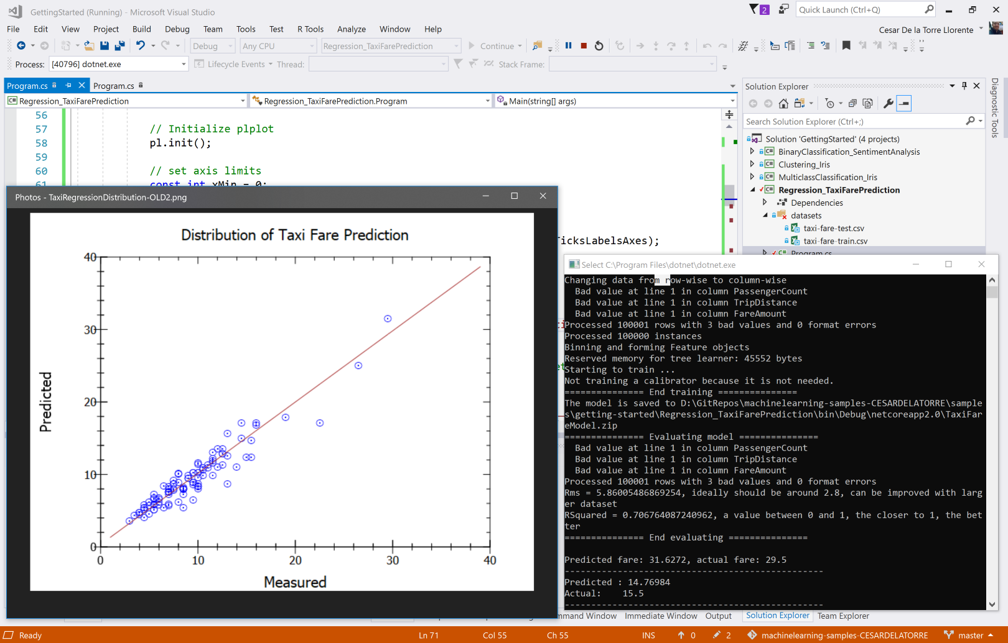
最后,您可以用方法PlotRegressionChart()在图表中展现测试预测的分布情况以及回归的执行方式,如下面的屏幕截图所示:
ML.NET 示例:回归之价格预测的更多相关文章
- ML.NET 示例:回归之销售预测
写在前面 准备近期将微软的machinelearning-samples翻译成中文,水平有限,如有错漏,请大家多多指正. 如果有朋友对此感兴趣,可以加入我:https://github.com/fei ...
- ML.NET 示例:开篇
写在前面 准备近期将微软的machinelearning-samples翻译成中文,水平有限,如有错漏,请大家多多指正. 如果有朋友对此感兴趣,可以加入我:https://github.com/fei ...
- ML.NET 示例:目录
ML.NET 示例中文版:https://github.com/feiyun0112/machinelearning-samples.zh-cn 英文原版请访问:https://github.com/ ...
- 二手车价格预测 | 构建AI模型并部署Web应用 ⛵
作者:韩信子@ShowMeAI 数据分析实战系列:https://www.showmeai.tech/tutorials/40 机器学习实战系列:https://www.showmeai.tech/t ...
- TensorFlow-Bitcoin-Robot:一个基于 TensorFlow LSTM 模型的 Bitcoin 价格预测机器人
简介 TensorFlow-Bitcoin-Robot:一个基于 TensorFlow LSTM 模型的 Bitcoin 价格预测机器人. 文章包括一下几个部分: 1.为什么要尝试做这个项目? 2.为 ...
- Python之逻辑回归模型来预测
建立一个逻辑回归模型来预测一个学生是否被录取. import numpy as np import pandas as pd import matplotlib.pyplot as plt impor ...
- TensorFlow-Bitcoin-Robot:一个基于 TensorFlow LSTM 模型的 Bitcoin 价格预测机器人。
简介 TensorFlow-Bitcoin-Robot:一个基于 TensorFlow LSTM 模型的 Bitcoin 价格预测机器人. 文章包括一下几个部分: 1.为什么要尝试做这个项目? 2.为 ...
- ML.NET教程之出租车车费预测(回归问题)
理解问题 出租车的车费不仅与距离有关,还涉及乘客数量,是否使用信用卡等因素(这是的出租车是指纽约市的).所以并不是一个简单的一元方程问题. 准备数据 建立一控制台应用程序工程,新建Data文件夹,在其 ...
- ML.NET 示例:聚类之客户细分
写在前面 准备近期将微软的machinelearning-samples翻译成中文,水平有限,如有错漏,请大家多多指正. 如果有朋友对此感兴趣,可以加入我:https://github.com/fei ...
随机推荐
- SQL学习总结-思维导图
- IPD咨询如何才能真正落地?
文/资深顾问 杨学明 IPD作为先进的产品开发理念,思想起源于PRTM公司,PACE,培思的力量,首先在IBM和波音公司迅速完善,中国是深圳华为公司. 1992年IBM公司利润停止增长,财务困难,IB ...
- Python之__new__方法
# -*- coding: utf-8 -*- """ Created on Sun Dec 2 11:03:03 2018 Python类构造过程 @author: z ...
- [20190306]奇怪的查询结果.txt
[20190306]奇怪的查询结果.txt--//链接http://www.itpub.net/thread-2108588-1-1.html提到一个非常古怪的问题,我自己重复测试看看:1.环境:SC ...
- [20170612]FOR ALL COLUMNS SIZE repeat(11g).txt
[20170612]FOR ALL COLUMNS SIZE repeat(11g).txt --//昨天看了https://jonathanlewis.wordpress.com/2017/06/0 ...
- AFURLSessionManager 上传下载使用
1.下载 Creating a Download Task NSURLSessionConfiguration *configuration = [NSURLSessionConfiguration ...
- Windows Server 2016-Active Directory复制概念(二)
本章继续补充有关Active Directory复制概念,具体内容如下: 连接对象: 连接对象是一个Active Directory对象,表示从源域控制器到目标域控制器的复制连接.域控制器是单个站点的 ...
- python创建列表和向列表添加元素方法
今天的学习内容是python中的列表的相关内容. 一.创建列表 1.创建一个普通列表 >>> tabulation1 = ['大圣','天蓬','卷帘'] >>> ...
- Apache中httpd.conf文件的详解
PHP中,Apache的配置至关重要,特别是httpd.conf这个文件,它是Apache中的核心文件.好了,废话不说,今天将这个文件中的一些内容讲解一番. ServerRoot "d:/w ...
- MySql 中文写入数据库乱码及Incorrect string value: '\xF0\x9F...' for column 'XXX' at row 1解决
一.中文写入乱码问题 我输入的中文编码是 urf8 的,建的库是 urf8 的,但是插入MySQL总是乱码,一堆"???????????????????????".可以使用以下的方 ...