
A_B_Good Bye 2018_cf
1 second
256 megabytes
standard input
standard output
Alice and Bob are decorating a Christmas Tree.
Alice wants only 33 types of ornaments to be used on the Christmas Tree: yellow, blue and red. They have yy yellow ornaments, bb blue ornaments and rr red ornaments.
In Bob's opinion, a Christmas Tree will be beautiful if:
- the number of blue ornaments used is greater by exactly 11 than the number of yellow ornaments, and
- the number of red ornaments used is greater by exactly 11 than the number of blue ornaments.
That is, if they have 88 yellow ornaments, 1313 blue ornaments and 99 red ornaments, we can choose 44 yellow, 55 blue and 66 red ornaments (5=4+15=4+1 and 6=5+16=5+1).
Alice wants to choose as many ornaments as possible, but she also wants the Christmas Tree to be beautiful according to Bob's opinion.
In the example two paragraphs above, we would choose 77 yellow, 88 blue and 99 red ornaments. If we do it, we will use 7+8+9=247+8+9=24ornaments. That is the maximum number.
Since Alice and Bob are busy with preparing food to the New Year's Eve, they are asking you to find out the maximum number of ornaments that can be used in their beautiful Christmas Tree!
It is guaranteed that it is possible to choose at least 66 (1+2+3=61+2+3=6) ornaments.
The only line contains three integers yy, bb, rr (1≤y≤1001≤y≤100, 2≤b≤1002≤b≤100, 3≤r≤1003≤r≤100) — the number of yellow, blue and red ornaments.
It is guaranteed that it is possible to choose at least 66 (1+2+3=61+2+3=6) ornaments.
Print one number — the maximum number of ornaments that can be used.
8 13 9
24
13 3 6
9
In the first example, the answer is 7+8+9=247+8+9=24.
In the second example, the answer is 2+3+4=92+3+4=9.
我的代码:
#include <iostream>

using namespace std;

int main()

{

    int y,b,r;

    while(cin>>y>>b>>r){

        for(int i=r;i>=;i--){

            if(b>=(i-)&&y>=(i-)){

                cout<<i+i-+i-<<endl;

                break;

            }

        }

    }

    return ;

}
大佬的代码:
/**

 *    author:  tourist

 *    created: 30.12.2018 17:35:22

**/

#include <bits/stdc++.h>

using namespace std;

int main() {

  ios::sync_with_stdio(false);

  cin.tie();

  int a, b, c;

  cin >> a >> b >> c;

  int x = min(b, min(a + , c - ));

  cout <<  * x << '\n';

  return ;

}
1.5 seconds
256 megabytes
standard input
standard output
Bob is a pirate looking for the greatest treasure the world has ever seen. The treasure is located at the point TT, which coordinates to be found out.
Bob travelled around the world and collected clues of the treasure location at nn obelisks. These clues were in an ancient language, and he has only decrypted them at home. Since he does not know which clue belongs to which obelisk, finding the treasure might pose a challenge. Can you help him?
As everyone knows, the world is a two-dimensional plane. The ii-th obelisk is at integer coordinates (xi,yi)(xi,yi). The jj-th clue consists of 22integers (aj,bj)(aj,bj) and belongs to the obelisk pjpj, where pp is some (unknown) permutation on nn elements. It means that the treasure is located at T=(xpj+aj,ypj+bj)T=(xpj+aj,ypj+bj). This point TT is the same for all clues.
In other words, each clue belongs to exactly one of the obelisks, and each obelisk has exactly one clue that belongs to it. A clue represents the vector from the obelisk to the treasure. The clues must be distributed among the obelisks in such a way that they all point to the same position of the treasure.
Your task is to find the coordinates of the treasure. If there are multiple solutions, you may print any of them.
Note that you don't need to find the permutation. Permutations are used only in order to explain the problem.
The first line contains an integer nn (1≤n≤10001≤n≤1000) — the number of obelisks, that is also equal to the number of clues.
Each of the next nn lines contains two integers xixi, yiyi (−106≤xi,yi≤106−106≤xi,yi≤106) — the coordinates of the ii-th obelisk. All coordinates are distinct, that is xi≠xjxi≠xj or yi≠yjyi≠yj will be satisfied for every (i,j)(i,j) such that i≠ji≠j.
Each of the next nn lines contains two integers aiai, bibi (−2⋅106≤ai,bi≤2⋅106−2⋅106≤ai,bi≤2⋅106) — the direction of the ii-th clue. All coordinates are distinct, that is ai≠ajai≠aj or bi≠bjbi≠bj will be satisfied for every (i,j)(i,j) such that i≠ji≠j.
It is guaranteed that there exists a permutation pp, such that for all i,ji,j it holds (xpi+ai,ypi+bi)=(xpj+aj,ypj+bj)(xpi+ai,ypi+bi)=(xpj+aj,ypj+bj).
Output a single line containing two integers Tx,TyTx,Ty — the coordinates of the treasure.
If there are multiple answers, you may print any of them.
2

2 5

-6 4

7 -2

-1 -3
1 2
4

2 2

8 2

-7 0

-2 6

1 -14

16 -12

11 -18

7 -14
9 -12
As n=2n=2, we can consider all permutations on two elements.
If p=[1,2]p=[1,2], then the obelisk (2,5)(2,5) holds the clue (7,−2)(7,−2), which means that the treasure is hidden at (9,3)(9,3). The second obelisk (−6,4)(−6,4) would give the clue (−1,−3)(−1,−3) and the treasure at (−7,1)(−7,1). However, both obelisks must give the same location, hence this is clearly not the correct permutation.
If the hidden permutation is [2,1][2,1], then the first clue belongs to the second obelisk and the second clue belongs to the first obelisk. Hence (−6,4)+(7,−2)=(2,5)+(−1,−3)=(1,2)(−6,4)+(7,−2)=(2,5)+(−1,−3)=(1,2), so T=(1,2)T=(1,2) is the location of the treasure.
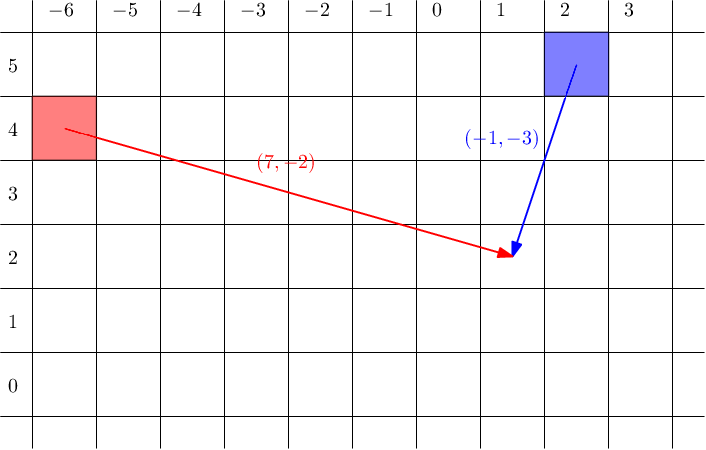
In the second sample, the hidden permutation is [2,3,4,1][2,3,4,1].
我的代码,当然没通过了...在第33组数据超时了.
#include <iostream>

#include <map>

#include <string>

#include <sstream>

#include <cstdio>

using namespace std;

map<string,int> m1;

int obe[][];

int main()

{

    int n,x,y,a,b;

    int resx,resy;

    cin>>n;

    for(int i=;i<n;i++){

        cin>>obe[i][]>>obe[i][];

    }

    int t1,t2;std::stringstream ss;

    for(int i=;i<n;i++){

        //scanf("%d %d",&t1,&t2);

        cin>>t1>>t2;

        int newx,newy;

        for(int j=;j<n;j++){

            newx=obe[j][]+t1;

            newy=obe[j][]+t2;

            string tmp1,tmp2;

            ss.clear();

            ss<<newx;

            ss>>tmp1;

            ss.clear();

            ss<<newy;

            ss>>tmp2;

            tmp1=tmp1+",";

            tmp1=tmp1+tmp2;

            //cout<<tmp1;

            m1[tmp1]++;

        }

    }

    map<string,int>::iterator aa=m1.begin();

    for(;aa!=m1.end();aa++){

        if(aa->second==n){

            string tmp=aa->first;

            int i;

            for(i=;tmp[i]!=',';i++){

                cout<<tmp[i];

            }

            printf(" ");

            for(i++;i<tmp.size();i++){

                //printf("%c",tmp[i]);

                cout<<tmp[i];

            }

            cout<<endl;

            break;

        }

    }

    return ;

}
hencuo Code
还是看一下tourist的吧.
题意是n个起点,有n个向量,有个一一对应的关系使每个起点加上一个向量之后是同一个点,让输出那个点的坐标.
所以这些每个起点+向量都是得到相同的坐标,然后把这每个值再加起来就是坐标的n倍啊!
再就是我的基本操作都不会啊,连个int和string 的相互转换都不会...
/**

 *    author:  tourist

 *    created: 30.12.2018 17:36:58

**/

#include <bits/stdc++.h>

using namespace std;

int main() {

  ios::sync_with_stdio(false);

  cin.tie();

  int n;

  cin >> n;

  long long x = , y = ;

  for (int i = ; i <  * n; i++) {

    int xx, yy;

    cin >> xx >> yy;

    x += xx;

    y += yy;

  }

  cout << (x / n) << " " << (y / n) << '\n';

  return ;

}
拖哥的代码中有两句看不懂的:
ios::sync_with_stdio(false);
cin.tie(0);
原来c++为了兼容c中的stdin stdout,防止混用cin scanf时出现问题,将输入输入流跟他们绑定到一块,然后就导致c++的cin cout速度慢了,
这两句代码可以解除两者的同步和cin与cout的绑定,加上之后再用cin cout 就与scanf printf的速度没什么差别了.
也有人对此做过测试https://www.byvoid.com/zhs/blog/fast-readfile.
(我的代码方法太挫了,加上这个仍然超时...)
A_B_Good Bye 2018_cf的更多相关文章
- Good Bye 2013 A
A. New Year Candles time limit per test 1 second memory limit per test 256 megabytes input standard ...
- codeforces Gym 100500 J. Bye Bye Russia
Problem J. Bye Bye RussiaTime Limit: 20 Sec Memory Limit: 256 MB 题目连接 http://codeforces.com/gym/1005 ...
- Good Bye 2018
Good Bye 2018 2018年最后一场CF,OVER! 弱弱的我只能做出3道A,B,D~~~~ 最后几分钟,感觉找到了C题的规律,结束的那一刻,提交了一发 "Wrong answer ...
- Good Bye 2018 (A~F, H)
目录 Codeforces 1091 A.New Year and the Christmas Ornament B.New Year and the Treasure Geolocation C.N ...
- English Voice of <<Bye Bye Bye>>
Bye Bye Bye - Lovestoned When i see you, looking back at me 当我看到你回首看我时 Watching this eye still 彼此凝视 ...
- Good Bye 2017(送命场)
9815人数场,9500+围观神仙打架...断断续续打Codeforces也快有一年啦,第一次打Good Bye场,满怀前排膜tourist的心愿参加了这场送命场,虽然没看到tourist.不过还是得 ...
- [T-ARA][Bye Bye]
歌词来源:http://music.163.com/#/song?id=22704472 사랑하는 그대 Bye Bye, Bye Bye, Bye Bye, [sa-lang-ha-neun geu ...
- Codeforces Good Bye 2018
咕bye 2018,因为我这场又咕咕咕了 无谓地感慨一句:时间过得真快啊(有毒 A.New Year and the Christmas Ornament 分类讨论后等差数列求和 又在凑字数了 #in ...
- codeforces Good bye 2016 E 线段树维护dp区间合并
codeforces Good bye 2016 E 线段树维护dp区间合并 题目大意:给你一个字符串,范围为‘0’~'9',定义一个ugly的串,即串中的子串不能有2016,但是一定要有2017,问 ...
随机推荐
- [Kubernetes]资源模型与资源管理
作为 Kubernetes 的资源管理与调度部分的基础,需要从它的资源模型说起. 资源管理模型的设计 我们知道,在 Kubernetes 里面, Pod 是最小的原子调度单位,这就意味着,所有和调度和 ...
- Node Graph ......
以前写过好多次,但是都没写完....主要是节点树的执行过程.这次打算好好写完. 这次目的是写一个 类似houdini sop下的 管理过程 目的是把大量流程中的杂乱比如后台处理,Arnold-> ...
- UGUI打字机效果文本组件
using System.Collections; using System.Collections.Generic; using UnityEngine; using UnityEngine.UI; ...
- 关于element-ui表单验证(自定义验证规则)
<el-form :model="ruleForm" :rules="rules" ref="ruleForm" label-widt ...
- 算法工程师<机器学习基础>
<机器学习基础> 逻辑回归,SVM,决策树 1.逻辑回归和SVM的区别是什么?各适用于解决什么问题? https://www.zhihu.com/question/24904422 2.L ...
- SpringBoot 动态切换多数据源
1. 配置文件application-dev.properties 2. 动态切换数据源核心 A. 数据源注册器 B. 动态数据源适配器 C. 自定义注解 D. 动态数据源切面 E. 数据源路 ...
- plsql developer 中文乱码(???)解决办法
添加环境变量 变量名称: NLS_LANG 内容: SIMPLIFIED CHINESE_CHINA.ZHS16GBK 再次新插入的数据就不会乱码了
- PHP实现多维数组按指定值排序
主要用到的PHP函数 array_multisort() .先实现指定多维数组一个字段排序 根据二维数组的id值来排序,转换后的数组格式如下: function arraySortByOneField ...
- pojo,javabean与entitybean
pojo:朴实无华的实体类 javabean:遵守某些规范的可重用的实体类 entitybean:与数据库中的数据记录对应的类 这个链接说的很明白!https://blog.csdn.net/chen ...
- Motrix for Mac(百度网盘加速/全能下载软件) v1.3.7最新版!
Motrix for Mac最新版第一时间在本站上线!Mac上最强大实用百度网盘加速器Motrix for Mac分享给您!Motrix for Mac是一款非常优秀的下载工具,采用Aria 2作为核 ...