
A million requests per second with Python
https://medium.freecodecamp.com/million-requests-per-second-with-Python-95c137af319
Is it possible to hit a million requests per second with python? Probably not until recently.
A lot of companies are migrating away from Python and to other programming languages so that they can boost their operation performance and save on server prices, but there’s no need really. Python can be right tool for the job.
The Python community is doing a lot of around performance lately. CPython 3.6 boosted overall interpreter performance with new dictionary implementation. CPython 3.7 is going to be even faster, thanks to the introduction of faster call convention and dictionary lookup caches.
For number crunching tasks you can use PyPy with its just-in-time code compilation. You can also run NumPy’s test suite, which now has improved overall compatibility with C extensions. Later this year PyPy is expected to reach Python 3.5 conformance.
All this great work inspired me to innovate in one of the areas where Python is used extensively: web and micro-service development.
Enter Japronto!
Japronto is a brand new micro-framework tailored for your micro-services needs. Its main goals include being fast, scalable, and lightweight. It lets you do both synchronous and asynchronous programming thanks to asyncio. And it’s shamelessly fast. Even faster than NodeJS and Go.
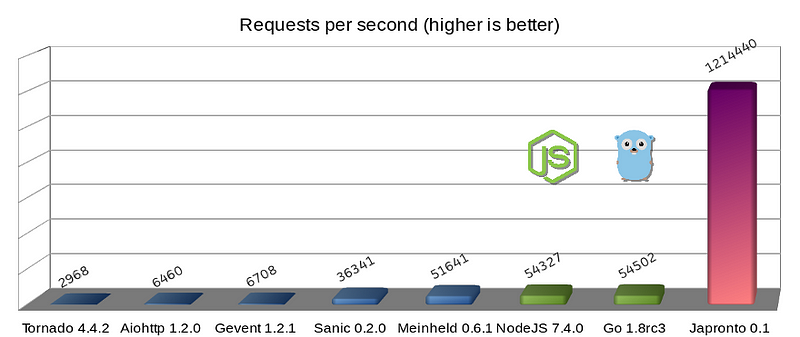
Python micro-frameworks (blue), Dark side of force (green) and Japronto (purple)
Errata: As user @heppu points out, go’s stdlib HTTP server can be 12% faster than this graph shows when written more carefully. Also there’s an awesome fasthttp server for Go that apparently is only 18% slower than Japronto in this particular benchmark. Awesome! For details see https://github.com/squeaky-pl/japronto/pull/12 and https://github.com/squeaky-pl/japronto/pull/14.
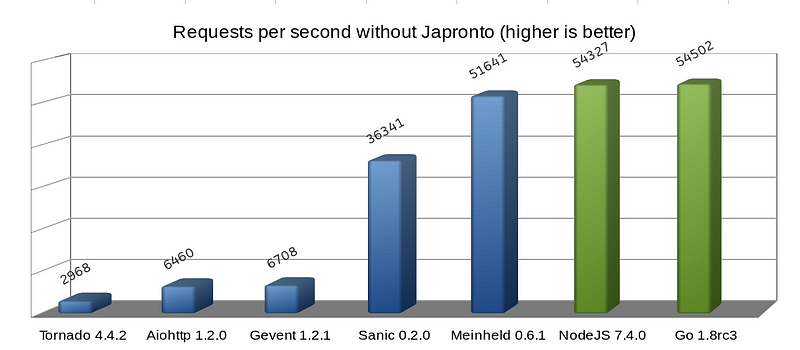
We can also see that Meinheld WSGI server is almost on par with NodeJS and Go. Despite of its inherently blocking design, it is a great performer compared to the preceding four, which are asynchronous Python solutions. So never trust anyone who says that asynchronous systems are always speedier. They are almost always more concurrent, but there’s much more to it than just that.
I performed this micro benchmark using a “Hello world!” application, but it clearly demonstrates server-framework overhead for a number of solutions.
These results were obtained on an AWS c4.2xlarge instance that had 8 VCPUs, launched in São Paulo region with default shared tenancy and HVM virtualization and magnetic storage. The machine was running Ubuntu 16.04.1 LTS (Xenial Xerus) with the Linux 4.4.0–53-generic x86_64 kernel. The OS was reporting Xeon® CPU E5–2666 v3 @ 2.90GHz CPU. I used Python 3.6, which I freshly compiled from its source code.
To be fair, all the contestants (including Go) were running a single-worker process. Servers were load tested using wrk with 1 thread, 100 connections, and 24 simultaneous (pipelined) requests per connection (cumulative parallelism of 2400 requests).
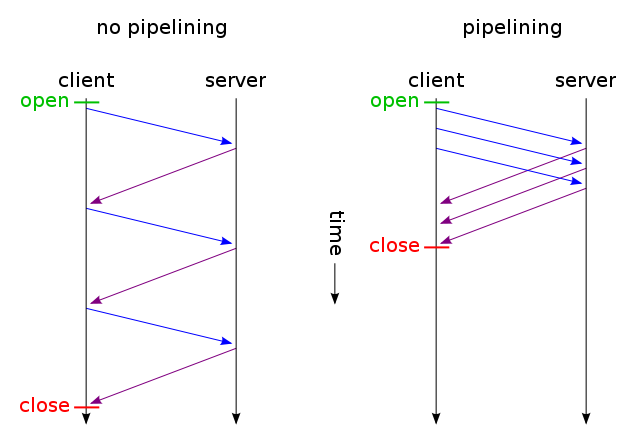
HTTP pipelining (image credit Wikipedia)
HTTP pipelining is crucial here since it’s one of the optimizations that Japronto takes into account when executing requests.
Most of the servers execute requests from pipelining clients in the same fashion they would from non-pipelining clients. They don’t try to optimize it. (In fact Sanic and Meinheld will also silently drop requests from pipelining clients, which is a violation of HTTP 1.1 protocol.)
In simple words, pipelining is a technique in which the client doesn’t need to wait for the response before sending subsequent requests over the same TCP connection. To ensure integrity of the communication, the server sends back several responses in the same order requests are received.
The gory details of optimizations
When many small GET requests are pipelined together by the client, there’s a high probability that they’ll arrive in one TCP packet (thanks to Nagle’s algorithm) on the server side, then be read back by one system call.
Doing a system call and moving data from kernel-space to user-space is a very expensive operation compared to, say, moving memory inside process space. That’s why doing it’s important to perform as few as necessary system calls (but no less).
When Japronto receives data and successfully parses several requests out of it, it tries to execute all the requests as fast as possible, glue responses back in correct order, then write back in one system call. In fact the kernel can aid in the gluing part, thanks to scatter/gather IO system calls, which Japronto doesn’t use yet.
Note that this isn’t always possible, since some of the requests could take too long, and waiting for them would needlessly increase latency.
Take care when you tune heuristics, and consider the cost of system calls and the expected request completion time.

Japronto gives a 1,214,440 RPS median of grouped continuous data, calculated as the 50th percentile, using interpolation.
Besides delaying writes for pipelined clients, there are several other techniques that the code employs.
Japronto is written almost entirely in C. The parser, protocol, connection reaper, router, request, and response objects are written as C extensions.
Japronto tries hard to delay creation of Python counterparts of its internal structures until asked explicitly. For example, a headers dictionary won’t be created until it’s requested in a view. All the token boundaries are already marked before but normalization of header keys, and creation of several str objects is done when they’re accessed for the first time.
Japronto relies on the excellent picohttpparser C library for parsing status line, headers, and a chunked HTTP message body. Picohttpparser directly employs text processing instructions found in modern CPUs with SSE4.2 extensions (almost any 10-year-old x86_64 CPU has it) to quickly match boundaries of HTTP tokens. The I/O is handled by the super awesome uvloop, which itself is a wrapper around libuv. At the lowest level, this is a bridge to epoll system call providing asynchronous notifications on read-write readiness.
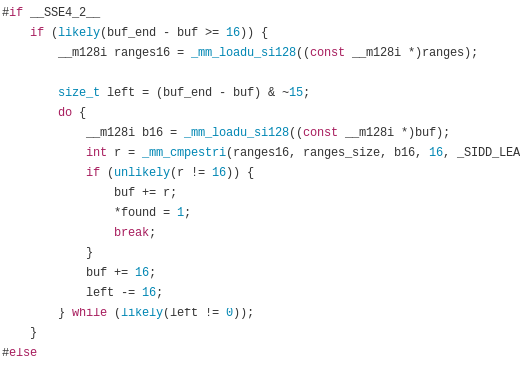
Picohttpparser relies on SSE4.2 and CMPESTRI x86_64 intrinsic to do parsing
Python is a garbage collected language, so care needs to be taken when designing high performance systems so as not to needlessly increase pressure on the garbage collector. The internal design of Japronto tries to avoid reference cycles and do as few allocations/deallocations as necessary. It does this by preallocating some objects into so-called arenas. It also tries to reuse Python objects for future requests if they’re no longer referenced instead of throwing them away.
All the allocations are done as multiples of 4KB. Internal structures are carefully laid out so that data used frequently together is close enough in memory, minimizing the possibility of cache misses.
Japronto tries to not copy between buffers unnecessarily, and does many operations in-place. For example, it percent-decodes the path before matching in the router process.
Open source contributors, I could use your help.
I’ve been working on Japronto continuously for past 3 months — often during weekends, as well as normal work days. This was only possible due to me taking a break from my regular programmer job and putting all my effort into this project.
I think it’s time to share the fruit of my labor with the community.
Currently Japronto implements a pretty solid feature set:
- HTTP 1.x implementation with support for chunked uploads
- Full support for HTTP pipelining
- Keep-alive connections with configurable reaper
- Support for synchronous and asynchronous views
- Master-multiworker model based on forking
- Support for code reloading on changes
- Simple routing
I would like to look into Websockets and streaming HTTP responses asynchronously next.
There’s a lot of work to be done in terms of documenting and testing. If you’re interested in helping, please contact me directly on Twitter. Here’s Japronto’s GitHub project repository.
Also, if your company is looking for a Python developer who’s a performance freak and also does DevOps, I’m open to hearing about that. I am going to consider positions worldwide.
Final words
All the techniques that I’ve mentioned here are not really specific to Python. They could be probably employed in other languages like Ruby, JavaScript or even PHP. I’d be interested in doing such work, too, but this sadly will not happen unless somebody can fund it.
I’d like to thank Python community for their continuous investment in performance engineering. Namely Victor Stinner @VictorStinner, INADA Naoki @methane and Yury Selivanov @1st1 and entire PyPy team.
For the love of Python.
A million requests per second with Python的更多相关文章
- (转)Making 1 million requests with python-aiohttp
转自:https://pawelmhm.github.io/asyncio/python/aiohttp/2016/04/22/asyncio-aiohttp.html Making 1 millio ...
- worker pool Handling 1 Million Requests per Minute with Golang
小结: 1. 我们决定使用 Go 通道的一种常用模式构建一个两层的通道系统,一个通道用作任务队列,另一个来控制处理任务时的并发量. 这个办法是想以一种可持续的速率.并发地上传数据至 S3 存储,这样既 ...
- python requests模块使用
python的网络编程能力十分强大,其中python中的requests库宣言:HTTP for Humans (给人用的 HTTP 库) 在网络编程中,最基本的任务包含: 发送请求 登录 获取数据 ...
- Python Requests模块讲解4
高级用法 会话对象 请求与响应对象 Prepared Requests SSL证书验证 响应体内容工作流 保持活动状态(持久连接) 流式上传 块编码请求 POST Multiple Multipart ...
- Python requests 安装与开发
Requests 是用Python语言编写HTTP客户端库,跟urllib.urllib2类似,基于 urllib,但比 urllib 更加方便,可以节约我们大量的工作,完全满足 HTTP 测试需求, ...
- Python+Requests接口测试教程(2):
开讲前,告诉大家requests有他自己的官方文档:http://cn.python-requests.org/zh_CN/latest/ 2.1 发get请求 前言requests模块,也就是老污龟 ...
- python requests库学习笔记(上)
尊重博客园原创精神,请勿转载! requests库官方使用手册地址:http://www.python-requests.org/en/master/:中文使用手册地址:http://cn.pytho ...
- python爬虫 - python requests网络请求简洁之道
http://blog.csdn.net/pipisorry/article/details/48086195 requests简介 requests是一个很实用的Python HTTP客户端库,编写 ...
- [python爬虫]Requests-BeautifulSoup-Re库方案--Requests库介绍
[根据北京理工大学嵩天老师“Python网络爬虫与信息提取”慕课课程编写 文章中部分图片来自老师PPT 慕课链接:https://www.icourse163.org/learn/BIT-10018 ...
随机推荐
- cocos2dx深度检测与Zorder
cocos2dx里面有两个渲染队列,RenderQueue和TransparentRenderQueue.我们可以从Renderer::render()的代码看到: void Renderer::re ...
- JAVA数组的定义以及使用1
public class HelloWorld { public static void main(String[] args){ // Scanner s = new Scanner(System. ...
- Android进阶(十)Android 发邮件
最近在做的APP涉及到发邮件,总结如下: 在android里进行邮件客户端开发可以有两种方式: 在邮件客户端的设计中,可以采用两种方法. 一种是调用android系统自带的邮件服务 优点:这种方法比较 ...
- JAVA之旅(十七)——StringBuffer的概述,存储,删除,获取,修改,反转,将缓存区的数据存储到数组中,StringBuilder
JAVA之旅(十七)--StringBuffer的概述,存储,删除,获取,修改,反转,将缓存区的数据存储到数组中,StringBuilder 讲完String,我们来聊聊他的小兄弟 一.StringB ...
- bash:chkconfig:command not found
1尝试sudo/su rootsudo chkconfig --list2上述方法不行,请检查是否安装chkconfigrpm -qa |grep chkconfigubuntu上默认是不支持chkc ...
- Caffe框架,了解三个文件
不知道从什么时候开始,Deep Learning成为了各个领域研究的热点,也不知道从什么时候开始,2015CVPR的文章出现了很多Deep Learning的文章,更不知道从什么时候开始,三维重建各个 ...
- 《java入门第一季》之正则表达式常见规则
正则表达式规则不用记住,只是知道是做什么用的即可.常见规则如下: A:字符 x 字符 x.举例:'a'表示字符a \\ 反斜线字符. \n 新行(换行)符 ('\u000A') (\\n来表示换行) ...
- 环境连接报错(最大连接数超过) APP-FND-01516
数据库用户登录服务器,sqlplu 解决办法: 先把界面上要保存的操作保存好 应用用户登录,切换到ora用户 杀掉进程 ps -fu ora | grep LOCAL=NO|grep -v grep| ...
- 新手自定义view练习实例之(一) 泡泡弹窗
转载请注明出处:http://blog.csdn.net/wingichoy/article/details/50455412 本系列是为新手准备的自定义view练习项目(大牛请无视),相信在学习过程 ...
- SpriteBuilder中的粒子系统属性
一个粒子发射器可以有2种模式,放射状和重力的(radial or gravity) 放射状模式允许你去使用发射器创建粒子旋涡状环绕在指定位置的效果. 当启用重力效果,你可以使得粒子在任何方向任意飞行, ...