
Codeforces Round #358 (Div. 2) C. Alyona and the Tree dfs
1 second
256 megabytes
standard input
standard output
Alyona decided to go on a diet and went to the forest to get some apples. There she unexpectedly found a magic rooted tree with root in the vertex 1, every vertex and every edge of which has a number written on.
The girl noticed that some of the tree's vertices are sad, so she decided to play with them. Let's call vertex v sad if there is a vertex u in subtree of vertex v such that dist(v, u) > au, where au is the number written on vertex u, dist(v, u) is the sum of the numbers written on the edges on the path from v to u.
Leaves of a tree are vertices connected to a single vertex by a single edge, but the root of a tree is a leaf if and only if the tree consists of a single vertex — root.
Thus Alyona decided to remove some of tree leaves until there will be no any sad vertex left in the tree. What is the minimum number of leaves Alyona needs to remove?
In the first line of the input integer n (1 ≤ n ≤ 105) is given — the number of vertices in the tree.
In the second line the sequence of n integers a1, a2, ..., an (1 ≤ ai ≤ 109) is given, where ai is the number written on vertex i.
The next n - 1 lines describe tree edges: ith of them consists of two integers pi and ci (1 ≤ pi ≤ n, - 109 ≤ ci ≤ 109), meaning that there is an edge connecting vertices i + 1 and pi with number ci written on it.
Print the only integer — the minimum number of leaves Alyona needs to remove such that there will be no any sad vertex left in the tree.
9
88 22 83 14 95 91 98 53 11
3 24
7 -8
1 67
1 64
9 65
5 12
6 -80
3 8
5
The following image represents possible process of removing leaves from the tree:
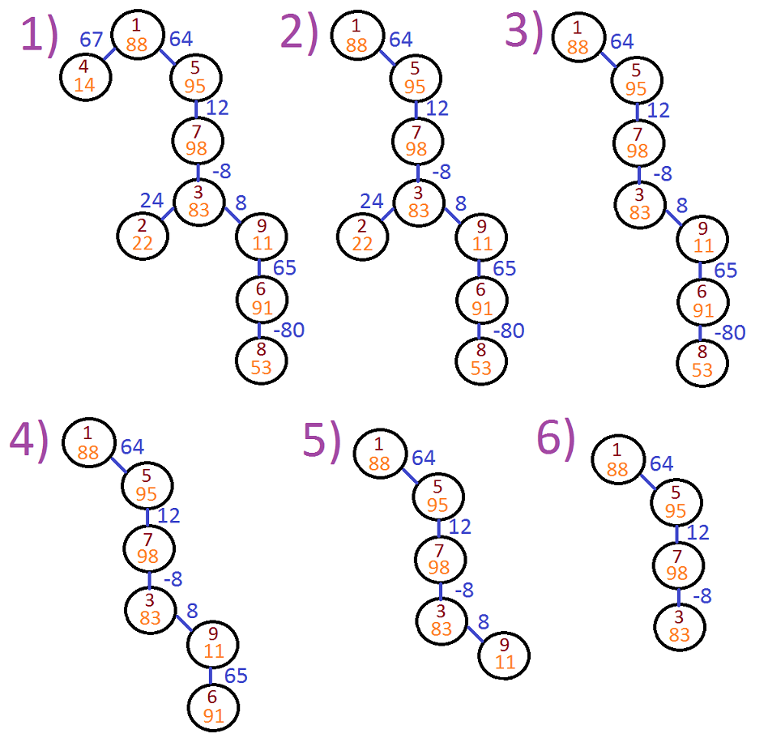
思路:dfs一波,找到sad的点,去掉sad为根的树;
#include<bits/stdc++.h>

using namespace std;

#define ll long long

#define mod 1000000007

#define esp 0.00000000001

const int N=1e5+,M=1e6+,inf=1e9+;

ll a[N];

vector<pair<int,int > >edge[N];

int getnum(int u)

{

    int ans=;

    for(int i=;i<edge[u].size();i++)

    ans+=getnum(edge[u][i].first);

    return ans+;

}

int dfs(int u,ll dis)

{

    int ans=;

    for(int i=;i<edge[u].size();i++)

    {

        if(a[edge[u][i].first]<dis+edge[u][i].second)

        ans+=getnum(edge[u][i].first);

        else

        ans+=dfs(edge[u][i].first,max(dis+edge[u][i].second,0LL));

    }

    return ans;

}

int main()

{

    int x,y,z,i,t;

    scanf("%d",&x);

    for(i=;i<=x;i++)

    scanf("%d",&a[i]);

    for(i=;i<x;i++)

    {

        int u,v;

        scanf("%d%d",&u,&v);

        edge[u].push_back(make_pair(i+,v));

    }

    int ans=dfs(,);

    printf("%d\n",ans);

    return ;

}
1 second
256 megabytes
standard input
standard output
Alyona decided to go on a diet and went to the forest to get some apples. There she unexpectedly found a magic rooted tree with root in the vertex 1, every vertex and every edge of which has a number written on.
The girl noticed that some of the tree's vertices are sad, so she decided to play with them. Let's call vertex v sad if there is a vertex u in subtree of vertex v such that dist(v, u) > au, where au is the number written on vertex u, dist(v, u) is the sum of the numbers written on the edges on the path from v to u.
Leaves of a tree are vertices connected to a single vertex by a single edge, but the root of a tree is a leaf if and only if the tree consists of a single vertex — root.
Thus Alyona decided to remove some of tree leaves until there will be no any sad vertex left in the tree. What is the minimum number of leaves Alyona needs to remove?
In the first line of the input integer n (1 ≤ n ≤ 105) is given — the number of vertices in the tree.
In the second line the sequence of n integers a1, a2, ..., an (1 ≤ ai ≤ 109) is given, where ai is the number written on vertex i.
The next n - 1 lines describe tree edges: ith of them consists of two integers pi and ci (1 ≤ pi ≤ n, - 109 ≤ ci ≤ 109), meaning that there is an edge connecting vertices i + 1 and pi with number ci written on it.
Print the only integer — the minimum number of leaves Alyona needs to remove such that there will be no any sad vertex left in the tree.
9
88 22 83 14 95 91 98 53 11
3 24
7 -8
1 67
1 64
9 65
5 12
6 -80
3 8
5
The following image represents possible process of removing leaves from the tree:
Codeforces Round #358 (Div. 2) C. Alyona and the Tree dfs的更多相关文章
- Codeforces Round #358 (Div. 2) C. Alyona and the Tree 水题
C. Alyona and the Tree 题目连接: http://www.codeforces.com/contest/682/problem/C Description Alyona deci ...
- Codeforces Round #358 (Div. 2)——C. Alyona and the Tree(树的DFS+逆向思维)
C. Alyona and the Tree time limit per test 1 second memory limit per test 256 megabytes input standa ...
- Codeforces Round #358 (Div. 2) C. Alyona and the Tree
C. Alyona and the Tree time limit per test 1 second memory limit per test 256 megabytes input standa ...
- Codeforces Round #381 (Div. 1) B. Alyona and a tree dfs序 二分 前缀和
B. Alyona and a tree 题目连接: http://codeforces.com/contest/739/problem/B Description Alyona has a tree ...
- Codeforces Round #381 (Div. 2) D. Alyona and a tree dfs序+树状数组
D. Alyona and a tree time limit per test 2 seconds memory limit per test 256 megabytes input standar ...
- Codeforces Round #381 (Div. 2) D. Alyona and a tree 树上二分+前缀和思想
题目链接: http://codeforces.com/contest/740/problem/D D. Alyona and a tree time limit per test2 secondsm ...
- Codeforces Round #381 (Div. 2)D. Alyona and a tree(树+二分+dfs)
D. Alyona and a tree Problem Description: Alyona has a tree with n vertices. The root of the tree is ...
- Codeforces Round #358 (Div. 2) A B C 水 水 dfs序+dp
A. Alyona and Numbers time limit per test 1 second memory limit per test 256 megabytes input standar ...
- Codeforces Round #358 (Div. 2) E. Alyona and Triangles 随机化
E. Alyona and Triangles 题目连接: http://codeforces.com/contest/682/problem/E Description You are given ...
随机推荐
- OVN实战---《OVN and Containers》翻译
Overview 在本篇文章中,我们要讨论的是OVN和容器的集成.到本次实验中,我们将会创建一个包含有一对容器的“虚拟机”,这些容器会直接和OVN logical switch相连,并且可以供逻辑网络 ...
- SSO详解(转)
转自:http://www.cnblogs.com/EzrealLiu/p/5559255.html 1. 摘要 SSO这一概念由来已久,网络上对应不同场景的成熟SSO解决方案比比皆是,从简单到复杂, ...
- python爬虫系列(1)——一个简单的爬虫实例
本文主要实现一个简单的爬虫,目的是从一个百度贴吧页面下载图片. 1. 概述 本文主要实现一个简单的爬虫,目的是从一个百度贴吧页面下载图片.下载图片的步骤如下: 获取网页html文本内容:分析html中 ...
- JavaScript闭包和this绑定
本文最主要讲讲JavaScript闭包和this绑定相关的我的小发现,鉴于这方面的基础知识已经有很多很好的文章讲过了,所以基本的就不讲了,推荐看看[酷壳](http://coolshell.cn/)上 ...
- 已经安装好了的lamp或者lnmp环境,编译其他的模块进来?
问题: 如何为已经编译好了的环境再次编译其他的模块? 方法: 一般分为两种情况: 1. php的源码安装包中本来就有这个 .so 的扩展,我们只需要进入到php的安装源码包中的ext文件夹下,然后找到 ...
- EXPORT_SYMBOL使用
EXPORT_SYMBOL只出现在2.6内核中,在2.4内核默认的非static 函数和变量都会自动导入到kernel 空间的, 都不用EXPORT_SYMBOL() 做标记的.2.6就必须用EXPO ...
- PAT 1136 A Delayed Palindrome[简单]
1136 A Delayed Palindrome (20 分) Consider a positive integer N written in standard notation with k+1 ...
- 20165324 2017-2018-2 《Java程序设计》课程总结
20165324 2017-2018-2 <Java程序设计>课程总结 每周作业链接汇总 预备作业1:20165324 我期望的师生关系 预备作业2:20165324 学习基础与C语言学习 ...
- jQuery Ajax使用总结
一.概述 jQuery对Ajax操作进行了封装,在jQuery中$.ajax()是属于最底层的方法,第2层是load().$.get()和$.post()方法,第三层是$.getScript()和$. ...
- rabbitmq报错type
TypeError: exchange_declare() got an unexpected keyword argument 'type' 原因应该为pika版本不同导致的用法不同,解决方法为把t ...