
Spring Boot 入门之 Web 篇(二)
一、前言
上一篇《Spring Boot 入门之基础篇(一)》介绍了 Spring Boot 的环境搭建以及项目启动打包等基础内容,本篇继续深入介绍 Spring Boot 与 Web 开发相关的知识。
二、整合模板引擎
由于 jsp 不被 SpringBoot 推荐使用,所以模板引擎主要介绍 Freemarker 和 Thymeleaf。
2.1 整合 Freemarker
2.1.1 添加 Freemarker 依赖
<dependency>

    <groupId>org.springframework.boot</groupId>

    <artifactId>spring-boot-starter-freemarker</artifactId>

</dependency>
2.1.2 添加 Freemarker 模板配置
在 application.properties 中添加如下内容:
spring.freemarker.allow-request-override=false

spring.freemarker.cache=true

spring.freemarker.check-template-location=true

spring.freemarker.charset=UTF-8

spring.freemarker.content-type=text/html

spring.freemarker.expose-request-attributes=false

spring.freemarker.expose-session-attributes=false

spring.freemarker.expose-spring-macro-helpers=false

spring.freemarker.prefix=

spring.freemarker.suffix=.ftl
上述配置都是默认值。
2.1.3 Freemarker 案例演示
在 controller 包中创建 FreemarkerController:
@Controller

@RequestMapping("freemarker")

public class FreemarkerController {

	@RequestMapping("hello")

	public String hello(Map<String,Object> map) {

		map.put("msg", "Hello Freemarker");

		return "hello";

	}

}
在 templates 目录中创建名为 hello.ftl 文件,内容如下:
<!DOCTYPE html>

<html lang="zh">

<head>

    <meta charset="UTF-8">

    <title>Document</title>

    <link href="/css/index.css" rel="stylesheet"/>

</head>

<body>

    <div class="container">

    	<h2>${msg}</h2>

    </div>

</body>

</html>
结果如下:

2.2 整合 Thymeleaf
2.2.1 添加 Thymeleaf 依赖
在 pom.xml 文件中添加:
<dependency>

    <groupId>org.springframework.boot</groupId>

    <artifactId>spring-boot-starter-thymeleaf</artifactId>

</dependency>
2.2.2 添加 Thymeleaf 模板配置
在 application.properties 中添加如下内容:
spring.thymeleaf.cache=true

spring.thymeleaf.prefix=classpath:/templates/

spring.thymeleaf.suffix=.html

spring.thymeleaf.mode=HTML5

spring.thymeleaf.encoding=UTF-8

spring.thymeleaf.content-type=text/html
上述配置都是默认值。
2.2.3 Thymeleaf 案例演示
在 controller 包中创建 ThymeleafController:
@Controller

@RequestMapping("thymeleaf")

public class ThymeleafController {

	@RequestMapping("hello")

	public String hello(Map<String,Object> map) {

		map.put("msg", "Hello Thymeleaf");

		return "hello";

	}

}
在 template 目录下创建名为 hello.html 的文件,内容如下:
<!DOCTYPE html>

<html lang="zh">

<head>

    <meta charset="UTF-8">

    <title>Document</title>

    <link href="/css/index.css" rel="stylesheet"/>

</head>

<body>

    <div class="container">

    	<h2 th:text="${msg}"></h2>

    </div>

</body>

</html>
结果如下:

三、整合 Fastjson
3.1 添加依赖
<dependency>

    <groupId>com.alibaba</groupId>

    <artifactId>fastjson</artifactId>

    <version>1.2.35</version>

</dependency>
3.2 整合 Fastjson
创建一个配置管理类 WebConfig ,如下:
@Configuration

public class WebConfig {

	@Bean

	public HttpMessageConverters fastJsonHttpMessageConverters() {

		FastJsonHttpMessageConverter fastJsonHttpMessageConverter = new FastJsonHttpMessageConverter();

		FastJsonConfig fastJsonConfig = new FastJsonConfig();

		fastJsonConfig.setSerializerFeatures(SerializerFeature.PrettyFormat);

		fastJsonHttpMessageConverter.setFastJsonConfig(fastJsonConfig);

		HttpMessageConverter<?> converter = fastJsonHttpMessageConverter;

		return new HttpMessageConverters(converter);

	}

}
3.3 演示案例:
创建一个实体类 User:
public class User {

	private Integer id;

	private String username;

	private String password;

	private Date birthday;

}
getter 和 setter 此处省略。
创建控制器类 FastjsonController :
@Controller

@RequestMapping("fastjson")

public class FastJsonController {

	@RequestMapping("/test")

	@ResponseBody

	public User test() {

		User user = new User();

		user.setId(1);

		user.setUsername("jack");

		user.setPassword("jack123");

		user.setBirthday(new Date());

		return user;

	}

}
打开浏览器,访问 http://localhost:8080/fastjson/test,结果如下图:

此时,还不能看出 Fastjson 是否正常工作,我们在 User 类中使用 Fastjson 的注解,如下内容:
@JSONField(format="yyyy-MM-dd")

private Date birthday;
再次访问 http://localhost:8080/fastjson/test,结果如下图:

日期格式与我们修改的内容格式一致,说明 Fastjson 整合成功。
四、自定义 Servlet
4.1 编写 Servlet
public class ServletTest extends HttpServlet {

	@Override

	protected void doGet(HttpServletRequest req, HttpServletResponse resp) throws ServletException, IOException {

		doPost(req, resp);

	}

	@Override

	protected void doPost(HttpServletRequest req, HttpServletResponse resp) throws ServletException, IOException {

		resp.setContentType("text/html;charset=utf-8");

		resp.getWriter().write("自定义 Servlet");

	}

}
4.2 注册 Servlet
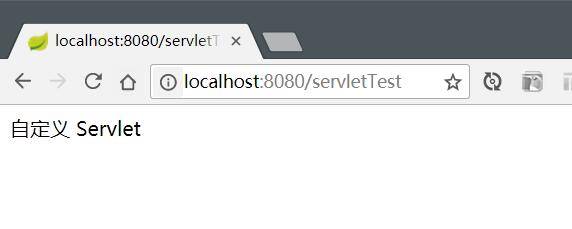
将 Servelt 注册成 Bean。在上文创建的 WebConfig 类中添加如下代码:
@Bean

public ServletRegistrationBean servletRegistrationBean() {

    return new ServletRegistrationBean(new ServletTest(),"/servletTest");

}
结果如下:
五、自定义过滤器/第三方过滤器
5.1 编写过滤器
public class TimeFilter implements Filter {

	@Override

	public void init(FilterConfig filterConfig) throws ServletException {

		System.out.println("=======初始化过滤器=========");

	}

	@Override

	public void doFilter(ServletRequest request, ServletResponse response, FilterChain filterChain)

			throws IOException, ServletException {

		long start = System.currentTimeMillis();

		filterChain.doFilter(request, response);

		System.out.println("filter 耗时:" + (System.currentTimeMillis() - start));

	}

	@Override

	public void destroy() {

		System.out.println("=======销毁过滤器=========");

	}

}
5.2 注册过滤器
要是该过滤器生效,有两种方式:
使用 @Component 注解
添加到过滤器链中,此方式适用于使用第三方的过滤器。将过滤器写到 WebConfig 类中,如下:
@Bean

public FilterRegistrationBean timeFilter() {

	FilterRegistrationBean registrationBean = new FilterRegistrationBean();

	TimeFilter timeFilter = new TimeFilter();

	registrationBean.setFilter(timeFilter);

	List<String> urls = new ArrayList<>();

	urls.add("/*");

	registrationBean.setUrlPatterns(urls);

	return registrationBean;

}
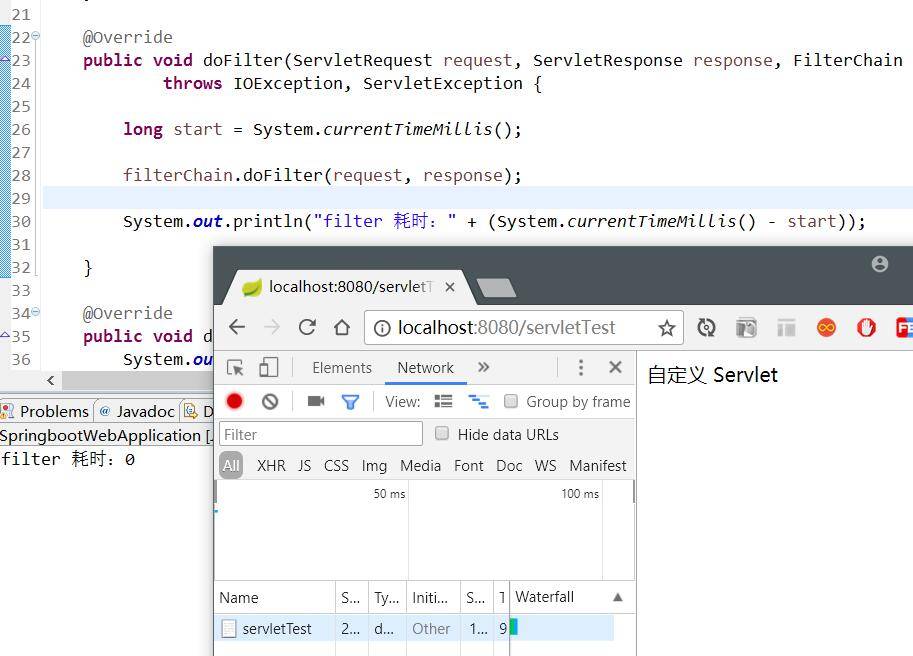
结果如下:
六、自定义监听器
6.1 编写监听器
public class ListenerTest implements ServletContextListener {

	@Override

	public void contextInitialized(ServletContextEvent sce) {

		System.out.println("监听器初始化...");

	}

	@Override

	public void contextDestroyed(ServletContextEvent sce) {

	}

}
6.2 注册监听器
注册监听器为 Bean,在 WebConfig 配置类中添加如下代码:
@Bean

public ServletListenerRegistrationBean<ListenerTest> servletListenerRegistrationBean() {

    return new ServletListenerRegistrationBean<ListenerTest>(new ListenerTest());

}
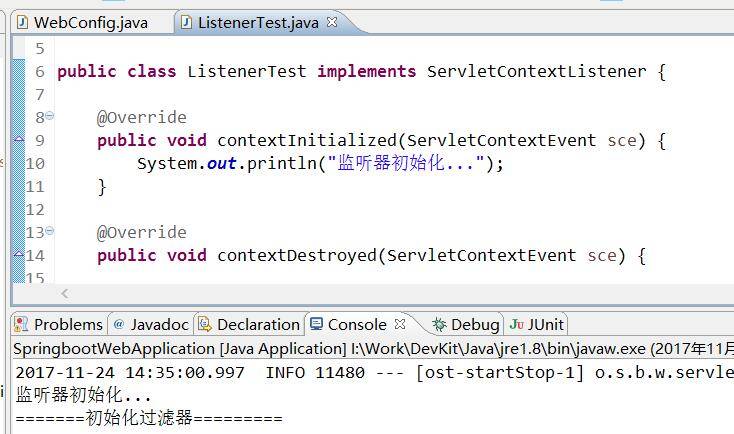
当启动容器时,结果如下:
针对自定义 Servlet、Filter 和 Listener 的配置,还有另一种方式:
@SpringBootApplication

public class SpringbootWebApplication implements ServletContextInitializer {

    @Override

    public void onStartup(ServletContext servletContext) throws ServletException {

    	// 配置 Servlet

        servletContext.addServlet("servletTest",new ServletTest())

        			  .addMapping("/servletTest");

        // 配置过滤器

        servletContext.addFilter("timeFilter",new TimeFilter())

        			  .addMappingForUrlPatterns(EnumSet.of(DispatcherType.REQUEST),true,"/*");

        // 配置监听器

        servletContext.addListener(new ListenerTest());

    }

	public static void main(String[] args) {

		SpringApplication.run(SpringbootWebApplication.class, args);

	}

}
七、自定义拦截器
7.1 编写拦截器
使用 @Component 让 Spring 管理其生命周期:
@Component

public class TimeInterceptor implements HandlerInterceptor {

	@Override

	public boolean preHandle(HttpServletRequest request, HttpServletResponse response, Object handler) throws Exception {

		System.out.println("========preHandle=========");

		System.out.println(((HandlerMethod)handler).getBean().getClass().getName());

		System.out.println(((HandlerMethod)handler).getMethod().getName());

		request.setAttribute("startTime", System.currentTimeMillis());

		return true;

	}

	@Override

	public void postHandle(HttpServletRequest request, HttpServletResponse response, Object handler, ModelAndView modelAndView)

			throws Exception {

		System.out.println("========postHandle=========");

		Long start = (Long) request.getAttribute("startTime");

		System.out.println("耗时:"+(System.currentTimeMillis() - start));

	}

	@Override

	public void afterCompletion(HttpServletRequest request, HttpServletResponse response, Object handler, Exception exception)

			throws Exception {

		System.out.println("========afterCompletion=========");

		Long start = (Long) request.getAttribute("startTime");

		System.out.println("耗时:"+(System.currentTimeMillis() - start));

		System.out.println(exception);

	}

}
7.2 注册拦截器
编写拦截器后,我们还需要将其注册到拦截器链中,如下配置:
@Configuration

public class WebConfig extends WebMvcConfigurerAdapter{

	@Autowired

	private TimeInterceptor timeInterceptor;

	@Override

	public void addInterceptors(InterceptorRegistry registry) {

		registry.addInterceptor(timeInterceptor);

	}

}
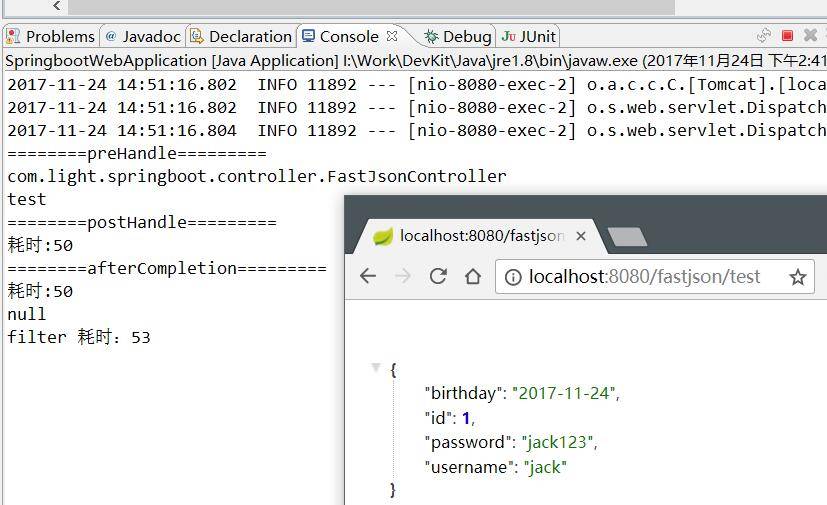
请求一个 controller ,结果如下:
八、配置 AOP 切面
8.1 添加依赖
<dependency>

	<groupId>org.springframework.boot</groupId>

	<artifactId>spring-boot-starter-aop</artifactId>

</dependency>
8.2 编写切面类
使用 @Component,@Aspect 标记到切面类上:
@Aspect

@Component

public class TimeAspect {

	@Around("execution(* com.light.springboot.controller.FastJsonController..*(..))")

	public Object method(ProceedingJoinPoint pjp) throws Throwable {

		System.out.println("=====Aspect处理=======");

		Object[] args = pjp.getArgs();

		for (Object arg : args) {

			System.out.println("参数为:" + arg);

		}

		long start = System.currentTimeMillis();

		Object object = pjp.proceed();

		System.out.println("Aspect 耗时:" + (System.currentTimeMillis() - start));

		return object;

	}

}
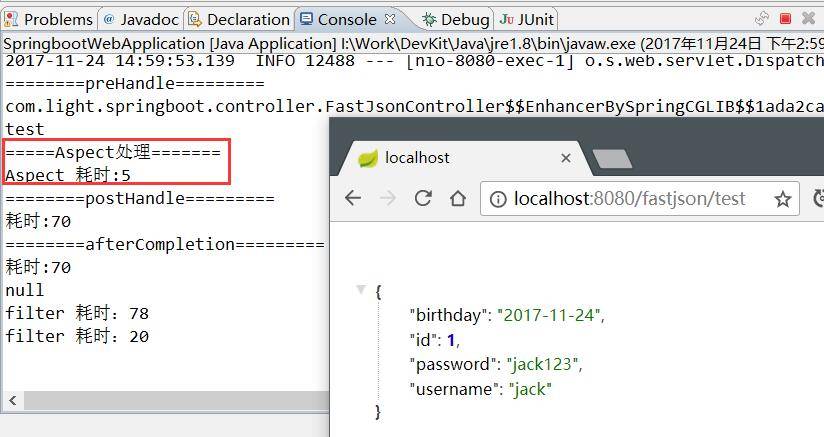
请求 FastJsonController 控制器的方法,结果如下:
九、错误处理
9.1 友好页面
先演示非友好页面,修改 FastJsonController 类中的 test 方法:
@RestController

@RequestMapping("fastjson")

public class FastJsonController {

	@RequestMapping("/test")

	public User test() {

		User user = new User();

		user.setId(1);

		user.setUsername("jack");

		user.setPassword("jack123");

		user.setBirthday(new Date());

		// 模拟异常

		int i = 1/0;

		return user;

	}

}
浏览器请求:http://localhost:8080/fastjson/test,结果如下:
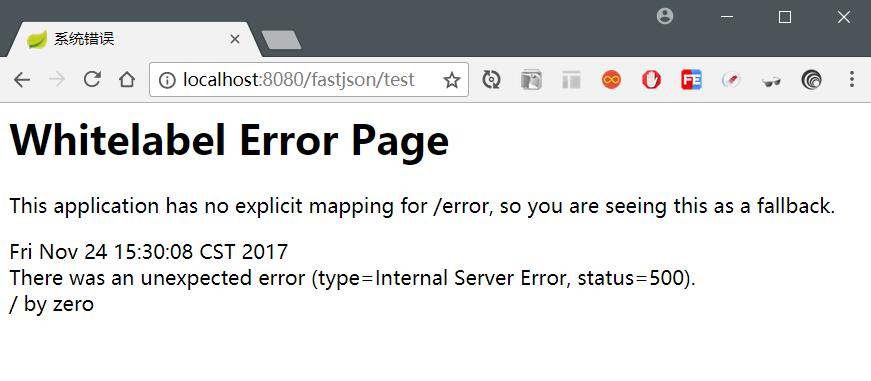
当系统报错时,返回到页面的内容通常是一些杂乱的代码段,这种显示对用户来说不友好,因此我们需要自定义一个友好的提示系统异常的页面。
在 src/main/resources 下创建 /public/error,在该目录下再创建一个名为 5xx.html 文件,该页面的内容就是当系统报错时返回给用户浏览的内容:
<!DOCTYPE html>

<html lang="zh">

<head>

    <meta charset="UTF-8">

    <title>系统错误</title>

    <link href="/css/index.css" rel="stylesheet"/>

</head>

<body>

    <div class="container">

    	<h2>系统内部错误</h2>

    </div>

</body>

</html>
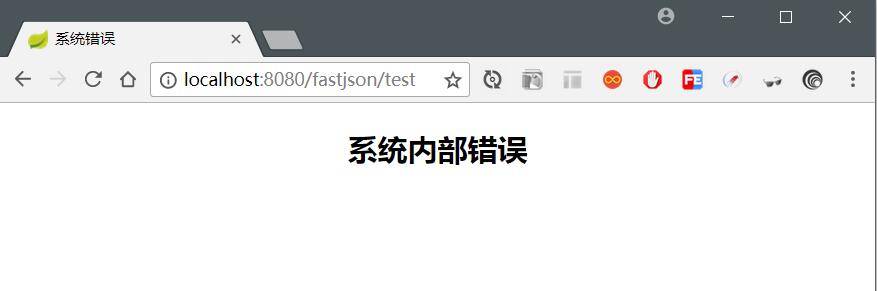
路径时固定的,Spring Boot 会在系统报错时将返回视图指向该目录下的文件。
如下图:
上边处理的 5xx 状态码的问题,接下来解决 404 状态码的问题。
当出现 404 的情况时,用户浏览的页面也不够友好,因此我们也需要自定义一个友好的页面给用户展示。
在 /public/error 目录下再创建一个名为 404.html 的文件:
<!DOCTYPE html>

<html lang="zh">

<head>

    <meta charset="UTF-8">

    <title>访问异常</title>

    <link href="/css/index.css" rel="stylesheet"/>

</head>

<body>

    <div class="container">

    	<h2>找不到页面</h2>

    </div>

</body>

</html>
我们请求一个不存在的资源,如:http://localhost:8080/fastjson/test2,结果如下图:

9.2 全局异常捕获
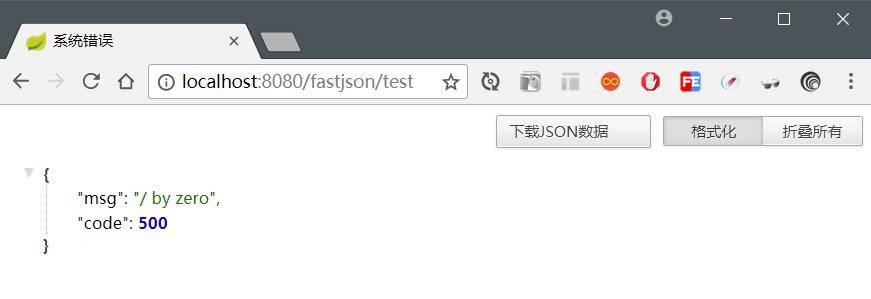
如果项目前后端是通过 JSON 进行数据通信,则当出现异常时可以常用如下方式处理异常信息。
编写一个类充当全局异常的处理类,需要使用 @ControllerAdvice 和 @ExceptionHandler 注解:
@ControllerAdvice

public class GlobalDefaultExceptionHandler {

	/**

	 * 处理 Exception 类型的异常

	 * @param e

	 * @return

	 */

	@ExceptionHandler(Exception.class)

	@ResponseBody

	public Map<String,Object> defaultExceptionHandler(Exception e) {

		Map<String,Object> map = new HashMap<String,Object>();

		map.put("code", 500);

		map.put("msg", e.getMessage());

		return map;

	}

}
其中,方法名为任意名,入参一般使用 Exception 异常类,方法返回值可自定义。
启动项目,访问 http://localhost:8080/fastjson/test,结果如下图:
我们还可以自定义异常,在全局异常的处理类中捕获和判断,从而对不同的异常做出不同的处理。
十、文件上传和下载
10.1 添加依赖
<!-- 工具 -->

<dependency>

	<groupId>commons-io</groupId>

	<artifactId>commons-io</artifactId>

	<version>2.4</version>

</dependency>
10.2 实现
编写一个实体类,用于封装返回信息:
public class FileInfo {

	private String path;

	public FileInfo(String path) {

		this.path = path;

	}

	public String getPath() {

		return path;

	}

	public void setPath(String path) {

		this.path = path;

	}

}
编写 Controller,用于处理文件上传下载:
@RestController

@RequestMapping("/file")

public class FileController {

	private String path = "d:\\";

	@PostMapping

	public FileInfo upload(MultipartFile file) throws Exception {

		System.out.println(file.getName());

		System.out.println(file.getOriginalFilename());

		System.out.println(file.getSize());

		File localFile = new File(path, file.getOriginalFilename());

		file.transferTo(localFile);

		return new FileInfo(localFile.getAbsolutePath());

	}

	@GetMapping("/{id}")

	public void download(@PathVariable String id, HttpServletRequest request, HttpServletResponse response) {

		try (InputStream inputStream = new FileInputStream(new File(path, id + ".jpg"));

				OutputStream outputStream = response.getOutputStream();) {

			response.setContentType("application/x-download");

			response.addHeader("Content-Disposition", "attachment;filename=" + id + ".jpg");

			IOUtils.copy(inputStream, outputStream);

		} catch (Exception e) {

			e.printStackTrace();

		}

	}

}
基本上都是在学习 javaweb 时用到的 API。
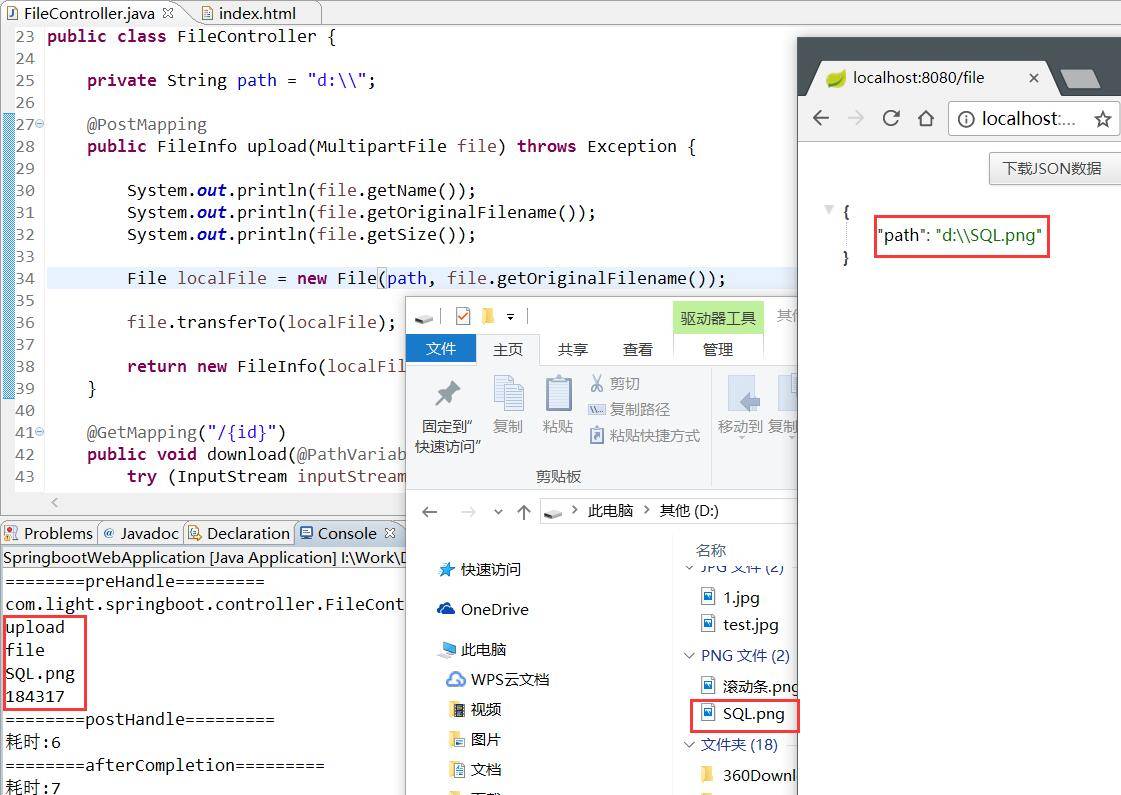
文件上传测试结果如下图:
十一、CORS 支持
前端页面:
<!DOCTYPE html>

<html lang="en">

<head>

    <meta charset="UTF-8">

    <title>跨域测试</title>

</head>

<body>

    <button id="test">测试</button>

    <script type="text/javascript" src="jquery-1.12.3.min.js"></script>

    <script type="text/javascript">

    $(function() {

        $("#test").on("click", function() {

            $.ajax({

                "url": "http://localhost:8080/fastjson/test",

                "type": "get",

                "dataType": "json",

                "success": function(data) {

                    console.log(data);

                }

            })

        });

    });

    </script>

</body>

</html>
通过 http 容器启动前端页面代码,笔者使用 Sublime Text 的插件启动的,测试结果如下:

从图中可知,前端服务器启动端口为 8088 与后端服务器 8080 不同源,因此出现跨域的问题。
现在开始解决跨域问题,可以两种维度控制客户端请求。
粗粒度控制:
方式一
@Configuration

public class WebConfig {

    @Bean

    public WebMvcConfigurer corsConfigurer() {

        return new WebMvcConfigurerAdapter() {

          @Override

          public void addCorsMappings(CorsRegistry registry) {

              registry.addMapping("/fastjson/**")

                      .allowedOrigins("http://localhost:8088");// 允许 8088 端口访问

          }

        };

    }

}
方式二
@Configuration

public class WebConfig extends WebMvcConfigurerAdapter{

    @Override

    public void addCorsMappings(CorsRegistry registry) {

        registry.addMapping("/fastjson/**")

              .allowedOrigins("http://localhost:8088");// 允许 8088 端口访问

    }

}
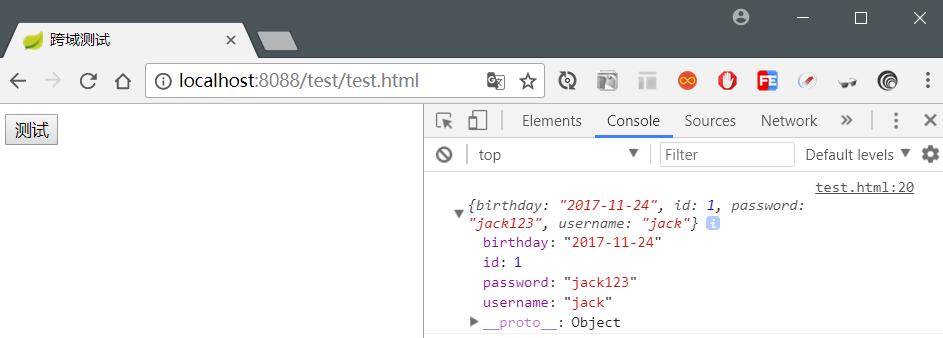
配置后,重新发送请求,结果如下:
细粒度控制:
在 FastJsonController 类中的方法上添加 @CrossOrigin(origins="xx") 注解:
@RequestMapping("/test")

@CrossOrigin(origins="http://localhost:8088")

public User test() {

	User user = new User();

	user.setId(1);

	user.setUsername("jack");

	user.setPassword("jack123");

	user.setBirthday(new Date());

	return user;

}
在使用该注解时,需要注意 @RequestMapping 使用的请求方式类型,即 GET 或 POST。
十二、整合 WebSocket
12.1 添加依赖
<dependency>

    <groupId>org.springframework.boot</groupId>

    <artifactId>spring-boot-starter-websocket</artifactId>

</dependency>
12.2 实现方式
方式一:
该方式只适用于通过 jar 包直接运行项目的情况。
WebSocket 配置类:
@Configuration

public class WebSocketConfig {

	@Bean

	public ServerEndpointExporter serverEndpointExporter() {

		return new ServerEndpointExporter();

	}

}
WebSocket 处理类:
@ServerEndpoint(value = "/webSocketServer/{userName}")

@Component

public class WebSocketServer {

	private static final Set<WebSocketServer> connections = new CopyOnWriteArraySet<>();

	private String nickname;

	private Session session;

	private static String getDatetime(Date date) {

		SimpleDateFormat format = new SimpleDateFormat("yyyy-MM-dd HH:mm:ss");

		return format.format(date);

	}

	@OnOpen

	public void start(@PathParam("userName") String userName, Session session) {

		this.nickname = userName;

		this.session = session;

		connections.add(this);

		String message = String.format("* %s %s", nickname, "加入聊天!");

		broadcast(message);

	}

	@OnClose

	public void end() {

		connections.remove(this);

		String message = String.format("* %s %s", nickname, "退出聊天!");

		broadcast(message);

	}

	@OnMessage

	public void pushMsg(String message) {

		broadcast("【" + this.nickname + "】" + getDatetime(new Date()) + " : " + message);

	}

	@OnError

	public void onError(Throwable t) throws Throwable {

	}

	private static void broadcast(String msg) {

		// 广播形式发送消息

		for (WebSocketServer client : connections) {

			try {

				synchronized (client) {

					client.session.getBasicRemote().sendText(msg);

				}

			} catch (IOException e) {

				connections.remove(client);

				try {

					client.session.close();

				} catch (IOException e1) {

					e.printStackTrace();

				}

				String message = String.format("* %s %s", client.nickname, "断开连接");

				broadcast(message);

			}

		}

	}

}
前端页面:
<!DOCTYPE html>

<html>

<head lang="zh">

    <meta charset="UTF-8">

    <link rel="stylesheet" href="css/bootstrap.min.css">

    <link rel="stylesheet" href="css/bootstrap-theme.min.css">

    <script src="js/jquery-1.12.3.min.js"></script>

    <script src="js/bootstrap.js"></script>

    <style type="text/css">

    #msg {

        height: 400px;

        overflow-y: auto;

    }

    #userName {

        width: 200px;

    }

    #logout {

        display: none;

    }

    </style>

    <title>webSocket测试</title>

</head>

<body>

    <div class="container">

        <div class="page-header" id="tou">webSocket及时聊天Demo程序</div>

        <p class="text-right" id="logout">

            <button class="btn btn-danger" id="logout-btn">退出</button>

        </p>

        <div class="well" id="msg"></div>

        <div class="col-lg">

            <div class="input-group">

                <input type="text" class="form-control" placeholder="发送信息..." id="message"> <span class="input-group-btn">

                    <button class="btn btn-default" type="button" id="send"

                        disabled="disabled">发送</button>

                </span>

            </div>

            <div class="input-group">

                <input id="userName" type="text" class="form-control" name="userName" placeholder="输入您的用户名" />

                <button class="btn btn-default" type="button" id="connection-btn">建立连接</button>

            </div>

            <!-- /input-group -->

        </div>

        <!-- /.col-lg-6 -->

    </div>

    <!-- /.row -->

    </div>

    <script type="text/javascript">

    $(function() {

        var websocket;

        $("#connection-btn").bind("click", function() {

            var userName = $("#userName").val();

            if (userName == null || userName == "") {

                alert("请输入您的用户名");

                return;

            }

            connection(userName);

        });

        function connection(userName) {

            var host = window.location.host;

            if ('WebSocket' in window) {

                websocket = new WebSocket("ws://" + host +

                    "/webSocketServer/" + userName);

            } else if ('MozWebSocket' in window) {

                websocket = new MozWebSocket("ws://" + host +

                    "/webSocketServer/" + userName);

            }

            websocket.onopen = function(evnt) {

                $("#tou").html("链接服务器成功!")

                $("#send").prop("disabled", "");

                $("#connection-btn").prop("disabled", "disabled");

                $("#logout").show();

            };

            websocket.onmessage = function(evnt) {

                $("#msg").html($("#msg").html() + "<br/>" + evnt.data);

            };

            websocket.onerror = function(evnt) {

                $("#tou").html("报错!")

            };

            websocket.onclose = function(evnt) {

                $("#tou").html("与服务器断开了链接!");

                $("#send").prop("disabled", "disabled");

                $("#connection-btn").prop("disabled", "");

                $("#logout").hide();

            }

        }

        function send() {

            if (websocket != null) {

                var $message = $("#message");

                var data = $message.val();

                if (data == null || data == "") {

                    return;

                }

                websocket.send(data);

                $message.val("");

            } else {

                alert('未与服务器链接.');

            }

        }

        $('#send').bind('click', function() {

            send();

        });

        $(document).on("keypress", function(event) {

            if (event.keyCode == "13") {

                send();

            }

        });

        $("#logout-btn").on("click", function() {

            websocket.close(); //关闭TCP连接

        });

    });

    </script>

</body>

</html>
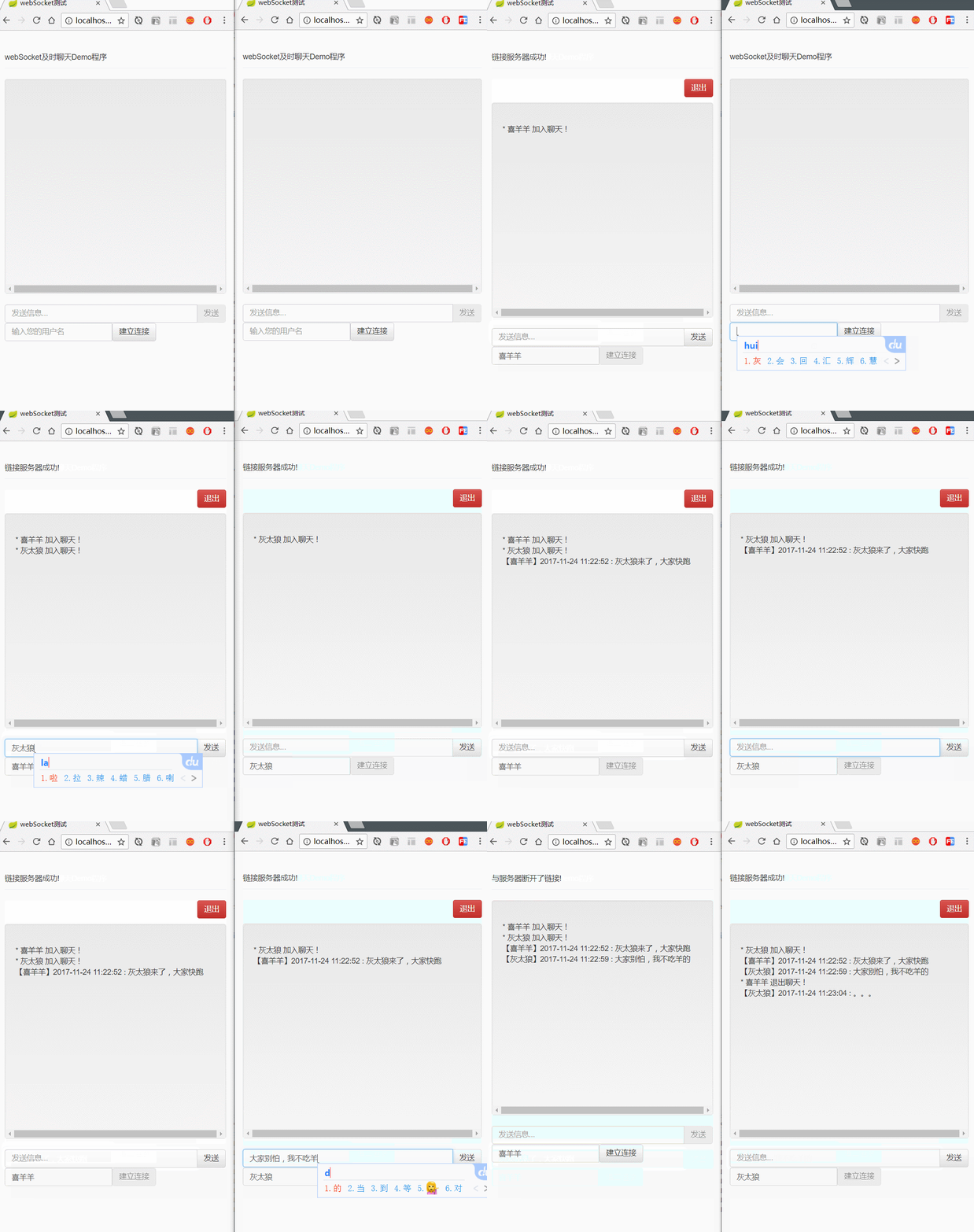
演示图如下:
如果使用该方式实现 WebSocket 功能并打包成 war 运行会报错:
javax.websocket.DeploymentException: Multiple Endpoints may not be deployed to the same path
方式二:
该方式适用于 jar 包方式运行和 war 方式运行。
WebSocket 配置类:
@Configuration

@EnableWebSocket

public class WebSocketConfig implements WebSocketConfigurer {

    @Override

    public void registerWebSocketHandlers(WebSocketHandlerRegistry registry) {

        registry.addHandler(webSocketServer(), "/webSocketServer/*");

    }

    @Bean

    public WebSocketHandler webSocketServer() {

        return new WebSocketServer();

    }

}
WebSocket 处理类:
public class WebSocketServer extends TextWebSocketHandler {

	private static final Map<WebSocketSession, String> connections = new ConcurrentHashMap<>();

	private static String getDatetime(Date date) {

		SimpleDateFormat format = new SimpleDateFormat("yyyy-MM-dd HH:mm:ss");

		return format.format(date);

	}

	/**

	 * 建立连接

	 */

	@Override

	public void afterConnectionEstablished(WebSocketSession session) throws Exception {

		String uri = session.getUri().toString();

		String userName = uri.substring(uri.lastIndexOf("/") + 1);

		String nickname = URLDecoder.decode(userName, "utf-8");

		connections.put(session, nickname);

		String message = String.format("* %s %s", nickname, "加入聊天!");

		broadcast(new TextMessage(message));

	}

	/**

	 * 断开连接

	 */

	@Override

	public void afterConnectionClosed(WebSocketSession session, CloseStatus status) throws Exception {

		String nickname = connections.remove(session);

		String message = String.format("* %s %s", nickname, "退出聊天!");

		broadcast(new TextMessage(message));

	}

	/**

	 * 处理消息

	 */

	@Override

	protected void handleTextMessage(WebSocketSession session, TextMessage message) throws Exception {

		String msg = "【" + connections.get(session) + "】" + getDatetime(new Date()) + " : " + message.getPayload();

		broadcast(new TextMessage(msg));

	}

	private static void broadcast(TextMessage msg) {

		// 广播形式发送消息

		for (WebSocketSession session : connections.keySet()) {

			try {

				synchronized (session) {

					session.sendMessage(msg);

				}

			} catch (Exception e) {

				connections.remove(session);

				try {

					session.close();

				} catch (Exception e2) {

					e2.printStackTrace();

				}

				String message = String.format("* %s %s", connections.get(session), "断开连接");

				broadcast(new TextMessage(message));

			}

		}

	}

}
运行结果与上图一致。
十三、整合 Swagger2
13.1 添加依赖
<dependency>

	<groupId>io.springfox</groupId>

	<artifactId>springfox-swagger2</artifactId>

	<version>2.7.0</version>

</dependency>

<dependency>

	<groupId>io.springfox</groupId>

	<artifactId>springfox-swagger-ui</artifactId>

	<version>2.7.0</version>

</dependency>
13.2 配置
重新创建一个配置类,如下:
@Configuration

@EnableSwagger2

public class Swagger2Configuration {

	@Bean

	public Docket accessToken() {

		return new Docket(DocumentationType.SWAGGER_2)

				.groupName("api")// 定义组

			    .select() // 选择那些路径和 api 会生成 document

			    .apis(RequestHandlerSelectors.basePackage("com.light.springboot.controller")) // 拦截的包路径

			    .paths(PathSelectors.regex("/*/.*"))// 拦截的接口路径

			    .build() // 创建

			    .apiInfo(apiInfo()); // 配置说明

	}

	private ApiInfo apiInfo() {

		return new ApiInfoBuilder()//

				.title("Spring Boot 之 Web 篇")// 标题

				.description("spring boot Web 相关内容")// 描述

				.termsOfServiceUrl("http://www.extlight.com")//

				.contact(new Contact("moonlightL", "http://www.extlight.com", "445847261@qq.com"))// 联系

				.version("1.0")// 版本

				.build();

	}

}
为了能更好的说明接口信息,我们还可以在 Controller 类上使用 Swagger2 相关注解说明信息。
我们以 FastJsonController 为例:
@Api(value = "FastJson测试", tags = { "测试接口" })

@RestController

@RequestMapping("fastjson")

public class FastJsonController {

	@ApiOperation("获取用户信息")

	@ApiImplicitParam(name = "name", value = "用户名", dataType = "string", paramType = "query")

	@GetMapping("/test/{name}")

	public User test(@PathVariable("name") String name) {

		User user = new User();

		user.setId(1);

		user.setUsername(name);

		user.setPassword("jack123");

		user.setBirthday(new Date());

		return user;

	}

}
注意,上边的方法是用 @GetMapping 注解,如果只是使用 @RequestMapping 注解,不配置 method 属性,那么 API 文档会生成 7 种请求方式。
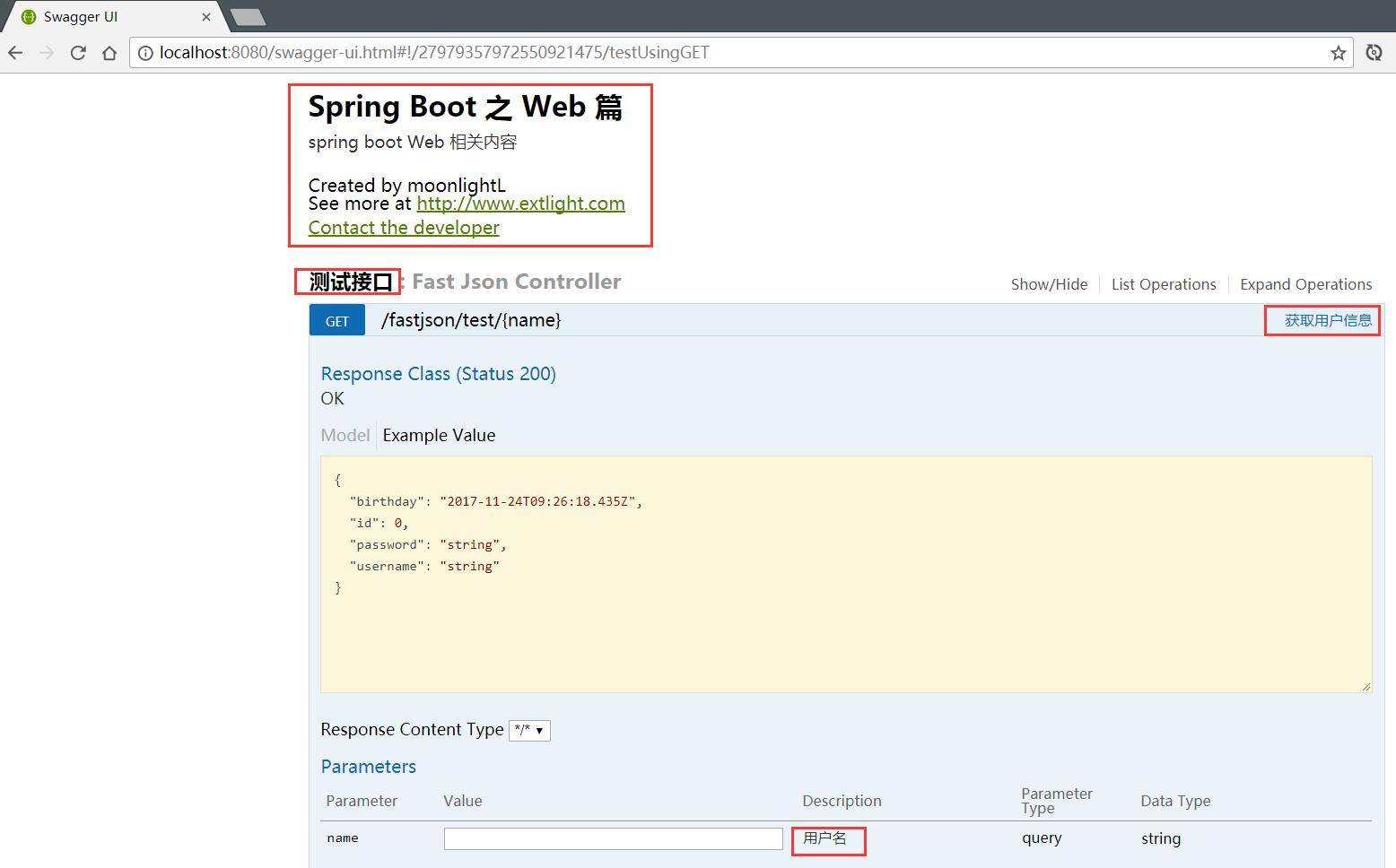
启动项目,打开浏览器访问 http://localhost:8080/swagger-ui.html。结果如下图:
十四、参考资料
Spring Boot 入门之 Web 篇(二)的更多相关文章
- Spring Boot 入门之基础篇(一)
原文地址:Spring Boot 入门之基础篇(一) 博客地址:http://www.extlight.com 一.前言 Spring Boot 是由 Pivotal 团队提供的全新框架,其设计目的是 ...
- Spring Boot 入门之消息中间件篇(五)
原文地址:Spring Boot 入门之消息中间件篇(五) 博客地址:http://www.extlight.com 一.前言 在消息中间件中有 2 个重要的概念:消息代理和目的地.当消息发送者发送消 ...
- Spring Boot 入门之单元测试篇(五)
博客地址:http://www.moonxy.com 一.前言 JUnit 是一个由 Java 语言编写的开源的回归测试(回归测试是指重复以前全部或部分的相同测试)框架,由Erich Gamma 和 ...
- Spring Boot 入门之消息中间件篇(转发)
一.前言 在消息中间件中有 2 个重要的概念:消息代理和目的地.当消息发送者发送消息后,消息就被消息代理接管,消息代理保证消息传递到指定目的地. 我们常用的消息代理有 JMS 和 AMQP 规范.对应 ...
- Spring Boot 入门之 Cache 篇(四)
博客地址:http://www.moonxy.com 一.前言 Spring Cache 对 Cahce 进行了抽象,提供了 @Cacheable.@CachePut.@CacheEvict 等注解. ...
- Spring Boot 入门之持久层篇(三)
原文地址:Spring Boot 入门之持久层篇(三) 博客地址:http://www.extlight.com 一.前言 上一篇<Spring Boot 入门之 Web 篇(二)>介绍了 ...
- spring boot入门教程——Spring Boot快速入门指南
Spring Boot已成为当今最流行的微服务开发框架,本文是如何使用Spring Boot快速开始Web微服务开发的指南,我们将使创建一个可运行的包含内嵌Web容器(默认使用的是Tomcat)的可运 ...
- Spring Boot 揭秘与实战(二) 数据缓存篇 - 快速入门
文章目录 1. 声明式缓存 2. Spring Boot默认集成CacheManager 3. 默认的 ConcurrenMapCacheManager 4. 实战演练5. 扩展阅读 4.1. Mav ...
- Spring Boot入门系列(二十)快速打造Restful API 接口
spring boot入门系列文章已经写到第二十篇,前面我们讲了spring boot的基础入门的内容,也介绍了spring boot 整合mybatis,整合redis.整合Thymeleaf 模板 ...
随机推荐
- c# Middleware impl
using NUnit.Framework; using System; using System.Collections.Generic; using System.Linq; using Syst ...
- Hugepages,hugetlb_shm_group与ORA-27125
Hugepages,hugetlb_shm_group与ORA-27125 转载:http://www.eygle.com/archives/2011/12/hugepageshugetl.html ...
- http请求的GET和POST请求:查询和新增(server.php)
<?php //设置页面内容是html编码格式是utf-8 header("Content-Type: text/plain;charset=utf-8"); //heade ...
- ASP.NET MVC 路由系统类
RouteData public class RouteData { private RouteValueDictionary _dataTokens; private IRouteHandler _ ...
- 同一主机,不同域名绑定不同网站(IIS主机头实现方法)
说明: 网站A域名:www.weba.com 网站A路径:D:\website\weba 网站B域名:www.webb.com 网站B路径:D:\website\webb 公用主机IP:111.222 ...
- LeetCode OJ:Remove Duplicates from Sorted List II(链表去重II)
Given a sorted linked list, delete all nodes that have duplicate numbers, leaving only distinct numb ...
- Java常用类:StringBuilder
一.介绍 2 3 4 5 //同样,StringBuilder也是final修饰的不可变,相比String来说,继承了AbstractStringBuilder,StringBuffer也是同样继承了 ...
- qml 带时钟效果
qt 自带源码样例:在样例中输入clock,找到名叫Qt Quick Demo Clocks. 这个样例写的不错,还是带时差的.不过我们其实不需要这么复杂的功能. timer启动这个就不用说了: Ti ...
- Java基础学习-接口-概述以及成员特点
package interfaceclass; /*接口的概述: * 接口解决的问题: * 因为java中的继承的单一局限性(子类只能继承一个父类),为了打破这个局限,java语言提供了一个机制,接口 ...
- ['1','2','3'].map(parseInt) 返回的是什么?
返回的是:[1,NaN,NaN] 首先我们先分析一下 parseInt 函数: parseInt()函数解析一个字符串参数,并返回指定基数的整数(数学系统中的基数). 它可以有两个参数,用法:pa ...