
转载:Bass management
https://kenrockwell.com/audio/bass-management.htm
https://www.axiomaudio.com/blog/bassmanagement
https://en.wikipedia.org/wiki/Bass_management
https://docs.microsoft.com/zh-cn/windows-hardware/drivers/audio/bass-management
https://www.soundandvision.com/content/bass-management-and-lfe-channel
Introduction
Bass management in 5.1 and other multichannel audio playback systems is a well thought-out process by which low-frequency information in the numerous playback channels is distributed to the loudspeakers best able, and most appropriate, to reproduce it.
Bass management is part of a playback system; it is not part of the mixing process.
Bass management is much more than simply sending all the bass to a single subwoofer.
Motion picture sound is completely different from music reproduction. This article addresses the reproduction of motion picture soundtracks at home.
The 5.1 System
Some time around 1990, Tom Holman, inventor of 5.1 and THX sound, was in a SMPTE subgroup meeting where various proposals for multi-channel motion picture sound were being discussed. Everyone was proposing various discrete channel counts and speaker positions, when Tom stood up and proposed a totally ridiculous "5.1 channels." Everyone stopped and stared. "What's a 'point one' channel?"
Tom explained a proposed Low-Frequency Effects, or LFE channel, the "0.1," as part of the movie sound systems we all take for granted today.
The LFE channel is a special low-frequency channel with extra headroom (+10 dB) used most often for reproducing loud booms. In fact, it's actually called the "boom" channel in Hollywood. (Only if you're curious, we get 10 dB more headroom by reducing the audio levels in the LFE channel by 10 dB and increasing the playback level of the LFE channel by 10 dB. Since these are digital as brought home, what's going on is that -20 dBFS in LFE should play at 95 dBC, while the other channels are set to 85 dBC at -20 dBFS if you're following THX reference levels. Yes, a lot of $30 Radio Shack sound level meters are all over big Hollywood studios for setting this!)
Most consumers improperly call the LFE (0.1) channel the "subwoofer channel," but that's not strictly correct outside of the home.
The five other channels are full-bandwidth. They all contain low bass. The 5.1 system (and other "x.1" or "x.2" systems) is at least five full-bandwdth channels, as well as one or two extra LFE (0.1 or 0.2) channel(s). 5.1 is not five little speakers and one subwoofer as are most home systems; that would only be (5x0.9) .1.
Movies are mixed with low bass running all over. There is a lot of very low bass happening in movies, with all the crazy effects which go far deeper than most music. If a helicopter pans over your head from left front to right rear, the bass pans along with it. It's obvious even listening to a movie on your iPad through headphones that the bass is in stereo, although with only one subwoofer, you can't hear the bass move.
In a pro system with five fullrange channels the bass will follow the helicopter, while in most home systems the bass doesn't move and only the higher-frequency information associated with the helicopter does. This is fine for watching a movie; unless you're a mixer you're probably not closing your eyes and only listening to the sound; your brain knows what's going on and the story is told, so all is well.
Professionally however, to get everything that's in a 5.1 soundtrack, if you don't have five big full-range speakers, you need at least six subwoofers: at least five for each of the main channels, and the last for the LFE (0.1) channel.
Bass Management
If you don't have at least five huge full-range speakers (or extra subwoofers) at home, the "bass management" function of your receiver, preamp or player reroutes the bass from the five or more fullrange and LFE (0.1) channels to wherever it can be reproduced best. You may have seen these settings labeled as something else, like "speaker size," in your equipment setup menus.
In most home systems with little speakers and only one subwoofer, this means the bass management system reroutes all the bass from the five fullrange channels into one mono subwoofer, along with the LFE information that was there in the first place.
If some of your speakers are big full-range speakers, the bass management system should be able to be programmed to send bass for those channels to those speakers instead of being hijacked into the mono LFE ("subwoofer") channel.
For instance, if you've got one big pair of left and right speakers, but the usual puny center and surround speakers, setting the bass management properly will route the bass to your front speakers and your subwoofer. Music will now be reproduced properly with stereo bass going to your main speakers, while the boom (LFE) track still comes through the mono subwoofer.
If you have no subwoofer, setting your bass management correctly will route the LFE information to your other speakers.
And so it goes. All you should have to do is set your bass management (or speaker size) menus to tell your processor what you've got, and it should do the rest for you — but you do have to find and program it if you have anything other than 5 small speakers and one subwoofer.
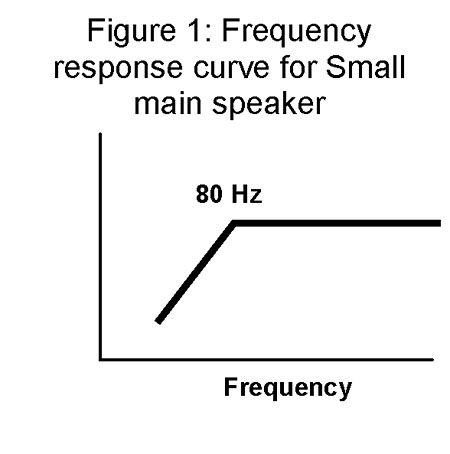
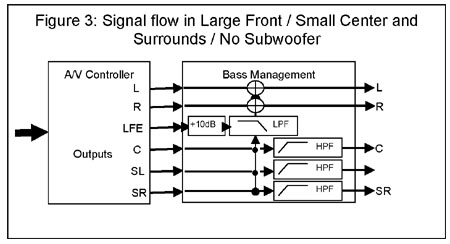
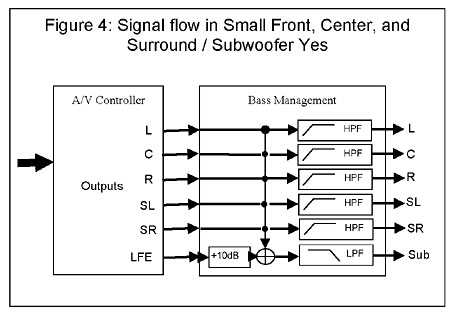
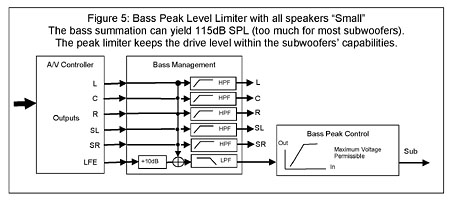
Small and Large
In the bass management setup menu, "Small" and "Large" don't refer to the physical size of your speaker enclosures so much as to whether or not each speaker in the system is capable of reproducing powerful deep bass below 80 Hz (note the emphasis on "powerful"). Nevertheless, the basic rules of physics that dictate small boxes cannot reproduce powerful deep bass can be used as a rough guide to manually adjusting your home theater's bass management.
For example, typical center-channel and surround speakers (and in lots of systems, the main speakers as well) are relatively small so as not to be obtrusive. Most well-designed ones of ample size (not the mini-cubes) will reproduce upper bass — from around 100 Hz and above-smoothly and consistently.
But when deeper bass frequencies below 100 Hz reach those speakers, the satellites do not have the power and air-moving properties (i.e., large-diameter cones) to adequately handle the bass, so the speaker's bass output begins to "roll off" or diminish. That's why you should set your center channel and surround speakers (and the mains if they are bookshelf size) to "Small" in your AV receiver's bass-management menu. The receiver's circuitry then inserts electronic high- and low-pass filters at a preset frequency (or one you manually select) at, typically, 80 Hz or 100 Hz.
80 Hz
Why 80 Hz? Because deep bass below that frequency (the aforementioned energy of the bass drum) is not directional; it's just low-frequency energy that needs the big woofer of a subwoofer (plus its powerful self-contained amplifier) to generate. So that's the process you trigger when you set your center and surround speakers to "Small". The receiver's bass management circuit routes the deepest bass to the subwoofer and all the upper bass and highs to the center and surround speakers (and to the main speakers if they are bookshelf models).
Note too that the digital filters inside your AV receiver don't just suddenly cut off all frequencies at 80 or 100 Hz. They have "slopes," so the process of extracting deep bass is a gradual one - as the bass gets deeper, the crossover filters remove more and more of it for the subwoofer and gradually send less of it to the smaller satellite speakers. The bass frequency ranges of sub and satellites overlap, so a seamless and inaudible transition occurs between the subwoofer and your center and surround speakers' upper bass and midrange. That's why you shouldn't notice or "hear" deep bass from the subwoofer in a conventional sense. Properly set up, the deepest bass should seem to come from the main front speakers in your system, because the sub is only supplying the lowest energy component of low-frequency sounds. (Depending on where the subwoofer is located you may hear knick-knacks vibrating or resonanating — even picture frames — which are set into motion by the bass energy from the sub.)
Audio and home theater enthusiasts often worry about "losing bass from the QS8s or the rears" as one Axiom customer recently put it. That would only occur if he were to set his surround speakers to "Large." Deep bass would then be sent to the surrounds, which aren't able to produce deep bass.
If you use floorstanding front left and right speakers, most receivers enable several options that let you set the mains to "Large" and choose whether or not to have the AV receiver also direct bass to the subwoofer. That may work well in lots of rooms, but be certain that your AV receiver's bass management filters also direct bass from the center and surrounds to the subwoofer and/or to the Large mains. Most do.
转载:Bass management的更多相关文章
- 转载:sql2005 Microsoft SQL Server Management Studio Express的安装问题
转载地址:http://blog.csdn.net/rjc20098022/article/details/26958105 在这个网址http://www.microsoft.com/zh-cn/d ...
- Crystal Clear Applied: The Seven Properties of Running an Agile Project (转载)
作者Alistair Cockburn, Crystal Clear的7个成功要素,写得挺好. 敏捷方法的关注点,大家可以参考,太激动所以转载了. 原文:http://www.informit.com ...
- 禁用SQL Server Management Studio的IntelliSense
禁用SQL Server Management Studio的IntelliSense 本文版权归作者所有,未经作者同意不得转载.
- 深入理解Oracle的并行操作-转载
转载:http://czmmiao.iteye.com/blog/1487568 并行(Parallel)和OLAP系统 并行的实现机制是:首先,Oracle会创建一个进程用于协调并行服务进程之间的信 ...
- 使用Source Safe for SQL Server解决数据库版本管理问题(转载)
简介 在软件开发过程中,版本控制是一个广为人知的概念.因为一个项目可能会需要不同角色人员的参与,通过使用版本控制软件,可以使得项目中不同角色的人并行参与到项目当中.源代码控制使得代码可以存在多个版本, ...
- Facebook的体系结构分析---外文转载
Facebook的体系结构分析---外文转载 From various readings and conversations I had, my understanding of Facebook's ...
- 转载:学习Entity Framework 中的Code First
看完觉得不错,适合作为学习资料,就转载过来了 原文链接:http://www.cnblogs.com/Wayou/archive/2012/09/20/EF_CodeFirst.html 这是上周就写 ...
- [CoreOS 转载] CoreOS实践指南(七):Docker容器管理服务
转载:http://www.csdn.net/article/2015-02-11/2823925 摘要:当Docker还名不见经传的时候,CoreOS创始人Alex就预见了这个项目的价值,并将其做为 ...
- 转载:有关SQL server connection Keep Alive 的FAQ(3)
转载:http://blogs.msdn.com/b/apgcdsd/archive/2012/06/07/sql-server-connection-keep-alive-faq-3.aspx 这个 ...
随机推荐
- 第一个,net core项目,一起入门 !!!
最近项目上开始使用.net core,新的项目,熟悉的东西比较多,现在花点时间来梳理一下,重头开始搭建一个.net core项目.哈哈,这个相对老手来说,估计会觉得小儿科,没事,也就当一次分享总结罢了 ...
- D - How Many Answers Are Wrong HDU - 3038【带权并查集】
How Many Answers Are Wrong Time Limit: 2000/1000 MS (Java/Others) Memory Limit: 32768/32768 K (Ja ...
- nginx中部署前端,后端打成jar包运行
项目是前后端分离:前端用vue开发,后端用的是springboot开发 会产生跨域问题,故在前端里用了代理 1.本前端项目是用vue开发: 1.1打包:终端 vscode快捷键:crtl+~ 然后n ...
- 在vue中使用elementUI饿了么框架使用el-tabs,切换Tab如何实现实时加载,以及el-table表格使用总结
当我们在开发中遇到tab切换,这时候用el的el-tabs感觉很方便 但当我在把代码都写完后,发现一个问题就是页面打开时 虽然我们只能看见当前一个tab页,但是vue会帮你把你写的所有tab页的内容都 ...
- 添加右键新增.md文件
Windows下设置.md文件右键可新建 应用场景:Windows10, Typora(Markdown编辑器) 因为习惯用Markdown来写文档, 所以常常需要新建.md文档,但由于Windows ...
- StackExchange.Redis 之 SortedSet 类型示例
1,增加操作 RedisCacheHelper.Instance.ZSortadd(); RedisCacheHelper.Instance.ZSortadd(); RedisCacheHelper. ...
- mysql远程链接(可以在服务器上配置然后在本地连接远程服务器)
ps:如果一下的连接不成功原因:一定要关闭windows防火墙或者linux的防火墙 1.在服务器端授权(黄色标记的地方第一个是用户名,第二个的意思是可以远程连接,第三个是密码) GRANT ALL ...
- [技术翻译]在现代JavaScript中编写异步任务
本周再来翻译一些技术文章,本次预计翻译三篇文章如下: 04.[译]使用Nuxt生成静态网站(Generate Static Websites with Nuxt) 05.[译]Web网页内容是如何影响 ...
- JavaScript DOM–节点操作
节点 节点至少拥有nodeType(节点类型).nodeName(节点名称)和nodeValue(节点值)这三个基本属性. 元素节点 nodeType 为1 属性节点 nodeType 为2 文本 ...
- Druid连接技术
1.导入jar包 druid-1.0.9.jar导入数据库驱动jar包 2.定义配置文件 properties形式 可以叫任意名称,可以放置在任意目录下.(意味着不能自动加载,需要手动导入)3.加载配 ...