
PCL超体聚类
超体聚类是一种图像的分割方法。
超体(supervoxel)是一种集合,集合的元素是“体”。与体素滤波器中的体类似,其本质是一个个的小方块。与大部分的分割手段不同,超体聚 类的目的并不是分割出某种特定物体,超体是对点云实施过分割(over segmentation),将场景点云化成很多小块,并研究每个小块之间的关系。这种将更小单元合并的分割思路已经出现了有些年份了,在图像分割中,像 素聚类形成超像素,以超像素关系来理解图像已经广为研究。本质上这种方法是对局部的一种总结,纹理,材质,颜色类似的部分会被自动的分割成一块,有利于后 续识别工作。比如对人的识别,如果能将头发,面部,四肢,躯干分开,则能更好的对各种姿态,性别的人进行识别。
点云和图像不一样,其不存在像素邻接关系。所以,超体聚类之前,必须以八叉树对点云进行划分,获得不同点团之间的邻接关系。与图像相似点云的邻接关系也有很多,如面邻接,线邻接,点邻接。
超体聚类实际上是一种特殊的区域生长算法,和无限制的生长不同,超体聚类首先需要规律的布置区域生长“晶核”。晶核在空间中实际上是均匀分布的,并指定晶核距离(Rseed)。再指定粒子距离(Rvoxel)。再指定最小晶粒(MOV),过小的晶粒需要融入最近的大晶粒。
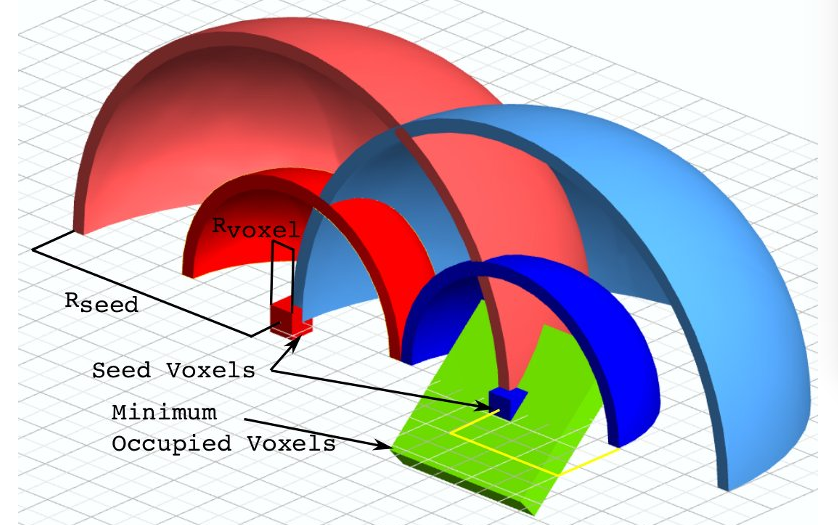
这些基本参数在接下来的参数中会有设置
#include <pcl/console/parse.h>

#include <pcl/point_cloud.h>

#include <pcl/point_types.h>

#include <pcl/io/pcd_io.h>

#include <pcl/visualization/pcl_visualizer.h>

#include <pcl/segmentation/supervoxel_clustering.h>

//VTK include needed for drawing graph lines

#include <vtkPolyLine.h>

// 数据类型

typedef pcl::PointXYZRGBA PointT;

typedef pcl::PointCloud<PointT> PointCloudT;

typedef pcl::PointNormal PointNT;

typedef pcl::PointCloud<PointNT> PointNCloudT;

typedef pcl::PointXYZL PointLT;

typedef pcl::PointCloud<PointLT> PointLCloudT;

//可视化

void addSupervoxelConnectionsToViewer (PointT &supervoxel_center,

                                       PointCloudT &adjacent_supervoxel_centers,

                                       std::string supervoxel_name,

                                       boost::shared_ptr<pcl::visualization::PCLVisualizer> & viewer);

int

main (int argc, char ** argv)

{

//解析命令行

  if (argc < )

  {

    pcl::console::print_error ("Syntax is: %s <pcd-file> \n "

                                "--NT Dsables the single cloud transform \n"

                                "-v <voxel resolution>\n-s <seed resolution>\n"

                                "-c <color weight> \n-z <spatial weight> \n"

                                "-n <normal_weight>\n", argv[]);

    return ();

  }

  //打开点云

  PointCloudT::Ptr cloud = boost::shared_ptr <PointCloudT> (new PointCloudT ());

  pcl::console::print_highlight ("Loading point cloud...\n");

  if (pcl::io::loadPCDFile<PointT> (argv[], *cloud))

  {

    pcl::console::print_error ("Error loading cloud file!\n");

    return ();

  }

  bool disable_transform = pcl::console::find_switch (argc, argv, "--NT");

  float voxel_resolution = 0.008f;  //分辨率

  bool voxel_res_specified = pcl::console::find_switch (argc, argv, "-v");

  if (voxel_res_specified)

    pcl::console::parse (argc, argv, "-v", voxel_resolution);

  float seed_resolution = 0.1f;

  bool seed_res_specified = pcl::console::find_switch (argc, argv, "-s");

  if (seed_res_specified)

    pcl::console::parse (argc, argv, "-s", seed_resolution);

  float color_importance = 0.2f;

  if (pcl::console::find_switch (argc, argv, "-c"))

    pcl::console::parse (argc, argv, "-c", color_importance);

  float spatial_importance = 0.4f;

  if (pcl::console::find_switch (argc, argv, "-z"))

    pcl::console::parse (argc, argv, "-z", spatial_importance);

  float normal_importance = 1.0f;

  if (pcl::console::find_switch (argc, argv, "-n"))

    pcl::console::parse (argc, argv, "-n", normal_importance);

//如何使用SupervoxelClustering函数

  pcl::SupervoxelClustering<PointT> super (voxel_resolution, seed_resolution);

  if (disable_transform)//如果设置的是参数--NT  就用默认的参数

  super.setUseSingleCameraTransform (false);

  super.setInputCloud (cloud);

  super.setColorImportance (color_importance); //0.2f

  super.setSpatialImportance (spatial_importance); //0.4f

  super.setNormalImportance (normal_importance); //1.0f

  std::map <uint32_t, pcl::Supervoxel<PointT>::Ptr > supervoxel_clusters;

  pcl::console::print_highlight ("Extracting supervoxels!\n");

  super.extract (supervoxel_clusters);

  pcl::console::print_info ("Found %d supervoxels\n", supervoxel_clusters.size ());

  boost::shared_ptr<pcl::visualization::PCLVisualizer> viewer (new pcl::visualization::PCLVisualizer ("3D Viewer"));

  viewer->setBackgroundColor (, , );

  PointCloudT::Ptr voxel_centroid_cloud = super.getVoxelCentroidCloud ();//获得体素中心的点云

  viewer->addPointCloud (voxel_centroid_cloud, "voxel centroids");

  viewer->setPointCloudRenderingProperties (pcl::visualization::PCL_VISUALIZER_POINT_SIZE,2.0, "voxel centroids");     //渲染点云

  viewer->setPointCloudRenderingProperties (pcl::visualization::PCL_VISUALIZER_OPACITY,0.95, "voxel centroids");

  PointLCloudT::Ptr labeled_voxel_cloud = super.getLabeledVoxelCloud ();

  viewer->addPointCloud (labeled_voxel_cloud, "labeled voxels");

  viewer->setPointCloudRenderingProperties (pcl::visualization::PCL_VISUALIZER_OPACITY,0.8, "labeled voxels");

  PointNCloudT::Ptr sv_normal_cloud = super.makeSupervoxelNormalCloud (supervoxel_clusters);

  //We have this disabled so graph is easy to see, uncomment to see supervoxel normals

  //viewer->addPointCloudNormals<PointNormal> (sv_normal_cloud,1,0.05f, "supervoxel_normals");

  pcl::console::print_highlight ("Getting supervoxel adjacency\n");

  std::multimap<uint32_t, uint32_t> supervoxel_adjacency;

  super.getSupervoxelAdjacency (supervoxel_adjacency);

  //To make a graph of the supervoxel adjacency, we need to iterate through the supervoxel adjacency multimap

  //为了使整个超体形成衣服图,我们需要遍历超体的每个临近的个体

  std::multimap<uint32_t,uint32_t>::iterator label_itr = supervoxel_adjacency.begin ();

  for ( ; label_itr != supervoxel_adjacency.end (); )

  {

    //First get the label

    uint32_t supervoxel_label = label_itr->first;

    //Now get the supervoxel corresponding to the label

    pcl::Supervoxel<PointT>::Ptr supervoxel = supervoxel_clusters.at (supervoxel_label);

    //Now we need to iterate through the adjacent supervoxels and make a point cloud of them

    PointCloudT adjacent_supervoxel_centers;

    std::multimap<uint32_t,uint32_t>::iterator adjacent_itr = supervoxel_adjacency.equal_range (supervoxel_label).first;

    for ( ; adjacent_itr!=supervoxel_adjacency.equal_range (supervoxel_label).second; ++adjacent_itr)

    {

      pcl::Supervoxel<PointT>::Ptr neighbor_supervoxel = supervoxel_clusters.at (adjacent_itr->second);

      adjacent_supervoxel_centers.push_back (neighbor_supervoxel->centroid_);

    }

    //Now we make a name for this polygon

    std::stringstream ss;

    ss << "supervoxel_" << supervoxel_label;

    //This function is shown below, but is beyond the scope of this tutorial - basically it just generates a "star" polygon mesh from the points given

//从给定的点云中生成一个星型的多边形,

    addSupervoxelConnectionsToViewer (supervoxel->centroid_, adjacent_supervoxel_centers, ss.str (), viewer);

    //Move iterator forward to next label

    label_itr = supervoxel_adjacency.upper_bound (supervoxel_label);

  }

  while (!viewer->wasStopped ())

  {

    viewer->spinOnce ();

  }

  return ();

}

//VTK可视化构成的聚类图

void

addSupervoxelConnectionsToViewer (PointT &supervoxel_center,

                                  PointCloudT &adjacent_supervoxel_centers,

                                  std::string supervoxel_name,

                                  boost::shared_ptr<pcl::visualization::PCLVisualizer> & viewer)

{

  vtkSmartPointer<vtkPoints> points = vtkSmartPointer<vtkPoints>::New ();

  vtkSmartPointer<vtkCellArray> cells = vtkSmartPointer<vtkCellArray>::New ();

  vtkSmartPointer<vtkPolyLine> polyLine = vtkSmartPointer<vtkPolyLine>::New ();

  //Iterate through all adjacent points, and add a center point to adjacent point pair

  PointCloudT::iterator adjacent_itr = adjacent_supervoxel_centers.begin ();

  for ( ; adjacent_itr != adjacent_supervoxel_centers.end (); ++adjacent_itr)

  {

    points->InsertNextPoint (supervoxel_center.data);

    points->InsertNextPoint (adjacent_itr->data);

  }

  // Create a polydata to store everything in

  vtkSmartPointer<vtkPolyData> polyData = vtkSmartPointer<vtkPolyData>::New ();

  // Add the points to the dataset

  polyData->SetPoints (points);

  polyLine->GetPointIds  ()->SetNumberOfIds(points->GetNumberOfPoints ());

  for(unsigned int i = ; i < points->GetNumberOfPoints (); i++)

    polyLine->GetPointIds ()->SetId (i,i);

  cells->InsertNextCell (polyLine);

  // Add the lines to the dataset

  polyData->SetLines (cells);

  viewer->addModelFromPolyData (polyData,supervoxel_name);

}
可执行文件生成后的图像显示如下
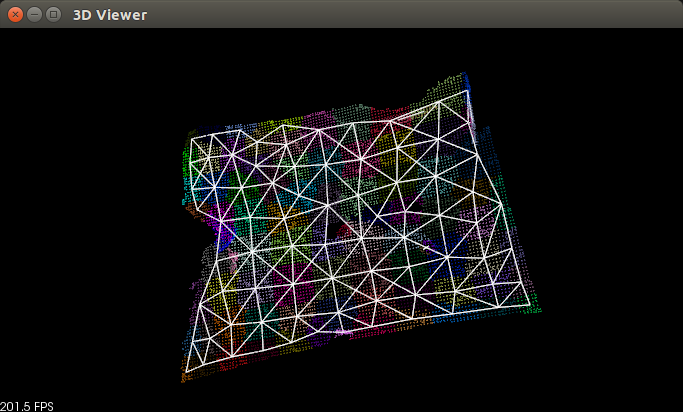
当然也可以自己设定参数生成自己想要的效果。同时在不同的场景中,使用的参数是十分重要的,
只是先了解超体的概念,如果想应用到实际的应用中,还需要很多其他的知识 ,所以这里只是基本的学习
有兴趣这关注我的微信公众号

PCL超体聚类的更多相关文章
- PCL—低层次视觉—点云分割(超体聚类)
1.超体聚类——一种来自图像的分割方法 超体(supervoxel)是一种集合,集合的元素是“体”.与体素滤波器中的体类似,其本质是一个个的小方块.与之前提到的所有分割手段不同,超体聚类的目的并不是分 ...
- PCL—点云分割(超体聚类) 低层次点云处理
博客转载自:http://www.cnblogs.com/ironstark/p/5013968.html 1.超体聚类——一种来自图像的分割方法 超体(supervoxel)是一种集合,集合的元素是 ...
- PCL—低层次视觉—点云分割(基于凹凸性)
1.图像分割的两条思路 场景分割时机器视觉中的重要任务,尤其对家庭机器人而言,优秀的场景分割算法是实现复杂功能的基础.但是大家搞了几十年也还没搞定——不是我说的,是接下来要介绍的这篇论文说的.图像分割 ...
- PCL—点云分割(基于凹凸性) 低层次点云处理
博客转载自:http://www.cnblogs.com/ironstark/p/5027269.html 1.图像分割的两条思路 场景分割时机器视觉中的重要任务,尤其对家庭机器人而言,优秀的场景分割 ...
- 基于传统方法点云分割以及PCL中分割模块
之前在微信公众号中更新了以下几个章节 1,如何学习PCL以及一些基础的知识 2,PCL中IO口以及common模块的介绍 3,PCL中常用的两种数据结构KDtree以及Octree树的介绍 ...
- [PCL]3 欧式距离分类EuclideanClusterExtraction
EuclideanClusterExtraction这个名字起的很奇怪,欧式距离聚类这个该如何理解?欧式距离只是一种距离测度的方法呀!有了一个Cluster在里面,我以为是某一种聚类算法,层次聚类?k ...
- PCL—低层次视觉—点云滤波(基于点云频率)
1.点云的频率 今天在阅读分割有关的文献时,惊喜的发现,点云和图像一样,有可能也存在频率的概念.但这个概念并未在文献中出现也未被使用,谨在本博文中滥用一下“高频”一词.点云表达的是三维空间中的一种信息 ...
- PCL—低层次视觉—点云分割(邻近信息)
分割给人最直观的影响大概就是邻居和我不一样.比如某条界线这边是中华文明,界线那边是西方文,最简单的分割方式就是在边界上找些居民问:"小伙子,你到底能不能上油管啊?”.然后把能上油管的居民坐标 ...
- PCL点云分割(3)
(1)Euclidean分割 欧几里德分割法是最简单的.检查两点之间的距离.如果小于阈值,则两者被认为属于同一簇.它的工作原理就像一个洪水填充算法:在点云中的一个点被“标记”则表示为选择在一个的集群中 ...
随机推荐
- nginx 读取文件 permission denied
nginx 是在root用户下安装的,静态网页的目录/var/www/html/ 目录下的内容所有者也是root 用户,按照 nginx配置文件中location说明 配置静态文件访问地址. 使用网址 ...
- tomcat 8.0 进程没有全部杀死
The web application [FileIO_new_interface] created a ThreadLocal with key of type [java.lang.ThreadL ...
- Eclipse_Configure
原文链接:http://android.eoe.cn/topic/android_sdk 1. 下载Eclipse 在前面我们配置好了JDK环境后,就可以开始配置Android的集成开发环境了,官方G ...
- 添加多个CCArmature
CCArmatureDataManager::sharedArmatureDataManager()-> addArmatureFileInfo("armature\\Cowboy0. ...
- 支付宝对账单下载Java沙箱调用
package code; import java.io.File; import java.io.FileOutputStream; import java.io.IOException; impo ...
- jqgrid传入的json数据,赋值了但是没有在表格上显示
1. datatype: "local",属性加入这个 2. dataValue就是json对象 for (var i = 0; i <= dataValue.length ...
- js模板引擎art-template使用方法
art-template是款性能卓越的 js 模板引擎 https://aui.github.io/art-template/ 特性 拥有接近 JavaScript 渲染极限的的性能 调试友好:语法. ...
- Asp.Net正则过滤一个div
Asp.Net过滤一对标签,例如div.ul.p.li.span等 html = “html page”; Regex regPage = new Regex(@"(?is)<div\ ...
- 当music-list向上滑动的时候,设置layer层,随其滚动,覆盖图片,往下滚动时候,图片随着展现出来
1.layer层代码: <div class="bg-layer" ref="layer"></div> 2.在mounted()的时候 ...
- hive添加UDF
hive添加UDF 步骤如下: 函数分为永久和临时函数,后者会话退出则消失,前者不会 查看已有函数(创建好后也可以通过这个来查看是否成功) show functions; 写UDF的java文件,如: ...