
POJ 3084 Panic Room(最大流最小割)
Description
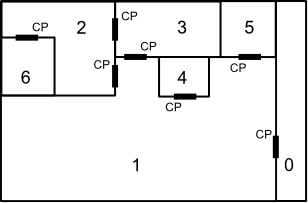 with rooms numbered 0-6 and control panels marked with the letters "CP" (each next to the door it can unlock and in the room that it is accessible from), then one could say that the minimum number of locks to perform to secure room 2 from room 1 is two; one has to lock the door between room 2 and room 1 and the door between room 3 and room 1. Note that it is impossible to secure room 2 from room 3, since one would always be able to use the control panel in room 3 that unlocks the door between room 3 and room 2.
 Input
- Start line – a single line "m n" (1 <=m<= 20; 0 <=n<= 19) where m indicates the number of rooms in the house and n indicates the room to secure (the panic room).
- Room list – a series of m lines. Each line lists, for a single room, whether there is an intruder in that room ("I" for intruder, "NI" for no intruder), a count of doors c (0 <= c <= 20) that lead to other rooms and have a control panel in this room, and a list of rooms that those doors lead to. For example, if room 3 had no intruder, and doors to rooms 1 and 2, and each of those doors' control panels were accessible from room 3 (as is the case in the above layout), the line for room 3 would read "NI 2 1 2". The first line in the list represents room 0. The second line represents room 1, and so on until the last line, which represents room m - 1. On each line, the rooms are always listed in ascending order. It is possible for rooms to be connected by multiple doors and for there to be more than one intruder!
Output
题目大意:有n个房间,若干扇门,门是单向的,只能从一边上锁(如一道门连接a→b,任何时刻都能从a走到b,但上了锁之后就不能从b走到a了)。现在有些坏蛋入侵了一些房间,你不想让他们来到你的房间,问最少要锁上多少扇门,若全锁上都木有用……就……
思路:新建一个源点S,从S到坏蛋们入侵的房间连一条容量为无穷大的边,对每扇门a→b,连一条边a→b容量为无穷大,连b→a容量为1。若最大流≥无穷大(我是增广到一条容量为无穷大的路径直接退出),则无解(死定啦死定啦),否则最大流为答案。实则为求最小割,好像不需要解释了挺好理解的……
 #include <cstdio>

 #include <cstring>

 #include <algorithm>

 #include <queue>

 using namespace std;

 const int MAXN = ;

 const int MAXE = ;

 const int INF = 0x3fff3fff;

 struct SAP {

     int head[MAXN], dis[MAXN], pre[MAXN], cur[MAXN], gap[MAXN];

     int to[MAXE], next[MAXE], flow[MAXE];

     int n, st, ed, ecnt;

     void init() {

         memset(head, , sizeof(head));

         ecnt = ;

     }

     void add_edge(int u, int v, int c) {

         to[ecnt] = v; flow[ecnt] = c; next[ecnt] = head[u]; head[u] = ecnt++;

         to[ecnt] = u; flow[ecnt] = ; next[ecnt] = head[v]; head[v] = ecnt++;

         //printf("%d->%d flow = %d\n", u, v, c);

     }

     void bfs() {

         memset(dis, 0x3f, sizeof(dis));

         queue<int> que; que.push(ed);

         dis[ed] = ;

         while(!que.empty()) {

             int u = que.front(); que.pop();

             ++gap[dis[u]];

             for(int p = head[u]; p; p = next[p]) {

                 int &v = to[p];

                 if(flow[p ^ ] && dis[v] > n) {

                     dis[v] = dis[u] + ;

                     que.push(v);

                 }

             }

         }

     }

     int Max_flow(int ss, int tt, int nn) {

         st = ss; ed = tt; n = nn;

         int ans = , minFlow = INF, u;

         for(int i = ; i <= n; ++i) {

             cur[i] = head[i];

             gap[i] = ;

         }

         u = pre[st] = st;

         bfs();

         while(dis[st] < n) {

             bool flag = false;

             for(int &p = cur[u]; p; p = next[p]) {

                 int &v = to[p];

                 if(flow[p] && dis[u] == dis[v] + ) {

                     flag = true;

                     minFlow = min(minFlow, flow[p]);

                     pre[v] = u;

                     u = v;

                     if(u == ed) {

                         if(minFlow == INF) return INF;//no ans

                         ans += minFlow;

                         while(u != st) {

                             u = pre[u];

                             flow[cur[u]] -= minFlow;

                             flow[cur[u] ^ ] += minFlow;

                         }

                         minFlow = INF;

                     }

                     break;

                 }

             }

             if(flag) continue;

             int minDis = n - ;

             for(int p = head[u]; p; p = next[p]) {

                 int &v = to[p];

                 if(flow[p] && minDis > dis[v]) {

                     minDis = dis[v];

                     cur[u] = p;

                 }

             }

             if(--gap[dis[u]] == ) break;

             gap[dis[u] = minDis + ]++;

             u = pre[u];

         }

         return ans;

     }

 } G;

 char s[];

 int n, ss, tt, T, c, x;

 int main() {

     scanf("%d", &T);

     while(T--) {

         scanf("%d%d", &n, &tt);

         ss = n;

         G.init();

         for(int i = ; i < n; ++i) {

             scanf("%s%d", s, &c);

             while(c--) {

                 scanf("%d", &x);

                 G.add_edge(i, x, INF);

                 G.add_edge(x, i, );

             }

             if(s[] == 'I') G.add_edge(ss, i, INF);

         }

         int ans = G.Max_flow(ss, tt, ss);

         if(ans == INF) puts("PANIC ROOM BREACH");

         else printf("%d\n", ans);

     }

 }
POJ 3084 Panic Room(最大流最小割)的更多相关文章
- POJ 3084 Panic Room (最小割建模)
[题意]理解了半天--大意就是,有一些房间,初始时某些房间之间有一些门,并且这些门是打开的,也就是可以来回走动的,但是这些门是确切属于某个房间的,也就是说如果要锁门,则只有在那个房间里才能锁. 现在一 ...
- POJ 3308 Paratroopers(最大流最小割の最小点权覆盖)
Description It is year 2500 A.D. and there is a terrible war between the forces of the Earth and the ...
- POJ 2987 Firing(最大流最小割の最大权闭合图)
Description You’ve finally got mad at “the world’s most stupid” employees of yours and decided to do ...
- POJ 1815 Friendship(最大流最小割の字典序割点集)
Description In modern society, each person has his own friends. Since all the people are very busy, ...
- HDU 1569 方格取数(2)(最大流最小割の最大权独立集)
Description 给你一个m*n的格子的棋盘,每个格子里面有一个非负数. 从中取出若干个数,使得任意的两个数所在的格子没有公共边,就是说所取数所在的2个格子不能相邻,并且取出的数的和最大. ...
- hiho 第116周,最大流最小割定理,求最小割集S,T
小Hi:在上一周的Hiho一下中我们初步讲解了网络流的概念以及常规解法,小Ho你还记得内容么? 小Ho:我记得!网络流就是给定了一张图G=(V,E),以及源点s和汇点t.每一条边e(u,v)具有容量c ...
- hihocoder 网络流二·最大流最小割定理
网络流二·最大流最小割定理 时间限制:10000ms 单点时限:1000ms 内存限制:256MB 描述 小Hi:在上一周的Hiho一下中我们初步讲解了网络流的概念以及常规解法,小Ho你还记得内容么? ...
- [HihoCoder1378]网络流二·最大流最小割定理
思路: 根据最大流最小割定理可得最大流与最小割相等,所以可以先跑一遍EdmondsKarp算法.接下来要求的是经过最小割切割后的图中$S$所属的点集.本来的思路是用并查集处理所有前向边构成的残量网络, ...
- FZU 1844 Earthquake Damage(最大流最小割)
Problem Description Open Source Tools help earthquake researchers stay a step ahead. Many geological ...
随机推荐
- 小程序OSS图片上传
图片上传加水印问题,代码如下! chooseImage: function (e) { var that = this; wx.chooseImage({ sizeType: ['original', ...
- mvc上传图片(上传和预览)webuploader
笔者看到mvc最近比较流行,而很多使用一些比较旧的的方法上传图片,再次安利一下百度的webuploader控件吧 webuploader第一步要先下载一些插件这点可以在webuploader官网上下载 ...
- Oracle条件判断列数量非where
sum(case when typename='测试' then 1 else 0 end)
- linux系统基础之---文件系统与日志(基于centos7.4 1708)
- H3C Telnet 配置-01
Telnet 配置管理方法是网络工程师和网络管理员使用最广泛的一种设备访问控制方法,它通过局域网或广域网实现本地或远程的访问控制,但是它的实验必须要求首先对设备进行初始化配置,否则用户无法正常登录和访 ...
- 关于ajax请求数据的方法
$.ajax({ //课程详情信息 type:'get', data: {'id':courseId}, dataType:'json', beforeSend : ...
- django创建第一个子应用-3
在Web应用中,通常有一些业务功能模块是在不同的项目中都可以复用的,故在开发中通常将工程项目拆分为不同的子功能模块,各功能模块间可以保持相对的独立,在其他工程项目中需要用到某个特定功能模块时,可以将该 ...
- python闭包的概念及使用
闭包:在函数里定义了另外一个函数(函数嵌套),内函数里运用了外函数的变量,外函数返回内函数的函数引用(函数名). nonlocal 的使用:闭包内部函数可直接调用外部函数的变量,如果修改需要使用non ...
- apache上.htaccess转向nginx上配置.htaccess伪静态规则
nginx上配置.htaccess伪静态规则 在apache上.htaccess转向,只要apache编译的时候指明支持rewrite模块即可. 但是换到nginx上方法会有不同,有人说把.htacc ...
- python脚本 mongodb到postgresql
安装 mongo模块 pip install pymongo 安装postgresql 驱动 pip install python-psycopg2 1 # -*- coding: utf-8 -* ...