
python 之 内置函数大全
一、罗列全部的内置函数
戳:https://docs.python.org/2/library/functions.html
二、range、xrange(迭代器)
无论是range()还是xrange()都是Python里的内置函数。这个两个内置函数最常用在for循环中。例如:
- >>> for i in range(5):
- ... print i
- ...
- 0
- 1
- 2
- 3
- 4
- >>> for i in xrange(5):
- ... print i
- ...
- 0
- 1
- 2
- 3
- 4
- >>>
range()和xrange() 在Python 2里是两种不同的实现。但是在Python 3里,range()这种实现被移除了;
保留了xrange()的实现,且将xrange()重新命名成range()。
首先,我们来看Python 2里range()。它是一个内置函数,这个函数用于创建整数等差数列。因此它
常被用于for循环。下面是range()的官方帮助文档。
- Help on built-in function range in module __builtin__:
- range(...)
- range(stop) -> list of integers
- range(start, stop[, step]) -> list of integers
- Return a list containing an arithmetic progression of integers.
- range(i, j) returns [i, i+1, i+2, ..., j-1]; start (!) defaults to 0.
- When step is given, it specifies the increment (or decrement).
- For example, range(4) returns [0, 1, 2, 3]. The end point is omitted!
- These are exactly the valid indices for a list of 4 elements.
- (END)
从官方帮助文档,我们可以看出下面的特性:
1、内置函数(built-in)
2、接受3个参数分别是start, stop和step(其中start和step是可选的,stop是必需的)
3、如果没有指定start,默认从0开始(Python都是从0开始的)
4、如果没有指定step,默认step是1。(step不能是0,如果指定step为0,“ValueError: range() step argument must not be zero”
将会被抛出。
额外的特性:
1、当step为正数时,start应该小于stop,否则将生成[ ],即空数列。
- >>> range(-3)
- []
- >>> range(5, 1)
- []
- >>> range(1,1)
- []
2、当step为负数时,start应该大于stop,否则将生成[ ],即空数列。
这两个特性说明range()可以生成递增和递减的数列。
下面是range()生成数列的例子:
- >>> range(5)
- [0, 1, 2, 3, 4]
- >>> range(1,8,3)
- [1, 4, 7]
- >>> range(0, -10)
- []
- >>> range(0, -10, -2)
- [0, -2, -4, -6, -8]
- >>>
接下来看看xrange()。 xrange()虽然也是内置函数,但是它被定义成了Python里一种类型(type),
这种类型就叫xrange。我们从Python 2的interactive shell里很容易看到这点。
- >>> range
- <built-in function range>
- >>> xrange
- <type 'xrange'>
- >>>
我们再来看看xragne的官方帮助文档:
- Help on class xrange in module __builtin__:
- class xrange(object)
- | xrange(stop) -> xrange object
- | xrange(start, stop[, step]) -> xrange object
- |
- | Like range(), but instead of returning a list, returns an object that
- | generates the numbers in the range on demand. For looping, this is
- | slightly faster than range() and more memory efficient.
- |
- | Methods defined here:
- |
- | __getattribute__(...)
- | x.__getattribute__('name') <==> x.name
- |
- | __getitem__(...)
- | x.__getitem__(y) <==> x[y]
- |
- | __iter__(...)
- | x.__iter__() <==> iter(x)
- |
- | __len__(...)
- | x.__len__() <==> len(x)
- |
- | __reduce__(...)
- |
- | __repr__(...)
- | x.__repr__() <==> repr(x)
- |
- | __reversed__(...)
- | Returns a reverse iterator.
- |
- | ----------------------------------------------------------------------
- | Data and other attributes defined here:
- |
- | __new__ =
- | T.__new__(S, ...) -> a new object with type S, a subtype of T
- (END)
从文档里可以看出,xrange和range的参数和用法是相同的。只是xrange()返回的不再是一个数列,而是一个
xrange对象。这个对象可以按需生成参数指定范围内的数字(即元素)。由于xrange对象是按需生成单个的
元素,而不像range那样,首先创建整个list。所以,在相同的范围内,xrange占用的内存空间将更小,xrange
也会更快。实际上,xrange由于是在循环内被调用时才会生成元素,因此无论循环多少次,只有当前一个元素
占用了内存空间,且每次循环占用的都是相同的单个元素空间。我们可以粗略的认为,相同n个元素的话,range占
用的空间是xrange的n倍。因此,在循环很大情况下,xrange的高效率和快速将表现的很明显。我们可以用timeit
来测试一下range和xrange的执行时间。
- >>> timeit.timeit('for i in range(10000000): pass',number=1)
- 0.49290895462036133
- >>> timeit.timeit('for i in xrange(10000000): pass',number=1)
- 0.2595210075378418
在大量循环的条件下,可以看到xrange的高效率是很明显的。
总结一下:
1、range()返回整个list。
2、xrange()返回的是一个xrange object,且这个对象是个iterable。
3、两者都用与for循环。
4、xrange()占用更少的内存空间,因为循环时xrange()只生成当前的元素,不像range()一开始就成生成完整的list。
这就是在Python 2里range和xrange的相同点和区别。
那么在Python 3里,我们在前面提到了range()被移除了,xrange()被重新命名成了range()。它们之间有区别吗?
请看下面的代码
Python 2的xrange()
- Python 2.7.6 (default, Dec 5 2013, 23:54:52)
- [GCC 4.6.3] on linux2
- Type "help", "copyright", "credits" or "license" for more information.
- >>> x = xrange(5)
- >>> x
- xrange(5)
- >>> x[:]
- Traceback (most recent call last):
- File "", line 1, in <module>
- TypeError: sequence index must be integer, not 'slice'
- >>> x[-1]
- 4
- >>> list(x)
- [0, 1, 2, 3, 4]
- >>> dir(x)
- ['__class__', '__delattr__', '__doc__', '__format__', '__getattribute__', '__getitem__', '__hash__', '__init__', '__iter__', '__len__', '__new__', '__reduce__', '__reduce_ex__', '__repr__', '__reversed__', '__setattr__', '__sizeof__', '__str__', '__subclasshook__']
- >>>
Python 3的range()
- Python 3.3.4 (default, Feb 23 2014, 23:07:23)
- [GCC 4.6.3] on linux
- Type "help", "copyright", "credits" or "license" for more information.
- >>> x = range(5)
- >>> x
- range(0, 5)
- >>> x[:]
- range(0, 5)
- >>> x[:3]
- range(0, 3)
- >>> list(x)
- [0, 1, 2, 3, 4]
- >>> x[-1]
- 4
- >>> dir(x)
- ['__class__', '__contains__', '__delattr__', '__dir__', '__doc__', '__eq__', '__format__', '__ge__', '__getattribute__', '__getitem__', '__gt__', '__hash__', '__init__', '__iter__', '__le__', '__len__', '__lt__', '__ne__', '__new__', '__reduce__', '__reduce_ex__','__repr__', '__reversed__', '__setattr__', '__sizeof__', '__str__', '__subclasshook__', 'count', 'index', 'start', 'step', 'stop']
- >>>
很明显,range object在Python里增加了新的attributes,'count', 'index', 'start', 'step', 'stop',
且能支持slicing。Python 3的range()在xrange()的基础上变得更强大了。
请理解下面这句话:
The advantage of the range type over a regular list or tuple is that a range object will always take the same (small) amount of memory, no matter the size of the range it represents (as it only stores the start, stop and step values, calculating individual items and subranges as needed).
到这里,我们应该比较清楚range和xrange的区别了
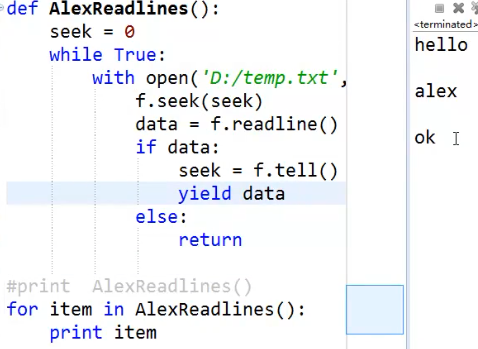
三、yield
def fab(max):

    n, a, b = 0, 0, 1

    while n < max:

        yield b

        # print b

        a, b = b, a + b

        n = n + 1

c = fab(10)

print(c.__next__())  # python 3.x 已经没有 next()方法

print(c.__next__())

print(c.__next__())

print(c.__next__())

# for i in fab(10):

#     print(i)
python 之 内置函数大全的更多相关文章
- Python 集合内置函数大全(非常全!)
Python集合内置函数操作大全 集合(s).方法名 等价符号 方法说明 s.issubset(t) s <= t 子集测试(允许不严格意义上的子集):s 中所有的元素都是 t 的成员 s ...
- python内置函数大全(分类)
python内置函数大全 python内建函数 最近一直在看python的document,打算在基础方面重点看一下python的keyword.Build-in Function.Build-in ...
- 【学习笔记】--- 老男孩学Python,day14 python内置函数大全
参考: https://www.cnblogs.com/pyyu/p/6702896.html http://www.runoob.com/python3/python3-built-in-func ...
- python基础===python内置函数大全
python python内建函数 一.数学运算类 abs(x) 求绝对值1.参数可以是整型,也可以是复数2.若参数是复数,则返回复数的模 complex([real[, imag]]) 创建一个复数 ...
- python3内置函数大全(顺序排列)
python3内置函数大全 内置函数 (1)abs(), 绝对值或复数的模 1 print(abs(-6))#>>>>6 (2)all() 接受一个迭代器,如果迭代器的所有 ...
- python基础-内置函数详解
一.内置函数(python3.x) 内置参数详解官方文档: https://docs.python.org/3/library/functions.html?highlight=built#ascii ...
- 如何查看Python的内置函数
经常调用的时候不知道python当前版本的内置函数是哪些,可以用下面的指令查看: C:\Users\Administrator>python Python 2.7.11 (v2.7.11:6d1 ...
- python_way,day3 集合、函数、三元运算、lambda、python的内置函数、字符转换、文件处理
python_way,day3 一.集合 二.函数 三.三元运算 四.lambda 五.python的内置函数 六.字符转换 七.文件处理 一.集合: 1.集合的特性: 特性:无序,不重复的序列 如果 ...
- Orace内置函数大全[转:http://www.cnblogs.com/lfx0692/articles/2395950.html]
NewProgramer Oracle SQL 内置函数大全(转) SQL中的单记录函数 1.ASCII 返回与指定的字符对应的十进制数;SQL> select ascii('A') A,a ...
随机推荐
- Spring入门示例
开发环境 Spring 4.3.0+Myeclipse2015+JDK1.8 准备阶段: 1.新建一Spring01项目,然后新建一个lib文件.将下面的添加到lib文件中 2.将lib文件所有的包导 ...
- .NET Remoting 入门实例
1.创建服务端Class:ProxyServerRemoting using System; using System.Collections.Generic; using System.Text; ...
- 服务器如何开启php的fsockopen函数? 使用发邮箱类
参考:http://www.daixiaorui.com/read/16.html#viewpl 服务器如何开启php的fsockopen函数?如果你要使用一些邮件的类,那么很多要求支持php的fso ...
- NE2018届校招内推笔试——数据挖掘
[单选题|2分/题] 1.在只有两类的情况下,二维特征向量通过共享相同的协方差矩阵的正态分布生成,其中协方差矩阵为: 均值向量分别为:,则根据贝叶斯分类,样本分类为:() A. 分类2 B. 无法确定 ...
- 为何 IntelliJ IDEA 比 Eclipse 更好
http://www.oschina.net/news/26929/why-intellij-is-better-than-eclipse圣战 有一些没有唯一正确答案的“永恒”的问题,例如哪个更好:是 ...
- Win7各个版本之间的区别
Windows7包含6个版本,分别为Windows7 Starter(初级版).Windows7 Home Basic(家庭普通版).Windows7 Home Premium(家庭高级版).Wind ...
- Docker运行报Cannot connect to the Docker daemon错误
核心问题所在:权限不足 操作docker命令提示:Cannot connect to the Docker daemon 请切换管理员权限,root权限,root安装的一般的用户访问会存在此问题.
- C#线程同步技术(二) Interlocked 类
接昨天谈及的线程同步问题,今天介绍一个比较简单的类,Interlocked.它提供了以线程安全的方式递增.递减.交换和读取值的方法. 它的特点是: 1.相对于其他线程同步技术,速度会快很多. 2.只能 ...
- Zynq GPIO 中断
/* * Copyright (c) 2009-2012 Xilinx, Inc. All rights reserved. * * Xilinx, Inc. * XILINX IS PROVIDIN ...
- makefile之调试信息
makefile 调试 1. 添加调试信息 执行到error时会中断,warning不中断makefile的执行, info不打印当前makefile名和行号. a.$(warning "s ...