
Introduction - Welcome
摘要: 本文是吴恩达 (Andrew Ng)老师《机器学习》课程,第一章《绪论:初识机器学习》中第1课时《欢迎参加机器学习课程》的视频原文字幕。为本人在视频学习过程中逐字逐句记录下来以便日后查阅使用。现分享给大家。如有错误,欢迎大家批评指正,在此表示诚挚地感谢!同时希望对大家的学习能有所帮助。
Welcome to this free online class on machine learning. Machine learning is one of the most exciting recent technologies. And in this class, you learn about the state of the art, and also gain practice implementing and deploying these algorithms yourself. You've probably use a learning algorithm dozens of times a day without knowing it. Every time you use a web search engine like Google or Bin to search the internet, one of the reasons that works so well is because a learning algorithm, one implemented by Google or Microsoft, has learned how to rank web pages. Every time you use Facebook or Apple's photo typing application, and it recognizes your friends' photos, that's also machine learning. Every time you read your email, and your spam filter saves you from having to wade through tons of spam emails, that's also a learning algorithm. For me, one of the reasons I'm excited is the AI dream of someday building machines as intelligent as you or I. We're a long way away from that goal, but many AI researchers believe that the best way towards that goal is through learning algorithms that try to mimic how the human brain learns. I'll tell you a little bit about that too in this class. In this class you learn about state-of-the-art machine learning algorithms. But it turns out just knowing the algorithms and knowing the math isn't that much good if you don't also know about how to actually get this stuff to work on problems that you care about. So, we've also spent a lot of time developing exercises for you to implement each of these algorithms and see how they work for yourself.
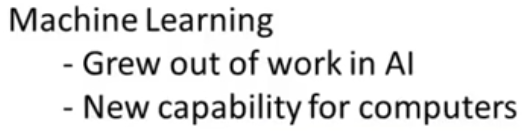

So why is machine learning so prevalent today? It turns out that machine learning is a field that had grown out of the field of AI, or artificial intelligence. We wanted to build intelligent machines, and it turns out that there are a few basic things that we could program a machine to do, such as how to find the shortest path from A to B. But for the most part, we just did not know how to write AI programs to do the more interesting things, such as web search or photo tagging or email anti-spam. There was a realization that the only way to do these things was to have a machine learn to do by itself. So, machine learning was developed as a new capability for computers, and today it touches many segments of industry and basic science. For me, I work on machine learning. And in a typical week, I might end up talking to helicopter pilots, biologists, a bunch of computer systems people (so my colleagues here at Stanford) and averaging two or three times a week I get email from people in industry from Silicon Valley contacting me with an interest in applying learning algorithms to their own problems. This is a sign of the range of problems that machine learning touches. There is autonomous robotics, computational biology, tons of things in Silicon Valley that machine learning is having an impact on.
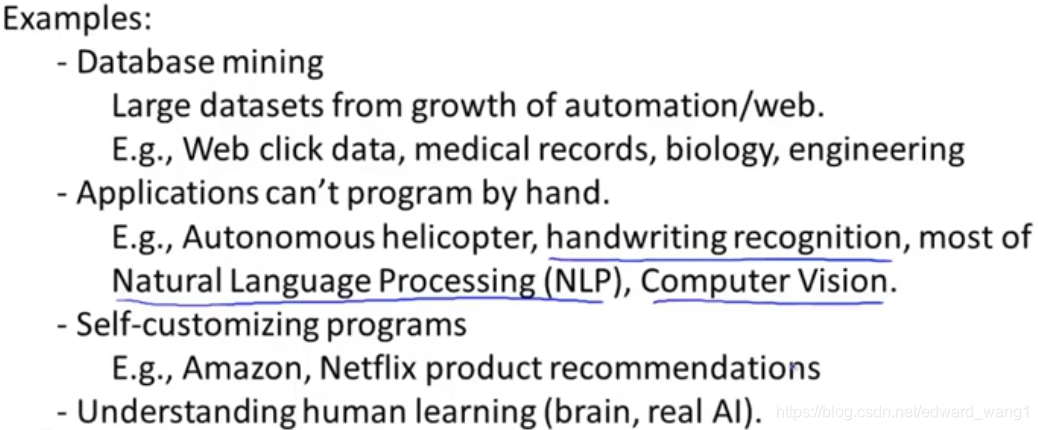
Here are some other examples of machine learning. There's database mining. One of the reasons machine learning has so pervaded is the growth of the web and the growth of automation. All this means that we have much larger data sets than ever before. So, for example tons of Silicon Valley companies are today collecting web click data, also called clickstream data, and are trying to use machine learning algorithms to mine the data to understand the users better and to serve the users better, that's a huge segment of Silicon Valley right now. Medical records. With the advent of automation, we now have electronic medical records, so if we can turn medical records into medical knowledge, then we can start to understand disease better. Computational biology. With automation again, biologists are collecting lots of data about gene sequences, DNA sequences, and so on, and machine learning algorithms are giving us a much better understanding of the human genome and what it means to be human. And in engineering as well, in all fields of engineering, we have larger and larger data sets, that we're trying to understand using learning algorithms. A second range of machinery application is ones that we cannot program by hand. So for example, I've worked on autonomous helicopters for many years. We just did not know how to write a computer program to make this helicopter fly by itself. The only thing that worked was having a computer learn by itself how to fly this helicopter. Handwriting recognition. It turns out one of the reasons it's so inexpensive today to route a piece of mail across the countries, in the US and internationally, is that when you write an envelope like this, it turns out there's a learning algorithm that has learned how to read your handwriting, so that it can automatically route this envelope on its way, and so it costs us a few cents to send this thing thousands of miles. And in fact, if you've seen the fields of natural language processing or computer vision, these are the fields of AI pertaining to understand language or understanding images. Most of natural language processing and most of computer vision today is applied machine learning. Learning algorithms are also widely used for self-customizing programs. Every time you go to Amazon or Netflix or iTunes Genius, and it recommends the movies or products and music to you, that's a learning algorithm. If you think about, they have a million users, there is no way to write a million different programs for your million users. The only way to have software have these customized recommendations is that it can learn by itself to customize itself to your preferences. Finally learning algorithms are being used today to understand human learning and to understand the brain. We'll talk about how researchers are using this to make progress towards the big AI dream.
A few months ago, a student showed me an article on the top twelve IT skills. The skills that information technology hiring managers cannot say no to. It was a slightly older article, but at the top of this list of the twelve most desirable IT skills was machine learning. Here at Stanford, the number of recruiters that contact me asking if I know any graduating machine learning students is far larger than the machine learning students, we graduate each year. So I think there is a vast, unfulfilled demand for the skill set. And this is a great time to be learning about machine learning. And I hope to teach you a lot about machine learning in this course.
In the next video, we'll start to give a more formal definition of what is machine learning. And we'll begin to talk about the main types of machine learning problems and algorithms. You will pick up some of the main machine learning terminology and start to get a sense of what are the different algorithms and when each one might be appropriate.
<end>
Introduction - Welcome的更多相关文章
- A chatroom for all! Part 1 - Introduction to Node.js(转发)
项目组用到了 Node.js,发现下面这篇文章不错.转发一下.原文地址:<原文>. ------------------------------------------- A chatro ...
- Introduction to graph theory 图论/脑网络基础
Source: Connected Brain Figure above: Bullmore E, Sporns O. Complex brain networks: graph theoretica ...
- INTRODUCTION TO BIOINFORMATICS
INTRODUCTION TO BIOINFORMATICS 这套教程源自Youtube,算得上比较完整的生物信息学领域的视频教程,授课内容完整清晰,专题化的讲座形式,细节讲解比国内的京师大 ...
- mongoDB index introduction
索引为mongoDB的查询提供了有效的解决方案,如果没有索引,mongodb必须的扫描文档集中所有记录来match查询条件的记录.然而这些扫描是没有必要,而且每一次操作mongod进程会处理大量的数据 ...
- (翻译)《Hands-on Node.js》—— Introduction
今天开始会和大熊君{{bb}}一起着手翻译node的系列外文书籍,大熊负责翻译<Node.js IN ACTION>一书,而我暂时负责翻译这本<Hands-on Node.js> ...
- Introduction of OpenCascade Foundation Classes
Introduction of OpenCascade Foundation Classes Open CASCADE基础类简介 eryar@163.com 一.简介 1. 基础类概述 Foundat ...
- 000.Introduction to ASP.NET Core--【Asp.net core 介绍】
Introduction to ASP.NET Core Asp.net core 介绍 270 of 282 people found this helpful By Daniel Roth, Ri ...
- Introduction to Microsoft Dynamics 365 licensing
Microsoft Dynamics 365 will be released on November 1. In preparation for that, Scott Guthrie hosted ...
- RabbitMQ消息队列(一): Detailed Introduction 详细介绍
http://blog.csdn.net/anzhsoft/article/details/19563091 RabbitMQ消息队列(一): Detailed Introduction 详细介绍 ...
- Introduction - SNMP Tutorial
30.1 Introduction In addition to protocols that provide network level services and application progr ...
随机推荐
- vue前端项目优化策略
vue前端项目有什么优化策略? .生成打包报告.(可以发现一些问题,并进行解决)2.使用第三方库启用CDN加载3.使用Element-ui的话,按需加载组件4.使用路由懒加载 生成打包报告: .生成打 ...
- 更改ejs模板引擎的后缀为html
安装 EJS 在项目目录右键->Open Command Prompt Here 输入 npm install ejs 打开app.js //app.set('view engine', 'ja ...
- 组件化网页开发 / 步骤一 · 4-4 匹配HTML标签
组件化网页开发 / 步骤一 · 4-4 匹配HTML标签
- mouseout([[data],fn])
mouseout([[data],fn]) 概述 当鼠标指针从元素上移开时,发生 mouseout 事件. 该事件大多数时候会与 mouseover 事件一起使用.深圳dd马达 注释:与 mousel ...
- synchronized和AtomicXXX效率比较
在Java中,i++和++i都是xian线程不安全的,如果要用十个线程累加一个资源,就会出现错误.synchronized和Atomic是实现线程安全常用方法.而二者效率问题孰优孰劣?本着规律符合任意 ...
- MySQL sql join 算发
在MySQL中,可以使用批量密钥访问(BKA)连接算法,该算法使用对连接表的索引访问和连接缓冲区. BKA算法支持:内连接,外连接和半连接操作,包括嵌套外连接. BKA的优点:更加高效的表扫描提高了连 ...
- python 局域网文件互传
PCa: import socket Sockin = socket.socket(socket.AF_INET, socket.SOCK_DGRAM) #新建socket Sockin.bind(( ...
- 使用Flask设计带认证token的RESTful API接口
大数据时代 Just a record. 使用Flask设计带认证token的RESTful API接口[翻译] 上一篇文章, 使用python的Flask实现一个RESTful API服务器端 简 ...
- codeforces gym #101987K -TV ShowGame(2-SAT)
题目链接: https://codeforces.com/gym/101987 题意: 有长度为$n$的只包含$B,R$的字符串 有m种关系,每个关系说出三个位置的确切字符 这三个位置的字符最多有一个 ...
- HDU 2243 考研路茫茫――单词情结 ——(AC自动机+矩阵快速幂)
和前几天做的AC自动机类似. 思路简单但是代码200余行.. 假设solve_sub(i)表示长度为i的不含危险单词的总数. 最终答案为用总数(26^1+26^2+...+26^n)减去(solve_ ...